The first stumbling block for a company asked by customers to cut CO2 emissions is that it has no reduction plan setting out “where to start.” For small and medium-sized enterprises (SMEs) without staff who have specialist knowledge, drawing up a reduction plan that covers a whole factory or business site on their own is not easy. This article sets out, based on primary sources such as the application guidelines, the Ministry of the Environment’s “SHIFT program,” which subsidizes most of the cost of drawing up such a plan.
Key points
- 1The SHIFT program is a subsidy program run by the Ministry of the Environment that supports decarbonization at the level of individual factories and business sites. As of FY2026 (Reiwa 8), it consists of two menus: one that supports drawing up CO2 reduction plans and one that supports equipment upgrades.
- 2The “DX-based CO2 reduction implementation support” menu, which supports drawing up reduction plans, is limited to SMEs, etc., with a subsidy rate of 3/4 and a cap of ¥2 million, designed to cover most of the cost of planning.
- 3The “retrofit support for low-CO2 systems” menu, which supports equipment upgrades, has a subsidy rate of 1/3 and a cap of ¥100 million or ¥500 million, with requirements such as a CO2 reduction rate and a payback period.
- 4In FY2026, a call that began on June 12 and an additional call that began on September 11 (called the “third call” in the Ministry of the Environment’s announcement) were held, and as of October 22, 2026 both have closed.
- 5The subsidy is in principle paid after the fact (reimbursement after completion), and you need to prepare on a schedule that covers everything from choosing a support organization to the completion report.
This article is an extra in the series “SMEs and Decarbonization.” Part 7 sorted reduction efforts into three stages: operational improvements, review of electricity contracts and capital investment in equipment. Part 11 surveyed the energy and decarbonization subsidies and tax incentives available to SMEs in six broad categories and placed the SHIFT program under “decarbonization plans and equipment.” This time, we focus on the menu within the SHIFT program that supports drawing up CO2 reduction plans, and check what the program contains.
Official Name and Purpose of the SHIFT Program
The official name of the SHIFT program is the “Project to Accelerate CO2 Reduction at Factories and Business Sites through Decarbonization Technologies (SHIFT program).” The Ministry of the Environment (MOE) is responsible for it, and the Greenhouse Gas Assurance Association of Japan (GAJ), a general incorporated association, handles the practical work of calls, screening and grants as the implementing organization. The program’s stated purpose is to create leading examples of decarbonization at factories and business sites and to publish the knowledge widely so that other companies can follow, thereby contributing to the national target for reducing greenhouse gas emissions by FY2030 and to carbon neutrality by 2050.
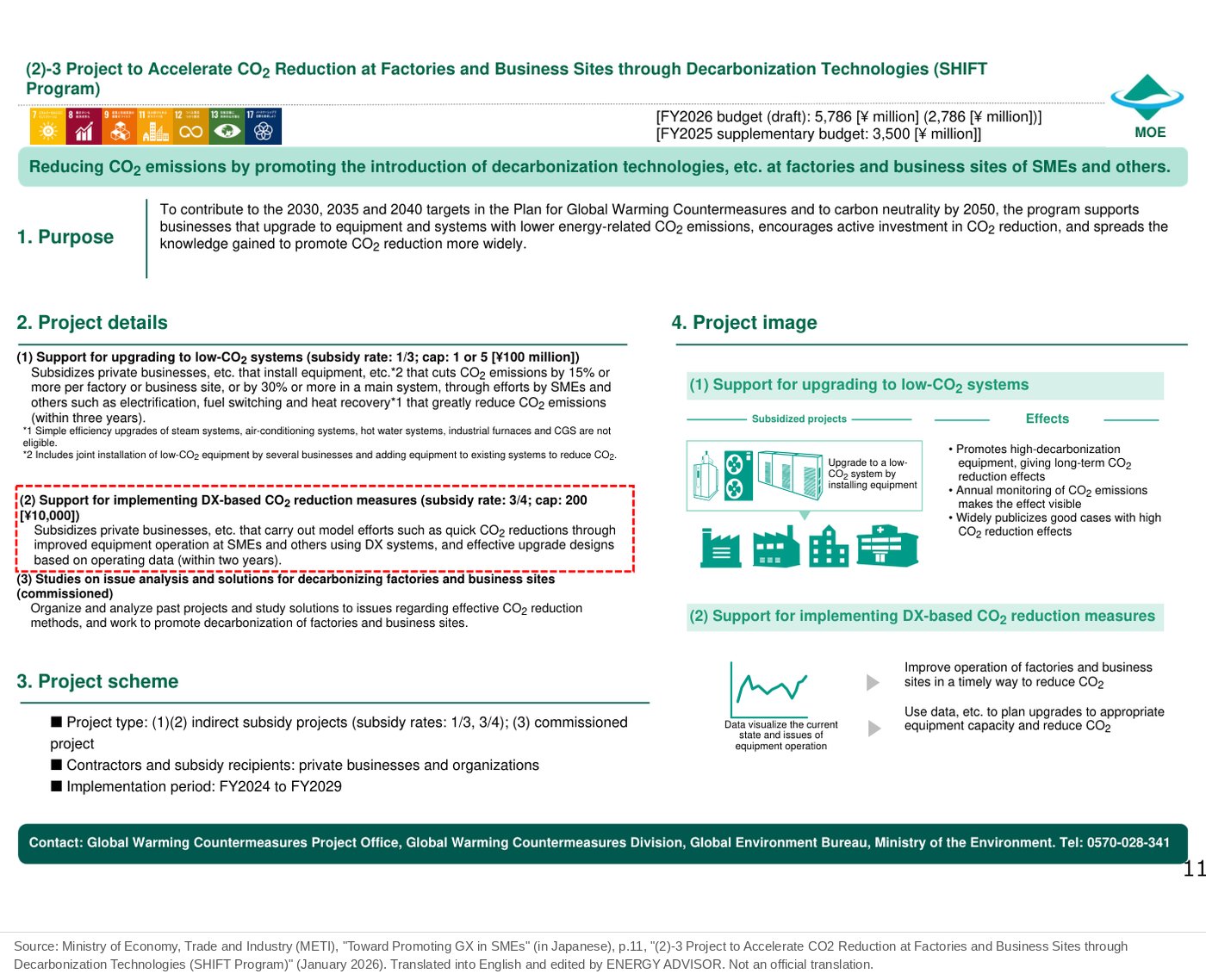
Judging only from the name “Project to Accelerate CO2 Reduction at Factories and Business Sites,” it looks like a capital investment program, but a distinctive feature is that it includes a menu that supports planning itself.
Structure of the Menus: One for Planning and One for Equipment
As of FY2026 (Reiwa 8), the SHIFT program consists of two main menus.
| Menu | Main content | Eligible applicants | Subsidy rate | Subsidy cap |
|---|---|---|---|---|
| DX-based CO2 reduction implementation support | CO2 reduction audits and implementation plans (including examination of operational improvements involving measurement by a DX system) | SMEs, etc. (SMEs under the Small and Medium-sized Enterprise Basic Act, incorporated administrative agencies, national and public university corporations, school corporations, social welfare corporations, medical corporations, cooperatives, general incorporated associations and foundations, etc.; sole proprietors and large companies are not eligible) | 3/4 | ¥2 million |
| Retrofit support for low-CO2 systems | Equipment upgrades through electrification, fuel switching, heat recovery, etc. | A wide range of corporations, including SMEs | 1/3 | ¥100 million or ¥500 million depending on CO2 reductions |
Sources: GAJ, “FY2026 SHIFT Program, DX-based CO2 Reduction Implementation Support: Application Guidelines” (in Japanese); same, “Retrofit Support for Low-CO2 Systems: Application Guidelines” (in Japanese)
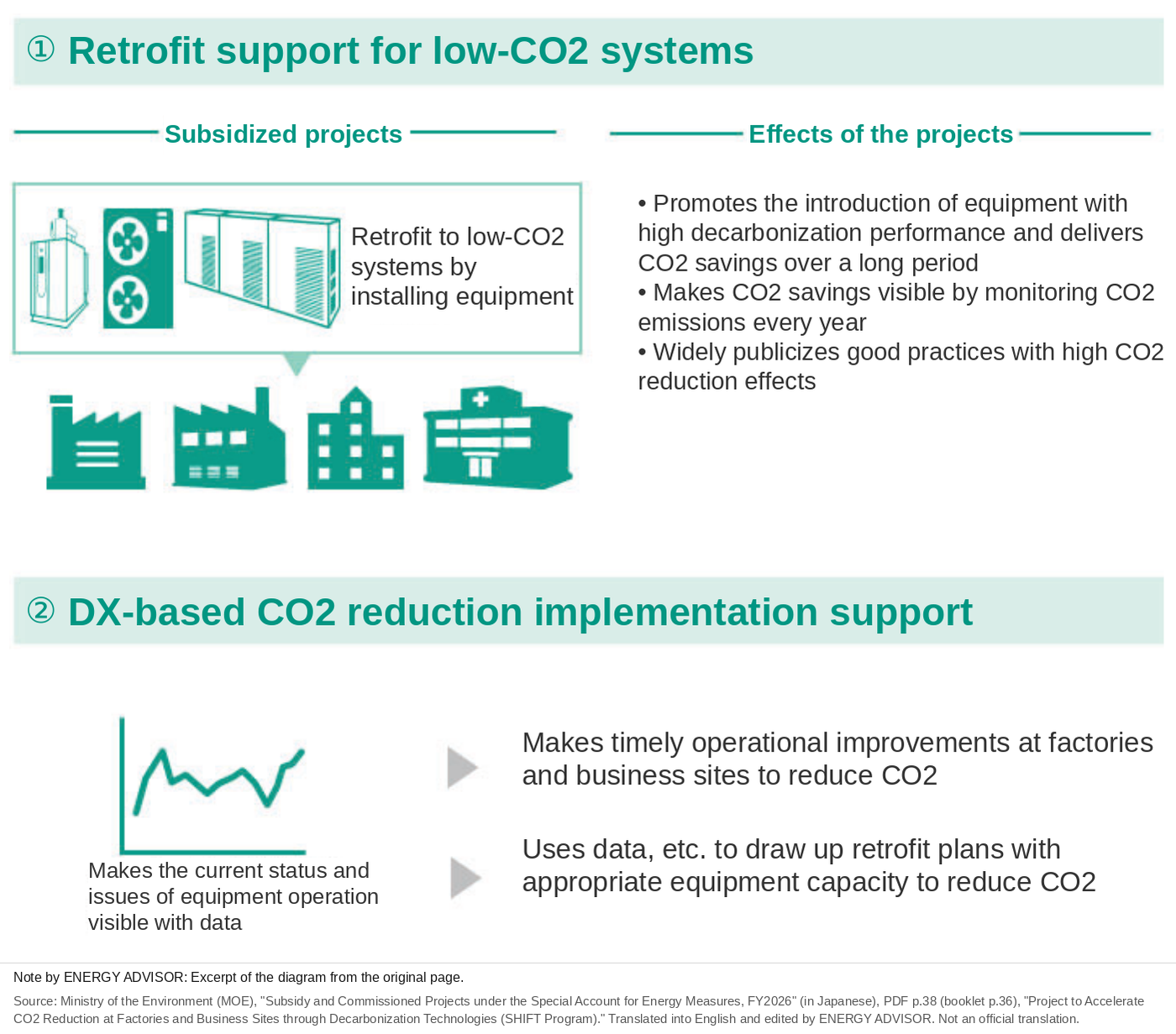
In some past fiscal years, there was also a separate menu supporting reductions across the whole value chain through collaboration between companies, but in the calls as of FY2026 (Reiwa 8), only these two menus are offered.
“DX-based CO2 Reduction Implementation Support,” Which Subsidizes Most of the Cost of Planning
This menu is what this article means by “subsidies for drawing up reduction plans.” It is open to SMEs, etc. that own factories or business sites with annual CO2 emissions of 50 t or more and less than 3,000 t. The requirements are that a support organization installs a DX system to measure current energy use, etc., examines three or more reduction measures, and includes several of them in an implementation plan. Deliverables include the results of an audit of the reduction potential and an implementation plan. The subsidy rate is 3/4 of eligible costs and the cap is a uniform ¥2 million, designed to cover most of the cost of drawing up a reduction plan with outside specialist support. The DX-based menu also requires a project report to be submitted each fiscal year for three years starting from the second fiscal year after the year in which the subsidized project is completed.
Sources: GAJ, “FY2026 SHIFT Program, DX-based CO2 Reduction Implementation Support: Application Guidelines” (in Japanese); same, “Second Call: Application Guidelines,” p.25, “8.1 Project Reports” (in Japanese); same, “Explanatory Material on the Application Guidelines (DX-based CO2 Reduction Implementation Support)” (in Japanese)
“Retrofit Support for Low-CO2 Systems,” Which Supports Equipment Upgrades
This menu supports the stage of actually upgrading equipment. Preparing a CO2 reduction plan is mandatory for an application, but this does not presuppose that you have completed the DX-based menu. If you draw up a new plan using a support organization included in the list of support organizations, you can also apply on its own without going through the DX-based menu. It covers equipment installations that cut annual CO2 emissions by 15% or more at the factory or business-site level, or by 30% or more in a main system line, with technologies such as electrification, fuel switching and heat recovery in view. The subsidy rate is 1/3 of eligible costs, and the cap depends on CO2 reductions: ¥100 million for reductions of less than 4,000 t-CO2/year and ¥500 million for 4,000 t-CO2/year or more. Another requirement is that the subsidized project’s payback period is three years or more. Upgrades of lighting equipment are said to be potentially eligible only for SMEs. Note also that even after the project is completed, there is an obligation (monitoring) to submit a project report on CO2 emission reduction effects, etc. every fiscal year to a party designated by MOE, for three years starting from the second fiscal year after the year in which the retrofit is completed.
FY2026 (Reiwa 8) Calls for Applications (First to Third)
The FY2026 call began on June 12, 2026. For retrofit support, this call had two deadlines: the first (July 15, 2026, noon) is called the first call and the second (August 26, noon) the second call. The deadline for DX-based CO2 reduction implementation support was August 26, noon. Then, on September 11, 2026, an additional call began. MOE announced it as the “third call” (the application guidelines for the DX-based menu call it the “second call”).
| Menu | Call that began June 12 | Call that began September 11 |
|---|---|---|
| Retrofit support for low-CO2 systems | Deadlines: July 15, noon (first) and August 26, noon (second) | Deadlines: October 1, noon (round 1) and October 15, noon (round 2) |
| DX-based CO2 reduction implementation support | Deadline: August 26, noon | Deadline: October 15, noon |
In the call that began on September 11, the subsidy rates and caps were unchanged: 1/3 for retrofit support (cap ¥100 million or ¥500 million) and 3/4 for the DX-based menu (cap ¥2 million). In the third call for retrofit support, applications rejected at the round 1 deadline for reasons other than failing to meet requirements continue to be screened at the round 2 deadline unless withdrawn. As of October 22, 2026, all of the deadlines have passed.
Sources: MOE, “Start of the Call for Applications for the FY2026 Project to Accelerate CO2 Reduction at Factories and Business Sites through Decarbonization Technologies (SHIFT Program)” (in Japanese); MOE, “Third Call for Applications for the SHIFT Program” (September 11, 2026) (in Japanese); GAJ, “FY2026 Retrofit Support for Low-CO2 Systems, Third Call: Application Guidelines,” pp.6 and 28 (in Japanese); same, “FY2026 DX-based CO2 Reduction Implementation Support, Second Call: Application Guidelines” (in Japanese)
Application Process and Points to Note
The SHIFT program is not one in which a business goes through the procedures alone. First, you ask two or more support organizations from the list published by the implementing organization for quotations, and choose one to provide support. You then submit a grant application, and after screening (about 1.5 months after the call deadline as a guide) you receive a grant decision. After that, the business and the support organization sign a contract and the actual support (audits and planning, equipment works, etc.) begins.
After the support is completed, you submit a completion report within 30 days of the project completion date (for the DX-based menu, by that date or February 19, 2027, whichever is earlier; the same applies to the call that began on September 11), and the grant amount is finalized after a final inspection. The subsidy is in principle paid after the fact (reimbursement after completion): if you submit a request for payment within two weeks of receiving notice of the finalized grant amount, the money is transferred to the designated account within 30 days after that. As with other subsidies, note that ordering or signing a contract before the grant decision makes the cost ineligible.
Grant applications are made through the electronic application system “jGrants,” which requires a separate “gBizID Prime” account. Obtaining gBizID Prime can take several business days even when issued online, and about one to two weeks by mail, so it is advisable to prepare the account early, in parallel with choosing a support organization. In particular, if you start preparing just before the deadline, obtaining the account alone may take days and you may miss the deadline.
Preparing such grant application documents on behalf of a business for a fee is, in principle, considered the exclusive practice of a Certified Administrative Procedures Legal Specialist (gyoseishoshi), a licensed professional who prepares documents submitted to government agencies. (For how this applies when the implementing organization is a private body, see the extra article on the Gyoseishoshi Act. Doing it free of charge does not fall under this.) The detailed background is covered in a separate extra article.
Summary
As of FY2026 (Reiwa 8), the SHIFT program (Project to Accelerate CO2 Reduction at Factories and Business Sites through Decarbonization Technologies) consists of two menus: “DX-based CO2 reduction implementation support,” which supports drawing up CO2 reduction plans (limited to SMEs, etc.; subsidy rate 3/4; cap ¥2 million), and “retrofit support for low-CO2 systems,” which supports equipment upgrades (subsidy rate 1/3; cap ¥100 million or ¥500 million). For companies that have been asked by customers to cut emissions but do not know where to start, the DX-based menu, which can cover most of the cost at the planning stage, is one realistic starting point. In FY2026, calls were held in June and September, and as of October 22, 2026 both have closed. When considering the next call as well, remember that the subsidy is paid after the fact, and prepare on a schedule that covers everything from choosing a support organization to the completion report.
Related Articles
- Part 7: The Order of Reduction Measures: Operational Improvements, Contract Review and Capital Investment (in Japanese)
- Part 11: A Map of Energy and Decarbonization Subsidies for SMEs (FY2026 Edition) (in Japanese)
The information in this article is current as of the time of posting and may have changed by the time you read it.
This article is based on published materials from the Ministry of Economy, Trade and Industry and its Agency for Natural Resources and Energy, the Electricity and Gas Market Surveillance Commission, the Organization for Cross-regional Coordination of Transmission Operators (OCCTO) and other sources. The English translations of figures are by ENERGY ADVISOR and are not official translations. When using this information for decisions, please check the original sources. When we find an error, we correct the article and note the date of the correction.
Sources
- MOE, “Start of the Call for Applications for the FY2026 Project to Accelerate CO2 Reduction at Factories and Business Sites through Decarbonization Technologies (SHIFT Program)” (in Japanese). https://www.env.go.jp/press/press_04967.html
- MOE, SHIFT program website (in Japanese). https://shift.env.go.jp/
- GAJ, “FY2026 SHIFT Program, DX-based CO2 Reduction Implementation Support: Application Guidelines” (in Japanese). https://www.gaj.or.jp/eie/shift/koubo/document/R8/A/sf08a1.pdf
- GAJ, “Explanatory Material on the Application Guidelines (DX-based CO2 Reduction Implementation Support)” (in Japanese). https://www.gaj.or.jp/eie/shift/koubo/document/R8/J/sf08j1.pdf
- GAJ, “FY2026 SHIFT Program, Retrofit Support for Low-CO2 Systems: Application Guidelines” (in Japanese). https://www.gaj.or.jp/eie/shift/koubo/document/R8/B/sf08b1.pdf
- GAJ, “Call and Grant Materials (FY2026 Projects)” (in Japanese). https://www.gaj.or.jp/eie/shift/koubo/
- Ministry of Internal Affairs and Communications (MIC), “Enforcement of the Act Partially Amending the Gyoseishoshi Act” (in force January 1, 2026; notice) (in Japanese). https://www.soumu.go.jp/main_content/001014708.pdf
- MOE, “Third Call for Applications for the Project to Accelerate CO2 Reduction at Factories and Business Sites through Decarbonization Technologies (SHIFT Program)” (September 11, 2026) (in Japanese). https://www.env.go.jp/press/press_05521.html
- GAJ, “FY2026 SHIFT Program, Retrofit Support for Low-CO2 Systems, Third Call: Application Guidelines” (p.5 monitoring obligation, p.6 two deadlines, p.28 caps and subsidy rate) (in Japanese). https://www.gaj.or.jp/eie/shift/koubo/document/R8/B/sf08b1a.pdf
- GAJ, “FY2026 SHIFT Program, DX-based CO2 Reduction Implementation Support, Second Call: Application Guidelines” (application period; completion deadline February 13, 2027; completion report February 19, 2027) (in Japanese). https://www.gaj.or.jp/eie/shift/koubo/document/R8/A/sf08a1a.pdf
- GAJ, “FY2026 Call and Grant Materials” (in Japanese). https://www.gaj.or.jp/eie/shift/koubo/R8.html
- GAJ website (English name “Greenhouse Gas Assurance Association of Japan”; viewed October 22, 2026). https://www.gaj.or.jp/
- MOE, “Subsidy and Commissioned Projects under the Special Account for Energy Measures, FY2026” (in Japanese). https://www.env.go.jp/content/000397154.pdf
- Ministry of Economy, Trade and Industry (METI), “Toward Promoting GX in SMEs” (January 2026) (in Japanese). https://www.meti.go.jp/policy/energy_environment/global_warming/SME/pamphlet/gx_gaiyou.pdf
- MOE, “MOE Priorities for FY2027” (August 2026) (in Japanese). https://www.env.go.jp/content/000426125.pdf