When a company wants to replace aging air conditioning, boilers or motors with high-efficiency equipment, the first candidate many small and medium-sized enterprises (SMEs) think of is the “Subsidy for Energy Conservation and Non-fossil Transition.” However, this subsidy groups four project types of different character under one name, from large-scale types covering a whole factory to types that can be used even to replace a single air conditioner, which makes it hard to tell which type your company fits. This article explains the differences among the four project types, the points checked in screening, and the application process, based on primary sources from the Ministry of Economy, Trade and Industry (METI) and SII (Sustainable open Innovation Initiative), which are responsible for and implement this subsidy.
Key points
- 1The Subsidy for Energy Conservation and Non-fossil Transition is funded from METI’s budget and implemented by SII (Sustainable open Innovation Initiative). Officially, it is the collective name for two subsidies: the “Subsidy for Supporting Energy Conservation Investment and Demand Structure Transformation” and the “Subsidy for Supporting Energy Conservation Investment.”
- 2Eligible projects are divided into four project types: (I) the factory and business-site type, (II) the electrification and fuel-switching type, (III) the equipment-unit type (including the GX equipment-unit type) and (IV) the energy demand optimization type. Eligible equipment, subsidy rates and caps differ by type.
- 3Of these, (III), the equipment-unit type, which you can apply for simply by replacing designated individual equipment, has no payback period requirement, and you just choose eligible equipment from a list published by SII. You can therefore consider applying even before you have an energy-saving plan for the whole factory.
- 4Screening checks how energy-saving effects are calculated and, for some types, whether the payback period requirement is met.
- 5The subsidy is in principle paid after the fact (reimbursement after completion). In FY2026, the 1st to 3rd calls have closed, and as of October 22, 2026 the 4th call (October 5–October 30) is open.
In this series, “SMEs and Decarbonization,” Part 11 sorted the subsidies and tax incentives available to SMEs into six broad categories and laid out the overall map. The program covered here, the Subsidy for Energy Conservation and Non-fossil Transition, falls under (a), energy-saving equipment upgrades. Capital investment is positioned as the last of the three reduction stages covered in Part 7. This time, we look at the content of this subsidy program in detail, following primary sources.
Official Name, Responsible Ministry and Implementing Organization
“Subsidy for Energy Conservation and Non-fossil Transition” is a common name; officially it is the collective name for the following two subsidies. Because the two budgets, which come from different funding sources, are presented on one special website and in one pamphlet, the common name is the more widely used.
Subsidy for Supporting Energy Conservation Investment and Demand Structure Transformation (funded by Japan Climate Transition Bonds); Subsidy for Supporting Energy Conservation Investment (funded by the Special Account for Energy Measures)
METI is the responsible ministry. Actual implementation (running the calls, screening, grant decisions, receiving completion reports, etc.) is carried out by SII (Sustainable open Innovation Initiative), as the lead member of a consortium with private companies. SII is a general incorporated association that serves as the implementing organization for several energy-related subsidies under METI’s jurisdiction.
SII is not a private subsidy broker but the organization that implements METI’s subsidies, and it is basically the only place to apply.
Overview of the Four Project Types
The Subsidy for Energy Conservation and Non-fossil Transition is divided into four project types by breadth of coverage and size of investment. The subsidy rates and caps by type are as follows. (These are the figures checked in the primary sources for the Reiwa 7 supplementary budget, 2nd call, and they are the same in the application guidelines for the 3rd and 4th calls.)
| Project type | Typical projects | Subsidy rate (SMEs, etc.) | Subsidy cap (guide) |
|---|---|---|---|
| (I) Factory and business-site type | Projects that achieve large energy savings across a factory or business site by combining advanced equipment, custom-made equipment or several items of designated equipment | Advanced window 2/3, general window 1/2, SME investment promotion window 1/2, supply chain collaboration window 1/2 (each window has a payback period requirement) | ¥1.5 billion for single-year projects (¥2 billion with non-fossil transition); up to ¥3 billion for multi-year and collaborative projects (¥4 billion with non-fossil transition) per project in total |
| (II) Electrification and fuel-switching type | Projects that replace, modify or newly install equipment using fossil fuels with equipment that uses electricity, low-carbon fuels or hydrogen | Replacement and modification 1/2, new installation 1/5 (construction costs are in principle eligible only when carried out by SMEs, etc.) | ¥300 million for replacement and modification (¥500 million with electrification), ¥300 million for new installation, per project in total |
| (III) Equipment-unit type (including the GX equipment-unit type) | Projects that replace designated equipment such as high-efficiency air conditioning, LED lighting, transformers and industrial motors unit by unit (the top-performance window also covers new installation) | Conventional window 1/3, manufacturer reinforcement window 1/3, top-performance window 1/2 (replacement) and 1/5 (new installation). No difference by company size | ¥100 million for the conventional window; ¥300 million for the manufacturer reinforcement and top-performance windows, per project in total |
| (IV) Energy demand optimization type | Projects that install an energy management system (EMS) registered with SII to reduce energy use and optimize demand | 1/2 | ¥100 million per project in total |
Sources: SII, “Subsidy for Energy Conservation and Non-fossil Transition (Factory and Business-Site Type), Reiwa 7 Supplementary Budget: Application Guidelines (for the 2nd call),” pp.29–30 (in Japanese); same (Equipment-Unit Type): Application Guidelines (for the 2nd call), pp.26, 38 and 55 (in Japanese); same (Factory and Business-Site Type): Application Guidelines (for the 4th call), PDF pp.7–8 (in Japanese); same (Equipment-Unit Type): Application Guidelines (for the 4th call), PDF pp.6–9 (in Japanese)
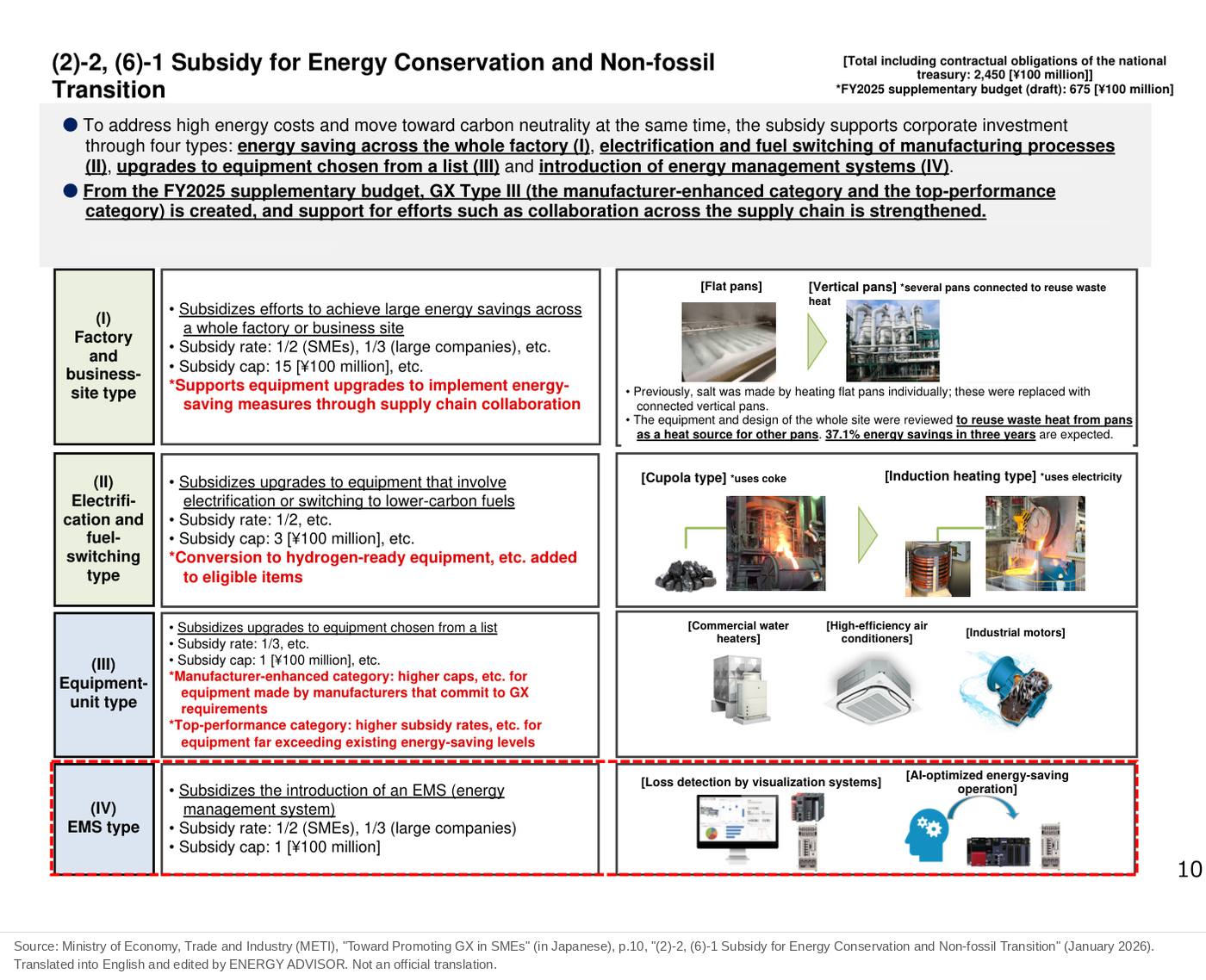
For large companies and others (businesses that are not SMEs), the subsidy rate is set lower than for SMEs, etc. for some types (e.g., 1/3 for the (I) general window; no difference by company size for (III); 1/3 for (IV)). The SME investment promotion window of (I), the factory and business-site type, is open only to SMEs, etc.; large companies cannot apply. The cap of ¥3 billion (¥4 billion with non-fossil transition) for (I) multi-year projects in the table above applies to the advanced window, and to the general and SME investment promotion windows when carried out as collaborative projects. When the general or SME investment promotion window is carried out as a standalone (non-collaborative) multi-year project, the cap is ¥2 billion (¥3 billion with non-fossil transition).
The four types differ greatly in coverage and requirements. Keeping two things in mind, “the factory and business-site type is for retrofitting a whole factory” and “the equipment-unit type is for replacing individual equipment,” helps you narrow down which type fits your company.
Why the “Equipment-Unit Type” Tends to Be the Entry Point for SMEs
Of the four types, (I), the factory and business-site type, has requirements such as a payback period of five years or more for both the advanced and general windows (in the general window, the subsidy rate drops if it is less than seven years), and it presupposes a substantial energy-saving plan at the site level. In contrast, for (III), the equipment-unit type, you choose eligible equipment from the list of designated equipment published by SII and can apply if you meet any one of the following: an energy-saving rate of 10% or more, energy savings of 1 kL or more, or energy savings per cost of 1 kL per ¥10 million or more. There is no payback period requirement at all.
In other words, a feature of (III), the equipment-unit type, is that even SMEs without the capacity to draw up an energy-saving plan for a whole factory can start with one-off investments such as replacing aging air conditioning or boilers. Which type actually suits your company, however, depends on the kind of equipment you want to install and the size of the investment.
Examples of Eligible Equipment under the Equipment-Unit Type
Eligible equipment under (III), the equipment-unit type, is “designated equipment” set in advance by SII. Designated equipment is limited to products in the following equipment categories that meet the energy efficiency and other criteria published by SII.
- High-efficiency air conditioning (commercial and industrial air conditioners)
- Industrial heat pumps
- Commercial water heaters
- High-performance boilers
- High-efficiency cogeneration
- Low-carbon industrial furnaces
- Transformers
- Refrigeration and freezing equipment
- Industrial motors (including pumps, compressors and blowers; inverter control is a requirement)
- LED lighting fixtures with control functions
- Machine tools, plastic processing machines, press machines, printing machines and die-casting machines
For (II), the electrification and fuel-switching type, five of these equipment categories that contribute to switching from fossil fuels to electricity or low-carbon fuels are eligible: industrial heat pumps, commercial heat pump water heaters, high-performance boilers, high-efficiency cogeneration and low-carbon industrial furnaces. Whether a product is designated equipment is checked by model number against the list published on SII’s website.
What Screening Looks At: Calculation of Energy-Saving Effects and Payback Period
The typical items checked in screening are the results of the energy-saving calculation and, for some types, the payback period. For (III), the equipment-unit type, the energy-saving effect is in principle obtained either by using a mechanism in which entering data such as the operating hours of the planned equipment into SII’s subsidy project portal calculates it automatically (designated calculation), or by the applicant’s own calculation (independent calculation). Planned energy savings are calculated as “annual energy use before the project − annual energy use after the project,” and must meet any one of the requirements of an energy-saving rate of 10% or more, energy savings of 1 kL or more, or energy savings per cost of 1 kL per ¥10 million or more.
For (I), the factory and business-site type, there is also a payback period requirement. The payback period is calculated as “eligible costs [¥] ÷ (planned energy savings [kL/year] × fuel valuation unit price [¥/kL]),” and must be five years or more for the advanced and general windows and three years or more for the SME investment promotion window. The payback period is an indicator of how many years it takes to recover the cost of a capital investment from the energy-saving effect (the reduction in fuel costs) the equipment produces. Projects whose payback period is shorter than required, that is, investments that would pay for themselves quickly, are judged likely to be carried out even without public support, and their subsidy rate is lowered or they become ineligible.
Note that under the payback period requirement, investments that pay off faster are at a disadvantage. Behind this is the program’s idea that, since public money is being spent, it should support investments that take a long time to recover and that are hard for the private sector to decide on alone.
FY2026 Calls for Applications (Reiwa 7 Supplementary Budget, 1st–4th Calls)
The factory and business-site type and the equipment-unit type of the Subsidy for Energy Conservation and Non-fossil Transition share a common schedule in FY2026 (April 2026–March 2027), and the following four calls have been held.
| Round | Application period | As of October 22, 2026 |
|---|---|---|
| 1st | March 30–April 27, 2026 | Closed |
| 2nd | June 1–July 9, 2026 | Closed |
| 3rd | August 20–September 28, 2026 | Closed |
| 4th | October 5–October 30, 2026 | Open |
The “Reiwa 7 supplementary budget” is a supplementary budget compiled in FY2025 (April 2025–March 2026), and calls under that project are being held in FY2026. The application guidelines for the 4th call of the equipment-unit type cover (II) the electrification and fuel-switching type, (III) the equipment-unit type and (IV) the energy demand optimization type together, with an application period of October 5–October 30, 2026, 17:00.
In the 4th call, industrial heat pumps (low-temperature range) and high-efficiency cogeneration were added to the eligible equipment of the top-performance window of the equipment-unit type (GX equipment-unit type).
Under the application guidelines for both the 2nd and 4th calls, the project period runs from the date of the grant decision to January 31, 2027 (the completion deadline for single-year projects). Multi-year investment and project plans are also supported, for up to four years for the factory and business-site type and up to two years for the equipment-unit type.
Sources: SII, “Subsidy for Energy Conservation and Non-fossil Transition, 2026 Special Website”: Call Information (in Japanese); SII, “Subsidy for Energy Conservation and Non-fossil Transition (Equipment-Unit Type), Reiwa 7 Supplementary Budget: Application Guidelines (for the 2nd call),” p.9 (in Japanese); same (Equipment-Unit Type): Application Guidelines (for the 4th call), PDF p.13 (budget), p.28 (project period) and p.29 (schedule of the 4th call) (in Japanese)
Application Process and Points to Note
The flow from application to receipt of the subsidy is: grant application → screening and selection → grant decision → project implementation (ordering, installation, acceptance inspection, etc.) → completion report → final inspection by SII → payment of the subsidy. There are four points to keep in mind here.
First, contracts and orders must always be placed on or after the date of the grant decision. Any part contracted or ordered before the grant decision is ineligible. Second, quotations for eligible costs must in principle be obtained from three or more vendors, and eligible costs must be calculated with the lowest price resulting from price competition, etc. as the ceiling (exceptions may apply when the contract amount is small). Quotations issued before the date the application guidelines were published may not be treated as valid, so the timing of obtaining quotations also needs attention. Third, the subsidy is in principle paid after the fact (reimbursement after completion). The business first pays the full equipment and construction costs, submits a completion report after installation and acceptance inspection are complete, and the subsidy is paid only after SII’s final inspection. Schedules must assume that the company temporarily covers the costs from its own funds. Fourth, receiving other national subsidies for the same eligible costs is not allowed (combination with subsidies from local governments’ general funds is possible).
Preparing such subsidy application documents on behalf of a business for a fee is, in principle, considered the exclusive practice of a Certified Administrative Procedures Legal Specialist (gyoseishoshi), a licensed professional who prepares documents submitted to government agencies. (For how this applies when the implementing organization is a private body, see the extra article on the Gyoseishoshi Act. Doing it free of charge does not fall under this. The background is covered in a separate extra article.)
Summary
The Subsidy for Energy Conservation and Non-fossil Transition is a program in which SII (Sustainable open Innovation Initiative) implements METI’s budget, and it consists of four project types of different character: (I) the factory and business-site type, (II) the electrification and fuel-switching type, (III) the equipment-unit type and (IV) the energy demand optimization type. Whereas (I) presupposes retrofitting a whole factory, (III), the equipment-unit type, can be applied for just by choosing designated equipment and has no payback period requirement, so you can consider applying even before you have a plan for the whole factory. Screening checks the results of the energy-saving calculation and the payback period requirement for each type, and the subsidy is paid after the fact, following ordering and installation after the grant decision and the completion report. In FY2026, the 1st to 4th calls have been held (the 4th call closes on October 30, 2026).
Related Articles
- Part 7: The Order of Reduction Measures: Operational Improvements, Contract Review and Capital Investment (in Japanese)
- Part 11: A Map of Energy and Decarbonization Subsidies for SMEs (FY2026 Edition) (in Japanese)
The information in this article is current as of the time of posting and may have changed by the time you read it.
This article is based on published materials from the Ministry of Economy, Trade and Industry and its Agency for Natural Resources and Energy, the Electricity and Gas Market Surveillance Commission, the Organization for Cross-regional Coordination of Transmission Operators (OCCTO) and other sources. The English translations of figures are by ENERGY ADVISOR and are not official translations. When using this information for decisions, please check the original sources. When we find an error, we correct the article and note the date of the correction.
Sources
- SII, “Subsidy for Energy Conservation and Non-fossil Transition, 2026 Special Website” (in Japanese). https://syouenehojyokin.sii.or.jp/
- SII, “Subsidy for Energy Conservation and Non-fossil Transition, 2026 Special Website”: Call Information (in Japanese). https://syouenehojyokin.sii.or.jp/information.html
- SII, “Subsidy for Energy Conservation and Non-fossil Transition (Factory and Business-Site Type), Reiwa 7 Supplementary Budget,” project top page (in Japanese). https://sii.or.jp/koujou07r/
- SII, “Subsidy for Energy Conservation and Non-fossil Transition (Factory and Business-Site Type), Reiwa 7 Supplementary Budget: Program Overview Pamphlet (for the 2nd call)” (in Japanese). https://sii.or.jp/koujou07r/uploads/r7h_panflet_gaiyou_kj_2.pdf
- SII, “Subsidy for Energy Conservation and Non-fossil Transition (Factory and Business-Site Type), Reiwa 7 Supplementary Budget: Application Guidelines (for the 2nd call)” (in Japanese). https://sii.or.jp/koujou07r/uploads/r7h_kj_01_kouboyouryou_2.pdf
- SII, “Subsidy for Energy Conservation and Non-fossil Transition (Equipment-Unit Type), Reiwa 7 Supplementary Budget,” project top page (in Japanese). https://sii.or.jp/setsubi07r/
- SII, “Subsidy for Energy Conservation and Non-fossil Transition (Equipment-Unit Type), Reiwa 7 Supplementary Budget: Program Overview Pamphlet (for the 2nd call)” (in Japanese). https://sii.or.jp/setsubi07r/uploads/r7h_panflet_gaiyou_st_2.pdf
- SII, “Subsidy for Energy Conservation and Non-fossil Transition (Equipment-Unit Type), Reiwa 7 Supplementary Budget: Application Guidelines (for the 2nd call)” (in Japanese). https://sii.or.jp/setsubi07r/uploads/r7h_st_01_kouboyouryou_2.pdf
- SII, “Subsidy for Energy Conservation and Non-fossil Transition (Factory and Business-Site Type), Reiwa 7 Supplementary Budget: Application Guidelines (for the 3rd call) and (for the 4th call)” (subsidy rates and caps PDF pp.7–8; project period PDF p.32) (in Japanese). https://sii.or.jp/koujou07r/uploads/r7h_kj_01_kouboyouryou_3.pdf / https://sii.or.jp/koujou07r/uploads/r7h_kj_01_kouboyouryou_4.pdf
- SII, “Subsidy for Energy Conservation and Non-fossil Transition (Equipment-Unit Type), Reiwa 7 Supplementary Budget: Application Guidelines (for the 3rd call) and (for the 4th call)” (subsidy rates and caps PDF pp.6–9; budget PDF p.13; project period PDF p.28; schedule of the 4th call PDF p.29) (in Japanese). https://sii.or.jp/setsubi07r/uploads/r7h_st_01_kouboyouryou_3.pdf / https://sii.or.jp/setsubi07r/uploads/r7h_st_01_kouboyouryou_4.pdf
- METI, “Toward Promoting GX in SMEs” (January 2026) (in Japanese). https://www.meti.go.jp/policy/energy_environment/global_warming/SME/pamphlet/gx_gaiyou.pdf