Once you can calculate your CO2 emissions, the next question is, “So how do we reduce them?” The reduction measures that tend to come up first are capital investments that cost a substantial amount, such as installing solar panels or replacing equipment with high-efficiency models. In reality, however, many measures that cost nothing remain to be taken before such investments. This article rearranges reduction efforts in order of cost and clearly sorts out where to start.
Key points
- 1Arranged by the size of the cost required, CO2 reduction measures can be organized into three stages: “operational improvements (almost ¥0) → contract review (from ¥0) → capital investment (using subsidies).”
- 2Operational improvements include measures you can start without additional investment, such as reviewing air conditioning operating hours and temperature settings, demand management and energy visualization.
- 3Reviewing your electricity contract and tariff plan affects not only the cost of electricity but also your CO2 emissions themselves.
- 4Capital investment is an unavoidable stage, but the basic approach is to reduce the burden by combining it with subsidies and tax incentives.
- 5At every stage, it is essential to run the cycle of estimating reductions, implementing measures and reflecting the results in your calculations.
In this series, “SMEs and Decarbonization,” we have looked so far (up to Part 6) at how to count and calculate your company’s CO2 emissions. Specifically, we covered the framework of Scope 1, 2 and 3 for counting emissions (Part 2, in Japanese), the schemes behind the calculations (Part 3, in Japanese), the practice of calculating Scope 2 emissions from electricity consumption (Part 4, in Japanese), the emission factor system used in the calculations (Part 5, in Japanese) and the calculation of Scope 1 from fuel use (Part 6, in Japanese). From this part on, we move to the stage of actually reducing the emissions you have calculated. First, we look at the framework for the order in which to proceed with reduction efforts as a whole.
Background to the Impression That “Decarbonization = Capital Investment”
The words “reducing CO2 emissions” often bring to mind measures that require substantial funds, such as installing solar power equipment or upgrading to high-efficiency equipment. Many of the decarbonization cases seen in the news or in dealings with customers also involve large capital investments, so the image that “decarbonization = expensive capital investment” tends to come first.
However, when you actually examine your company’s room for reduction, many measures remain that you can start simply by reviewing how you use and operate equipment, without changing existing equipment or contracts. First, we sort out the overall framework: which measures to consider, and in what order.
Before deciding whether to invest, check whether measures that can be taken by reviewing operations or contracts remain.
Three Stages: Operational Improvements → Contract Review → Capital Investment
Rearranged by the size of the cost required, efforts to reduce CO2 emissions can be organized into the following three stages:
- Operational improvements: Measures that review only how equipment is used, leaving existing equipment and contracts as they are. They require almost no additional cost.
- Contract review: Measures that review the terms of your contract with the electricity company and your tariff plan. Switching contracts itself usually involves no additional capital investment.
- Capital investment: Measures that involve initial investment, such as installing high-efficiency equipment or self-consumption solar PV. In many cases, however, they can be combined with national or local government subsidies.
In other words, decarbonization efforts do not need to start with deciding whether to make a capital investment; you can consider them step by step, starting from the stages that cost nothing. The handbook that the Ministry of the Environment (MOE) publishes for small and medium-sized businesses also presents a framework for developing a reduction plan in stages. Note that the categories presented in the handbook itself are three: “operational improvements,” “partial replacement and added functions” and “installation of equipment.” This article’s “operational improvements → contract review → capital investment,” which inserts electricity contract review as a stage, is this series’ own arrangement based on that approach.
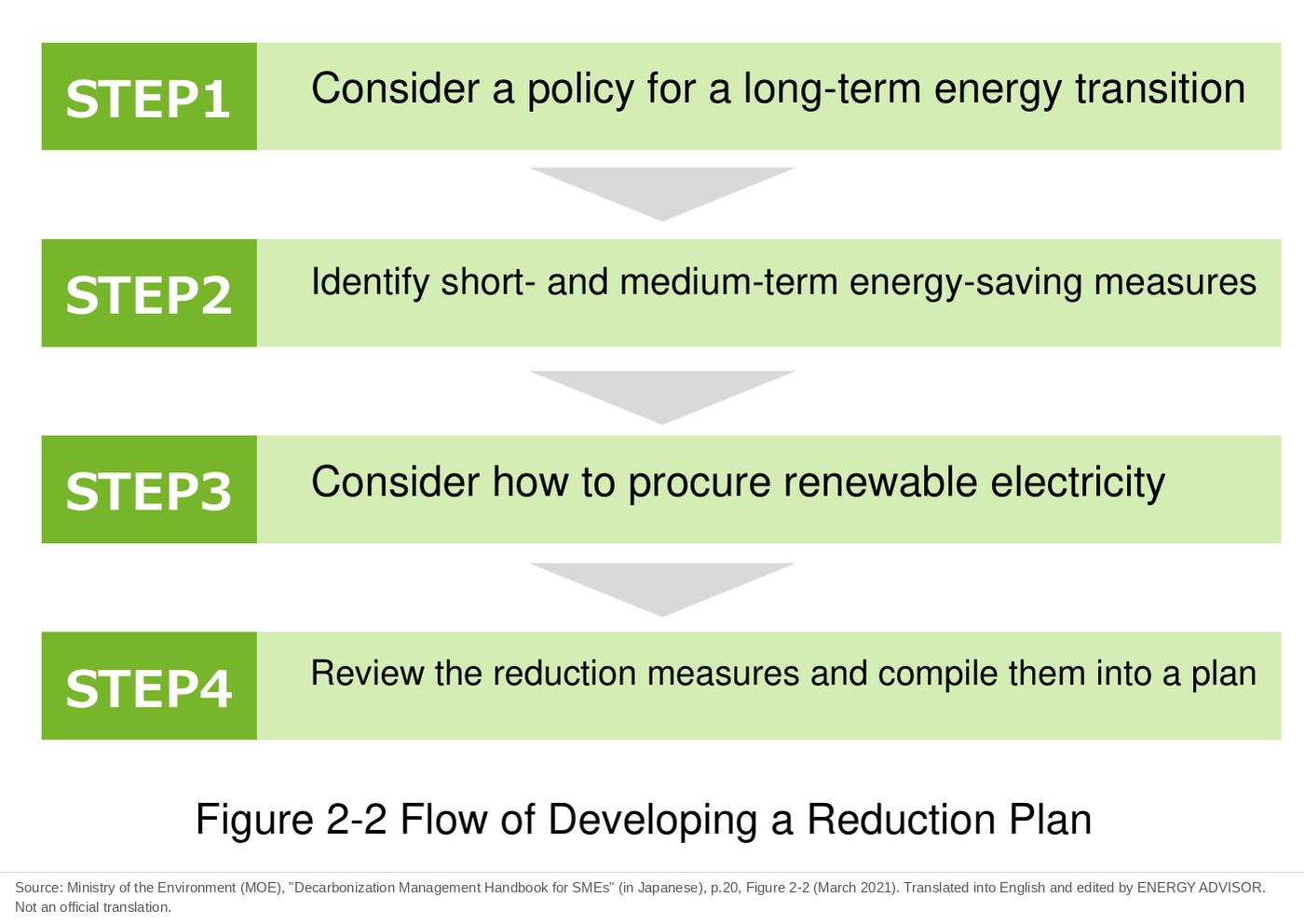
Source: MOE, “Decarbonization Management Handbook for SMEs,” p. 20 (in Japanese)
Below, we look at what specifically to do at each stage.
Stage 1, Operational Improvements: Measures You Can Start for Almost ¥0
Operational improvements are measures that reduce energy consumption by reviewing how existing equipment is used and set, while continuing to use it as it is. Because they involve no additional capital investment, this is the easiest stage for many companies to start with.
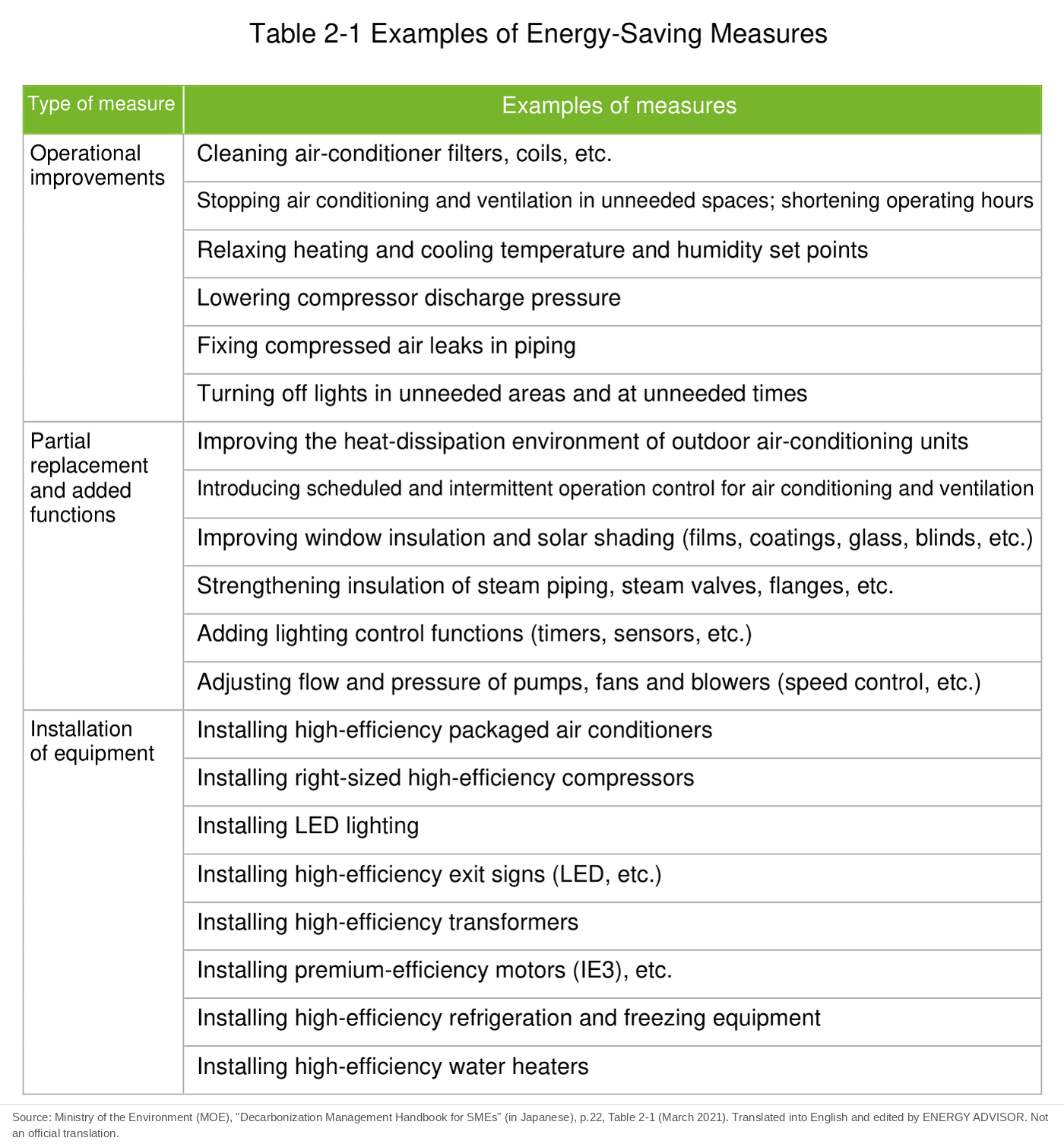
MOE’s handbook lists the following as typical examples of operational improvements:
| Type of measure | Example measures |
|---|---|
| Operational improvement | Cleaning air conditioner filters, coils, etc. |
| Operational improvement | Stopping air conditioning and ventilation in spaces that do not need them, and shortening operating hours |
| Operational improvement | Relaxing heating and cooling temperature and humidity settings |
| Operational improvement | Lowering compressor discharge pressure |
| Operational improvement | Fixing compressed air leaks in piping |
| Operational improvement | Turning off lights in unneeded areas and at unneeded times |
Source: MOE, “Decarbonization Management Handbook for SMEs,” p. 22, Table 2-1 (in Japanese)
Another important measure related to reviewing operating hours is demand management. The 30-minute demand (kW) is the average power used over each 30-minute period. For many high-voltage supply contracts, the contract demand (the power on which the demand charge is based) is determined by the maximum 30-minute demand over the most recent year, including the current month. Once a large 30-minute demand occurs, it continues to affect the contract demand for the following year. Efforts to hold down peaks in 30-minute demand by spreading out equipment operating hours and adjusting the timing of operation so that several pieces of equipment do not start at the same time are generally called demand management. Installing a new dedicated monitoring and control system comes closer to the capital investment described later, but simply checking existing demand monitoring records and reviewing operating hours can be done within the scope of operational improvements.
Another pillar is energy visualization. Energy visualization means capturing electricity and energy use as data so that it can be analyzed by time of day and by equipment. In one company’s case introduced in MOE’s handbook, the company reported working on “visualization” of electricity consumption and adjusting air conditioner temperature settings as part of its operational improvements.
Source: MOE, “Decarbonization Management Handbook for SMEs,” p. 36 (in Japanese)
How much effect operational improvements alone can deliver depends on the industry and the equipment, but actual cases using free energy audits have also confirmed a certain effect. In a casebook of energy audits published by The Energy Conservation Center, Japan (ECCJ), an electronic components manufacturer in Hokkaido reported that four operational improvements involving no investment (stopping unneeded equipment at night, using inverters (variable speed drives) on fans, fixing compressed air leaks in piping and holding down maximum demand through demand management) were expected to cut its electricity costs by about ¥1.41 million per year.
As in the audit case above, there are cases where measures that cost nothing alone produce effects of over a million yen per year. The first things to check are air conditioning operating hours and temperature settings.
Stage 2, Contract Review: Effective for Both CO2 and Costs
After reviewing how you use equipment through operational improvements, the next thing to consider is the terms of your contract with the electricity company and your tariff plan. Reviewing the contract affects not only the cost of electricity but also CO2 emissions. As confirmed in Part 5, CO2 emissions from electricity use are calculated by multiplying consumption by the emission factor of the electricity supplier and plan you have a contract with. In other words, even without reducing consumption itself, the calculated CO2 emissions may change if your electricity plan changes.
Reviewing the contract itself usually requires no additional capital investment. However, there are points to check in advance; for example, depending on the timing of the contract change, an early termination fee may be charged.
Contract review is a measure that may reduce CO2 emissions without changing consumption.
Stage 3, Capital Investment: The Standard Approach Is to Combine It with Subsidies
If you still fall short of your reduction target after operational improvements and contract review, the last thing to consider is capital investment, such as installing high-efficiency equipment or self-consumption solar PV. Unlike the other two stages, capital investment involves substantial initial costs.
However, as MOE’s handbook points out, among energy-saving measures, operational improvements are highly cost-effective and easy to take in the short term, while for capital investment, the burden on cash flow may be eased by using national and local government subsidies and tax incentives for SMEs such as tax credits and special depreciation.
Source: MOE, “Decarbonization Management Handbook for SMEs,” p. 27 (in Japanese)
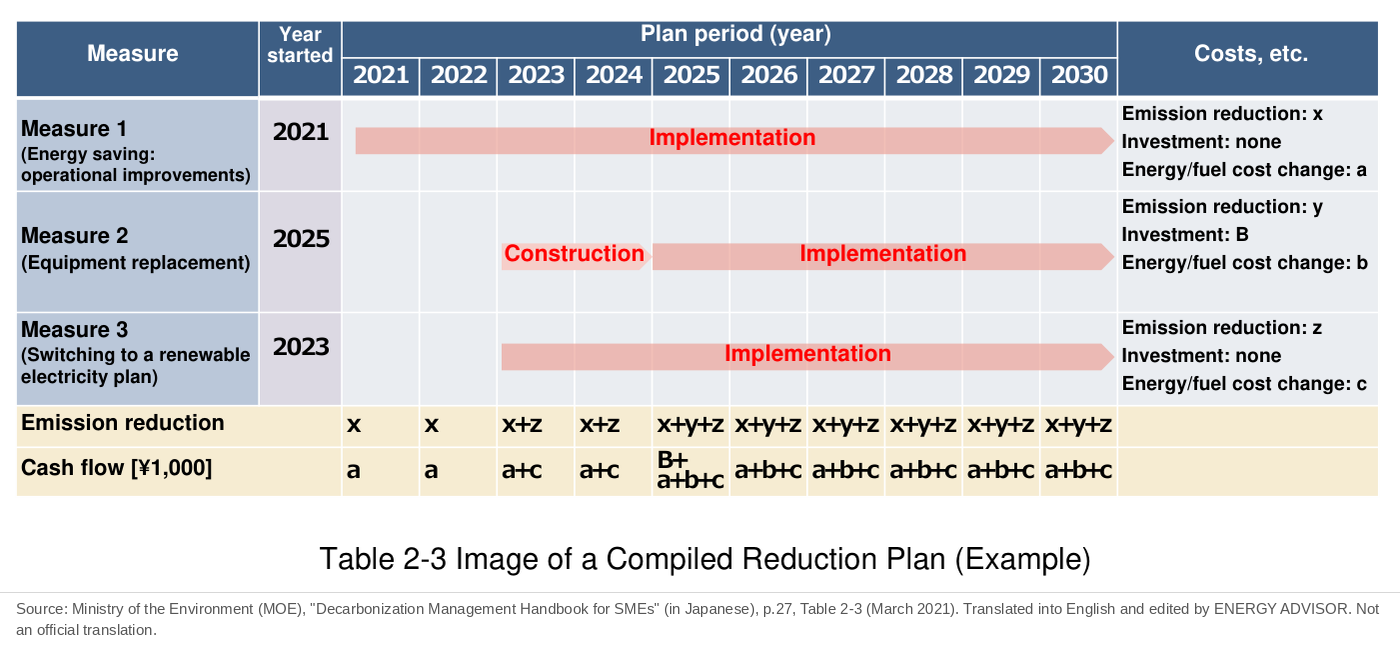
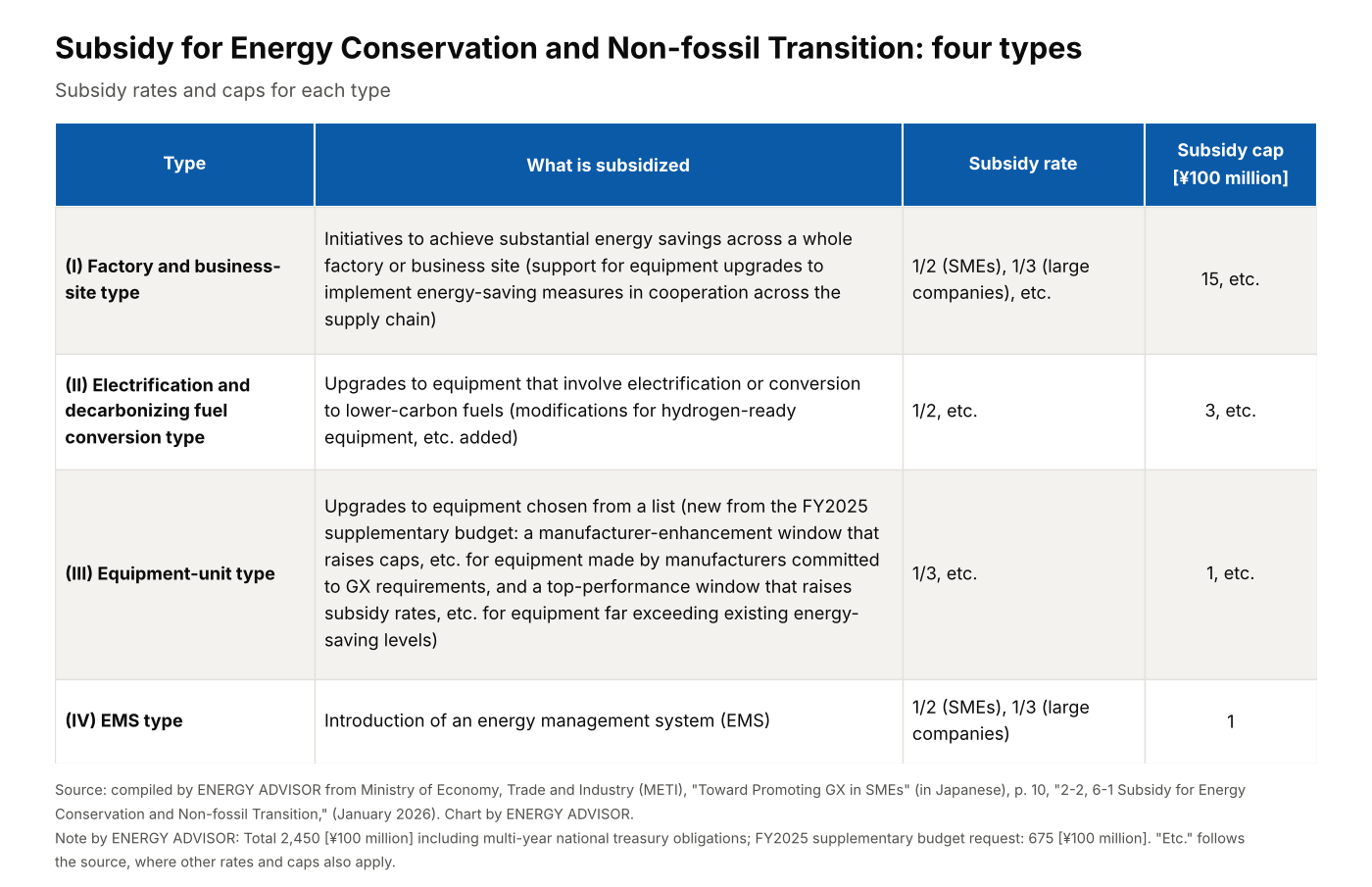
In fact, the national subsidy for energy conservation and non-fossil transition has a mechanism that gives SMEs preferential subsidy rates. Specific subsidy programs will be covered individually in the supplementary parts of this series.
The Cycle at Every Stage: Estimate → Implement → Reflect in Calculations
What is common to every stage (operational improvements, contract review and capital investment) is not implementing measures on a whim, but running a cycle: estimate the reduction, implement the measure, and reflect the result in your calculations.
MOE’s handbook shows an approach in which, when compiling reduction measures into a plan, you quantify for each measure (1) the expected greenhouse gas reduction (t-CO2/year), (2) the expected investment amount (¥) and (3) the expected increase or decrease in utility and fuel costs (¥/year), and then check whether the total reduction in the target year is enough to meet the target.
Source: MOE, “Decarbonization Management Handbook for SMEs,” p. 26 (in Japanese)
Applied to SME practice, the cycle can be organized as follows. First, estimate how much electricity and fuel consumption is likely to fall if a measure is implemented. Next, actually implement the measure. Then, using the formulas covered in Part 4 and Part 6 (electricity consumption × emission factor; fuel consumption × emission factor), recalculate CO2 emissions based on consumption after implementation, and check the difference from the estimate. Repeating this sequence for each measure in operational improvements, contract review and capital investment is the practice of reduction.
If you treat recalculating after implementation as part of the same set, the effect of your efforts becomes visible as numbers.
How This Order Relates to Cost Burden and Lack of Know-How
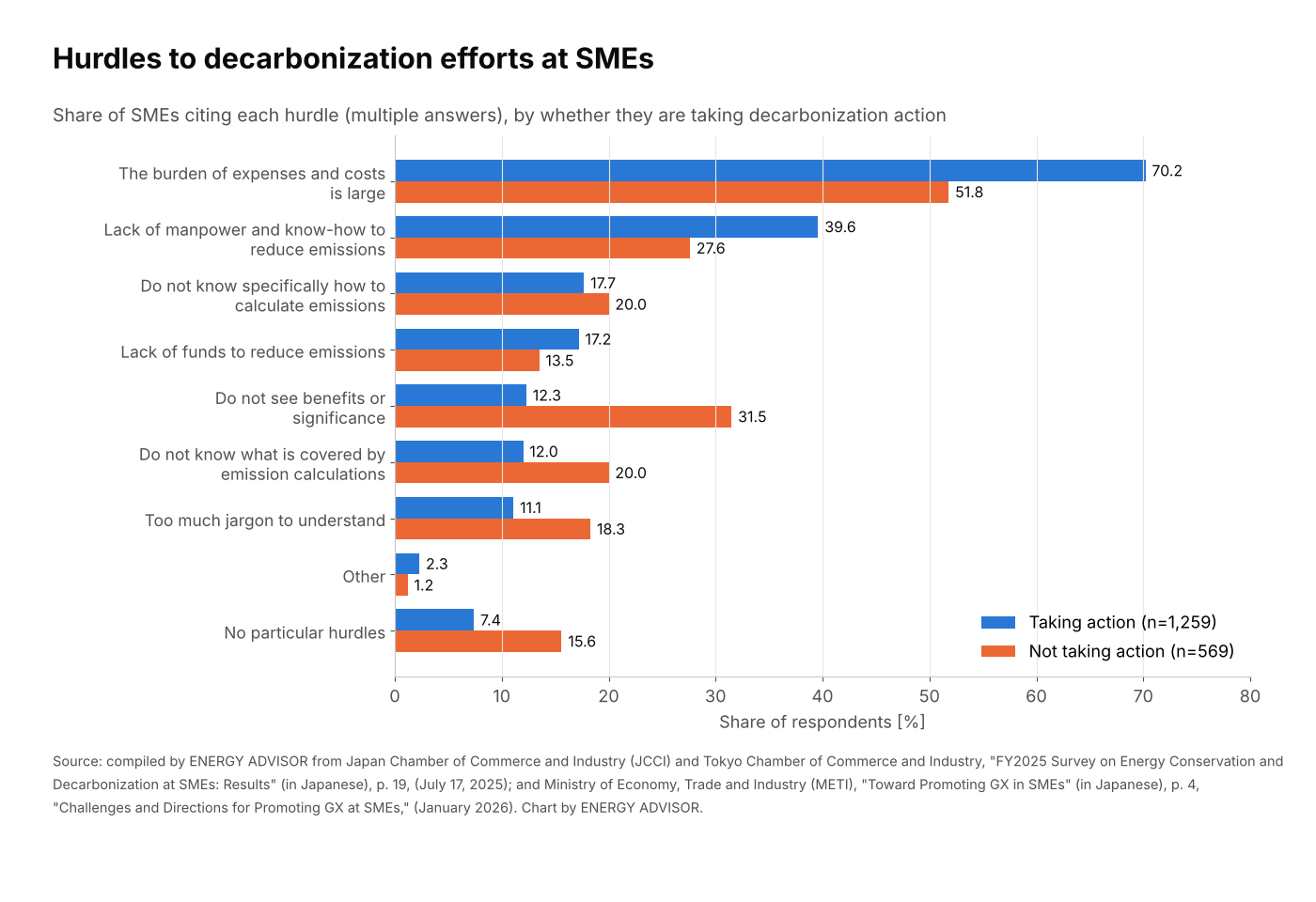
As confirmed in Part 1, in a survey by the Ministry of Economy, Trade and Industry (METI), “the burden of expenses and costs is large” ranked highest as a hurdle to decarbonization among both companies taking action and those not: 70.2% of companies taking action and 51.8% of those not. In the same survey, “a lack of manpower and know-how for reducing emissions” was the next most commonly cited hurdle.
Source: METI, “Toward Promoting GX for SMEs” (January 2026), p. 4 (in Japanese)
The three-stage order set out in this article addresses both of these hurdles. On cost, operational improvements, which come first, cost almost ¥0, so you can get started even while in the position of “we cannot move because it costs money.” On know-how, starting with familiar measures that require no specialized knowledge (such as changing air conditioning settings, turning off lights and checking contract terms) and actually going through one round of estimate → implement → calculate builds a foundation for considering the next stage. Rather than trying to decide on a large capital investment right away, proceeding step by step from familiar operational improvements is a realistic way to deal with the two barriers of cost burden and lack of know-how.
Summary
Arranged by the size of the cost required, CO2 reduction measures can be organized into three stages: “operational improvements (almost ¥0) → contract review (from ¥0) → capital investment (using subsidies).” Operational improvements include measures that involve no additional investment, such as reviewing air conditioning temperature settings and operating hours, demand management and energy visualization, and actual energy audit cases have confirmed a certain effect. Contract review affects both electricity costs and CO2 emissions, and the basic approach to capital investment is to combine it with subsidies and tax incentives. At every stage, it is essential to run the cycle of estimating reductions, implementing measures and reflecting the results in your calculations. This order can be described as a realistic way to proceed that responds both to cost burden, the biggest hurdle for SMEs, and to the next biggest, lack of know-how.
Related Articles
- Part 1: What Is Supply Chain Decarbonization? (Overview: how requests arise and data on their spread)
- Part 4: Calculating Scope 2 in Practice — CO2 Emissions from Electricity Consumption
- Part 5: The Emission Factor System — Basic, Adjusted, Menu-Specific and Residual Mix
- Part 6: Calculating Scope 1, and How Far You Can Go for Free
Note: The information in this article is current as of the time of posting and may have changed by the time you read it.
This article is based on published materials from the Ministry of Economy, Trade and Industry and its Agency for Natural Resources and Energy, the Electricity and Gas Market Surveillance Commission, the Organization for Cross-regional Coordination of Transmission Operators (OCCTO) and other sources. The English translations of figures are by ENERGY ADVISOR and are not official translations. When using this information for decisions, please check the original sources. When we find an error, we correct the article and note the date of the correction.
Sources
- MOE, “Decarbonization Management Handbook for SMEs” (in Japanese). https://www.env.go.jp/earth/SMEs_handbook.pdf
- METI, “Toward Promoting GX for SMEs” (January 2026) (in Japanese). https://www.meti.go.jp/policy/energy_environment/global_warming/SME/pamphlet/gx_gaiyou.pdf
- The Energy Conservation Center, Japan (ECCJ), “Energy-Saving Casebook Leading to Business Improvement, FY2024” (in Japanese). https://www.shindan-net.jp/pdf/shindan_jirei2024.pdf
- Sustainable open Innovation Initiative (SII), “Subsidy for Energy Conservation and Non-fossil Transition” (in Japanese). https://syouenehojyokin.sii.or.jp/