Basics of Japan’s Power System
Japan’s power grid is divided into ten regional service areas: Hokkaido, Tohoku, Tokyo, Chubu, Hokuriku, Kansai, Chugoku, Shikoku, Kyushu and Okinawa. The transmission and distribution network in each area is operated by that area’s general transmission and distribution company (GT&D company), which acts as the TSO (transmission system operator). GT&D companies are independent of power generation companies and retail electricity suppliers, and are responsible for maintaining frequency and balancing supply and demand.
Eastern Japan (Hokkaido, Tohoku and Tokyo) runs at 50 Hz, and western Japan (Chubu to Kyushu) runs at 60 Hz. East and west are connected only through frequency converter stations. The Okinawa area is not connected to the mainland grid and is outside the balancing market. The areas are linked by cross-regional interconnection lines, whose operation is managed nationwide by the Organization for Cross-regional Coordination of Transmission Operators, JAPAN (OCCTO).
Market design is studied in councils of the Agency for Natural Resources and Energy (ANRE), part of the Ministry of Economy, Trade and Industry (METI). Market monitoring is carried out by the Electricity and Gas Market Surveillance Commission (EGC). The wholesale electricity market, where energy (kWh) is traded, is operated by the Japan Electric Power Exchange (JEPX).
Japan uses planned-value balancing (30-minute balancing against plans): power generation companies and retail electricity suppliers prepare plans for every 30 minutes and must match their actual results to those plans. After one hour before real time (gate closure, GC), plans can no longer be changed. Any mismatch that arises after GC is covered by the GT&D company using balancing capacity.
What the Balancing Market Is
The Supply and Demand Balancing Market (balancing market) is the market in which GT&D companies procure the balancing capacity (ΔkW) they use to maintain frequency and balance supply and demand. It opened on April 1, 2021 (excluding the Okinawa area).
“Balancing capacity” is the ability to raise or lower output in response to instructions from the GT&D company. It is distinct from electricity itself (kWh). The balancing market trades only this ability. Unlike the day-ahead market (spot market), it is not a market for energy.
The payment for a trade is the “ΔkW charge,” which is paid for keeping the ability to respond to instructions available. Energy actually generated in response to instructions is settled separately.
The market is operated by the Electric Power Reserve eXchange (EPRX), a general incorporated association. EPRX was established on January 26, 2024. On April 1, 2024, it took over the work of the association that nine GT&D companies had previously run jointly.
Five Products
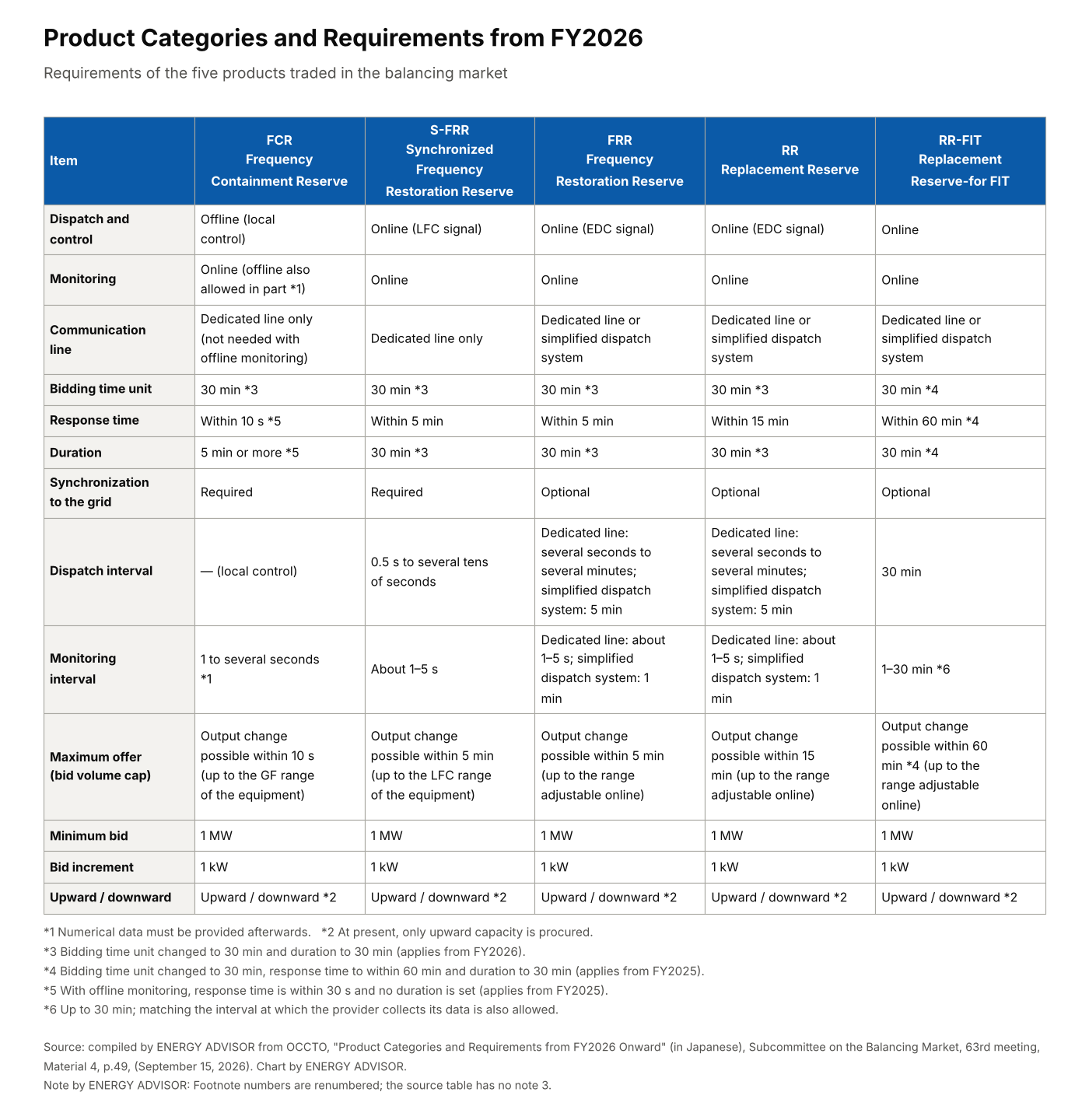
The balancing market has five products. They differ by response speed (response time), how long output must be held (duration), and how instructions are given. The products started in stages, and trading of all products was in place in FY2024 (April 2024–March 2025) (full launch). In Japan, the fiscal year runs from April to March.
| Product | Fluctuation covered | Response time | Duration | Trading started |
|---|---|---|---|---|
| Frequency Containment Reserve (FCR; primary) | Fluctuations of seconds to minutes; generator trips | Within 10 seconds | 5 minutes or more | April 2024 |
| Synchronized Frequency Restoration Reserve (S-FRR; secondary (1)) | Fluctuations of minutes to around ten-plus minutes; generator trips | Within 5 minutes | 30 minutes | April 2024 |
| Frequency Restoration Reserve (FRR; secondary (2)) | Forecast errors after GC (long-period component) | Within 5 minutes | 30 minutes | April 2024 |
| Replacement Reserve (RR; tertiary (1)) | Forecast errors after GC; generator trips | Within 15 minutes | 30 minutes | April 2022 |
| Replacement Reserve-for FIT (RR-FIT; tertiary (2)) | Forecast errors of FIT renewables (from two days ahead to GC) | Within 60 minutes | 30 minutes | April 2021 |
The minimum bid is 1 MW for all products, and the bidding time unit is 30 minutes for all products. At present, only upward balancing capacity (the side that increases output) is procured. The role and requirements of each product are explained from the second article in this series onward.
The four products from FCR to RR, together with the “combined product,” in which one resource offers several products together, are called the “combined market.”
Sellers and Buyers
Sellers: Power Generation Companies and Aggregators
Sellers can be power generation companies or aggregators connected to a GT&D company’s grid. An aggregator is a company that bundles customers’ equipment and distributed resources and offers them as balancing capacity. Any type of resource that meets the requirements can take part, including thermal plants, pumped-storage hydropower, batteries, on-site generation and DR (demand response, which adjusts consumption on the demand side).
To participate, a resource must pass a test of its response capability set for each product. The faster the product, such as FCR or S-FRR, the fewer resources can take part.
Buyers: GT&D Companies
The only buyers are the GT&D companies of the nine areas other than Okinawa. Each GT&D company procures from the market the balancing capacity needed to operate its area, and issues instructions as needed during the delivery period.
Transition from Balancing Capacity Tenders
Before the balancing market, GT&D companies held “balancing capacity tenders” once a year for the following fiscal year’s resources (Type I resources and Type II resources), and secured balancing capacity (ΔkW) and supply capacity (kW) as a set. The balancing market was designed to procure only ΔkW, and the balancing capacity tenders ended in FY2024, except in the Okinawa area. The third article explains how the transition happened.
Trading Flow
Trading Timing (Day-Ahead Trading)
From delivery on March 14, 2026, all products are traded on the day before delivery. Until then, FCR to RR and the combined product were traded one week before delivery (week-ahead trading), and only RR-FIT was traded day-ahead.
| Item | Up to delivery on March 13, 2026 | From delivery on March 14, 2026 |
|---|---|---|
| Trading of FCR to RR and the combined product | Week-ahead (bidding and clearing in the previous week) | Day-ahead |
| Trading of RR-FIT | Day-ahead | Day-ahead (unchanged) |
| Bidding time unit (FCR to RR, combined product) | 3-hour blocks | 30 minutes |
Today the trading times are the same for all products. Bids are accepted from 11:30 to 14:00 on the day before delivery, and clearing is completed by 15:00 on the day before. With the move to day-ahead trading, the start of bid acceptance was brought forward by 30 minutes.
Delivery Period and Bidding
Sellers bid by specifying the time slots in which they will provide balancing capacity (the delivery period). For cleared time slots, they are obliged to provide balancing capacity. Because they can set the volume and price for each time slot, they can bid in line with their resources’ operating schedules.
Performance Assessment (Checking That Obligations Are Met)
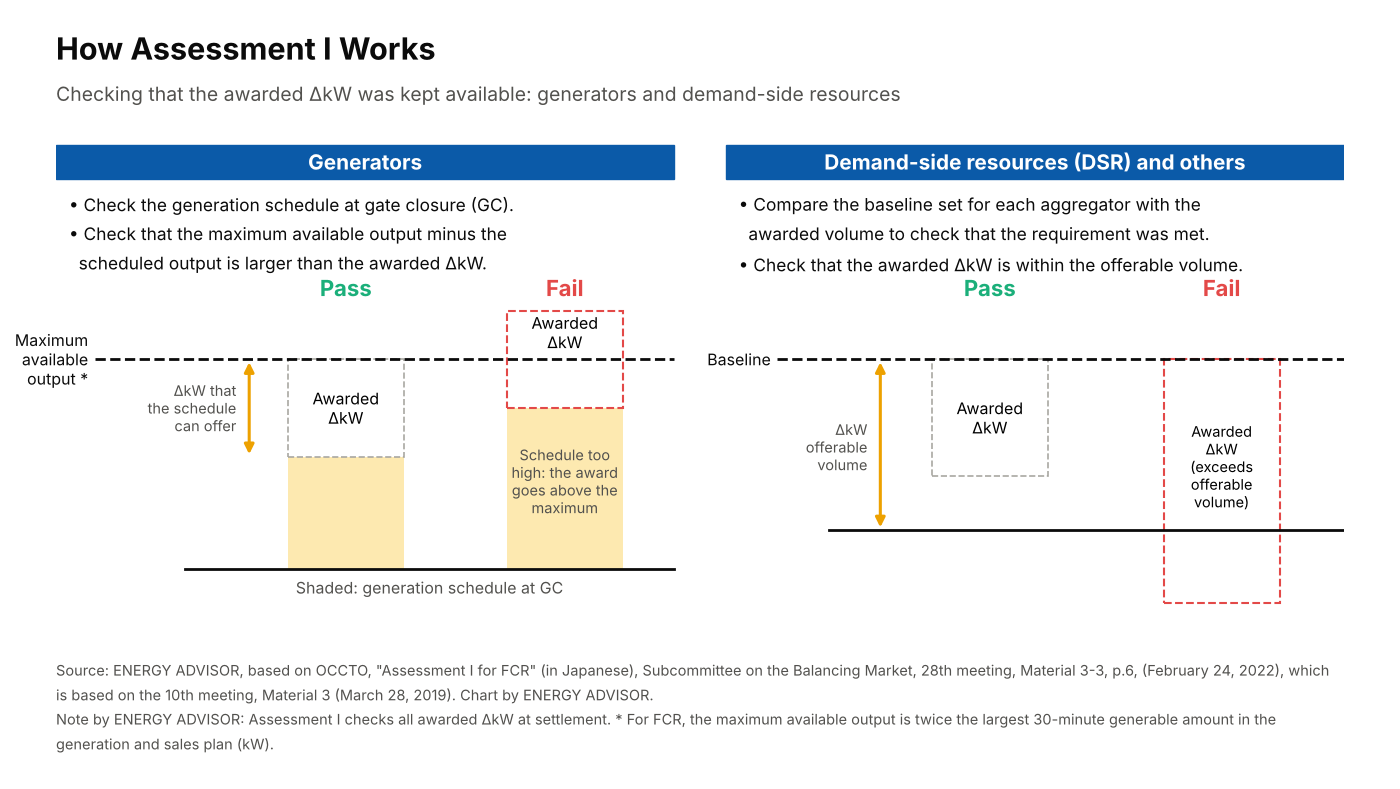
Sellers are subject to two types of performance assessment that check whether they met their obligations in cleared time slots.
- Assessment I (check of available reserve capacity): Every 30 minutes, it checks that the volume the seller can provide has not fallen below the cleared volume. If the resource cannot provide it because of an outage or output limits, it is judged non-compliant.
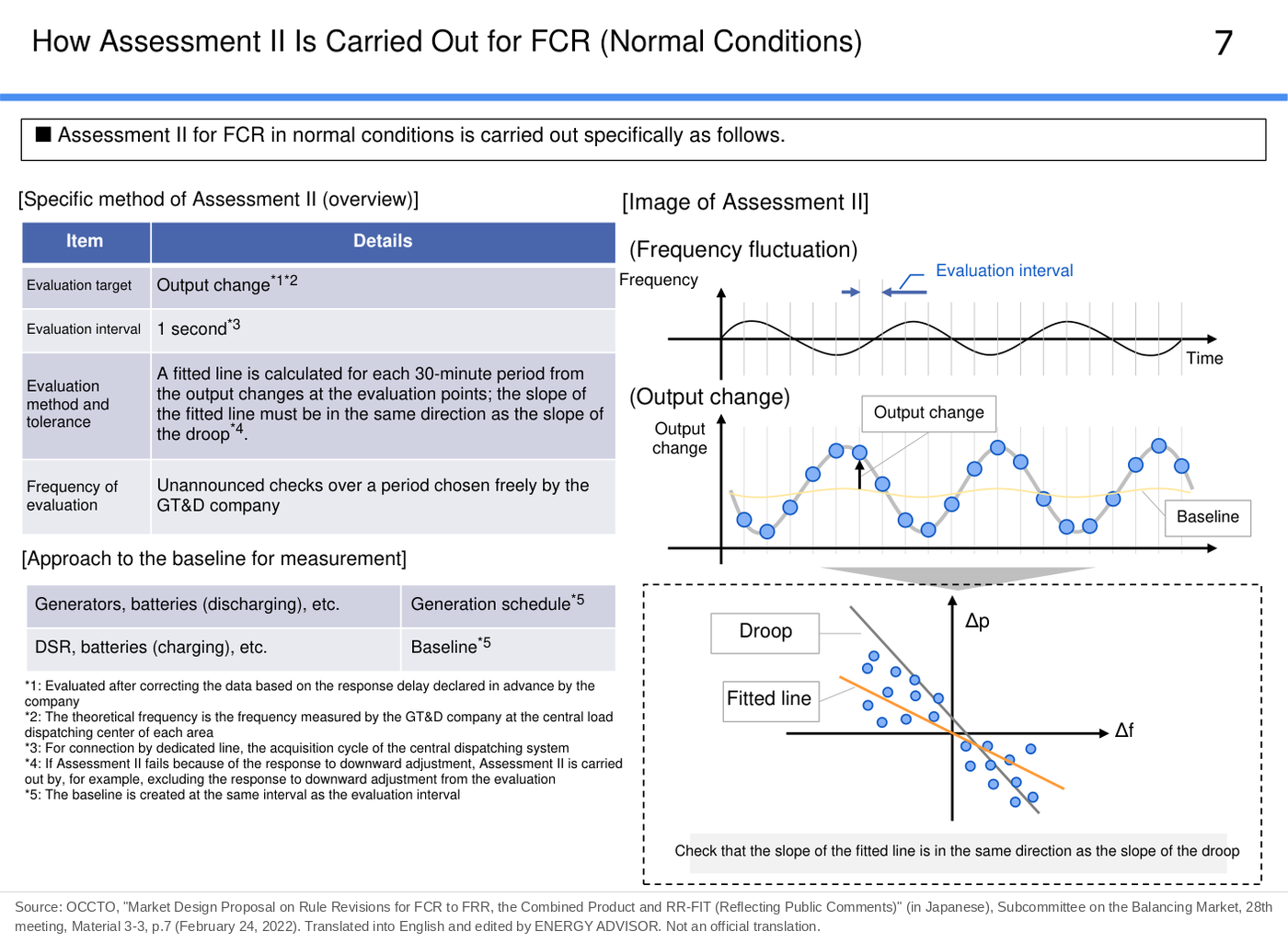
- Assessment II (check of actual response): When the GT&D company issues an instruction, it checks whether the resource properly followed the instructed value. The evaluation method and tolerance are set for each product, and judgments are made every 30 minutes.
Penalties
If a resource is judged non-compliant, a penalty charge applies. The formula depends on the type and degree of non-compliance and differs by product. Repeated non-compliance leads to increasingly severe measures: a recommendation for correction, suspension of trading, and then expulsion.
Settlement
In addition to the clearing charge and penalty charges, the energy actually increased or decreased in response to instructions is settled. Settlement is monthly.
Cross-Regional Procurement
Cross-regional procurement is a system in which the GT&D companies of several areas jointly procure balancing capacity across area boundaries. It allows them to use balancing capacity in other areas. However, it can be used only within the available capacity of the interconnection lines that link the areas.
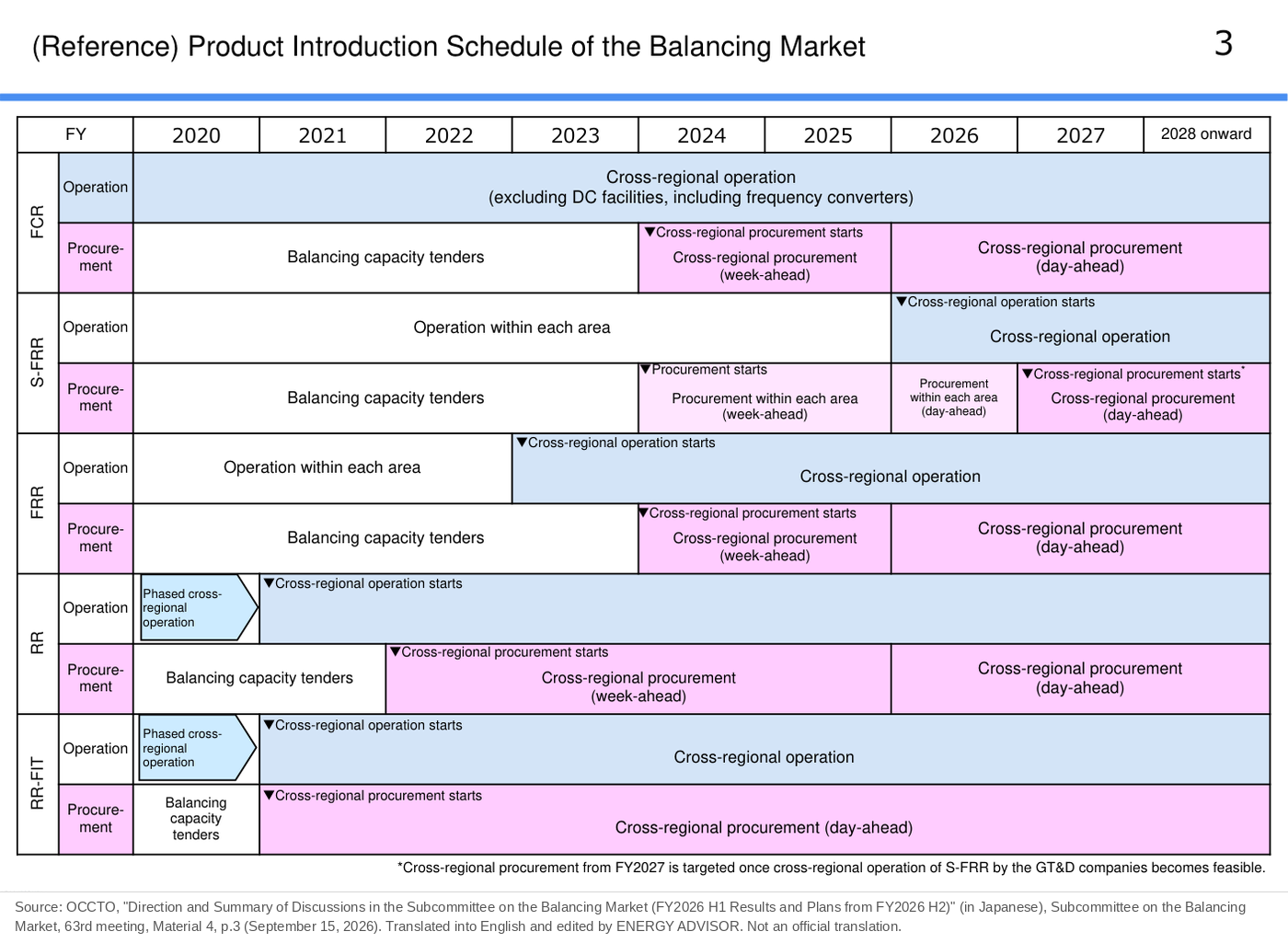
Cross-regional procurement started product by product. Only S-FRR is still procured within each area.
| Product | Status of cross-regional procurement |
|---|---|
| RR-FIT | Cross-regional procurement from FY2021 (day-ahead) |
| RR | Cross-regional procurement from FY2022 (week-ahead); day-ahead from March 2026 |
| FCR | Cross-regional procurement from FY2024 (week-ahead); day-ahead from March 2026. Operation across DC facilities, including frequency converters, is excluded |
| FRR | Cross-regional procurement from FY2024 (week-ahead); day-ahead from March 2026 |
| S-FRR | Procured within each area. Cross-regional procurement is targeted from FY2027, once cross-regional operation by the GT&D companies is in place |
S-FRR is a product that follows the control signal (LFC signal) issued by each area’s central load dispatching center. To use it across areas, “cross-regional operation,” in which this signal is handled across areas, must come first. That is why it is last.
Procurement Shortfalls and How the Measures Evolved
What Under-Procurement Means
In the balancing market, the GT&D company shows the volume it needs as the “procurement volume,” and sellers bid against it. When bids do not reach the procurement volume, this is called “under-procurement” (undersubscription). Under-procurement means price competition does not work and high-priced bids also clear, which raises the cost of balancing capacity.
After trading of all products began in April 2024, bid and cleared volumes fell short of the procurement volume in all products. RR had faced the same problem since its trading began in FY2022.
Measures up to FY2025
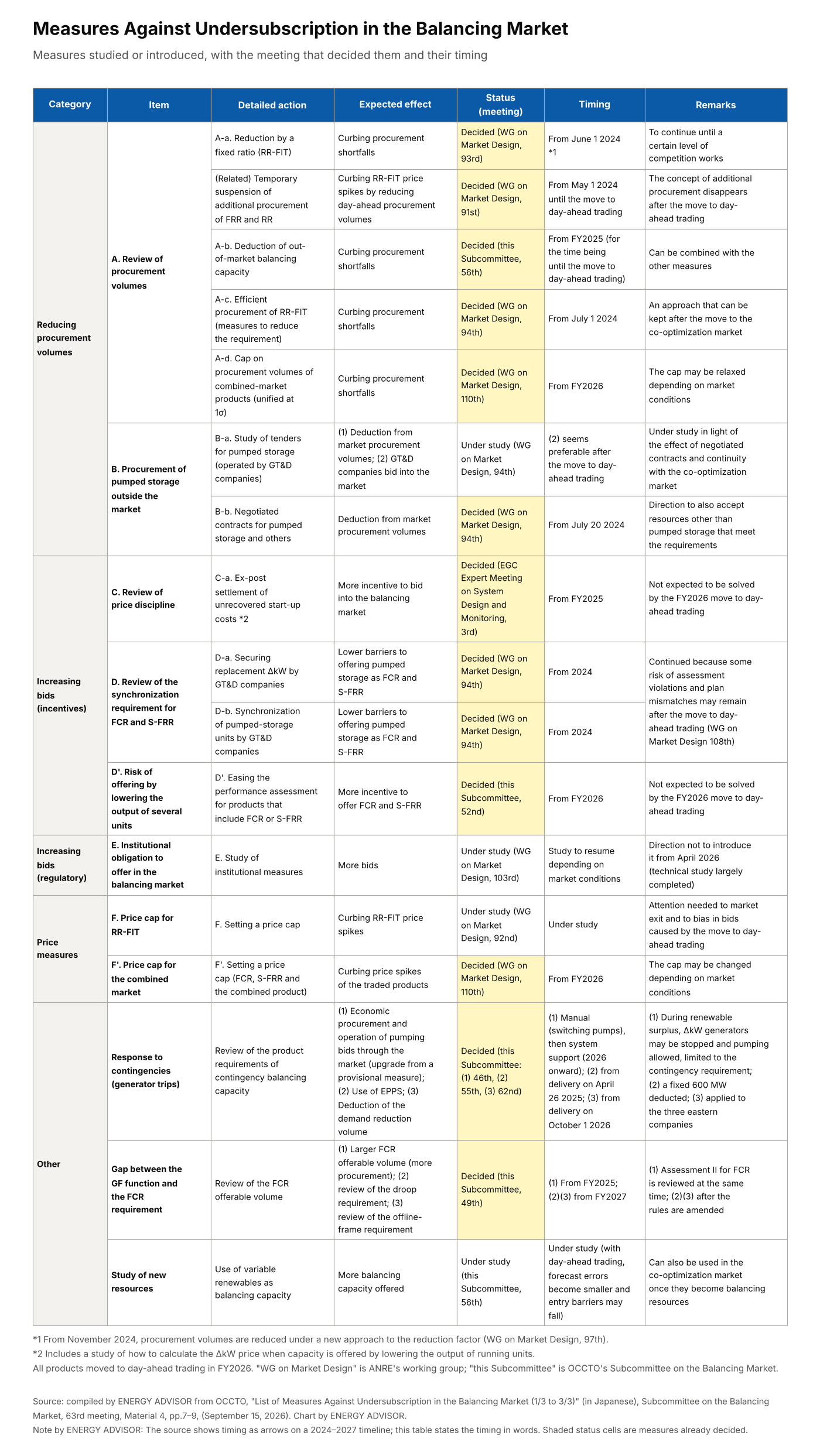
Two kinds of measures have been taken against under-procurement: reducing the procurement volume and increasing bids. The main ones are as follows.
| Measure | Content | Timing |
|---|---|---|
| Reducing the RR-FIT procurement volume | Review of how the requirement is calculated, a method of first procuring the 1σ-equivalent value in the market, and others (article 8) | FY2024– |
| Negotiated contracts for pumped storage | GT&D companies contract directly with pumped-storage hydropower and deduct that amount from the procurement volume (article 10) | From July 2024 in the Chubu area |
| Deduction of the expected effect of EPPS | The effect of EPPS, a function of the 50 Hz/60 Hz frequency converters that instantly sends power from the healthy side to the faulted side, is deducted from the requirement for generator trips | For delivery from April 26, 2025 (in areas that were ready) |
| Deduction of out-of-market balancing capacity (unoffered headroom) | Explained below | For delivery from June 14, 2025 to March 2026 |
Deduction of Out-of-Market Balancing Capacity (Unoffered Headroom)
“Unoffered headroom” is the spare output left on resources that power generation companies and others have decided to start up, which has not been bid into the balancing market. OCCTO’s Subcommittee on the Balancing Market examined results from FY2024 onward and confirmed that all nine areas had a certain amount of unoffered headroom (56th meeting, Material 2, p.2).
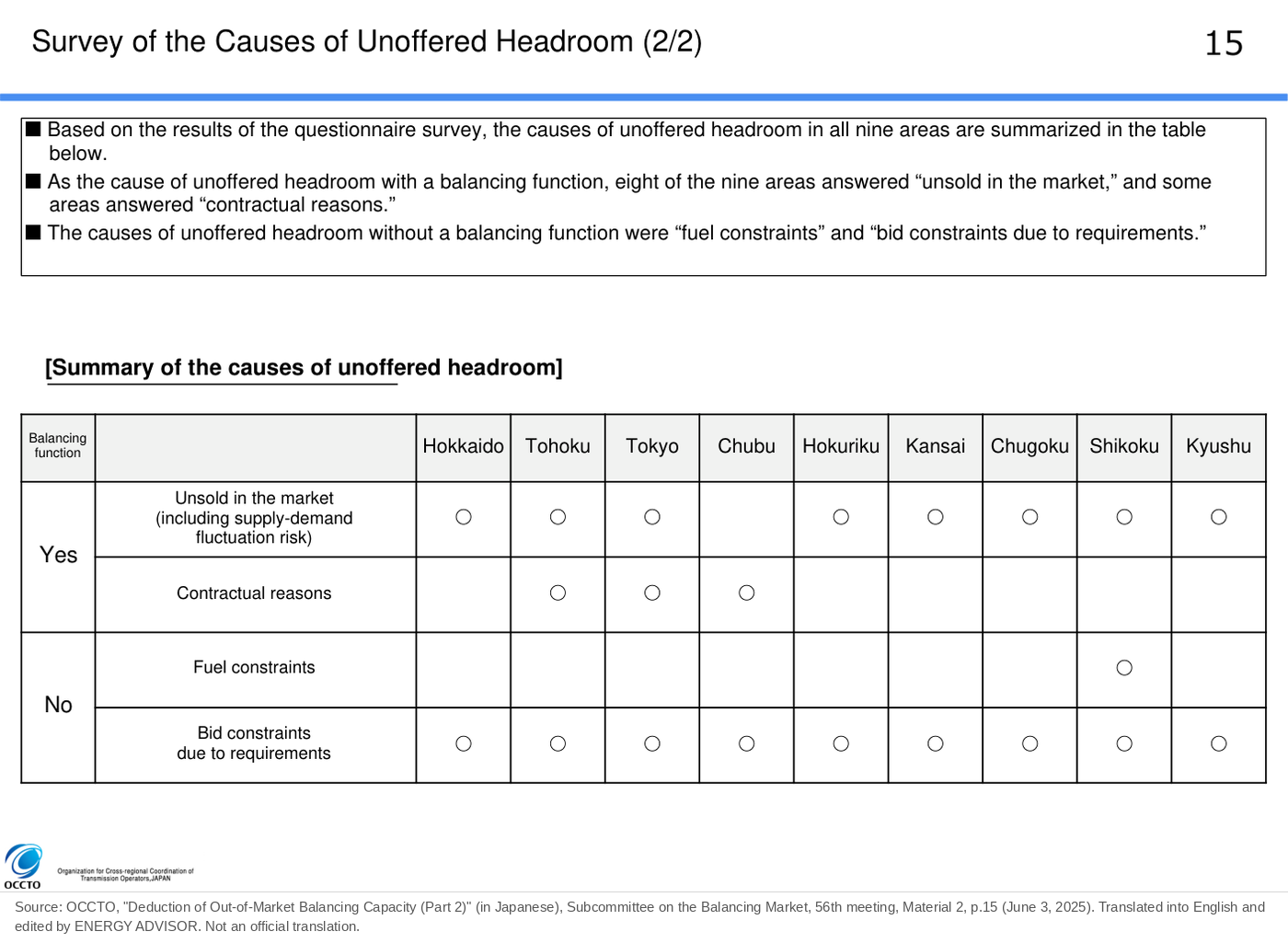
If this headroom reliably remains at GC, it can be used in real time without buying it in the market. The reasons headroom arises were therefore categorized through a survey of power generation companies (same, p.15).
| Reason headroom arises | Balancing function | Treatment for deduction |
|---|---|---|
| Unsold in the market (bid but not awarded, or not bid) | Yes | Can be deducted until all products move to day-ahead trading |
| Contractual reasons (cannot be offered to the market because of bilateral contracts, etc.) | Yes | Can be deducted |
| Fuel constraints | No | Cannot be deducted |
| Cannot bid because requirements are not met (ramp rate does not meet product requirements, etc.) | No | Cannot be deducted |
Following this, an operation that deducts out-of-market balancing capacity from the requirement for the combined product and for FCR to RR started for delivery from June 14, 2025, in areas that were ready. Because the move to day-ahead trading from FY2026 would change the situation, the deduction was limited to FY2025 (Study Committee on Regulating and Marginal Supply Capability and Long-Term Supply–Demand Balance Evaluation, 117th meeting, Material 4, pp.63–64).
The deduction ended in March 2026. Because of its end, the procurement volume in the second half of March 2026 was larger than in the first half (Subcommittee on the Balancing Market, 61st meeting, Material 2, p.25). From FY2026 onward, it is to be reconsidered as needed while watching market trading and the state of unoffered headroom (same, p.9). In OCCTO’s review of FY2025 issues, the unoffered headroom of resources not participating in the balancing market is described as nearly zero in most areas (117th meeting, Material 4, p.15).
At the 63rd meeting of the Subcommittee on the Balancing Market on September 15, 2026, it was reported, based on results for April to June 2026, that a certain amount of unoffered headroom remained on both thermal and pumped-storage plants even after the move to day-ahead trading (less than in the same period of FY2024). OCCTO’s secretariat said it would continue the survey from July onward, including the heavy-load season, and proposed asking balancing capacity providers why they do not bid into the market. No conclusion on whether to resume the deduction had been reached at that point (63rd meeting, Material 3, p.9, p.24 and p.28).
FY2026 Changes: Day-Ahead Trading, Procurement Volume and Price Cap
Ahead of FY2026, ANRE’s Working Group on Market Design (110th meeting, January 23, 2026) set out the following direction.
- Trading timing: Trade FCR to RR and the combined product day-ahead, and change the bidding time unit from 3 hours to 30 minutes. In week-ahead trading, sellers had limited their bid volumes to allow for various risks, so moving trading to the day before delivery was expected to increase bids.
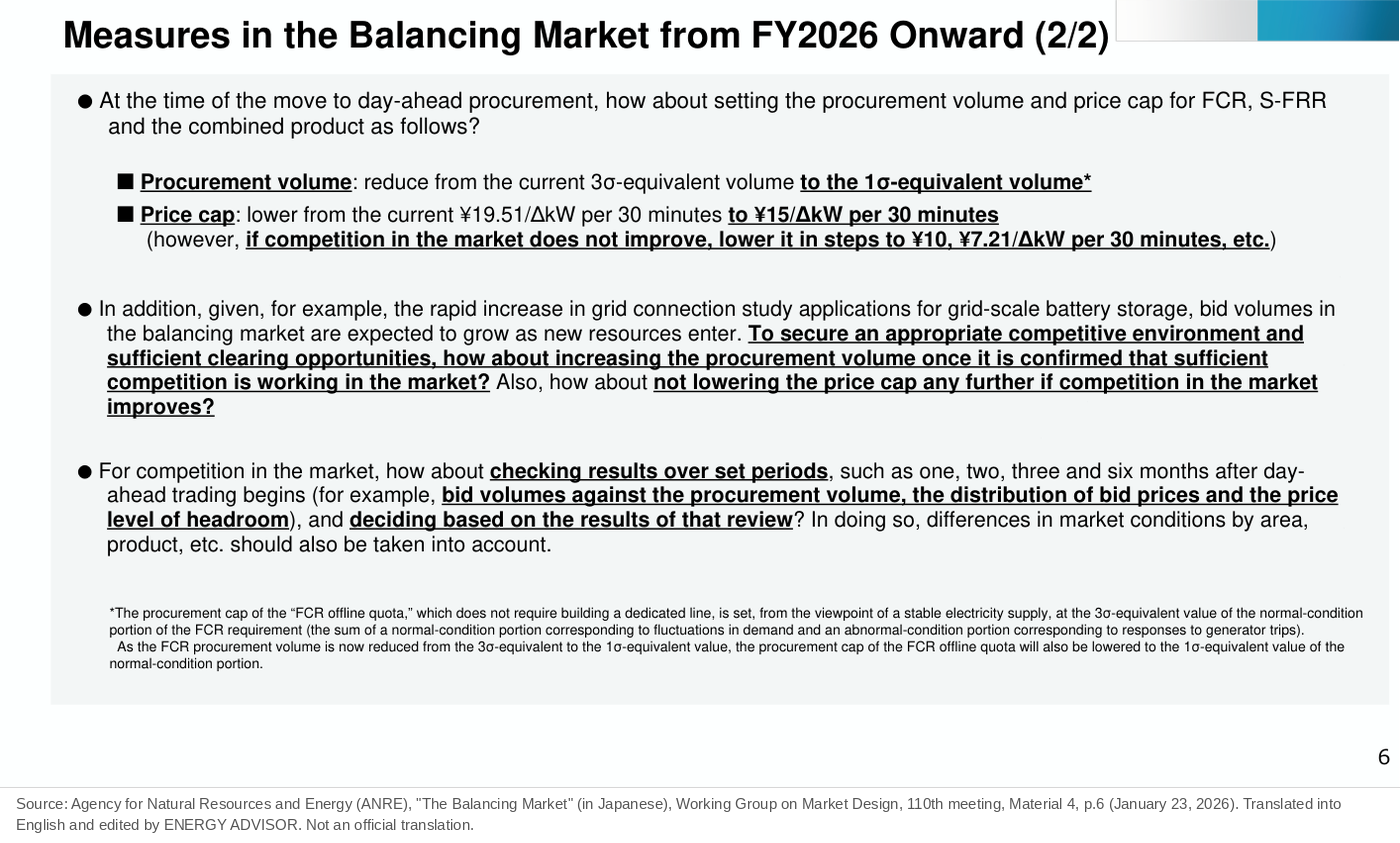
- Procurement volume: Align the upper limit of the volume procured in the market to the 1σ-equivalent value.
- Price cap: Lower the price cap for FCR, S-FRR and the combined product.
The 1σ-equivalent and 3σ-equivalent values are volumes derived statistically from past fluctuations. The 3σ-equivalent value covers almost all fluctuations (the 99.87th percentile), and the 1σ-equivalent value is smaller than that.
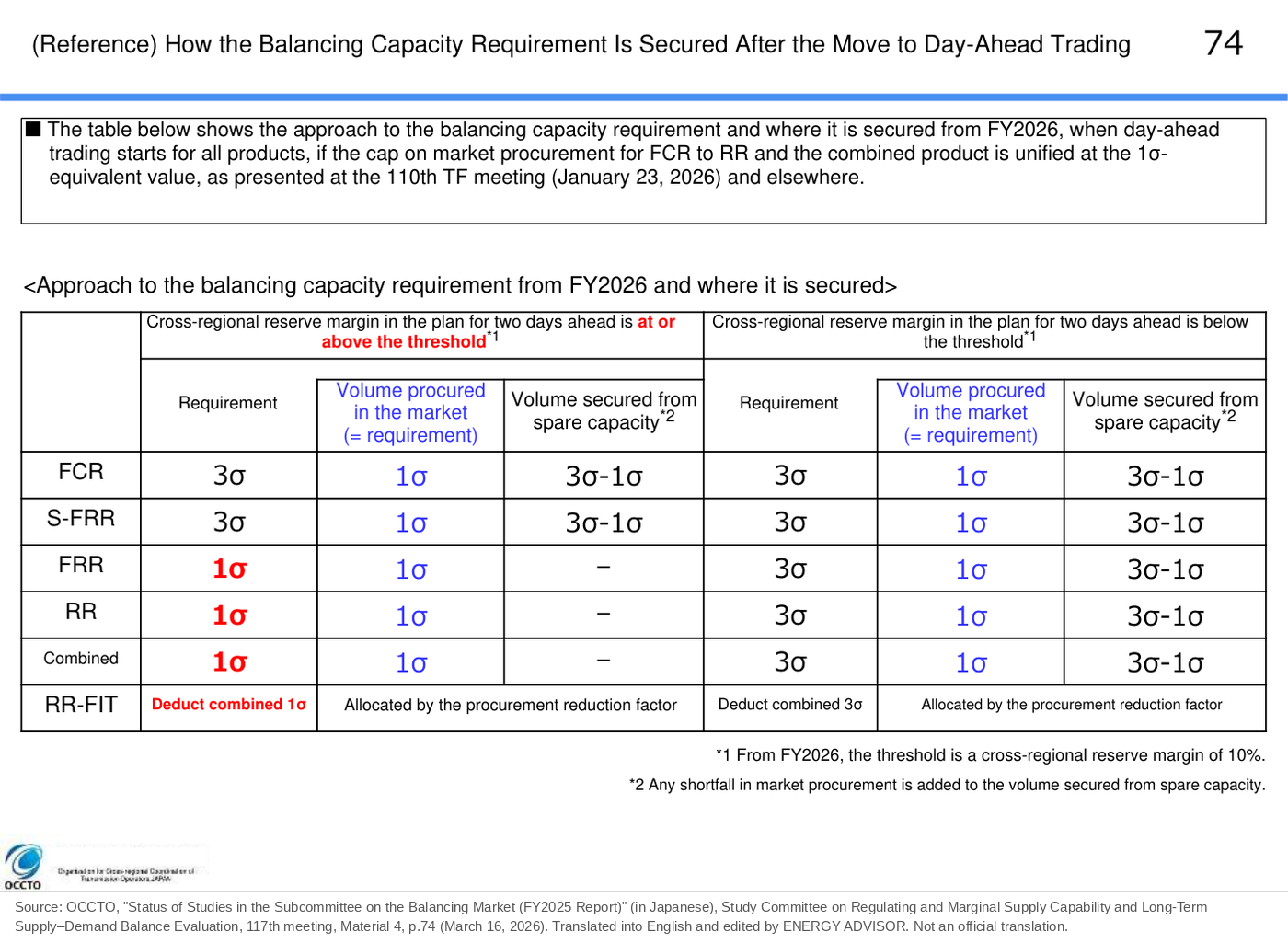
The requirement itself (3σ-equivalent for FCR and S-FRR) was not changed. The volume bought in the market is limited to 1σ, and the rest is secured through “spare-capacity utilization contracts.” A spare-capacity utilization contract is required of resources with balancing functions in the capacity market (a market that secures supply capacity four years ahead), and allows the GT&D company to use the spare capacity of resources that are already running (Subcommittee on the Balancing Market, 61st meeting, Material 2, p.6).
| Product | Requirement | Volume procured in the market | Volume secured through spare-capacity utilization contracts |
|---|---|---|---|
| FCR | 3σ | 1σ | 3σ−1σ |
| S-FRR | 3σ | 1σ | 3σ−1σ |
| FRR, RR and combined product | 1σ (when the cross-regional reserve margin in the plan for two days ahead is 10% or more) / 3σ (when it is below 10%) | 1σ | — / 3σ−1σ |
The cross-regional reserve margin is an indicator published by OCCTO that shows how much supply capacity exceeds demand. The 10% figure was set as the threshold for this judgment from FY2026 (117th meeting, Material 4, p.22 and p.74). Any shortfall in the market is added to the volume secured from spare capacity.
The price cap was lowered as follows.
| Period | Price cap for FCR, S-FRR and the combined product |
|---|---|
| Up to delivery on March 13, 2026 | ¥19.51/ΔkW per 30 minutes |
| From delivery on March 14, 2026 | ¥15/ΔkW per 30 minutes |
| From delivery on September 1, 2026 | ¥10/ΔkW per 30 minutes |
The cut to ¥10 was presented at the 4th meeting of the Working Group on Stable Power Supply (July 14, 2026). The reason was that clearing near the price cap continued even after the move to day-ahead trading, making it hard to judge that competition had improved (Subcommittee on the Balancing Market, 62nd meeting, Material 2, p.16). ANRE has set out a policy of lowering the cap in steps to ¥10 and then ¥7.21 if competition does not improve, and of increasing the procurement volume once sufficient competition is confirmed (Working Group on Market Design, 110th meeting, Material 4, p.6).
The Situation After the Move to Day-Ahead Trading
OCCTO reviewed trading results from April 2025 to April 2026 and reported the following (61st meeting, Material 2, p.10 and p.35).
- For combined-market products, total national bid volumes increased after the move to day-ahead trading.
- For FCR and S-FRR, a certain shortfall continued. Shortfalls in procurement continued in many areas, starting with the Tohoku area.
- For RR-FIT, bid volumes fell and clearing prices rose after it began trading at the same time as the combined market. However, this did not lead to a continuing shortfall or a surge in procurement costs.
- As of the start of FY2026, undersubscription could not be said to have improved fundamentally, and the problem of high-priced resources clearing continued.
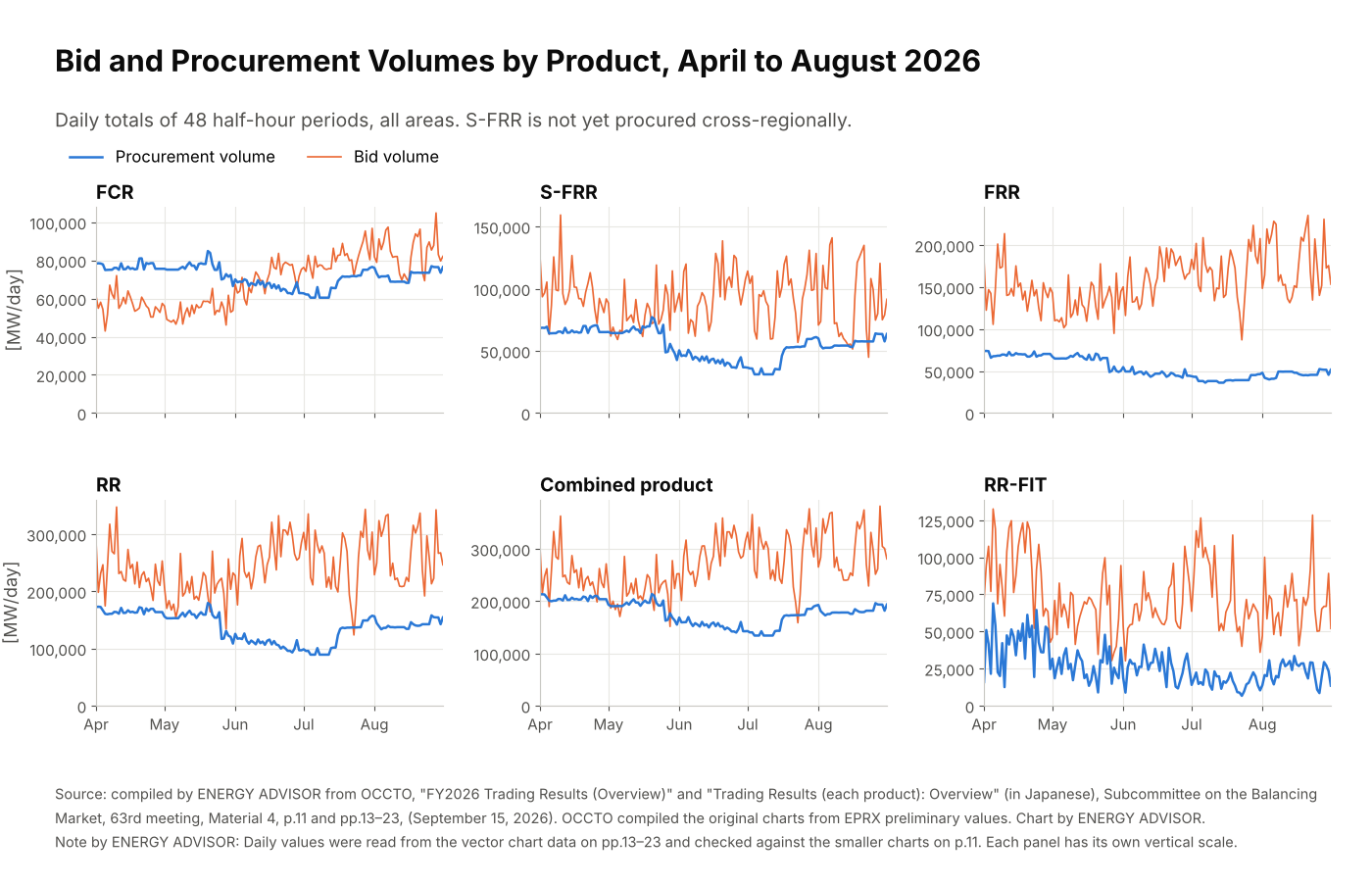
On results for the first half of FY2026 (up to August 31), OCCTO reported the following at the 63rd meeting of the Subcommittee on the Balancing Market (September 15, 2026) (63rd meeting, Material 4, p.11 and pp.13–23).
- Nationwide, bid volumes for combined-market products increased, and the under-procurement of FCR at the start of the fiscal year was trending toward improvement. Other products mostly met their procurement volumes.
- For S-FRR, bid volumes increased but the shortfall rate remained high. Shortfall rates continued to be high in the Tohoku, Hokuriku and Kansai areas.
- For RR-FIT, bid volumes fell from the previous year, and the number of days with a shortfall increased. Average awarded prices also continued to swing sharply.
Remaining Issues and the Co-Optimization Market
Behind the procurement shortfalls in the balancing market and the competition for resources with the day-ahead market lies the fact that the energy (kWh) market and the balancing capacity (ΔkW) market operate separately. To address this, a “co-optimization market (simultaneous market for energy and balancing capacity),” which clears kWh and ΔkW at the same time, is being studied. Its mechanism and the current state of the study are explained in article 11.
This article is based on published materials from the Ministry of Economy, Trade and Industry and its Agency for Natural Resources and Energy, the Electricity and Gas Market Surveillance Commission, the Organization for Cross-regional Coordination of Transmission Operators (OCCTO) and other sources. The English translations of figures are by ENERGY ADVISOR and are not official translations. When using this information for decisions, please check the original sources. When we find an error, we correct the article and note the date of the correction.
Sources
- Electric Power Reserve eXchange (EPRX), “What Is the Supply and Demand Balancing Market” (in Japanese), accessed October 2026. https://www.eprx.or.jp/outline/outline.html
- EPRX, “Organization Overview” (in Japanese), accessed October 2026. https://www.eprx.or.jp/about/about.html
- EPRX, “Product Requirements and Trading Schedule of the Supply and Demand Balancing Market (6th edition)” (in Japanese), p.2 (product requirements), p.3 (trading schedule), p.4 (revision history), March 13, 2026. https://www.eprx.or.jp/outline/docs/shouhin_ver.6_20260313.pdf
- EPRX, “Trading Guide (All Products), Version 8.1” (in Japanese) (performance assessment and penalties). https://www.eprx.or.jp/outline/docs/guide_ver.8.1_260314.pdf
- OCCTO, Subcommittee on the Balancing Market, 57th meeting, Material 5, “Direction and Summary of Discussions in the Subcommittee on the Balancing Market (Results for the First Half of FY2025 and Plans for the Second Half of FY2025)” (in Japanese), p.3 (product introduction schedule) and p.27, September 26, 2025. https://www.occto.or.jp/assets/iinkai/chouseiryoku/jukyuchousei/2025/files/jukyu_shijyo_57_05.pdf
- OCCTO, Subcommittee on the Balancing Market, 56th meeting, Material 2, “Deduction of Out-of-Market Balancing Capacity (Part 2)” (in Japanese), p.2 and pp.15–18, June 3, 2025. https://www.occto.or.jp/assets/iinkai/chouseiryoku/jukyuchousei/2025/files/jukyu_shijyo_56_02.pdf
- OCCTO, Study Committee on Regulating and Marginal Supply Capability and Long-Term Supply–Demand Balance Evaluation, 117th meeting, Material 4, “Status of Discussions in the Subcommittee on the Balancing Market (FY2025 Report)” (in Japanese), p.2, p.22, pp.61–65 and pp.72–74, March 16, 2026. https://www.occto.or.jp/assets/chousei_117_04.pdf
- OCCTO, Subcommittee on the Balancing Market, 61st meeting, Material 2, “Trading Status of the Balancing Market” (in Japanese), p.2, p.5, p.6, p.9, p.10, p.25 and p.35, June 9, 2026. https://www.occto.or.jp/assets/iinkai/jukyuchousei/61/jukyu_shijyo_61_02.pdf
- OCCTO, Subcommittee on the Balancing Market, 62nd meeting, Material 2, “Results of Fact-Finding Surveys on the Balancing Market” (in Japanese), pp.15–16, July 31, 2026. https://www.occto.or.jp/assets/iinkai/jukyuchousei/62/jukyu_shijyo_62_02.pdf
- ANRE, Working Group on Market Design, 110th meeting, Material 4, “The Balancing Market” (in Japanese), p.2, p.6 and p.7, January 23, 2026. https://www.meti.go.jp/shingikai/enecho/denryoku_gas/jisedai_kiban/system_review/pdf/110_04_00.pdf
- OCCTO, Study Committee on Regulating and Marginal Supply Capability and Long-Term Supply–Demand Balance Evaluation, 86th meeting, Material 1, “Upper Limit of Balancing Capacity Procurement” (in Japanese), p.2 and p.4, May 29, 2023. https://www.occto.or.jp/iinkai/chouseiryoku/2023/files/chousei_86_01.pdf
- OCCTO, Subcommittee on the Balancing Market, 63rd meeting, Material 3, “Status of Out-of-Market Balancing Capacity After the Move to Day-Ahead Trading in the Balancing Market” (in Japanese), p.2, p.9, p.24 and p.28, September 15, 2026. https://www.occto.or.jp/assets/iinkai/jukyuchousei/63/jukyu_shijyo_63_03.pdf
- OCCTO, Subcommittee on the Balancing Market, 63rd meeting, Material 4, “Direction and Summary of Discussions in the Subcommittee on the Balancing Market (Results for the First Half of FY2026 and Plans for the Second Half of FY2026 Onward)” (in Japanese), p.3, pp.7–9, p.11, pp.13–23 and p.49, September 15, 2026. https://www.occto.or.jp/assets/iinkai/jukyuchousei/63/jukyu_shijyo_63_04.pdf
- OCCTO, Subcommittee on the Balancing Market, 28th meeting, Material 3-3 (Assessment I and II for FCR) (in Japanese), p.6 and p.7, February 24, 2022. https://www.occto.or.jp/iinkai/chouseiryoku/jukyuchousei/2021/files/jukyu_shijyo_28_03_03.pdf