Two mechanisms support the large-scale deployment of renewable energy in Japan: the FIT and FIP schemes, and the market for non-fossil certificates. At first glance they look like separate systems, but they are closely linked. This article explains how the two relate to each other and how they work.
The arrangement looks complicated because two products are traded separately: the electricity itself and its “environmental attributes.”
Key points
- 1The FIT scheme and the FIP scheme treat non-fossil certificates very differently.
- 2A non-fossil certificate can be traded separately from the electricity itself (its value as energy).
- 3The environmental attributes of FIT electricity belong to electricity users as a whole, and generators cannot sell them. For FIP and post-FIT generators, the environmental attributes belong to the generator, and certificate sales become a source of revenue.
FIT Scheme and Non-Fossil Certificates
The Feed-in Tariff (FIT) scheme requires renewable electricity to be purchased at a fixed price set by the government for a set period. In Japanese it is called the “fixed-price purchase scheme,” and it started in July 2012. It covers a range of renewable sources, including solar, wind, hydropower, geothermal and biomass.
Renewable electricity purchased under the FIT scheme by general transmission and distribution companies (GT&D companies: the ten regulated regional companies that operate the grid in each area, for example TEPCO Power Grid) is then sold on the market. One route, for example, is sale on the markets of the Japan Electric Power Exchange (JEPX), Japan’s only wholesale power exchange.
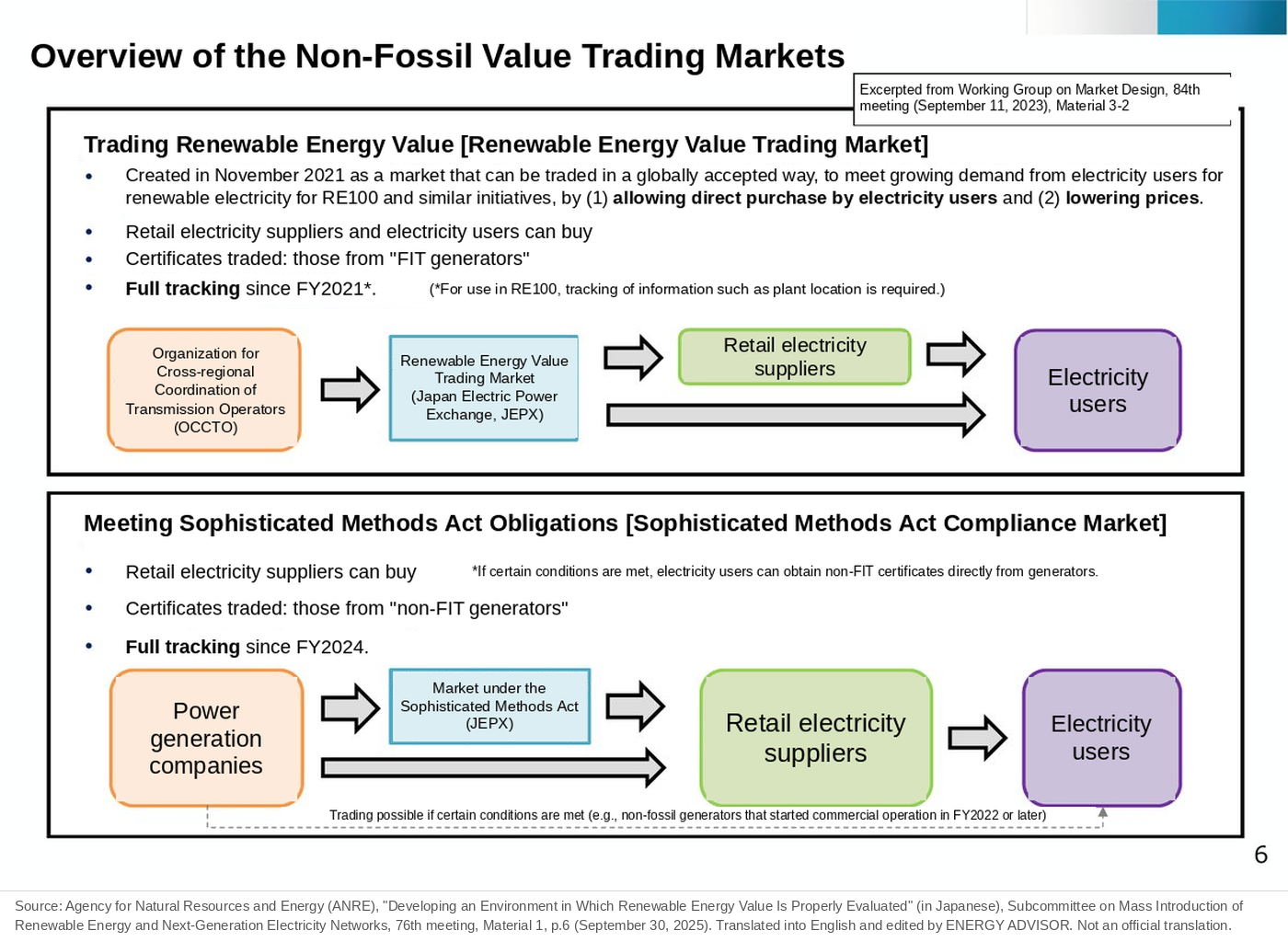
The key question is how the non-fossil value of FIT electricity is handled. The cost of purchasing FIT electricity is borne by all electricity users through the renewable energy surcharge, a charge that every user pays in proportion to the electricity they use. For this reason, the environmental attributes of FIT electricity are treated as belonging to electricity users as a whole, who bear the surcharge. Generators cannot sell the non-fossil value of FIT electricity themselves.
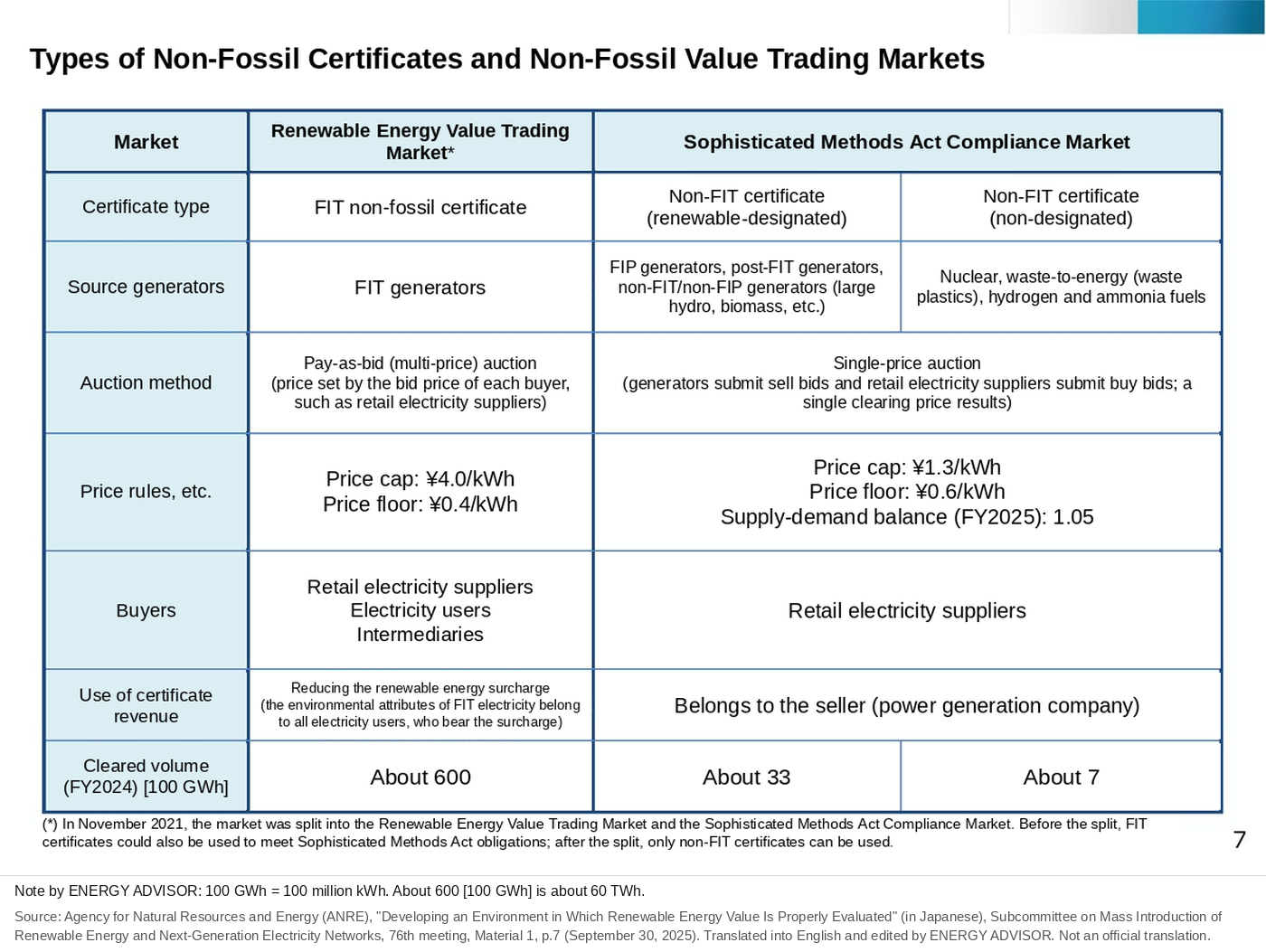
The entire volume of non-fossil value of FIT electricity certified by the Organization for Cross-regional Coordination of Transmission Operators, JAPAN (OCCTO) becomes FIT non-fossil certificates. OCCTO acts as the seller and sells them on JEPX’s Renewable Energy Value Trading Market. The sales revenue is used to reduce the burden of the renewable energy surcharge. In other words, FIT electricity is also traded separately as “the electricity itself” and “non-fossil value (certificates),” but the seller of the certificates is not the generator. It is the scheme itself.
FIP Scheme and Non-Fossil Certificates
The Feed-in Premium (FIP) scheme is a relatively new scheme introduced in 2022. Under FIP, generators sell their electricity at market prices and receive a “premium” on top. When market prices are high, the premium is small; when market prices are low, the premium is large.
The FIT scheme can be described as a “price-guarantee” scheme that guarantees a fixed price for electricity, and the FIP scheme as a “premium-guarantee” scheme that guarantees an add-on to the market price. A defining feature of the FIP scheme is that generators sell electricity on the market themselves. As a result, they are more exposed to movements in market prices and in non-fossil certificate prices.
Under the FIP scheme, the environmental attributes belong to the generator. The non-fossil value of FIP generators can be sold as non-FIT non-fossil certificates (renewable-designated), either to retail electricity suppliers on the Sophisticated Methods Act Compliance Market or directly to electricity users and others. Generators therefore have three sources of revenue: income from selling electricity on the market, the premium, and certificate sales.
FIP-certified capacity, including both new certifications and transfers from FIT, was about 3,795 MW (1,889 projects) at the end of March 2025. The government has said it is desirable for all renewable generators to move to FIP, and that it will improve the business environment, for example by expanding direct trading of non-fossil certificates (Subcommittee on Mass Introduction of Renewable Energy and Next-Generation Electricity Networks, 77th meeting, Material 1, p.26; reproduced in the Working Group on Market Design, 109th meeting, Material 3, p.50).
Note that the FIP premium calculation deducts the average market price of non-fossil certificates (the “non-fossil value equivalent”) (the FIP formula; joint meeting of the 23rd Subcommittee on Mass Introduction of Renewable Energy and Next-Generation Electricity Networks and the 11th Subcommittee on Making Renewable Energy a Main Power Source, Material 1). For this reason, some have pointed out that if certificates go unsold, it becomes harder to secure that portion of revenue.
With market prices fluctuating, the combination of the premium and certificate prices affects generators’ earnings. Certificate prices are not a factor generators can ignore, and they need to watch both market prices and certificate prices when deciding when and how to sell.
Ownership of Environmental Attributes: FIT, FIP and Post-FIT Compared
The table below compares who owns the environmental attributes under the three arrangements.
| Scheme | Buyer of the electricity | Owner of non-fossil value | Generator’s revenue sources | Market risk |
|---|---|---|---|---|
| FIT scheme | GT&D company (fixed price) | Electricity users as a whole (certificates sold by OCCTO) | Fixed purchase price | Low (fixed purchase price) |
| FIP scheme | Generator sells on the market | Generator | Market sales + premium + certificate sales | High (market price fluctuations) |
| Post-FIT generators | Generator sells on the market or to retail electricity suppliers | Generator | Electricity sales + certificate sales | High (no premium) |
Under the FIT scheme, the purchase price is fixed, so generators can count on revenue from electricity sales. In exchange, the non-fossil value does not belong to the generator.
Under the FIP scheme, generators bear market price risk directly. In exchange, they receive the premium (the difference between the reference price and the market price) and can also sell non-fossil certificates. Post-FIT generators receive no premium, so their earnings depend on both electricity prices and non-fossil certificate prices.
Impact of Expiring FIT Purchase Periods on the Certificate Market
Generators whose purchase period under the FIT scheme (including its predecessor, the surplus electricity purchase scheme) has ended are known as “post-FIT” generators.
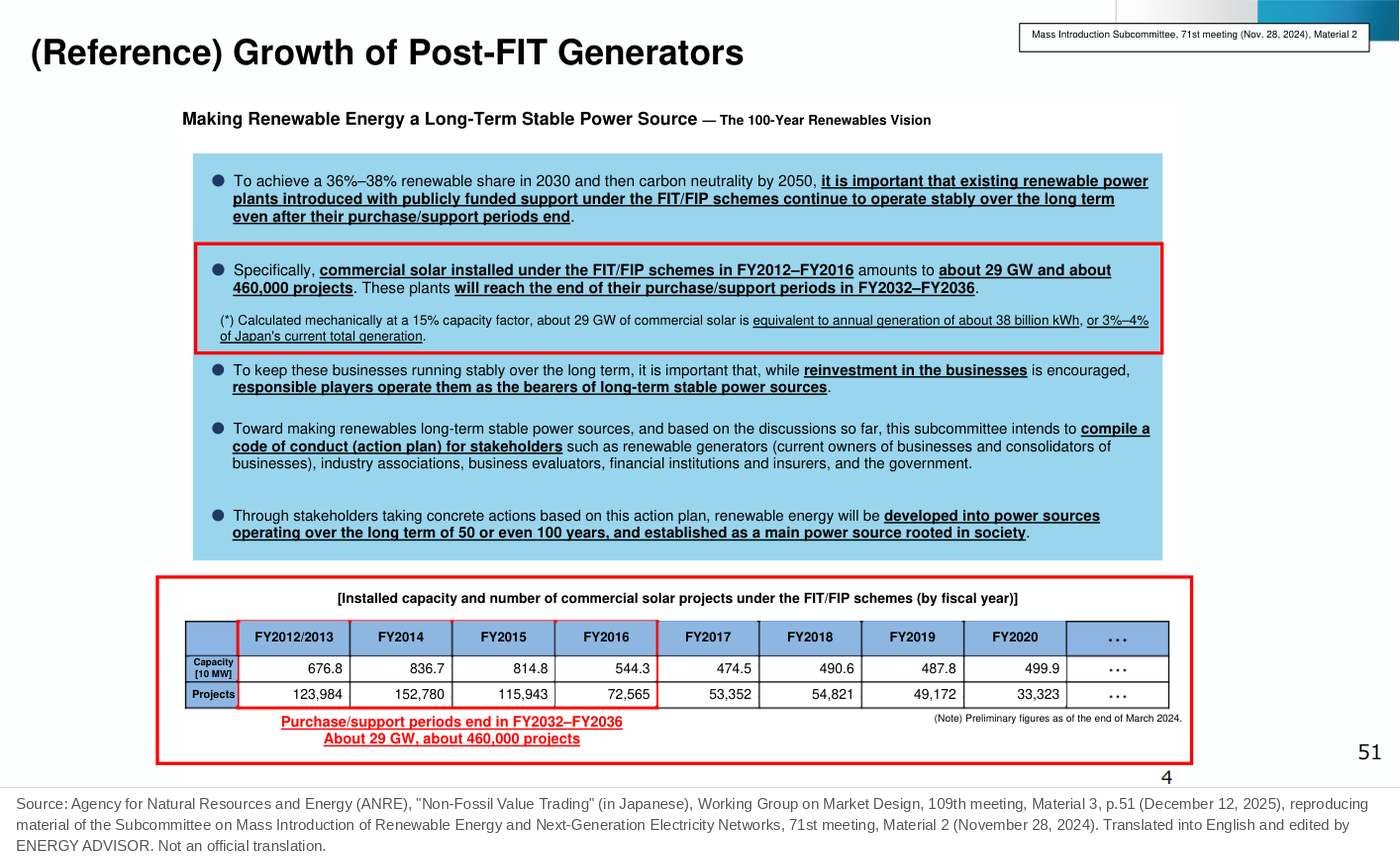
Purchases of surplus electricity from residential solar (electricity that households generate but do not use themselves) started in 2009, with a 10-year purchase period. For this reason, purchase periods have been ending one after another since 2019 (Agency for Natural Resources and Energy, “Dou suru? Solar”). For commercial solar, about 29 GW (about 460,000 projects) installed in FY2012–FY2016 (April 2012–March 2017) will reach the end of their purchase or support periods in FY2032–FY2036 (April 2032–March 2037) (Subcommittee on Mass Introduction of Renewable Energy and Next-Generation Electricity Networks, 71st meeting, Material 2; reproduced in the Working Group on Market Design, 109th meeting, Material 3, p.51).
Once the purchase period ends, generators must switch to selling on the wholesale market or to retail electricity suppliers. At this point, non-fossil certificates become important. Even when electricity prices are low, extra revenue from certificate sales may allow them to keep operating.
Demand for non-FIT certificates is largely determined by the level of the interim targets under the Sophisticated Methods Act, which also affects the price of certificates from post-FIT generators (see articles 12 and 18 in this series).
Summary: Ownership of Environmental Attributes by Scheme
The FIT and FIP schemes and non-fossil certificates are different mechanisms, but they complement each other in supporting large-scale renewable deployment. Fixed-price purchases under the FIT scheme played a major role in attracting early investment in renewables. The FIP scheme, introduced as the market matured, aims to make use of market mechanisms and strengthen generators’ competitiveness.
The environmental attributes of FIT electricity belong to electricity users as a whole, and OCCTO sells the certificates. The environmental attributes of FIP and post-FIT generators belong to the generator and can be sold as non-FIT certificates. Understanding these ownership rules correctly is the starting point for market participants in planning their strategy.
This article is based on published materials from the Ministry of Economy, Trade and Industry and its Agency for Natural Resources and Energy, the Electricity and Gas Market Surveillance Commission, the Organization for Cross-regional Coordination of Transmission Operators (OCCTO) and other sources. The English translations of figures are by ENERGY ADVISOR and are not official translations. When using this information for decisions, please check the original sources. When we find an error, we correct the article and note the date of the correction.
Sources
- Agency for Natural Resources and Energy (ANRE), Subcommittee on Mass Introduction of Renewable Energy and Next-Generation Electricity Networks, 76th meeting, Material 1, “Developing an Environment in Which Renewable Energy Value Is Properly Evaluated” (in Japanese), September 30, 2025, p.6 (users can also buy FIT certificates), p.7 (FIT certificate revenue reduces the renewable energy surcharge; FIP generators are eligible for non-FIT renewable-designated certificates), p.15 (the average market price of certificates is deducted from FIP payments; concern that unsold certificates make revenue harder to secure). https://www.meti.go.jp/shingikai/enecho/denryoku_gas/saisei_kano/pdf/076_01_00.pdf
- Joint meeting of the 23rd Subcommittee on Mass Introduction of Renewable Energy and Next-Generation Electricity Networks and the 11th Subcommittee on Making Renewable Energy a Main Power Source, Material 1, “Reference Price and Premium under the FIP Scheme” (in Japanese), January 12, 2021, p.2 (premium = reference price − (benchmark price + non-fossil value equivalent − balancing cost)). https://www.enecho.meti.go.jp/category/saving_and_new/saiene/kaitori/dl/fip_2020/fip_seido_gaiyou.pdf
- ANRE, “Dou suru? Solar” (in Japanese) (surplus electricity purchases from residential solar started in 2009 with a 10-year purchase period, expiring in turn from 2019; accessed October 22, 2026). https://www.enecho.meti.go.jp/category/saving_and_new/saiene/solar-2019after/
- ANRE, Working Group on Market Design, 109th meeting, Material 3, “Non-Fossil Value Trading” (in Japanese), December 12, 2025, p.50 (reproducing Subcommittee on Mass Introduction of Renewable Energy and Next-Generation Electricity Networks, 77th meeting, November 12, 2025, Material 1, p.26: FIP-certified capacity of about 3,795 MW and 1,889 projects at the end of March 2025; expansion of direct certificate trading), p.51 (reproducing Subcommittee on Mass Introduction of Renewable Energy and Next-Generation Electricity Networks, 71st meeting, November 28, 2024, Material 2: about 29 GW and about 460,000 commercial solar projects installed in FY2012–FY2016 will reach the end of their purchase or support periods in FY2032–FY2036). https://www.meti.go.jp/shingikai/enecho/denryoku_gas/jisedai_kiban/system_review/pdf/109_03_00.pdf
- Japan Electric Power Exchange, “Non-Fossil Value Trading Rules” (in Japanese), Article 9 (FIT certificate trades are concluded between OCCTO and trading participants), Article 14, Paragraph 4 (OCCTO places sell bids for the entire certified volume). https://www.jepx.jp/nonfossil/outline/pdf/nonfossil_rules.pdf