When a company tries to take its decarbonization efforts as far as capital investment, it always runs into the same question: which subsidies can it use? Subsidy names, subsidy rates and application periods are reorganized every fiscal year. If you rely on last year’s articles or on an acquaintance’s experience, you may end up planning around a program that has already ended. Rather than memorizing individual programs, this article sorts the energy and decarbonization subsidies and tax incentives available to small and medium-sized enterprises (SMEs) into six broad categories, and checks their status in FY2026 against primary sources.
Key points
- 1Subsidies change their names, subsidy rates and application periods every year. Learning to read the map, that is, knowing which broad category a program belongs to, makes it easier to keep up with the yearly updates.
- 2The programs available to SMEs can be broadly sorted into six categories: (a) energy-saving equipment upgrades, (b) renewable energy and self-consumption, (c) decarbonization plans and equipment, (d) productivity and labor saving, (e) tax incentives, and (f) local government programs.
- 3The schedule of the calls for applications held under each program in FY2026, and their status as of October 22, 2026, were checked against primary sources and summarized in a table near the end of this article.
- 4Subsidy programs have three things in common: application periods are limited, payment is in principle made after the fact (reimbursement after completion), and plans must cover everything up to the completion report. (Tax incentives are not built around calls for applications and reimbursement; their procedures center on certification and tax filing.)
- 5Because the programs change every year, learning how to look up the latest information yourself (Mirasapo plus, the official websites of ministries and agencies, and local government websites) will remain useful in the years ahead.
In this series, “SMEs and Decarbonization,” we have covered the order in which to pursue reduction measures (Part 7), the four ways to procure renewable electricity and environmental attributes (Part 9), and, among them, the economics of self-consumption solar PV and batteries (Part 10). This time, we map the subsidies and tax incentives that support such capital investment as of FY2026. Japan’s fiscal year runs from April to March; FY2026 is April 2026–March 2027. Japanese material names use the Reiwa era calendar: “Reiwa 8” refers to FY2026, and the “Reiwa 7 supplementary budget” refers to a supplementary budget compiled in FY2025 (see the note in Part 1).
Why Broad Categories Rather Than Program Names
Subsidy names, subsidy rates, caps and application periods are reviewed every fiscal year in line with the national budget process. It is not unusual for a program available in one fiscal year to end the next, or for a new window to be added. Memorizing specific program names or figures stops working in the following fiscal year.
Rechecking primary sources each time the fiscal year changes is a precondition for using subsidy information.
This is where looking at “broad categories” rather than individual program names helps. The next sections sort the programs into six broad categories.
Common Ground Across Subsidies: Calls for Applications, Payment After the Fact and Completion Reports
The programs differ by category, but there are common points to watch. First, every call for applications has a limited period; you cannot apply year-round. The same program may be split into several rounds, such as a 1st and a 2nd call, and once a deadline passes you must wait for the next call. Second, subsidies are in principle paid after the fact (reimbursement after completion). As the materials of the Sustainable open Innovation Initiative (SII) state clearly, ordering or signing a contract before the grant decision makes the cost ineligible. Ordering equipment first and then looking for a subsidy does not work.
Third, a subsidy is not finished when you receive the grant decision. After the equipment is installed, you submit a completion report, and the subsidy is paid only after a final inspection. Schedules need to include everything up to the completion report from the planning stage. Note that preparing subsidy application documents on behalf of others for a fee is, in principle, considered the exclusive practice of a Certified Administrative Procedures Legal Specialist (gyoseishoshi), a licensed professional who prepares documents submitted to government agencies. (For how this applies when the implementing organization is a private body, see the extra article on the Gyoseishoshi Act. Doing it free of charge does not fall under this. The background is covered in that extra article.) Fourth, the subsidy received is subject to corporate tax or income tax. Under the National Tax Agency’s treatment, national subsidies are in principle included in taxable income or revenue. However, when the subsidy is used to acquire fixed assets, taxation may be deferred to future periods through a method called reduction entry (tax deferral for subsidized assets). It is important to confirm at the funding-plan stage that a subsidy does not simply stay in your hands in full.
Sources: National Tax Agency, “Section 2: Reduction Entry for Assets Acquired with National Subsidies” (Basic Circular on Corporation Tax) (in Japanese); National Tax Agency, Tax Answer No. 2202, “When You Receive National Subsidies” (in Japanese)
Even after selection, ordering or signing a contract before the grant decision may make the cost ineligible. Check the relevant parts of the application guidelines at an early stage of planning.
Map of Subsidies and Tax Incentives Available to SMEs (as of FY2026)
| Broad category | Program | Ministry (implementing organization) | Who and what it covers | Subsidy rate and cap (guide) | Suited to companies that… |
|---|---|---|---|---|---|
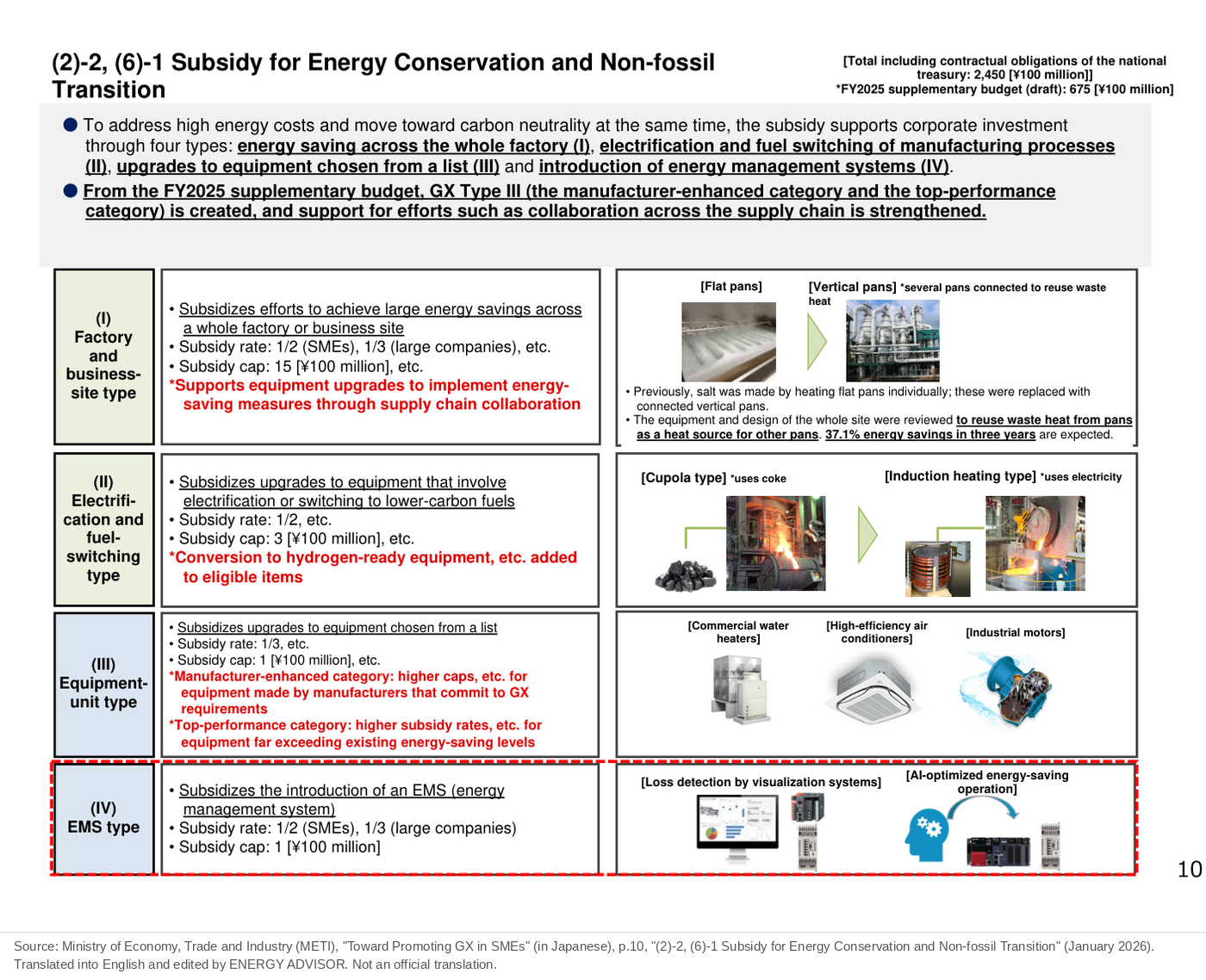
| (a) Energy-saving equipment upgrades | Subsidy for Energy Conservation and Non-fossil Transition (factory and business-site type / equipment-unit type) | Ministry of Economy, Trade and Industry (METI) (SII) | Factory and business-site type = substantial energy-saving retrofits at the site level / Equipment-unit type = replacement of individual equipment such as air conditioning, boilers and motors | Factory and business-site type: 1/2–2/3 for SMEs (cap ¥1.5 billion; ¥2 billion with non-fossil transition) / Equipment-unit type: 1/5–1/2 (varies by window and by replacement vs. new installation; no difference by company size; cap ¥100–300 million) | Manufacturers and factory owners that want to replace aging air conditioning, boilers, motors and lighting with high-efficiency equipment |
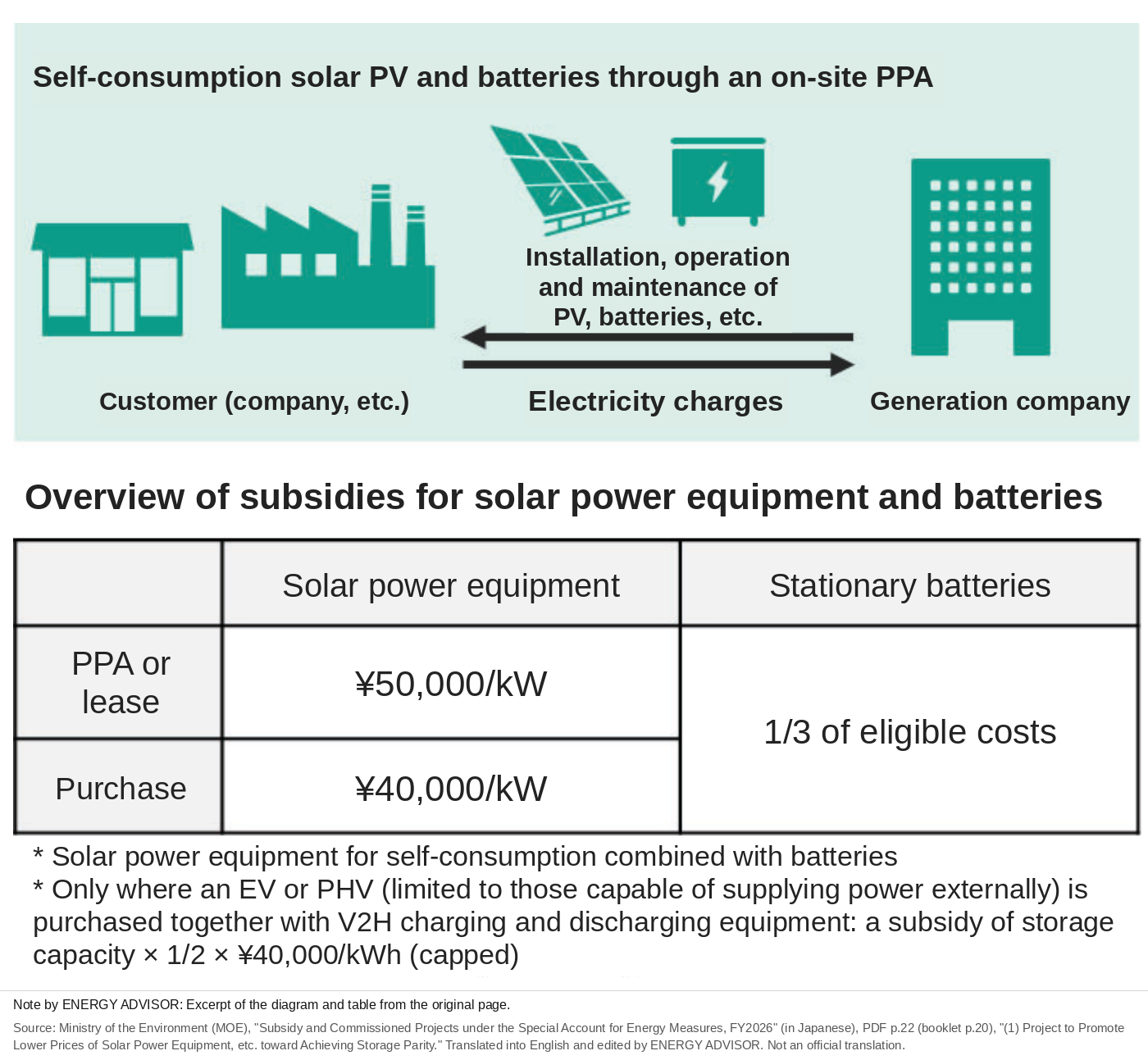
| (b) Renewable energy and self-consumption | Project to Promote Lower Prices of Solar Power Equipment, etc. toward Achieving Storage Parity | Ministry of the Environment (MOE) (Environmental Innovation Information Organization, EIC) | Corporations and sole proprietors (blue-form tax filers) installing self-consumption solar PV and batteries together. Not limited to SMEs | Solar ¥40,000/kW (self-owned, etc.) to ¥50,000/kW (PPA or lease); batteries ¥39,000/kWh (commercial and industrial); total cap of ¥60 million per project | Companies that want to install solar and batteries as a set on their roof or site to cut electricity costs and prepare for outages (see Part 10) |
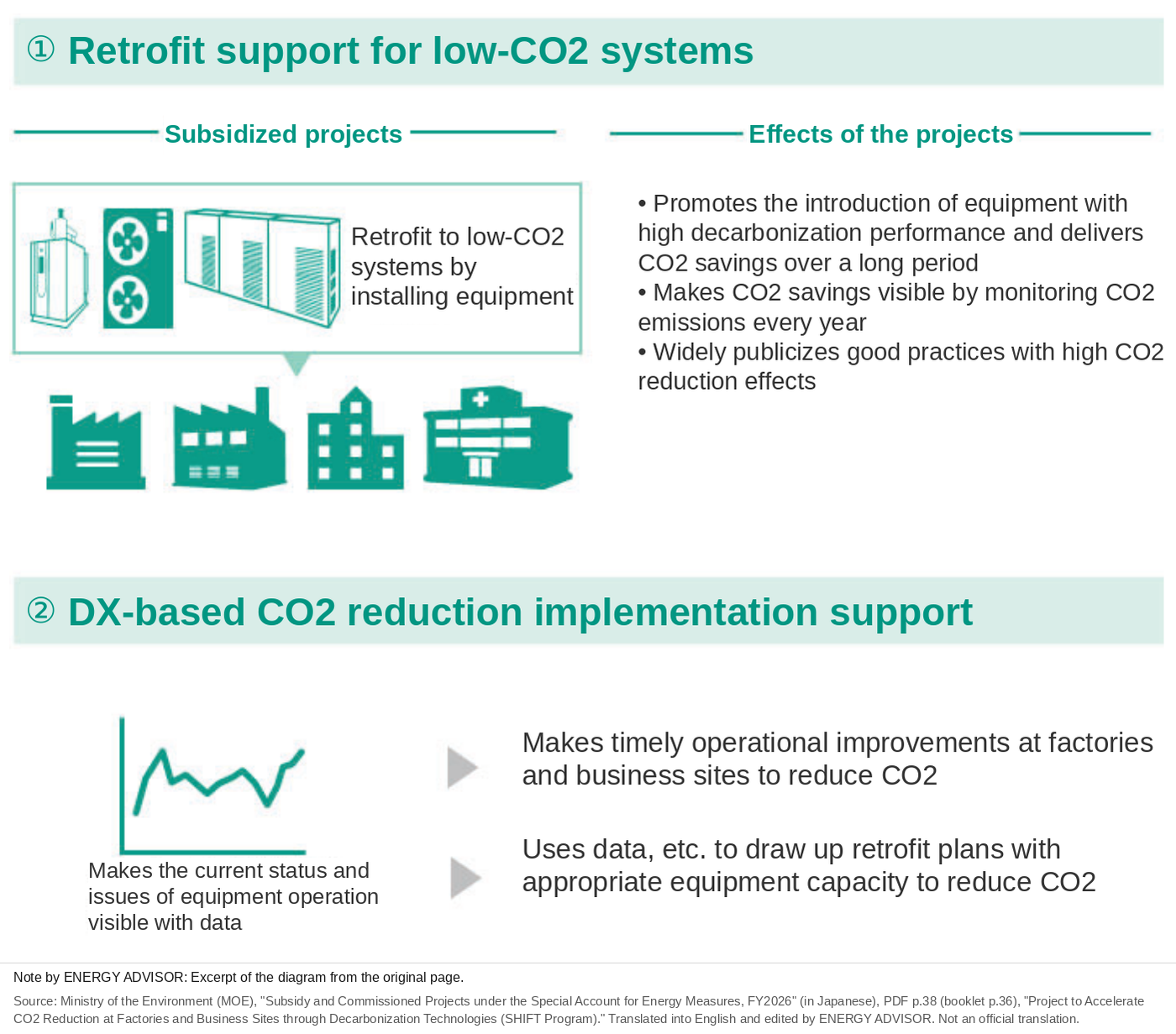
| (c) Decarbonization plans and equipment | Project to Accelerate CO2 Reduction at Factories and Business Sites through Decarbonization Technologies (SHIFT program) | MOE (Greenhouse Gas Assurance Association of Japan) | Retrofit support = private companies, etc. (excluding sole proprietors; large companies also eligible) planning and carrying out CO2 reductions of at least a set rate at the factory or business-site level / DX-based = limited to SMEs, etc.; supports CO2 reduction audits and implementation plans | Retrofit support: 1/3 (cap ¥100 million or ¥500 million) / DX-based: 3/4 (cap ¥2 million) | Companies that want to draw up a CO2 reduction plan for a whole factory or business site and carry it out over several years |
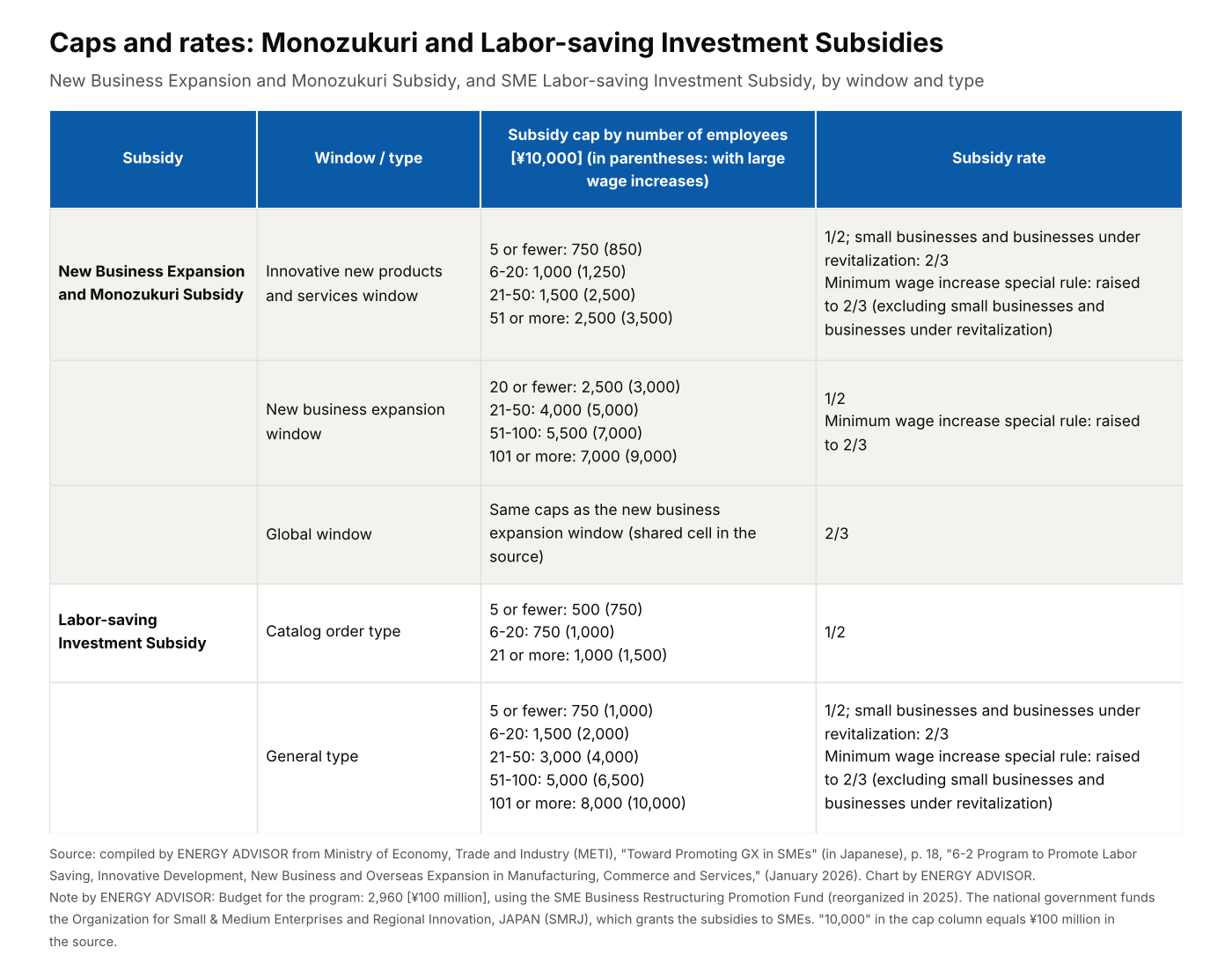
| (d) Productivity and labor saving | Monozukuri Subsidy / SME Labor-saving Investment Subsidy | Small and Medium Enterprise Agency | Developing new products and services and opening up overseas demand (Monozukuri) / Installing labor-saving equipment to deal with labor shortages (labor-saving investment) | Monozukuri Subsidy: 1/2 (cap ¥7.5–30 million) / Labor-saving Investment Subsidy (general type): 1/2–2/3 for SMEs (cap ¥7.5–80 million; ¥10–100 million with wage increases) | Companies whose main goal is not decarbonization itself but that want to choose more energy-efficient equipment when upgrading |
| (e) Tax incentives | SME Management Reinforcement Tax Incentive | Small and Medium Enterprise Agency / National Tax Agency | SMEs, etc. with a certified Business Enhancement Plan acquiring high-efficiency equipment, etc. (Solar PV for selling all output is not eligible. It may be eligible only when the expected share of generation sold, as in self-consumption, is at or below a set level) | Immediate depreciation, or a tax credit of 10% of the acquisition cost (7% for capital over ¥30 million) | Companies that want to cut the burden of capital investment through a tax incentive first, without waiting for a subsidy selection |
| (f) Local government programs | Subsidies of prefectures and municipalities (e.g., Tokyo) | Each local government | Varies by local government. E.g., Tokyo (Cool Net Tokyo) offers support for SMEs, etc. | (Tokyo example) 2/3–3/4, cap ¥10–45 million. Whether a program exists, and its content, differ greatly by local government | Companies whose head office or factory is in a local government with its own program (the starting point is searching where your company is located) |
Sources: SII, “Subsidy for Energy Conservation and Non-fossil Transition (Factory and Business-Site Type), Reiwa 7 Supplementary Budget: Program Overview Pamphlet (for the 2nd call)” (in Japanese); same (Equipment-Unit Type) (for the 2nd call) (in Japanese); MOE, “Storage Parity Project, FY2026 Budget”: Application Guidelines (KY) (in Japanese); MOE, “FY2026 SHIFT Program, Retrofit Support for Low-CO2 Systems”: Explanatory Material on the Application Guidelines (in Japanese); Small and Medium Enterprise Agency, “Subsidy for Promoting Productivity Improvement in Manufacturing, Commerce and Services: Summary of the 23rd Call Guidelines” (in Japanese); SME Labor-saving Investment Subsidy (general type) (in Japanese); Small and Medium Enterprise Agency, “SME Management Reinforcement Tax Incentive” (in Japanese); Small and Medium Enterprise Agency, “Q&A on the SME Management Reinforcement Tax Incentive” (in Japanese); Cool Net Tokyo, “Support Program for Installing Energy-Saving Equipment and Improving Operations toward Zero Emissions” (in Japanese)
Status of Each Program in FY2026
This section adds detail to the table and checks the status of each call for applications (open, closed or not yet announced).
(a) Energy-saving equipment upgrades: For the Subsidy for Energy Conservation and Non-fossil Transition implemented by SII (Sustainable open Innovation Initiative), the factory and business-site type and the equipment-unit type shared a common schedule in FY2026. Calls were held in a 1st round (March 30–April 27, 2026), a 2nd round (June 1–July 9) and a 3rd round (August 20–September 28). As of October 22, 2026, the 4th call (October 5–October 30) is open. The subsidy rates and caps in the table were checked in the materials for the 2nd call, and they are the same in the application guidelines for the 3rd and 4th calls.
Sources: SII, “Subsidy for Energy Conservation and Non-fossil Transition (Factory and Business-Site Type), Reiwa 7 Supplementary Budget: Program Overview Pamphlet” (2nd call) (in Japanese); SII, “Subsidy for Energy Conservation and Non-fossil Transition, 2026 Special Website”: Call Information (in Japanese); SII, same (Factory and Business-Site Type): Application Guidelines (for the 4th call), PDF pp.7–8 (in Japanese); SII, same (Equipment-Unit Type): Application Guidelines (for the 4th call), PDF pp.6–9 (in Japanese)
(b) Renewable energy and self-consumption: MOE’s Storage Parity Project covers projects that install self-consumption solar PV and batteries together. Eligible applicants include private companies (of any corporate form) and sole proprietors (blue-form tax filers); it is not limited to SMEs. It is the main option when a company goes ahead with installation after the economic assessment covered in Part 10. Two calls were held under the FY2026 initial budget, the first (July 9–July 31, 2026, noon) and the second (August 27–October 2, 2026, noon), and both have closed. The application guidelines revised for the second call (revised August 27, 2026) keep the same subsidy unit rates and grant caps as the first call.
Sources: MOE, “Call for Applications for the Project to Promote Lower Prices of Solar Power Equipment, etc. toward Achieving Storage Parity, FY2026 Budget” (in Japanese); same (second call) (August 27, 2026) (in Japanese); same, Application Guidelines (KY) (revised August 27, 2026) (in Japanese)
(c) Decarbonization plans and equipment: MOE’s SHIFT program has two parts: “retrofit support,” in which a company draws up a CO2 reduction plan for a factory or business site and carries it out over several years, and the “DX-based” menu, which supports CO2 reduction audits and implementation plans. In FY2026, after the call that began on June 12 (retrofit support had two deadlines, July 15 and August 26; the DX-based menu had a deadline of August 26), an additional call began on September 11 (MOE’s announcement calls it the “third call”; retrofit support had two deadlines, October 1 and October 15, and the DX-based menu had a deadline of October 15). As of October 22, 2026, all of these have closed. In terms of how to approach reduction planning, this falls under the capital investment stage of the three stages covered in Part 7: operational improvements, review of electricity contracts and capital investment in equipment.
Sources: MOE, “Start of the Call for Applications for the FY2026 Project to Accelerate CO2 Reduction at Factories and Business Sites through Decarbonization Technologies (SHIFT Program)” (in Japanese); MOE, “Third Call for Applications for the SHIFT Program” (September 11, 2026) (in Japanese)
(d) Productivity and labor saving: The Monozukuri Subsidy and the Labor-saving Investment Subsidy are not aimed directly at decarbonization. However, choosing more energy-efficient equipment when replacing aging equipment also leads indirectly to lower CO2 emissions. For the Monozukuri Subsidy, the selection results of the 23rd call (deadline May 8, 2026) were announced on August 7, 2026. As of October 22, 2026, the Monozukuri Subsidy’s official website shows “Applications for this subsidy have closed” and directs new applicants to the “New Business Expansion and Monozukuri Commerce and Services Subsidy.” The 1st call of the new New Business Expansion and Monozukuri Commerce and Services Subsidy began on June 29, 2026. In the call schedule on its official website, the original application start of August 31 and application deadline of September 30, 18:00 are struck through and changed to an application start of September 30 and an application deadline of October 30, 18:00. The SME Labor-saving Investment Subsidy (general type) accepts applications in separate rounds. The 7th round (applications July 1–July 31) and the 8th round (applications September 18–October 16) have closed, and the 9th round is announced to open in early November with an application deadline in late December.
Sources: Small and Medium Enterprise Agency, “Subsidy for Promoting Productivity Improvement in Manufacturing, Commerce and Services: Summary of the 23rd Call Guidelines” (in Japanese); Monozukuri Subsidy portal site (viewed October 22, 2026) (in Japanese); Organization for Small & Medium Enterprises and Regional Innovation, JAPAN (SMRJ), “Application Guidelines for the 7th Round of the Labor-saving Investment Subsidy (General Type) Released” (in Japanese); SME Labor-saving Investment Subsidy, “Schedule (General Type)” (viewed October 22, 2026) (in Japanese); New Business Expansion and Monozukuri Commerce and Services Subsidy, official website (viewed October 22, 2026) (in Japanese)
(e) Tax incentives: The SME Management Reinforcement Tax Incentive lets SMEs, etc. with a certified Business Enhancement Plan choose immediate depreciation or a tax credit when they acquire designated equipment. The plan must be certified before the equipment is acquired, and the incentive applies until March 31, 2027. For solar PV, equipment intended to sell all of its output is not eligible, and even when combined with self-consumption it may be ineligible depending on the share of electricity expected to be sold. Cases with a high share of on-site use, such as the self-consumption type in Part 10, are therefore considered more likely to be eligible. Subsidies involve screening and applications can be rejected, whereas the tax incentive has no selection hurdle: it applies once the required procedures are followed, such as certification of the Business Enhancement Plan before acquiring the equipment. It is therefore worth considering in parallel.
Sources: Small and Medium Enterprise Agency, “SME Management Reinforcement Tax Incentive” (in Japanese); Small and Medium Enterprise Agency, “Q&A on the SME Management Reinforcement Tax Incentive” (in Japanese)
(f) Local government programs: In addition to national programs, prefectures and municipalities sometimes set up their own subsidies. For example, Tokyo supports SMEs, etc. in installing energy-saving equipment and improving operations through Cool Net Tokyo, and several application rounds are planned for FY2026 as well. However, the content differs completely from one local government to another, and some have no such program at all. The starting point is to check the websites of the local governments where your head office and factories are located.
FY2026 Calls for Applications and How to Check Next Year’s Outlook
In FY2026, after the first calls that began in spring and summer, additional calls continued into the autumn. The table below summarizes the FY2026 call schedules for the national subsidies covered in this article (as of October 22, 2026).
| Program | FY2026 calls | As of October 22, 2026 |
|---|---|---|
| Subsidy for Energy Conservation and Non-fossil Transition (factory and business-site type, equipment-unit type) | 1st: March 30–April 27 / 2nd: June 1–July 9 / 3rd: August 20–September 28 / 4th: October 5–October 30 | 4th call open |
| Storage Parity Project (FY2026 initial budget) | First: July 9–July 31, noon / Second: August 27–October 2, noon | Closed |
| SHIFT program, retrofit support | Opened June 12 (deadlines July 15 and August 26) / Third call opened September 11 (deadlines October 1 and October 15) | Closed |
| SHIFT program, DX-based | Opened June 12 (deadline August 26) / Opened September 11 (deadline October 15) | Closed |
| Monozukuri Subsidy | 23rd call (deadline May 8; selection results announced August 7) | Shown as closed. New applicants are directed to the New Business Expansion and Monozukuri Commerce and Services Subsidy |
| New Business Expansion and Monozukuri Commerce and Services Subsidy | 1st call opened June 29 (application start September 30, application deadline October 30, 18:00; changed from the original August 31 and September 30) | 1st call accepting applications (deadline October 30, 18:00) |
| Labor-saving Investment Subsidy (general type) | 7th round: applications July 1–July 31 / 8th round: applications September 18–October 16 | 9th round scheduled to open in early November with a deadline in late December |
Sources: SII, “Subsidy for Energy Conservation and Non-fossil Transition, 2026 Special Website”: Call Information (in Japanese); MOE, Storage Parity Project, second call (August 27, 2026) (in Japanese); MOE, SHIFT program, third call (September 11, 2026) (in Japanese); Monozukuri Subsidy portal site (in Japanese); New Business Expansion and Monozukuri Commerce and Services Subsidy, official website (in Japanese); SME Labor-saving Investment Subsidy, “Schedule (General Type)” (in Japanese)
Information like that in this table (“which round in which month”) changes every fiscal year. Check the next fiscal year’s schedules in the following way.
How to Check Next Year’s Outlook
When checking the latest information yourself from next year on, three sources are basic. Search subsidies and support measures across programs on Mirasapo plus, run by the Small and Medium Enterprise Agency. For individual programs, check the latest application guidelines directly on the websites of the responsible ministries and agencies, such as METI, MOE and the Small and Medium Enterprise Agency, or on the special websites of SII and other implementing organizations. For local government programs, check the websites of the prefectures and municipalities where your head office and factories are located. Going to primary sources, rather than reusing figures from secondary summary sites, is the basic step for redrawing the map every year.
Summary
Because subsidy names, subsidy rates and application periods are reorganized every year, it is easier to keep up with the yearly updates if you learn to see programs by broad category: (a) energy-saving equipment upgrades, (b) renewable energy and self-consumption, (c) decarbonization plans and equipment, (d) productivity and labor saving, (e) tax incentives and (f) local government programs, rather than memorizing individual program names. In FY2026, the SII Subsidy for Energy Conservation and Non-fossil Transition held calls up to a 4th round, the Storage Parity Project up to a second round and the SHIFT program up to a third call, and additional calls continued into the autumn after the first calls in spring and summer. As of October 22, 2026, among the national subsidies covered in this article, the ones confirmed as open are the 4th call of the SII Subsidy for Energy Conservation and Non-fossil Transition (deadline October 30) and the 1st call of the New Business Expansion and Monozukuri Commerce and Services Subsidy (deadline October 30). Subsidy programs have in common limited application periods, payment after the fact, and the need to plan up to the completion report; tax incentives differ in that their procedures center on tax filing. From next year on, use Mirasapo plus and the official websites of ministries, agencies and local governments to check the latest situation yourself along the lines of this map.
Related Articles
- Part 1: What Is Supply Chain Decarbonization? (overview, how requests work and data on their spread) (in Japanese)
- Part 7: The Order of Reduction Measures: Operational Improvements, Contract Review and Capital Investment (in Japanese)
- Part 9: Four Ways to Procure Renewable Energy: Renewable Tariffs, Non-fossil Certificates, PPAs and Self-consumption (in Japanese)
- Part 10: Self-consumption Solar PV and Batteries: Calculating the Economics and the Value for Outages (in Japanese)
The information in this article is current as of the time of posting and may have changed by the time you read it.
This article is based on published materials from the Ministry of Economy, Trade and Industry and its Agency for Natural Resources and Energy, the Electricity and Gas Market Surveillance Commission, the Organization for Cross-regional Coordination of Transmission Operators (OCCTO) and other sources. The English translations of figures are by ENERGY ADVISOR and are not official translations. When using this information for decisions, please check the original sources. When we find an error, we correct the article and note the date of the correction.
Sources
- SII, “Subsidy for Energy Conservation and Non-fossil Transition (Factory and Business-Site Type), Reiwa 7 Supplementary Budget: Program Overview Pamphlet” (in Japanese). https://sii.or.jp/koujou07r/uploads/r7h_panflet_gaiyou_kj_2.pdf
- SII, “Subsidy for Energy Conservation and Non-fossil Transition (Equipment-Unit Type), Reiwa 7 Supplementary Budget: Program Overview Pamphlet (for the 2nd call)” (in Japanese). https://sii.or.jp/setsubi07r/uploads/r7h_panflet_gaiyou_st_2.pdf
- MOE, “Call for Applications for the Project to Promote Lower Prices of Solar Power Equipment, etc. toward Achieving Storage Parity, FY2026 Budget” (in Japanese). https://www.env.go.jp/press/press_05272.html
- MOE, “Storage Parity Project, FY2026 Initial Budget”: Application Guidelines (KY) (in Japanese). https://www.eic.or.jp/eic/topics/2026/st_r08/1st/files/SP_R8_ky.pdf
- MOE, “Start of the Call for Applications for the FY2026 Project to Accelerate CO2 Reduction at Factories and Business Sites through Decarbonization Technologies (SHIFT Program)” (in Japanese). https://www.env.go.jp/press/press_04967.html
- MOE and Greenhouse Gas Assurance Association of Japan, “FY2026 SHIFT Program, Retrofit Support for Low-CO2 Systems”: Explanatory Material on the Application Guidelines (in Japanese). https://www.gaj.or.jp/eie/shift/koubo/document/R8/J/sf08j2.pdf
- Small and Medium Enterprise Agency, “Subsidy for Promoting Productivity Improvement in Manufacturing, Commerce and Services: Summary of the 23rd Call Guidelines” (in Japanese). https://portal.monodukuri-hojo.jp/common/bunsho/ippan/23th/%E5%85%AC%E5%8B%9F%E8%A6%81%E9%A0%98%E6%A6%82%E8%A6%81%E7%89%88_23%E6%AC%A1%E7%B7%A0%E5%88%87_20260206.pdf
- SMRJ, “SME Labor-saving Investment Subsidy (General Type)” (https://shoryokuka.smrj.go.jp/ippan/) and “Application Guidelines for the 7th Round Released” (in Japanese). https://seisansei.smrj.go.jp/news/20260605-3.html
- Small and Medium Enterprise Agency, “SME Management Reinforcement Tax Incentive” (in Japanese). https://www.chusho.meti.go.jp/keiei/kyoka/kyoka_zeisei.html
- Small and Medium Enterprise Agency, “Q&A on the SME Management Reinforcement Tax Incentive” (in Japanese). https://www.chusho.meti.go.jp/keiei/kyoka/pdf/kyokaqanda.pdf
- National Tax Agency, “Section 2: Reduction Entry for Assets Acquired with National Subsidies” (Basic Circular on Corporation Tax) (in Japanese). https://www.nta.go.jp/law/tsutatsu/kihon/hojin/10/10_02.htm
- National Tax Agency, Tax Answer No. 2202, “When You Receive National Subsidies” (in Japanese). https://www.nta.go.jp/taxes/shiraberu/taxanswer/shotoku/2202.htm
- Cool Net Tokyo, “Support Program for Installing Energy-Saving Equipment and Improving Operations toward Zero Emissions” (in Japanese). https://www.tokyo-co2down.jp/subsidy/zeroemi-shoene/
- Small and Medium Enterprise Agency, “Mirasapo plus: Subsidy and Comprehensive Support Site for SMEs” (in Japanese). https://mirasapo-plus.go.jp/
- SII, “Subsidy for Energy Conservation and Non-fossil Transition, 2026 Special Website”: Call Information (application periods of the 1st to 4th calls; viewed October 22, 2026) (in Japanese). https://syouenehojyokin.sii.or.jp/information.html
- MOE, “Call for Applications for the Project to Promote Lower Prices of Solar Power Equipment, etc. toward Achieving Storage Parity, FY2026 Budget (Second Call)” (August 27, 2026) (in Japanese). https://www.env.go.jp/press/press_05472.html
- MOE and Environmental Innovation Information Organization (EIC), “Storage Parity Project, FY2026 Initial Budget: Application Guidelines” (revised August 27, 2026) (in Japanese). https://www.eic.or.jp/eic/topics/2026/st_r08/1st/files/SP_R8_ky_v2.pdf
- MOE, “Third Call for Applications for the Project to Accelerate CO2 Reduction at Factories and Business Sites through Decarbonization Technologies (SHIFT Program)” (September 11, 2026) (in Japanese). https://www.env.go.jp/press/press_05521.html
- Monozukuri Subsidy portal site (shown as closed; selection results of the 23rd call announced August 7, 2026; viewed October 22, 2026) (in Japanese). https://portal.monodukuri-hojo.jp/
- SII, “Subsidy for Energy Conservation and Non-fossil Transition (Factory and Business-Site Type), Reiwa 7 Supplementary Budget: Application Guidelines (for the 3rd call) and (for the 4th call)” (subsidy rates and caps on PDF pp.7–8; same as for the 2nd call) (in Japanese). https://sii.or.jp/koujou07r/uploads/r7h_kj_01_kouboyouryou_3.pdf / https://sii.or.jp/koujou07r/uploads/r7h_kj_01_kouboyouryou_4.pdf
- SII, “Subsidy for Energy Conservation and Non-fossil Transition (Equipment-Unit Type), Reiwa 7 Supplementary Budget: Application Guidelines (for the 3rd call) and (for the 4th call)” (subsidy rates and caps on PDF pp.6–9; same as for the 2nd call) (in Japanese). https://sii.or.jp/setsubi07r/uploads/r7h_st_01_kouboyouryou_3.pdf / https://sii.or.jp/setsubi07r/uploads/r7h_st_01_kouboyouryou_4.pdf
- New Business Expansion and Monozukuri Commerce and Services Subsidy, official website (schedule of the 1st call; viewed October 22, 2026) (in Japanese). https://shinjigyou-monodukuri.smrj.go.jp/
- SME Labor-saving Investment Subsidy, “Schedule (General Type)” (1st to 9th rounds; viewed October 22, 2026) (in Japanese). https://shoryokuka.smrj.go.jp/ippan/schedule/
- METI, “Toward Promoting GX in SMEs” (January 2026) (in Japanese). https://www.meti.go.jp/policy/energy_environment/global_warming/SME/pamphlet/gx_gaiyou.pdf
- MOE, “Subsidy and Commissioned Projects under the Special Account for Energy Measures, FY2026” (in Japanese). https://www.env.go.jp/content/000397154.pdf