Among SMEs that have started considering solar power in response to customers’ requests, many run into questions such as “Should we sell the electricity we generate or use it ourselves?” and “How much is the initial investment, and how many years will it take to recover?” Based on primary sources, this article clearly explains how self-consumption solar power, which assumes you use the electricity you generate yourself, works, and how to calculate its economics yourself, together with the meaning of adding batteries and their value against power outages.
Key points
- 1Solar power includes a “self-consumption” type, in which a company mainly uses the electricity it generates, and the “self-consumption ratio,” the share of generation actually used by the company, is the starting point for calculating the economics.
- 2For the economics, you can calculate an estimated payback period yourself by finding “annual generation × self-consumption ratio × electricity rate = annual savings” and dividing the initial investment by these annual savings.
- 3If you cannot prepare the initial cost, there are also options to install with zero initial investment using third-party ownership arrangements such as PPAs and leases.
- 4Adding batteries, in addition to raising the self-consumption ratio and helping with demand measures, also creates value as equipment that lets you use electricity during power outages (business continuity planning, BCP).
- 5Subsidies and tax incentives such as the storage parity subsidy and the SME Management Reinforcement Tax Incentive may be available.
In this series, “SMEs and Decarbonization,” we have, up to last time (Part 9, in Japanese), followed the review of electricity contracts and tariff plans (Part 8, in Japanese) by organizing four types of renewable electricity procurement: switching tariff plans, buying non-fossil certificates, PPAs and self-consumption. This time, we take up the self-consumption type and concretely explain how to think about the economics of installing solar power and batteries, and their value against power outages.
Self-Consumption Solar PV: How It Differs from the Surplus-Sale Type, and the Self-Consumption Ratio
Ways of installing solar power equipment fall into those aimed at selling much of the generated electricity to an electricity company, and the “self-consumption” type, aimed mainly at using the generated electricity in your own facilities. The self-consumption type is a way of installing solar power in which the electricity generated by the equipment is not sold to the grid (the electricity company’s transmission and distribution network), or sales are kept to a minimum, and the electricity is mainly used within the facility where it is generated. The share of generation actually used by the company is called the “self-consumption ratio.”
This difference also shows up in the certification requirements of the national Feed-in Tariff (FIT) scheme. Since April 2020, low-voltage solar power of 10 kW or more and less than 50 kW has been subject to self-consumption requirements for FIT certification. Specifically, both of the following must be met: at least 30% self-consumption or similar at the site of the generating facility, and islanded operation in a disaster with a power outlet made available for general use.
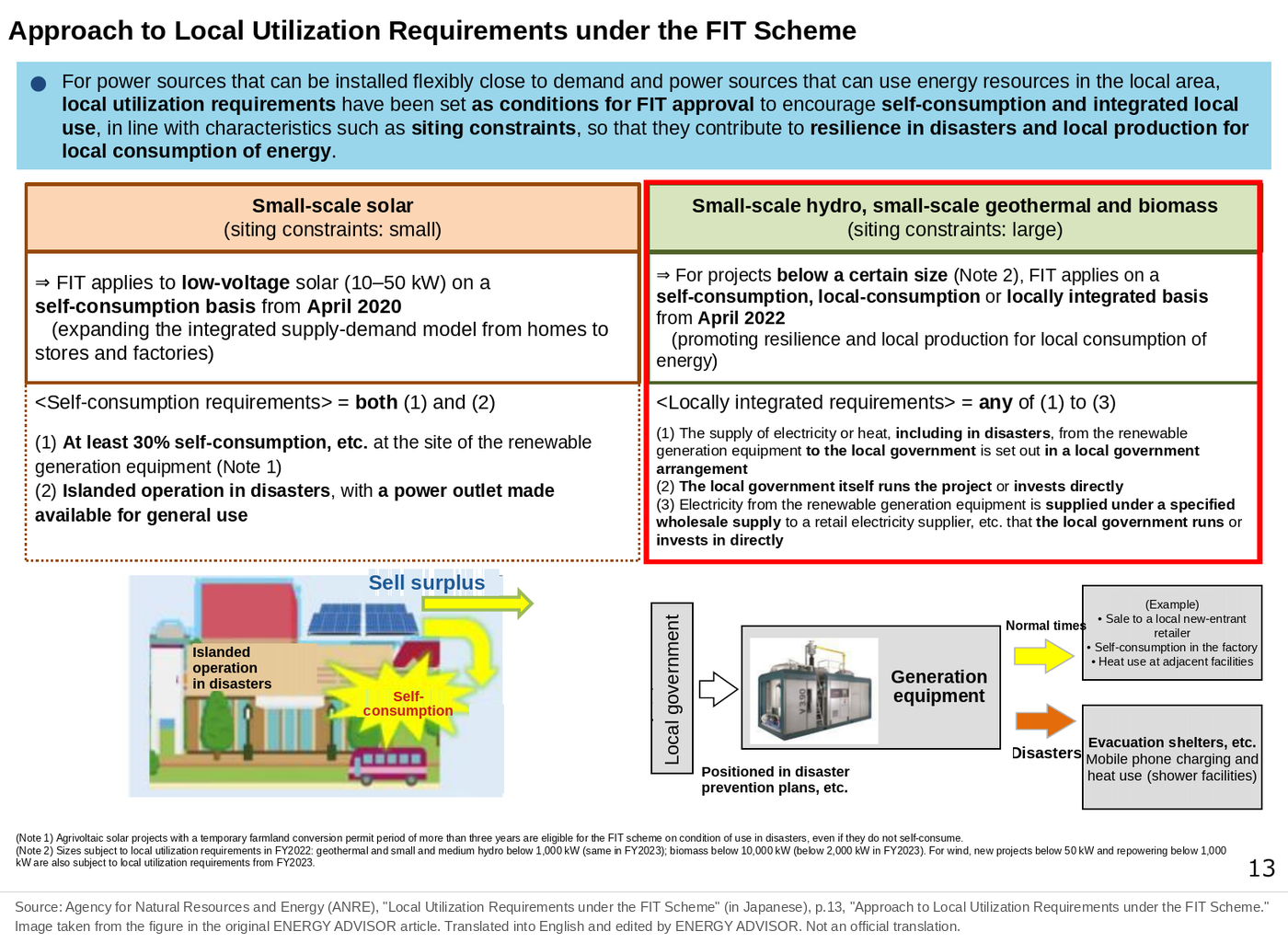
In other words, even the self-consumption type does not require you to use up all the electricity you generate; selling surplus electricity is not prevented by the system. What matters is the self-consumption ratio, that is, how much of the generated electricity can go toward reducing your company’s electricity consumption, and this figure is the starting point for the economic calculation explained next.
If you start considering solar power only with the image that “installing solar will lower our electricity bill,” you will overlook how much you can actually self-consume. The first step in the decision is to check the self-consumption ratio.
Calculating the Economics Yourself: From Annual Generation to the Payback Period
The economics of solar power can be calculated with your own figures in the following four steps:
- Check an estimate of annual generation
- Assume a self-consumption ratio and find the amount of electricity self-consumed
- Multiply by the electricity rate for the self-consumed portion to find the annual savings
- Divide the initial investment by the annual savings to find the payback period
First, the estimate of annual generation. Annual generation can be roughly estimated by multiplying the installed capacity (kW) by an estimate of annual generation per kW. This estimate varies with the region and the orientation and angle of the roof, but as a primary source, the “capacity factor” presented by the Calculation Committee for Procurement Prices of the Ministry of Economy, Trade and Industry (METI) is a useful reference. In the figures the committee presented as assumed values for FY2026 (April 2026–March 2027) and FY2027, the capacity factor of rooftop commercial solar of 10 kW or more is 14.5%. Multiplying this by 8,760 hours per year gives an estimate of about 1,270 kWh per kW per year (14.5% × 8,760 hours). The same material also gives a capacity factor of 13.7% (about 1,200 kWh per kW per year) for residential solar of less than 10 kW, so note that the level of the estimate differs with the scale and type of installation.
Next, the self-consumption ratio. As confirmed in the previous section, the requirements for 10–50 kW low-voltage solar to receive FIT certification call for at least 30% self-consumption. However, this is only the minimum under the system; the actual self-consumption ratio varies greatly depending on how much the facility’s operating hours overlap with the hours when solar generates power. For a factory that operates during weekday daytime, the self-consumption ratio could exceed this.
Once you know the amount of electricity self-consumed, multiplying it by the electricity rate for the self-consumed portion (the effective rate of purchased electricity, including the energy charge, fuel cost adjustment and so on) gives the annual savings on your electricity bill. Then, dividing the initial investment by these annual savings gives an estimated payback period.
Calculation Example (Hypothetical Illustration, Checked)
The following is purely a hypothetical illustration to help understand the steps; the figures are not based on any real quotation. When you actually consider an installation, replace them with your own consumption, electricity rate and equipment quotation.
- Installed capacity: 50 kW (rooftop)
- Annual generation: 50 kW × about 1,270 kWh/kW ≈ 63,510 kWh (based on the capacity factor estimate of 14.5% above)
- Self-consumption ratio (assumed): 60%
- Electricity self-consumed: 63,510 kWh × 60% ≈ 38,106 kWh
- Electricity rate (assumed, illustrative value): ¥18/kWh
- Annual savings: 38,106 kWh × ¥18 ≈ ¥685,900 (about ¥686,000)
- Initial investment (assumed): 50 kW × ¥150,000/kW = ¥7.5 million
- Payback period: ¥7.5 million ÷ about ¥686,000 ≈ about 10.9 years
In this example, the payback period comes out at about 11 years, but this number changes greatly if the self-consumption ratio, the electricity rate or the equipment quotation changes. Note also that this is an estimate based on past results and general guidelines and does not guarantee future generation or electricity rate levels.
With these four steps, you can check the figures presented by a contractor against your own actual figures instead of accepting them as they are. The self-consumption ratio in particular is a variable you can estimate yourself if you have electricity consumption data.
Options for Installing Without Initial Costs: Third-Party Ownership (PPAs and Leases)
The calculation so far assumes “self-ownership,” in which your company buys the solar power equipment. However, even if you cannot prepare the initial cost, you may be able to install self-consumption solar PV without initial investment by using an arrangement in which a third party owns the equipment.
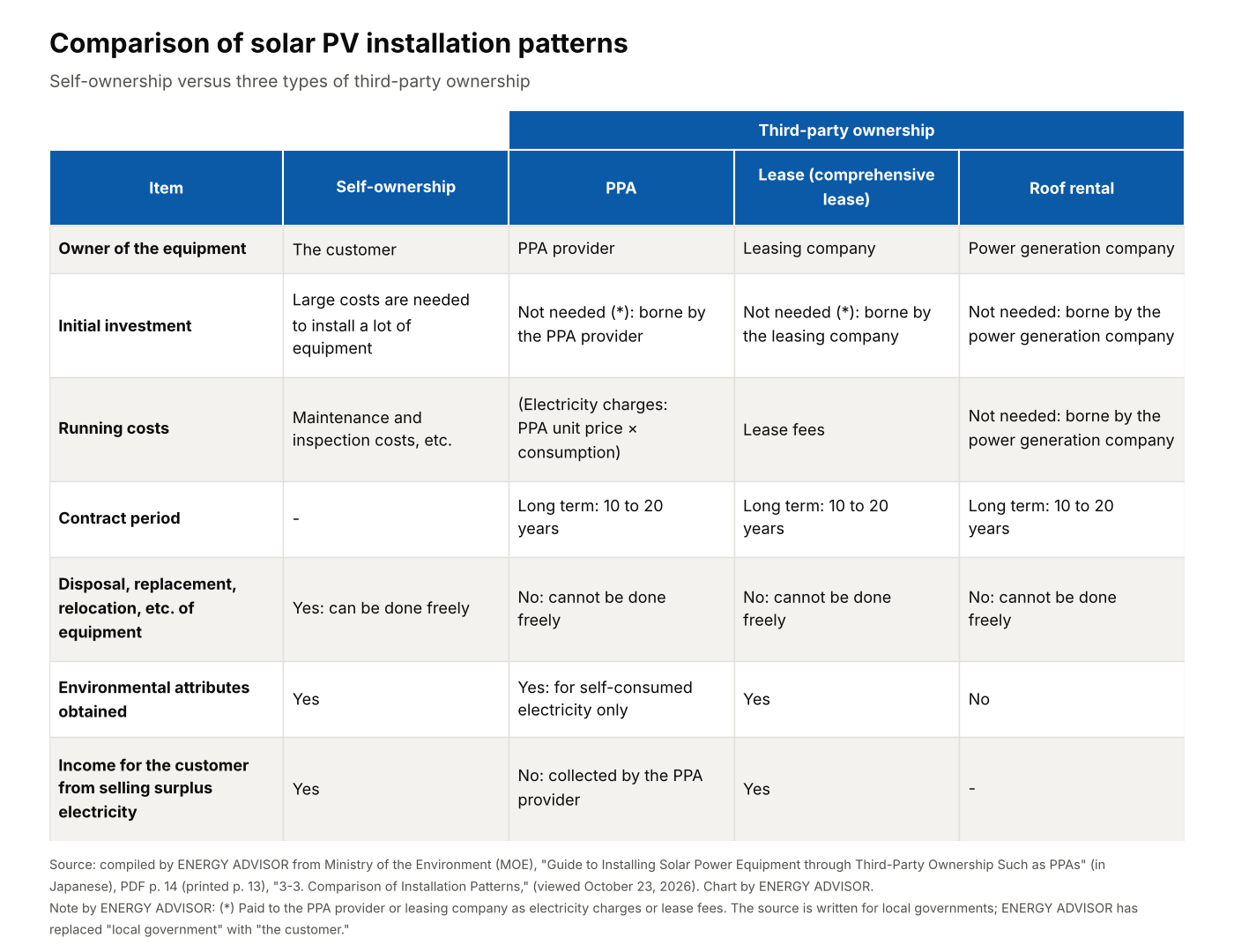
Third-party ownership is an arrangement in which a third party, such as a solar power company, installs and owns solar power equipment on the customer’s (your company’s) premises and supplies the generated electricity to the customer. Typical methods are the “on-site PPA” (PPA stands for power purchase agreement), in which the customer pays according to the electricity it uses, and the “lease,” in which the customer pays a fixed equipment fee. In both, the third party bears the initial cost and maintenance cost of the equipment, recovering them through the electricity or service charges, so in principle the customer needs no initial investment.
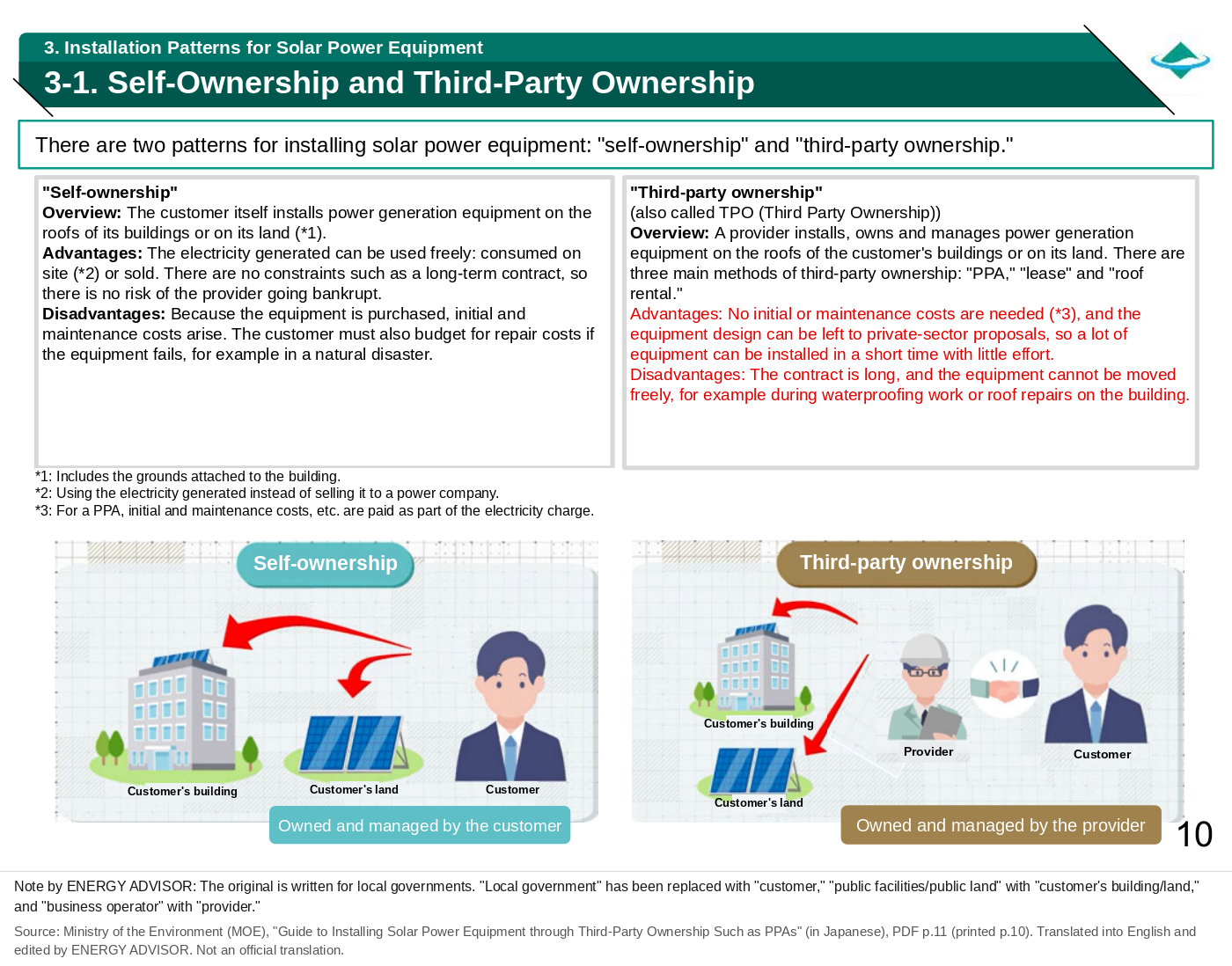
On the other hand, third-party ownership also has points to note. Contract periods are generally long, around 20 years (longer than the statutory useful life of 17 years for tax purposes), and you continue paying electricity or service charges during that time. Because you make no initial investment, it is essential to consider it after checking contract terms such as the contract period, conditions for early termination and how the equipment is handled.
Why Add Batteries: Higher Self-Consumption, Demand Measures and Value During Power Outages
Adding batteries to solar power creates value both in economics and in preparing for emergencies.
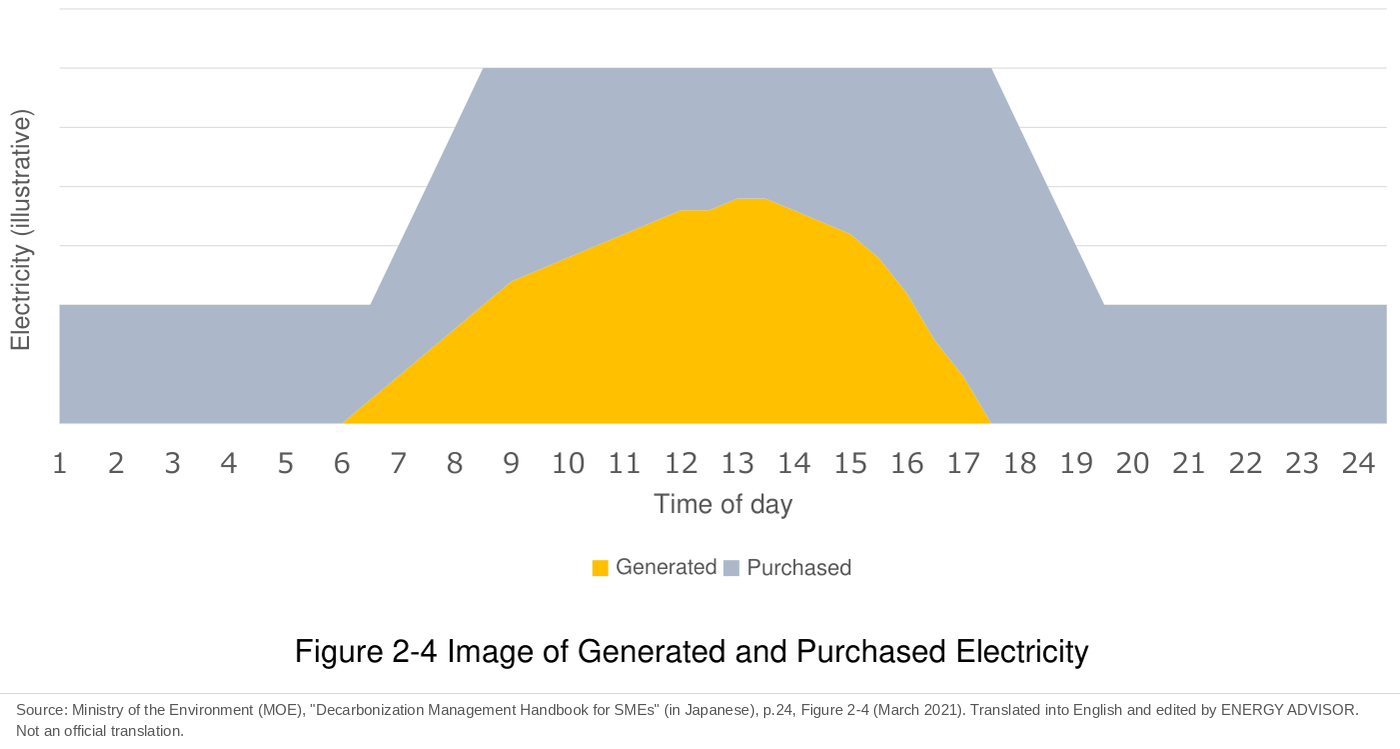
First, a higher self-consumption ratio. At sites where the hours of high solar generation (daytime) do not necessarily match the hours of high electricity use, storing part of the electricity generated during the day in batteries and using it in hours of low generation may raise the self-consumption ratio.
Second, demand measures. As confirmed in Part 8, the demand charge of a high-voltage supply contract is determined by the demand (the maximum 30-minute demand) on which the contract demand is based. Discharging batteries during peak hours of electricity use may help hold down the contract demand. However, as with the demand control discussed in Part 8, this is mainly a cost effect, and whether it involves reducing consumption itself (reducing CO2 emissions) depends on the timing of discharge.
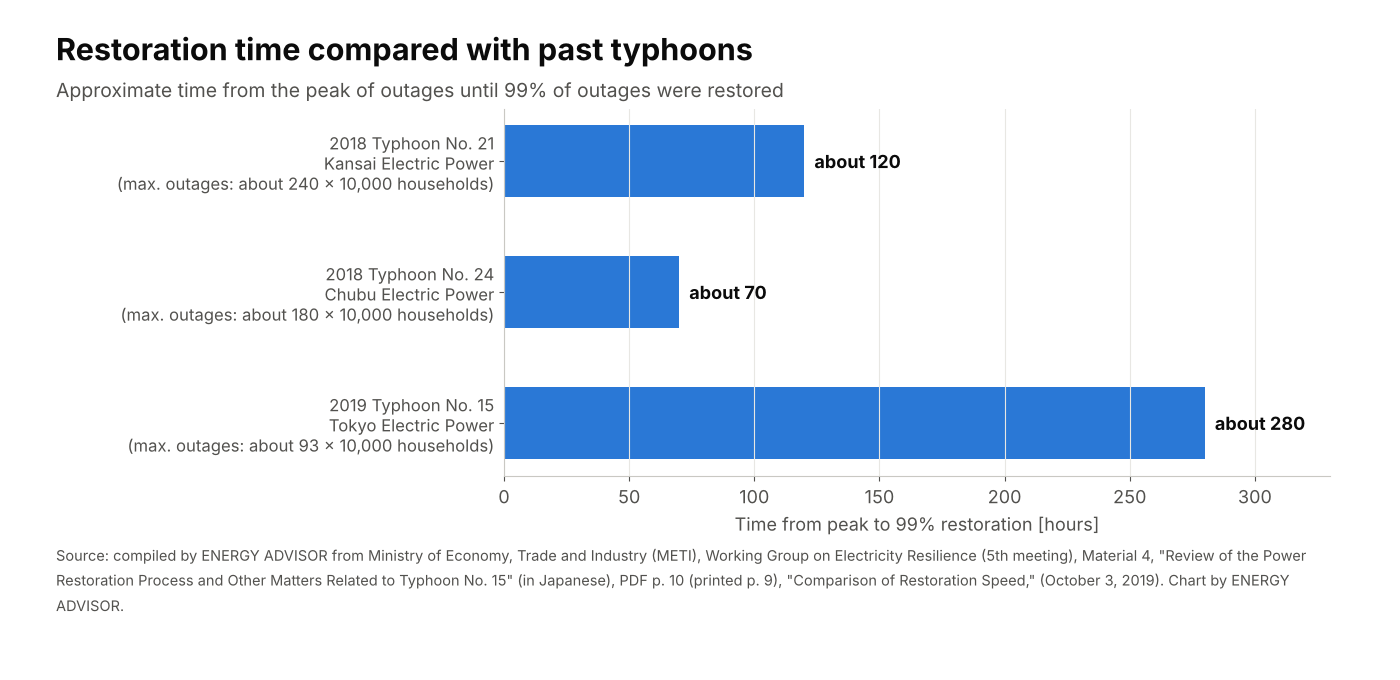
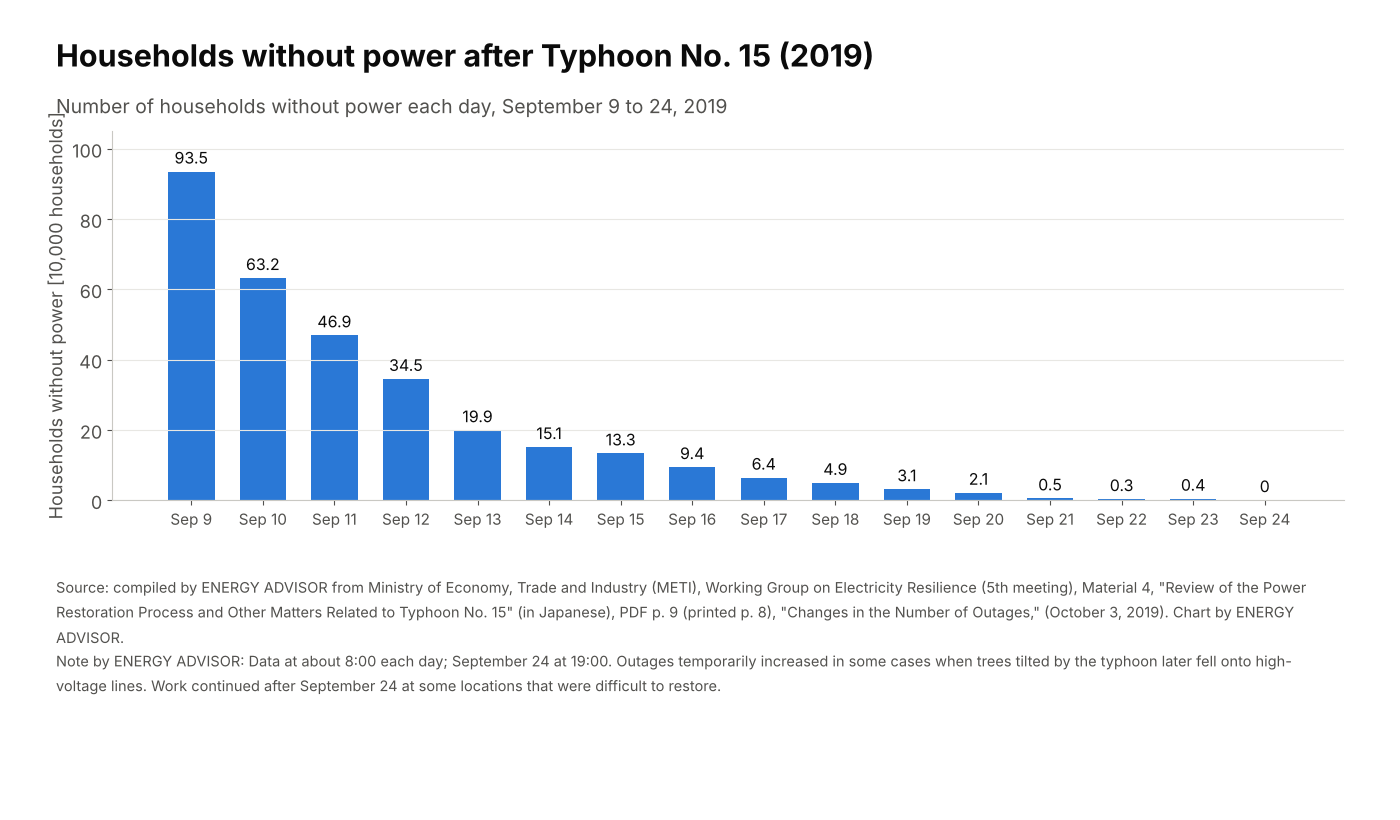
Third, value during power outages. In Japan, large-scale, long-lasting power outages can occur due to accidents at transmission and distribution facilities or natural disasters. For example, Typhoon No. 15 of 2019 (the Reiwa 1 Boso Peninsula Typhoon) cut power to up to about 930,000 households across the wider Kanto region, and it took about 280 hours from the peak to restore 99% of the outages.
Apart from such large-scale outages, short outages can also occur at individual sites due to equipment failures or construction work. Solar power equipment normally stops generating when the grid has an outage, but by combining it with a power conditioner (inverter) that has an islanded operation function or with batteries, you may be able to use some electricity even during an outage. As shown in the figure above, the self-consumption requirements of the FIT scheme also call for an islanded operation function in disasters. However, islanded operation generally covers only limited capacity and time, so you need to decide in advance which equipment to prioritize in an emergency. It is good to understand that not all electricity demand can be met during an outage.
Deciding in advance what you want to run, and for how long, during an outage makes it easier to consider the battery capacity you need.
Subsidies and Tax Incentives That May Be Available
National subsidies and tax incentives may be available for installing solar power and batteries.
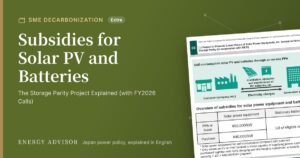
A typical subsidy is MOE’s “Program to Promote Price Reductions of Solar Power Equipment and Related Equipment Toward Achieving Storage Parity” (commonly called the storage parity subsidy). Its base amounts are a flat ¥40,000 per kW for solar power equipment (¥50,000 for on-site PPAs and leases) and a flat ¥39,000 per kWh for stationary batteries for business and industrial use (capped at one-third of the expenses eligible for the indirect subsidy). The grant caps are ¥20 million for solar power equipment and ¥40 million for batteries and related equipment, up to ¥60 million in total (for the FY2026 initial budget; the FY2025 supplementary budget had the same base amounts and caps). Because application periods and requirements change each fiscal year, the detailed requirements and the results of the FY2026 call for applications are covered in a supplementary part.
Sources: MOE and Environmental Innovation Information Organization (EIC), “FY2026 Initial Budget, Program to Promote Price Reductions of Solar Power Equipment and Related Equipment Toward Achieving Storage Parity: Application Guidelines” (revised August 27, 2026), p. 63, Appended Table 1 (in Japanese); same, “FY2025 (Supplementary Budget)” Application Guidelines, pp. 63–64 (in Japanese)
On the tax side, there is the “SME Management Reinforcement Tax Incentive,” under which, in principle, a company that obtains approval of a Business Enhancement Plan before acquiring eligible equipment can choose either immediate depreciation or a tax credit of 10% of the acquisition cost (7% for corporations with capital of more than ¥30 million). The measure runs until March 31, 2027. Whether solar power equipment is eligible for this incentive depends on the purpose and share of electricity sales. According to the Small and Medium Enterprise Agency’s Q&A on this incentive, equipment intended to sell all the electricity it generates is regarded as “equipment used for the electricity business” and is not eligible. Even when only part of the electricity is sold, the equipment is not eligible if the share of electricity expected to be sold exceeds one-half of the electricity expected to be generated by the equipment. Therefore, equipment with a high share of self-consumption, like the self-consumption type covered in this article, can be eligible, but checking individual requirements is covered in a supplementary part.
Sources: Small and Medium Enterprise Agency, “SME Management Reinforcement Tax Incentive” (in Japanese); Small and Medium Enterprise Agency, “Q&A on the SME Management Reinforcement Tax Incentive” (in Japanese)
Points to Check Before Installation
Here are the points to check before concretely considering the installation of solar power and batteries.
First, the condition of the roof. Solar power equipment is generally used for around 20 years, so you need to check in advance whether the structure of the building and roof can bear the weight of the panels, and the roof’s waterproofing, remaining useful life and planned renovation timing. If roof renovation becomes necessary during a third-party ownership contract, contractual arrangements such as temporarily removing the equipment may be required.
Second, the relationship with the contract demand. As confirmed in Part 8, under the actual-demand method, the contract demand is determined by the maximum demand over the past 12 months. If self-consumption from solar power reduces daytime power use, it may help hold down the contract demand. On the other hand, generation varies with the weather, so a decision to lower the contract demand on the assumption of solar generation should be made carefully, based on actual data.
Third, the capacity of the power conditioner. A power conditioner is a device that converts the direct current generated by solar panels into alternating current that can be used in the facility. The capacity of the power conditioner is not necessarily designed to be the same as the total output of the panels. For example, in one supermarket’s installation introduced in an MOE casebook, the panel output is 302 kW, while the power conditioner output is 170 kW.
Source: MOE, “First Guide to Using Renewable Energy (for Companies),” p. 13 (in Japanese)
It is good to check these points with contractors at the quotation stage and use them as material for comparing several proposals.
Summary
Self-consumption solar power is a way of installing solar power in which a company mainly uses the electricity it generates, and the self-consumption ratio, the share of generation actually used by the company, is the starting point for considering the economics. For the economics, you can calculate an estimated payback period yourself by finding “annual generation × self-consumption ratio × electricity rate = annual savings” and dividing the initial investment by these annual savings. If you cannot prepare the initial cost, third-party ownership arrangements such as PPAs and leases are also an option. Adding batteries, in addition to raising the self-consumption ratio and helping with demand measures, also creates value as equipment that lets you use electricity during power outages, but note that what can be covered is limited. Subsidies and tax incentives such as the storage parity subsidy and the SME Management Reinforcement Tax Incentive may be available, and it is good to check points such as the condition of the roof, the relationship with the contract demand and the capacity of the power conditioner before installation.
Related Articles
- Part 7: The Order of Reductions — Operational Improvements, Contract Review and Capital Investment
- Part 8: Electricity Contracts and CO2 — How Reviewing Your Contract and Tariff Plan Affects Emissions and Costs
- Part 9: Four Ways to Procure Renewable Energy — Plans, Non-Fossil Certificates, PPAs and Self-Consumption
Note: The information in this article is current as of the time of posting and may have changed by the time you read it.
This article is based on published materials from the Ministry of Economy, Trade and Industry and its Agency for Natural Resources and Energy, the Electricity and Gas Market Surveillance Commission, the Organization for Cross-regional Coordination of Transmission Operators (OCCTO) and other sources. The English translations of figures are by ENERGY ADVISOR and are not official translations. When using this information for decisions, please check the original sources. When we find an error, we correct the article and note the date of the correction.
Sources
- ANRE, “Local Utilization Requirements under the FIT Scheme” (in Japanese). https://www.enecho.meti.go.jp/category/saving_and_new/saiene/community/dl/20220316_fit.pdf
- ANRE, Calculation Committee for Procurement Prices (110th meeting, January 2026), Material 1, “Solar Power” (in Japanese). https://www.meti.go.jp/shingikai/santeii/pdf/110_01_00.pdf
- MOE, “Guide to Installing Solar Power Equipment through Third-Party Ownership Such as PPAs” (in Japanese). https://www.env.go.jp/content/000118595.pdf
- MOE and Environmental Innovation Information Organization (EIC), “FY2025 (Supplementary Budget), Program to Promote Price Reductions of Solar Power Equipment and Related Equipment Toward Achieving Storage Parity: Application Guidelines” (in Japanese). https://www.eic.or.jp/eic/topics/2025/st_r07c/1st/files/SP_R7_ky.pdf
- Small and Medium Enterprise Agency, “SME Management Reinforcement Tax Incentive” (in Japanese). https://www.chusho.meti.go.jp/keiei/kyoka/kyoka_zeisei.html
- Small and Medium Enterprise Agency, “Q&A on the SME Management Reinforcement Tax Incentive” (in Japanese). https://www.chusho.meti.go.jp/keiei/kyoka/pdf/kyokaqanda.pdf
- METI, Working Group on Electricity Resilience (5th meeting, October 3, 2019), Material 4, “Review of the Power Restoration Process and Other Matters Related to Typhoon No. 15” (in Japanese). https://www.meti.go.jp/shingikai/enecho/denryoku_gas/denryoku_gas/resilience_wg/pdf/005_04_00.pdf
- MOE, “First Guide to Using Renewable Energy (for Companies)” (in Japanese). https://www.env.go.jp/earth/%E3%81%AF%E3%81%98%E3%82%81%E3%81%A6%E3%81%AE%E5%86%8D%E3%82%A8%E3%83%8D%E6%B4%BB%E7%94%A8%E3%82%AC%E3%82%A4%E3%83%89%EF%BC%88%E4%BC%81%E6%A5%AD%E5%90%91%E3%81%91%EF%BC%89.pdf
- MOE and Environmental Innovation Information Organization (EIC), “FY2026 Initial Budget, Program to Promote Price Reductions of Solar Power Equipment and Related Equipment Toward Achieving Storage Parity: Application Guidelines” (revised August 27, 2026), p. 63, Appended Table 1 (in Japanese). https://www.eic.or.jp/eic/topics/2026/st_r08/1st/files/SP_R8_ky_v2.pdf