The standard tariffs for high-voltage and extra-high-voltage supply include a Market-Linked Plan that reflects wholesale electricity market prices. Some companies only check the content of their plan after their electricity bill suddenly goes up, without having noticed that this mechanism was built into part of their contract. This article sets out how the Market-Linked Plan works and the risks to check before signing.
Key points
- 1A Market-Linked Plan is a plan that reflects prices on the wholesale electricity market (JEPX) in electricity charges.
- 2From April 2026, spot prices in the Tokyo area at times rose into the ¥40–50/kWh range.
- 3In the outlook as of March 2026, the minimum summer reserve margin in the Tokyo area was below 3% in August. A later tender for additional supply capacity brought the outlook up to securing 3%.
- 4Standard tariffs have an item called the market price adjustment rate. In the actual July 2026 rates, the daytime rate of the Market-Linked Plan was ¥14.26/kWh, higher than the Basic Plan.
- 5Points to check before signing up for a Market-Linked Plan.
Part 4 looked at the three plans of the standard tariff (the Basic Plan, the Zero Market Adjustment Plan and the Market-Linked Plan). This part looks in detail at how the Market-Linked Plan, which requires particular care, works and its risks.
What a Market-Linked Plan Is
A Market-Linked Plan is a plan that directly reflects the market price of electricity traded on the Japan Electric Power Exchange (JEPX) in the calculation of electricity charges. TEPCO Energy Partner’s standard tariff also offers a Market-Linked Plan alongside the Basic Plan and the Zero Market Adjustment Plan. Under this mechanism, when market prices rise, electricity charges rise with them. The overall structure of the standard tariff is as seen in Part 4.
Unlike the Basic Plan, where costs are reflected gradually through the fuel cost adjustment, the Market-Linked Plan’s key feature is that it reflects changes in wholesale electricity market prices more directly in electricity charges. For this reason, in months when market prices move sharply, electricity costs also swing widely.
In the Market-Linked Plan of TEPCO Energy Partner’s standard tariff, the average price in the JEPX day-ahead market (spot market) over the most recent one month is reflected in the rate for the current month or the following month, under the same start-of-period rule as the fuel cost adjustment. For this reason, there is an effective time lag of about one to two months between a change in market prices and its actual reflection on the bill. For market price adjustment clauses of new entrant retailers’ own plans, the timing of reflection may differ depending on each company’s terms and conditions of supply.
Source: TEPCO Energy Partner, “What Are the Fuel Cost Adjustment System and the Market Price Adjustment System?” (in Japanese)
As an example of a new entrant retailer, ENNET also shows an adjustment item that reflects market prices on its rates page (ENNET, “Rates,” in Japanese).
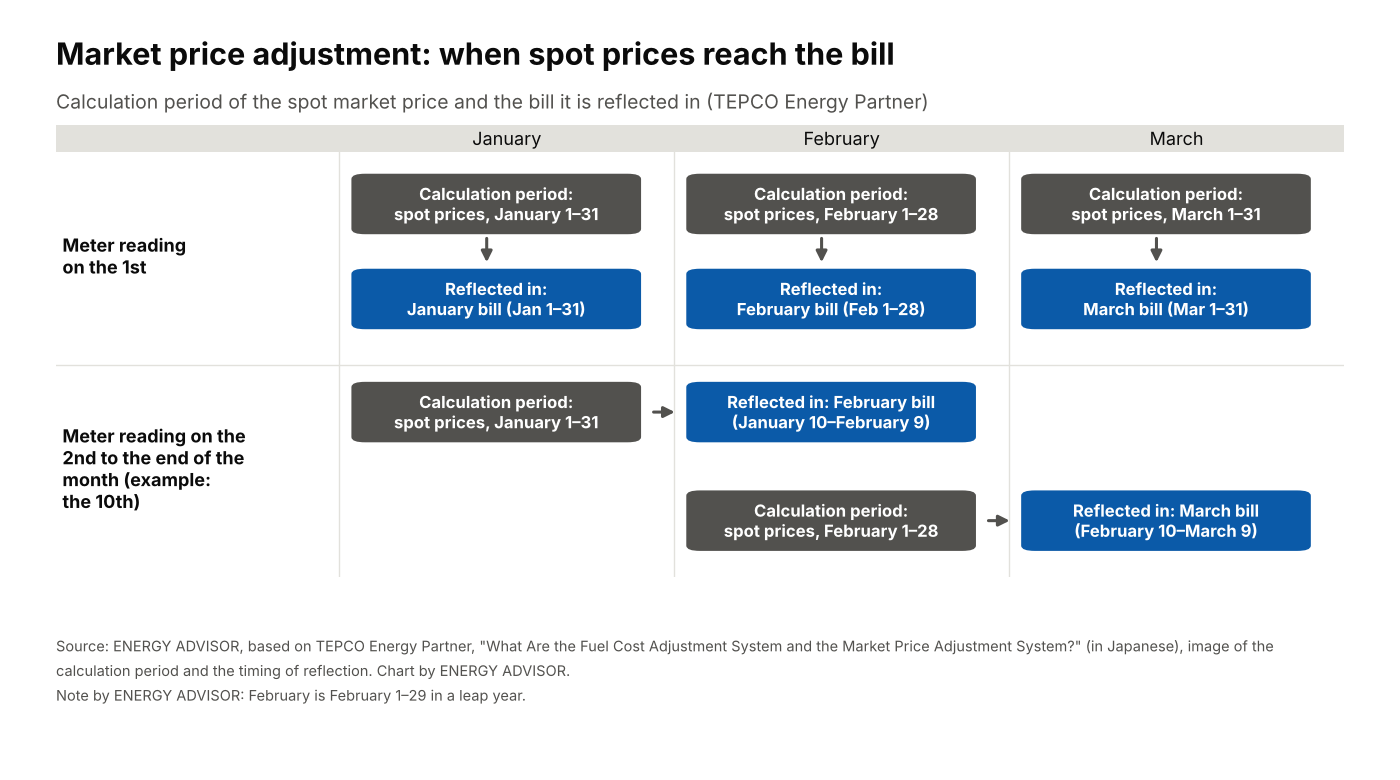
Source: TEPCO Energy Partner, “What Are the Fuel Cost Adjustment System and the Market Price Adjustment System?” (in Japanese)
Some companies continue with contracts close to a Market-Linked Plan without having checked the contract clauses. The author often hears of cases where they notice only when the bill suddenly goes up.
Price Movements in 2026
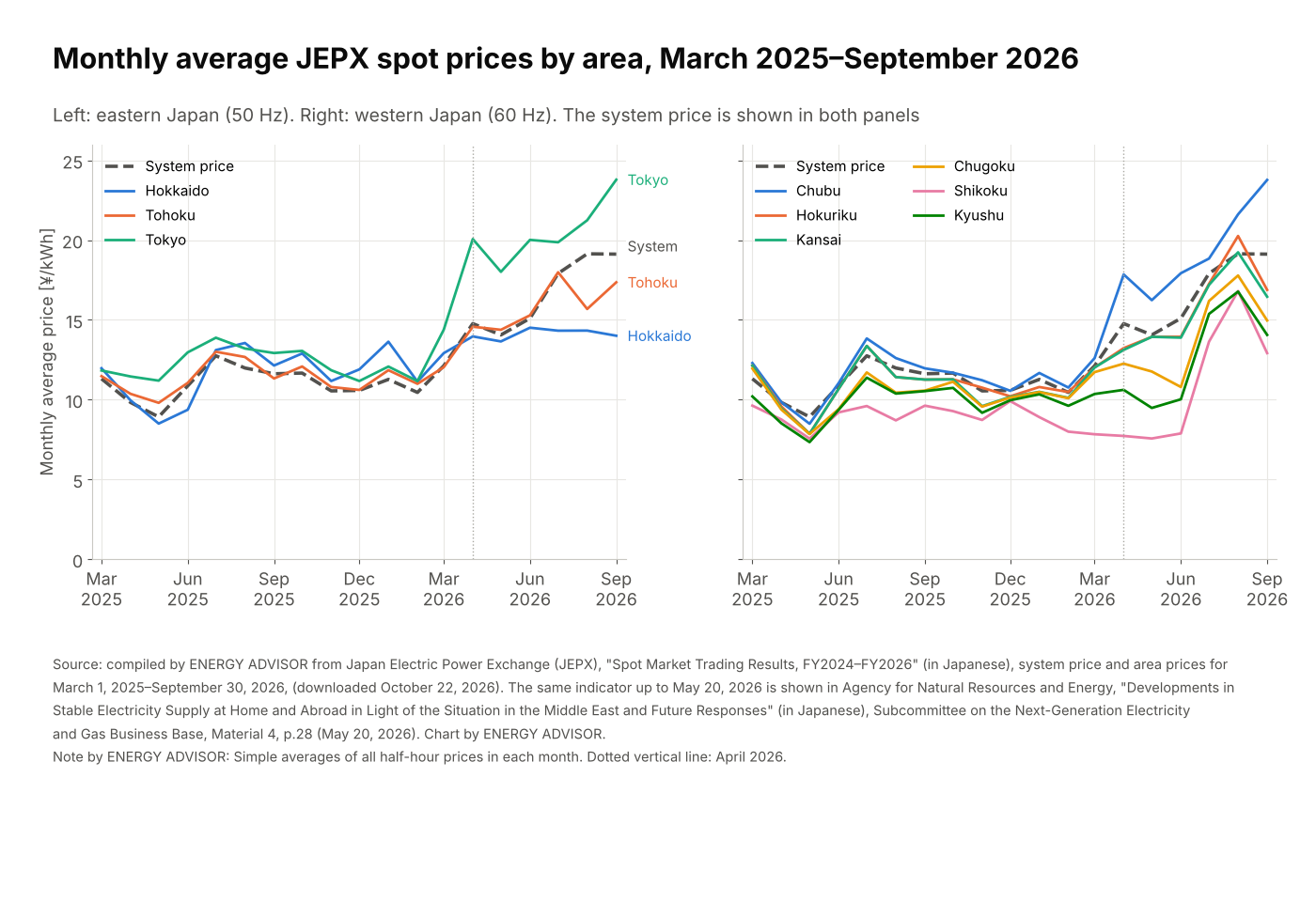
The JEPX spot price is the price of electricity traded in 30-minute units on the wholesale electricity market. From April 2026, spot prices in the Tokyo area at times rose into the ¥40–50/kWh range. The materials of the Electricity and Gas Market Surveillance Commission (EGC) cite three factors behind this: higher fuel prices, the end of long-term power purchase agreements, and constraints on supply capacity from the restriction of the total transfer capability (TTC) of the Tohoku–Tokyo interconnection line (a transmission line for exchanging electricity between areas) and from scheduled maintenance outages of generating facilities and similar causes. In the outlook as of March 2026, the summer reserve margin in the Tokyo area (the ratio of spare supply capacity to peak demand) was below 3% in August. However, a tender for additional supply capacity secured 976 MW, and the outlook became one of securing 3%. The causes and the detailed course of summer supply and demand are explained in Part 2.
Source: EGC, Expert Meeting on System Design and Monitoring, 21st meeting, Material 3, “Spot Market Price Surge” (in Japanese); Agency for Natural Resources and Energy, “Electricity Supply-Demand Outlook for FY2026” (in Japanese), March 27, 2026, Material 8; Agency for Natural Resources and Energy, “Electricity Supply-Demand Measures for Summer FY2026” (in Japanese), May 20, 2026, Material 5
The Market-Linked Plan Within the Standard Tariff: Actual Market Price Adjustment Rates
Let us check the risk of the Market-Linked Plan with concrete figures. Standard tariffs have an item called the “market price adjustment rate,” separate from the fuel cost adjustment, and the level of this rate differs among the three plans: the Basic Plan, the Zero Market Adjustment Plan and the Market-Linked Plan. The rates by time period for July 2026 (high-voltage, customers whose metering period does not start on the 1st of each month, tax included) are shown in the table below.
| Time period | Basic Plan | Market-Linked Plan |
|---|---|---|
| Morning | ¥4.13/kWh | ¥9.59/kWh |
| Daytime | ¥6.15/kWh | ¥14.26/kWh |
| Evening | ¥5.77/kWh | ¥13.38/kWh |
| Night | ¥2.99/kWh | ¥6.93/kWh |
(July 2026, high-voltage, customers whose metering period does not start on the 1st of each month, tax included)
As the table shows, the daytime rate of the Market-Linked Plan was ¥14.26/kWh, more than twice the Basic Plan’s daytime rate of ¥6.15/kWh. In the morning, evening and night periods as well, the Market-Linked Plan’s rate is higher than the Basic Plan’s.
However, comparing only the market price adjustment rates is misleading, because the Market-Linked Plan’s energy charge and demand charge are set lower than those of the Basic Plan (Part 4). Adding the energy charge and the market price adjustment rate and comparing the daytime period for July 2026 gives the following (excluding the fuel cost adjustment, the renewable energy surcharge and the demand charge).
| July 2026, daytime | Basic Plan | Market-Linked Plan |
|---|---|---|
| Energy charge | ¥17.43/kWh | ¥15.18/kWh |
| Market price adjustment rate | ¥6.15/kWh | ¥14.26/kWh |
| Total | ¥23.58/kWh | ¥29.44/kWh |
Even adding that month’s fuel cost adjustment rate (¥1.47/kWh) to the Basic Plan gives ¥25.05/kWh, so in the daytime period of that month the Market-Linked Plan was more expensive.
Source: TEPCO Energy Partner, “Notice of Fuel Cost Adjustment and Other Rates (July 2026)” (in Japanese); same company, “FY2026 Electricity Rate Table (Extra-High-Voltage and High-Voltage)” (in Japanese); same company, “List of Fuel Cost Adjustment Rates and Other Rates” (in Japanese). Totals are the author’s calculation
Thus, even within the same standard tariff, the level of the unit price actually paid changes greatly depending on whether you choose the Market-Linked Plan. When signing up for a Market-Linked Plan, it is important to consider how much fluctuation your company can accept, taking into account the difference in levels shown in actual examples like this.
This is an actual example from one particular month, July 2026, and the size of the difference changes from month to month. The market price adjustment rates for October 2026 (same conditions) were as follows.
| Time period | Basic Plan | Market-Linked Plan |
|---|---|---|
| Morning | ¥5.30/kWh | ¥13.43/kWh |
| Daytime | ¥6.20/kWh | ¥16.03/kWh |
| Evening | ¥6.23/kWh | ¥16.13/kWh |
| Night | ¥3.98/kWh | ¥9.65/kWh |
The Market-Linked Plan’s market price adjustment rates for August to October 2026 include the discount from government electricity bill relief (¥1.80 for August, ¥2.30 for September and ¥1.80/kWh for October). The Basic Plan’s market price adjustment rates do not include it (in the Basic Plan, it is included in the fuel cost adjustment rate; see Part 6).
Source: TEPCO Energy Partner, “List of Fuel Cost Adjustment Rates and Other Rates” (in Japanese), checked October 22, 2026
What to Check Before Signing
When signing up for a Market-Linked Plan, you need to understand that changes in wholesale electricity market prices are reflected directly in electricity charges. Note, however, that checking past results is only a check of past trends and does not guarantee future prices. Before signing, it is important to check how market prices are reflected, whether there is a cap, the contract term, the cancellation conditions and so on.
Specifically, this means checking the calculation method (in which time periods and in what units market prices are reflected), checking whether a price cap is set for when prices exceed a certain level, and checking whether there is an early termination fee if you cancel during the contract term. A price cap is a mechanism that sets an upper limit in advance so that the adjustment rate does not exceed a certain level. These points often cannot be understood without reading the contract clauses one by one, and they are hard to notice by looking only at the unit prices in a quotation.
A Market-Linked Plan is not necessarily an option to avoid. What matters is deciding whether to sign up after understanding how it works.
Summary
A Market-Linked Plan is a plan that reflects wholesale electricity market prices in electricity charges. From April 2026, spot prices in the Tokyo area rose more often, and together with lower supply capacity, the outlook as of March 2026 was that the minimum summer reserve margin in the Tokyo area would fall below the required level of 3% in August (the outlook became one of securing 3%, taking into account a tender for additional supply capacity). Within the standard tariff, actual examples have been confirmed in which the Market-Linked Plan is more expensive than the Basic Plan once the energy charge and the market price adjustment rate are combined (¥29.44/kWh versus ¥23.58/kWh in the daytime period for July 2026). When signing up for a Market-Linked Plan, it is important to understand the price risk and to check how prices are reflected and the contract terms. How to compare high-voltage electricity as a whole is as seen in Part 1.
This article is based on published materials from the Ministry of Economy, Trade and Industry and its Agency for Natural Resources and Energy, the Electricity and Gas Market Surveillance Commission, the Organization for Cross-regional Coordination of Transmission Operators (OCCTO) and other sources. The English translations of figures are by ENERGY ADVISOR and are not official translations. When using this information for decisions, please check the original sources. When we find an error, we correct the article and note the date of the correction.
Sources
- TEPCO Energy Partner, “What Are the Fuel Cost Adjustment System and the Market Price Adjustment System?” (in Japanese). https://www.tepco.co.jp/ep/corporate/adjust2/index-j.html
- TEPCO Energy Partner, “Notice of Fuel Cost Adjustment and Other Rates (July 2026)” (in Japanese) (as at the time of the original article; the same URL now shows the latest month). https://www.tepco.co.jp/ep/corporate/adjust2/new/index-j.html
- TEPCO Energy Partner, “List of Fuel Cost Adjustment Rates and Other Rates” (in Japanese), checked October 22, 2026. https://www.tepco.co.jp/ep/private/fuelcost2/newlist/index-j.html
- TEPCO Energy Partner, “Revisions to Extra-High-Voltage and High-Voltage Standard Tariffs from April 1, 2026” (in Japanese). https://www.tepco.co.jp/ep/corporate/plan_h/minaoshi_2026.html
- Agency for Natural Resources and Energy, “Electricity Supply-Demand Outlook for FY2026” (in Japanese), March 27, 2026, Material 8. https://www.meti.go.jp/shingikai/enecho/denryoku_gas/jisedai_kiban/pdf/005_08_00.pdf
- Agency for Natural Resources and Energy, “Electricity Supply-Demand Measures for Summer FY2026” (in Japanese), Advisory Committee for Natural Resources and Energy, Subcommittee on the Next-Generation Electricity and Gas Business Base, May 20, 2026, Material 5. https://www.meti.go.jp/shingikai/enecho/denryoku_gas/jisedai_kiban/pdf/006_05_00.pdf
- TEPCO Power Grid, “Results of the Tender for Additional Supply Capacity for Summer FY2026” (in Japanese), April 24, 2026. https://www.tepco.co.jp/pg/company/press-information/information/2026/pdf/260424j0201.pdf
- EGC, Expert Meeting on System Design and Monitoring, 21st meeting (June 19, 2026), Material 3, “Spot Market Price Surge” (in Japanese). https://www.egc.meti.go.jp/activity/emsc_systemsurveillance/pdf/021_03_00.pdf
- ENNET, “Rates” page (in Japanese). https://www.ennet.co.jp/price/
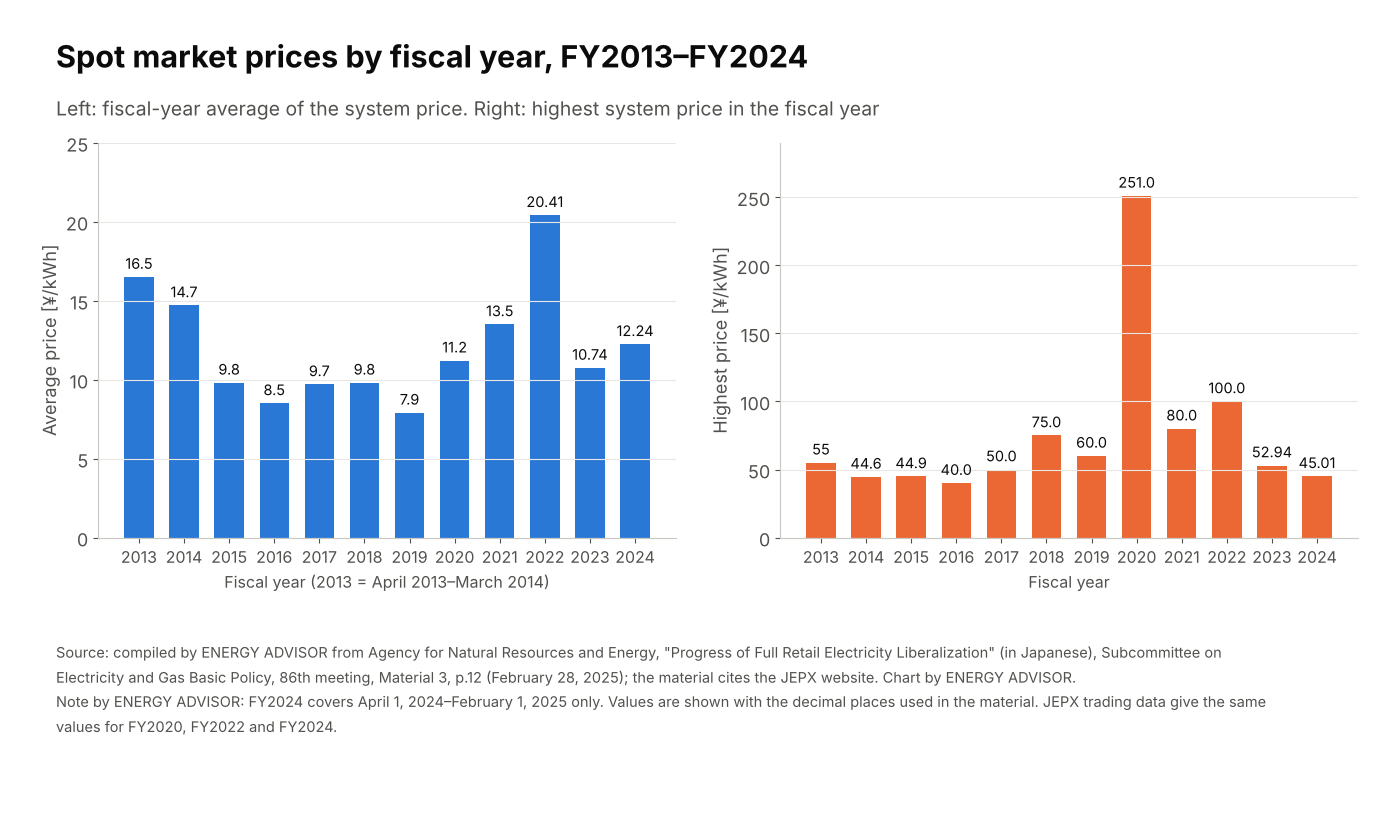
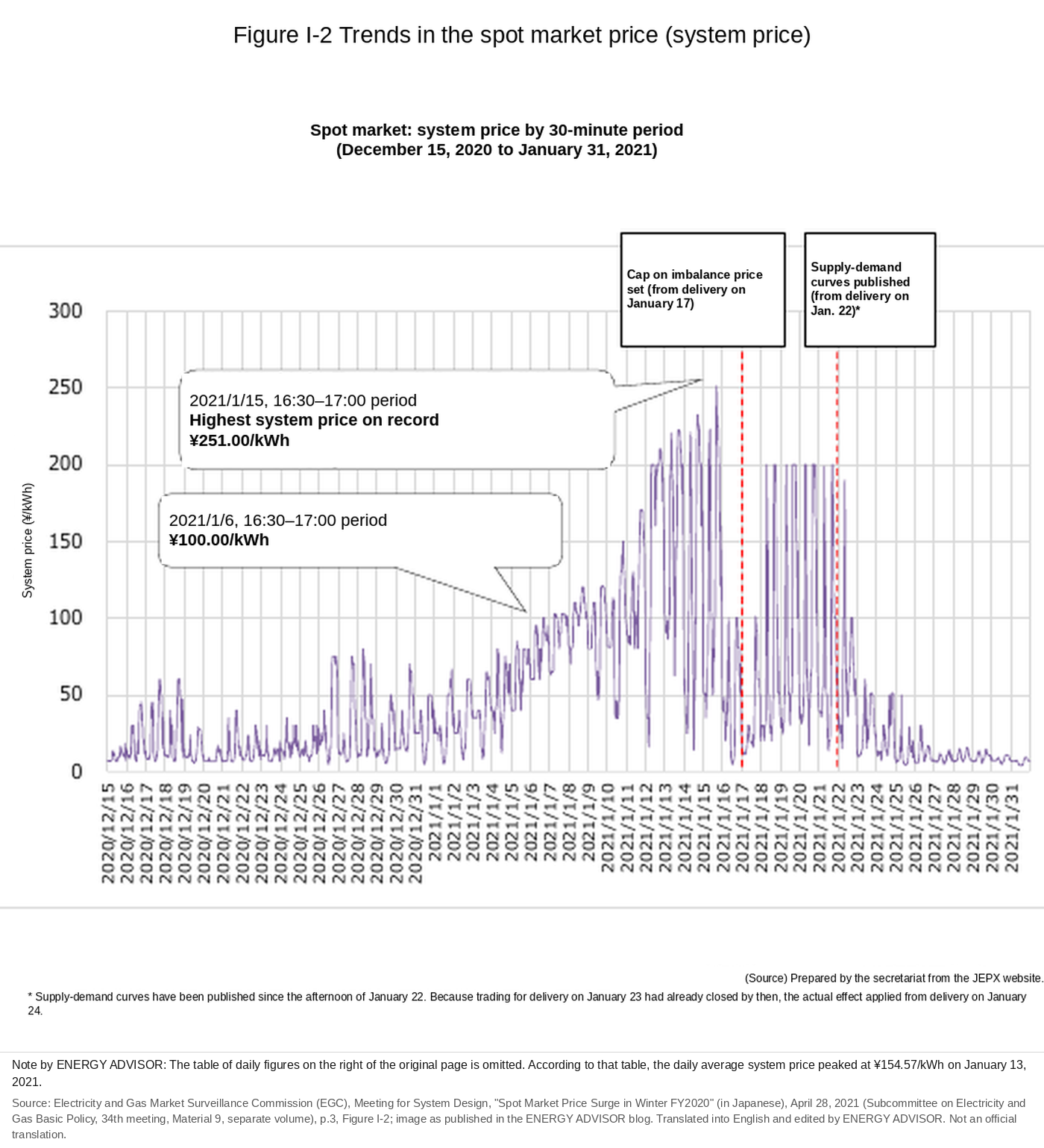
- EGC, Meeting for System Design, “Spot Market Price Surge in Winter FY2020” (in Japanese), April 28, 2021, Subcommittee on Electricity and Gas Basic Policy, 34th meeting, Material 9 (separate volume). https://www.meti.go.jp/shingikai/enecho/denryoku_gas/denryoku_gas/pdf/034_b09_00.pdf
- Agency for Natural Resources and Energy, “Progress of Full Retail Electricity Liberalization” (in Japanese), Subcommittee on Electricity and Gas Basic Policy, 86th meeting, Material 3, February 28, 2025. https://www.meti.go.jp/shingikai/enecho/denryoku_gas/denryoku_gas/pdf/086_03_00.pdf
- Agency for Natural Resources and Energy, “Developments in Stable Electricity Supply at Home and Abroad in Light of the Situation in the Middle East and Future Responses” (in Japanese), Subcommittee on the Next-Generation Electricity and Gas Business Base, May 20, 2026, Material 4. https://www.meti.go.jp/shingikai/enecho/denryoku_gas/jisedai_kiban/pdf/006_04_00.pdf