When a customer asks for a report on CO2 emissions or for reduction targets, the explanation may mention terms such as “SBT,” “CDP” or “GX-ETS.” Many companies are unsure how to respond because they cannot tell whether the request is required by law or is the customer’s own demand. This article sorts out, based on primary sources, what these schemes are and how they differ from legal reporting obligations.
Key points
- 1Behind customers’ requests are three schemes, SBT, CDP and GX-ETS, which differ in who runs them and whom they cover.
- 2SBT is a certification scheme for science-based reduction targets. As of March 31, 2025, a cumulative 1,563 Japanese companies were participating (of which 1,479 had obtained validation), and there is also a route for SMEs.
- 3CDP is a voluntary questionnaire sent on behalf of investors and others. Requests also reach SMEs through its “Supply Chain program.”
- 4The GX Emissions Trading System (GX-ETS) is a statutory emissions trading system that started in April 2026, at the start of FY2026 (April 2026–March 2027), but it covers only companies with direct emissions of 100,000 t or more. SMEs are not directly covered.
- 5Legal reporting obligations (under the Act on Promotion of Global Warming Countermeasures and the Energy Conservation Act) are also limited to businesses above a certain size. For many SMEs, requests come from customers, not from the law.
In the previous parts (up to Part 2), we looked at Scope 1, 2 and 3 as ways of counting emissions, and at the carbon footprint of products (CFP) as a way of calculating emissions per product. This time, we sort out the schemes that actually ask companies for these calculations and reports. For an overview of the series, see Part 1.
SBT: Validation of Science-Based Reduction Targets
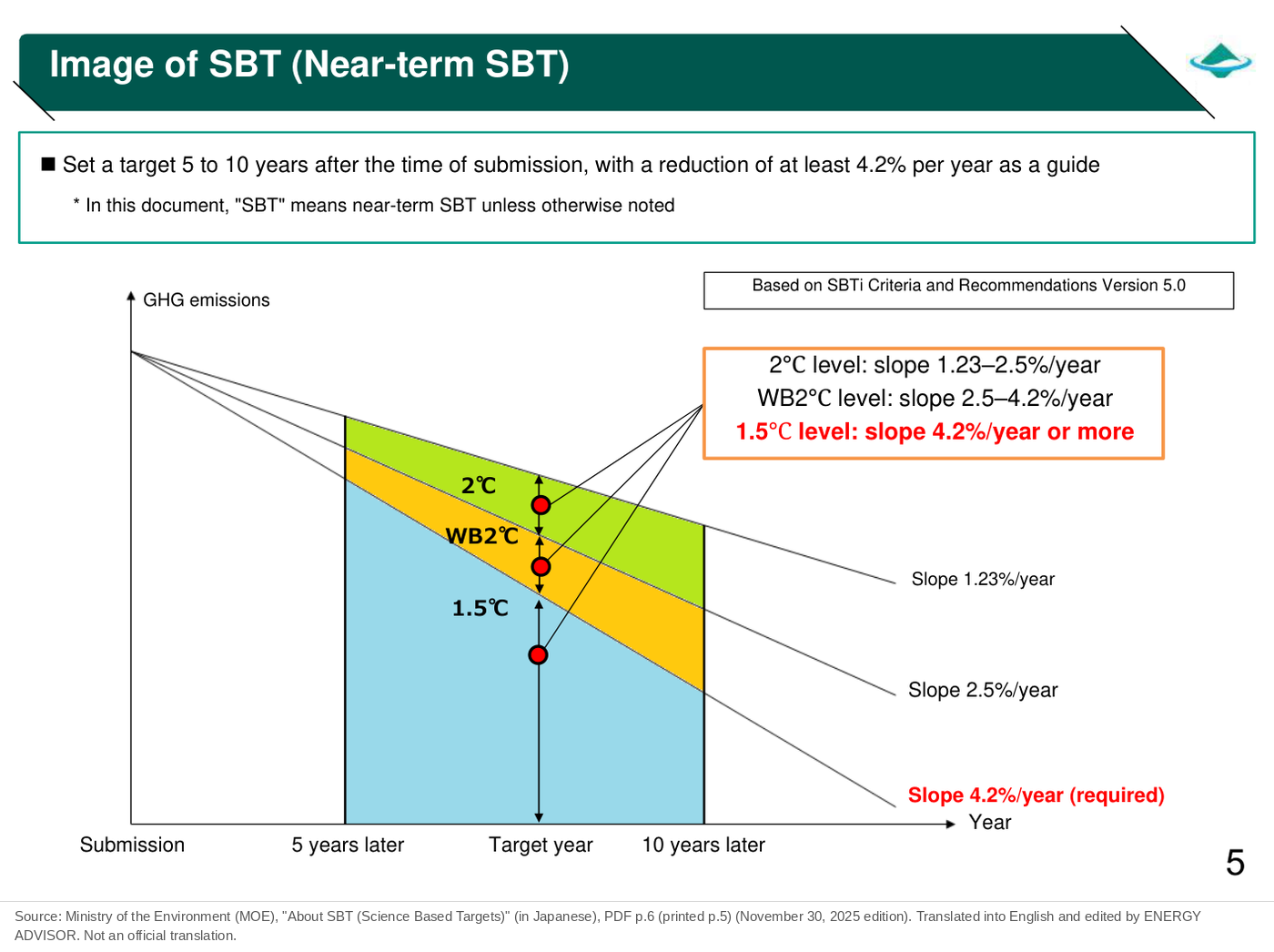
Science Based Targets (SBT) is a scheme in which a company sets reduction targets consistent with the level required by the Paris Agreement and has them validated after review by the Science Based Targets initiative (SBTi), a private validation body. SBTi is an international initiative jointly run by CDP, the UN Global Compact, WRI and WWF; it is not a scheme based on law. According to a Ministry of the Environment (MOE) material (p. 46, as of March 31, 2025), the cumulative number of Japanese companies participating in SBT (validated companies plus committed companies) was 1,563, and the text states that “1,479 companies had obtained validation in FY2024.” The same chart shows 84 “committed” companies, which have declared that they will obtain validation within two years.
Source: MOE, “About SBT (Science Based Targets)” (November 30, 2025 edition), p. 46 (in Japanese)
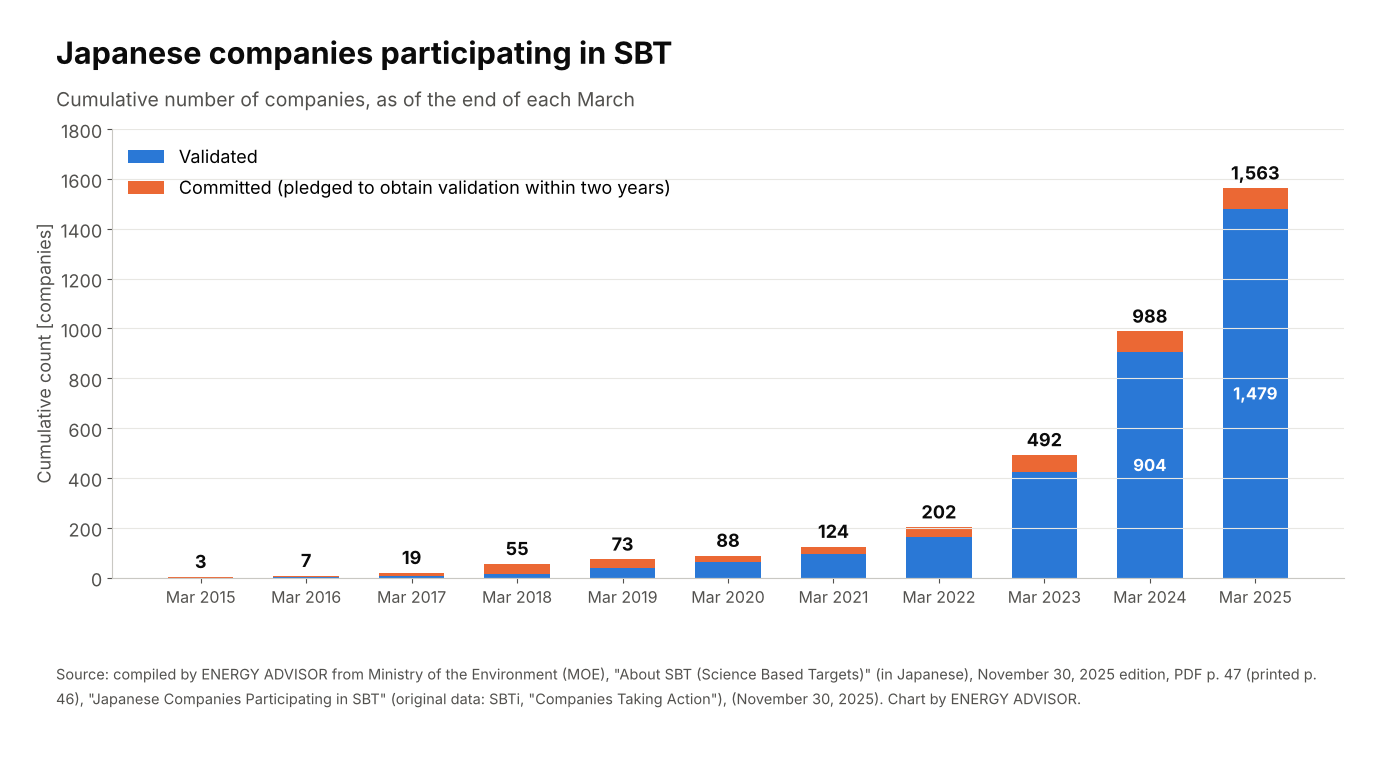
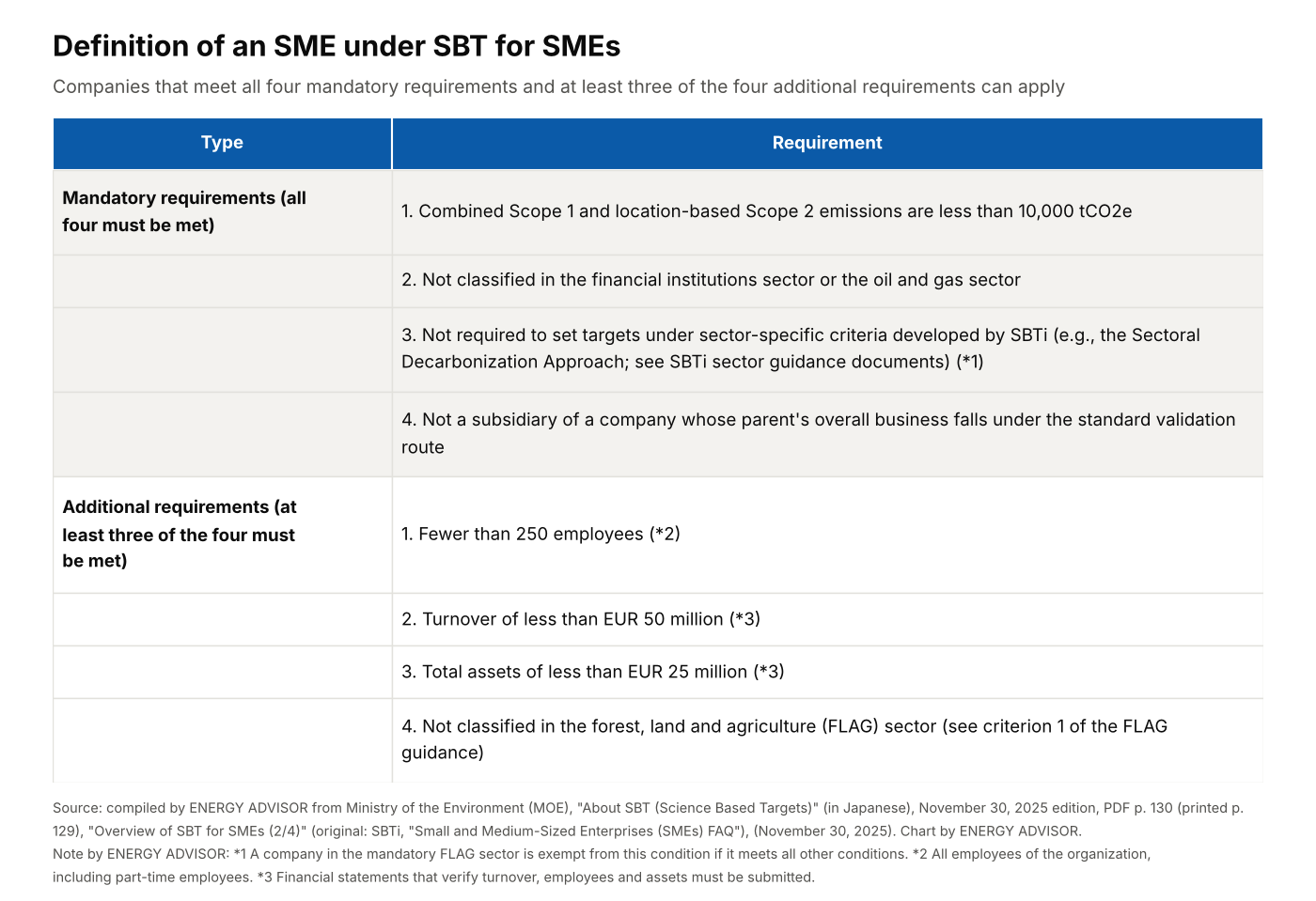
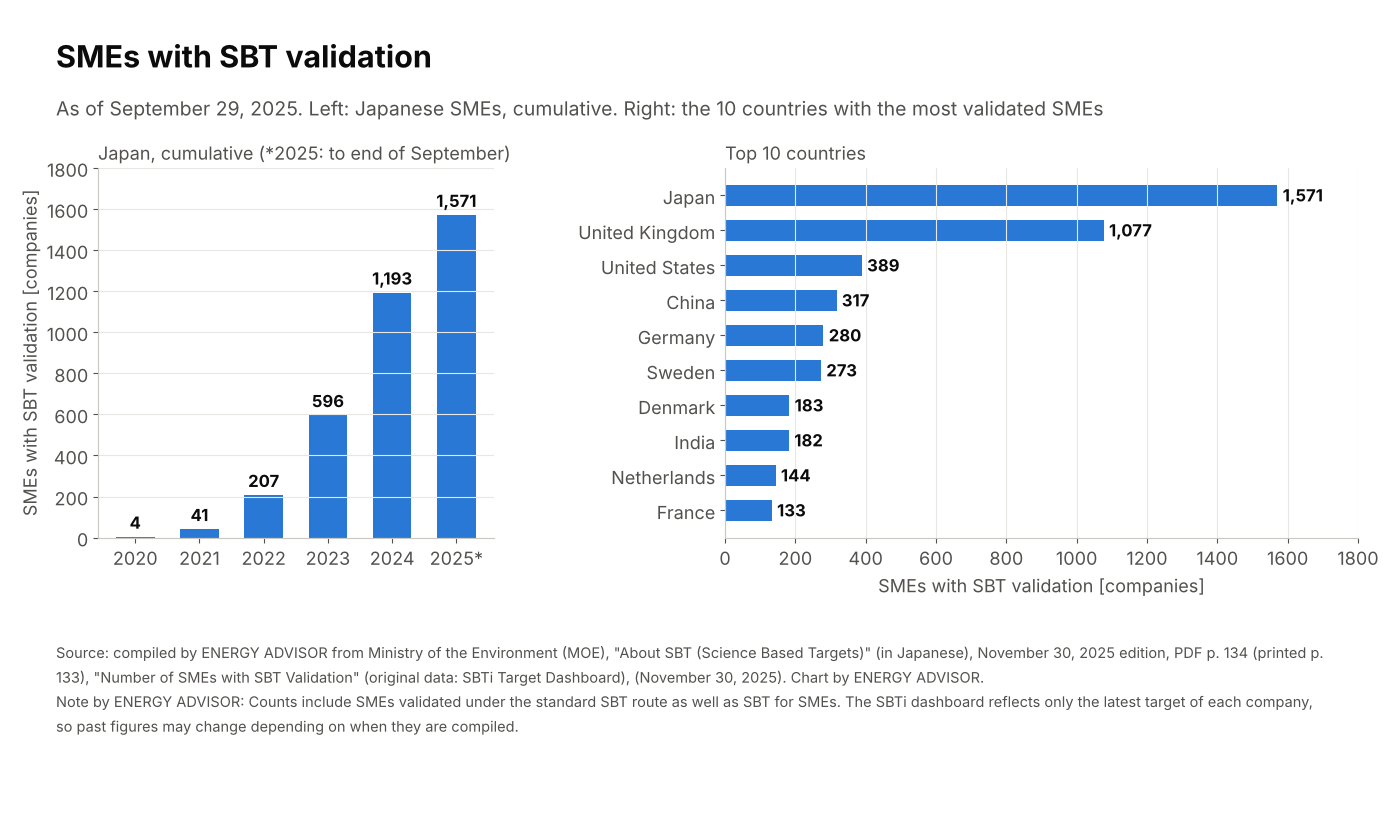
In addition to the standard version, SBT has a route for SMEs, the SBTi SME target-setting route (SBT for SMEs). A company can obtain validation through a simplified procedure if it meets all four mandatory requirements, such as total Scope 1 and 2 emissions (location-based method) of less than 10,000 tCO2e, and at least three of four additional requirements, such as having fewer than 250 employees. As with the standard version, SMEs can choose a near-term target year 5 to 10 years from submission (previously it was fixed at 2030). Under MOE’s support program for SMEs setting SBT and RE100 targets, the number of companies obtaining validation also increased: 4 in FY2018, 7 in FY2019 and 10 in FY2020.
Sources: MOE, “About SBT (Science Based Targets),” Reference 1: SBT for SMEs (as of January 31, 2025), pp. 1–2 (in Japanese); same material, pp. 57–59 (in Japanese)
SBT is strictly a validation that companies obtain voluntarily. Not having it is not a violation of any law.
CDP: A Questionnaire Sent on Behalf of Investors and Others
CDP is an international nonprofit organization that asks companies to disclose information on environmental issues such as climate change, water security and forests; the term also refers to the questionnaire it sends. At the request of institutional investors and others, it sends questionnaires in a standard format to companies, scores the responses and discloses them to the requesters. Because the questions in the questionnaire are copyrighted by CDP, this article does not reproduce them.
CDP has a mechanism called the “Supply Chain program,” through which purchasing companies (large companies) can become CDP members and ask their suppliers to disclose. According to CDP’s page (as worded in October 2026), more than 200 purchasing companies use this mechanism, and more than 45,000 suppliers received disclosure requests in 2025. Many of the CDP-related requests that reach SMEs are sent by large customers through this mechanism.
Sources: CDP, “CDP Supply Chain Membership” (in Japanese); CDP, “CDP Questionnaire” (in Japanese)
GX-ETS: A Statutory Emissions Trading System Launched in FY2026
The GX Emissions Trading System (GX-ETS) is a statutory scheme that, under the Act on the Promotion of a Smooth Transition to a Decarbonized Growth-Oriented Economic Structure (GX Promotion Act), requires CO2 emitters above a certain size to hold emission allowances. Phase 1, from FY2023, was a voluntary framework in which GX League member companies set and reported their own targets. In Phase 2, from FY2026 (April 2026), participation became mandatory for covered businesses under the amended GX Promotion Act. The scheme is overseen by the Ministry of Economy, Trade and Industry (METI), and the GX Acceleration Agency runs the emissions trading portal site.
Sources: METI, Industrial Structure Council, Subcommittee on Emissions Trading System, “Policy for the Detailed Design of the Emissions Trading System” (July 2, 2025, Material 3), p. 7 (in Japanese); METI, “Emissions Trading System” (viewed October 22, 2026) (in Japanese)
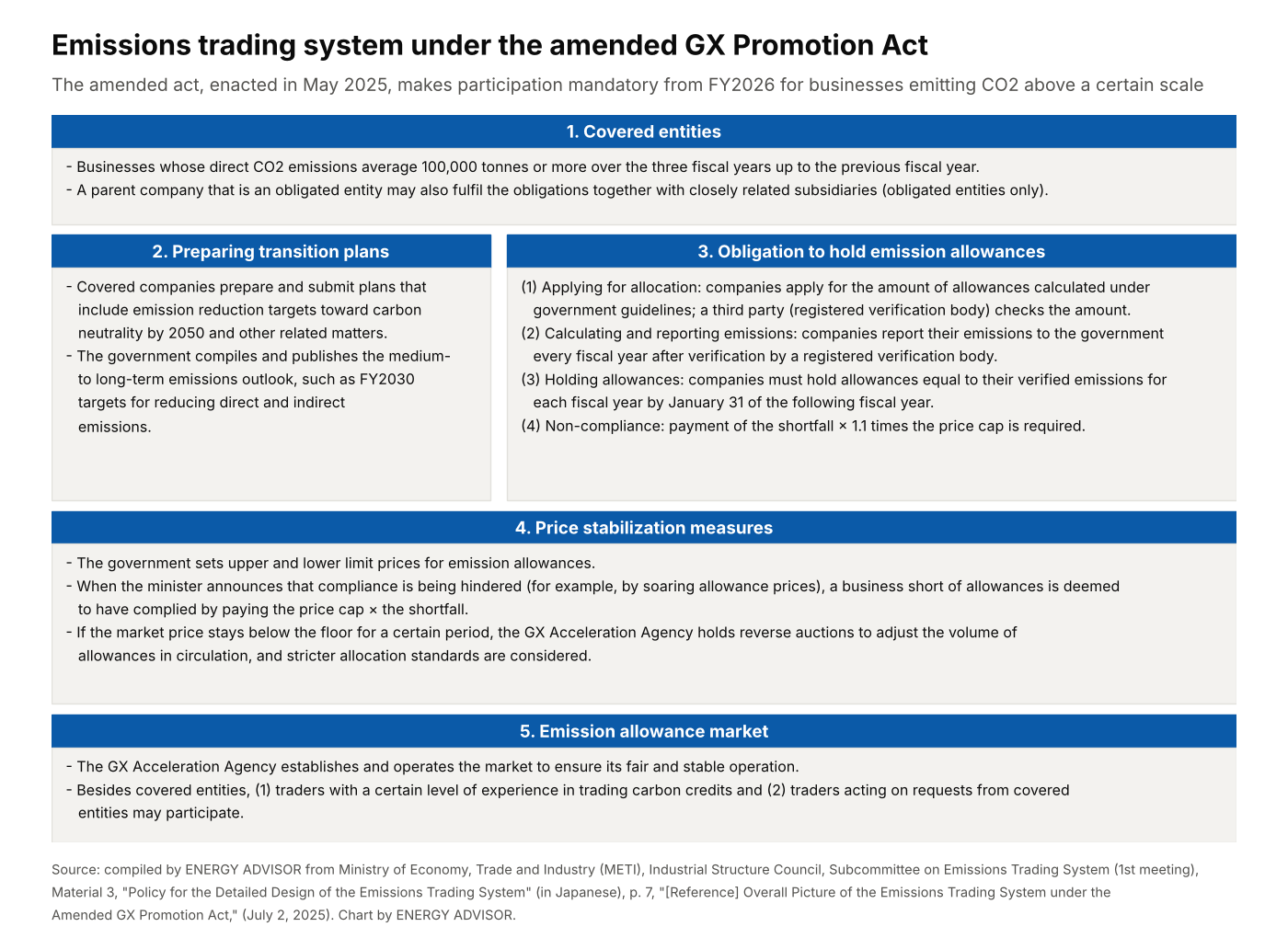
The coverage threshold for Phase 2 is direct CO2 emissions of 100,000 t or more, as an average of the three fiscal years up to the previous fiscal year. At the design stage (July 2025), this threshold was expected to cover about 300–400 businesses, accounting for nearly 60% of Japan’s greenhouse gas emissions. 100,000 t is a considerable scale even for a single factory, and most SMEs do not reach this threshold directly and have no obligation to participate. However, as covered companies switch fuels or install energy-saving equipment to secure allowances, they may ask their SME suppliers to provide emissions data or review their processes. The impact arrives not through direct application of the scheme but through customers.
Even if your company is not on the list of covered businesses, if a covered company moves into reducing emissions across its entire supply chain while securing allowances, the impact will also reach its suppliers.
Legal Reporting Obligations: The SHK System and the Energy Conservation Act
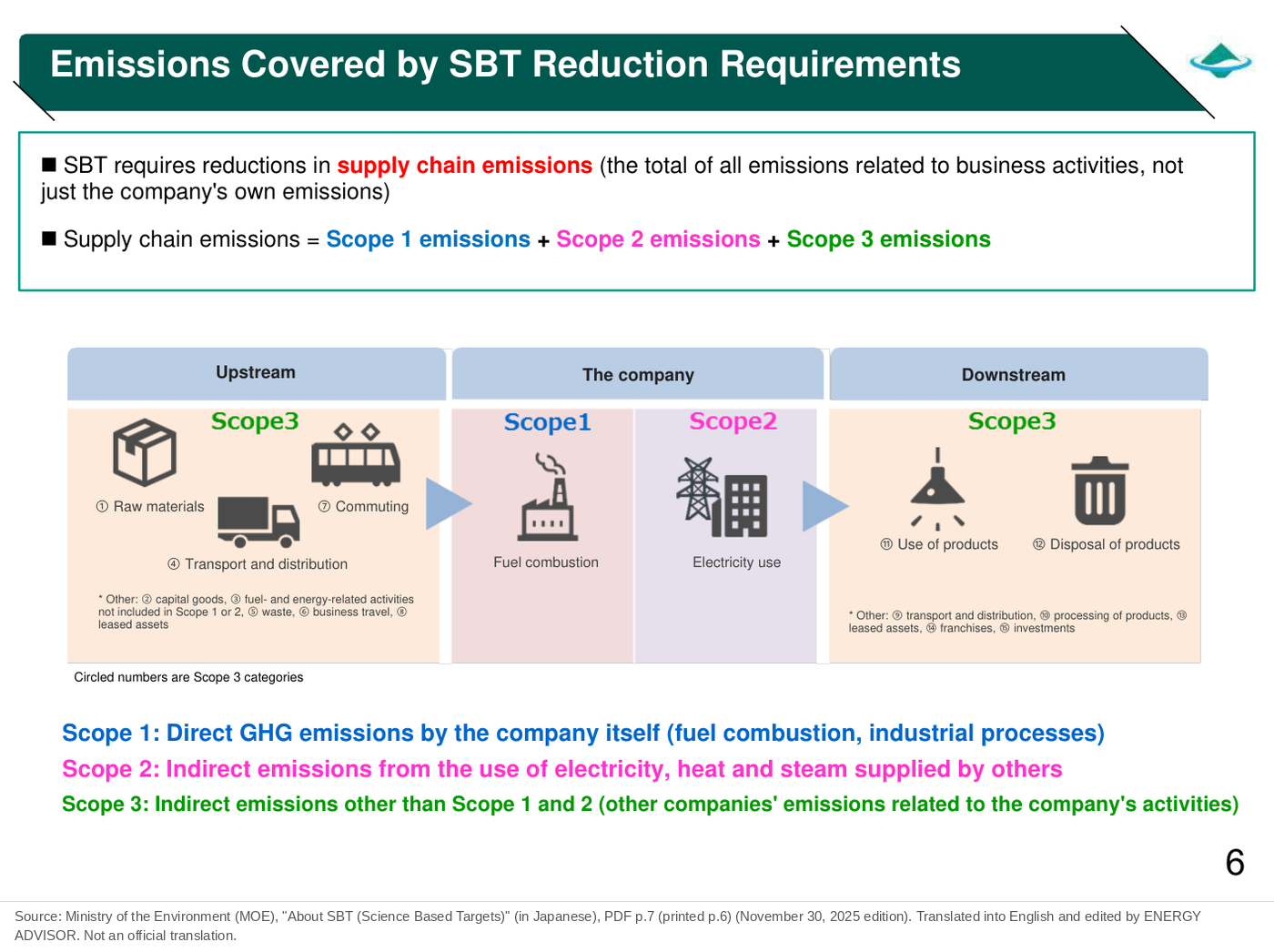
Apart from SBT, CDP and GX-ETS, there are also schemes in which the law itself requires companies to calculate and report emissions. The “SHK system” is the short name of the Mandatory Greenhouse Gas Accounting and Reporting System under the Act on Promotion of Global Warming Countermeasures. It requires businesses above a certain size to calculate their emissions every fiscal year and report them to the government. Covered businesses include energy-related CO2 emitters whose total energy use across all business sites is 1,500 kL/year or more in crude oil equivalent (electricity and fuel use converted into the volume of crude oil with the same heat content), and emitters of non-energy-related gases with 3,000 t or more in CO2 equivalent and 21 or more employees. Under the Act on Rationalization of Energy Use and Shift to Non-fossil Energy (Energy Conservation Act) as well, businesses whose energy use is 1,500 kL/fiscal year or more in crude oil equivalent are designated as “Specified Business Operators” and must submit periodic reports.
Sources: MOE, “Mandatory Greenhouse Gas Accounting and Reporting System: Overview” (in Japanese); Agency for Natural Resources and Energy (ANRE), “Business Categories and Obligations” (in Japanese)
The threshold of 1,500 kL/year in crude oil equivalent applies only to a limited number of large business sites. In other words, the legal reporting obligations under the Act on Promotion of Global Warming Countermeasures and the Energy Conservation Act were designed from the start for a limited number of large businesses, and the vast majority of SMEs have no direct reporting obligation under these laws. This is the core of this article. SBT and CDP requests from customers, and requests from companies dealing with GX-ETS, are not obligations the law imposes on SMEs. They arrive through customers, based either on voluntary private initiatives or on large companies’ own legal obligations. For many SMEs, the starting point for deciding how to respond is to recognize that the party asking them to report or reduce emissions is their customer, not the law.
Even SMEs not covered by the Act on Promotion of Global Warming Countermeasures need to consider separately how to respond to customers’ requests.
Summary of the Schemes: Who Runs Them, Whom They Cover, and How They Reach SMEs
The table below summarizes the differences among the schemes covered so far.
| Scheme | Run by | Covers | How it reaches SMEs |
|---|---|---|---|
| SBT | SBTi (jointly run by CDP, the UN Global Compact, WRI and WWF) | Voluntary participants (standard version and SME version) | Validated companies ask suppliers for emissions data and reductions to cut Scope 3 |
| CDP | CDP (a nonprofit acting on behalf of investors and others) | Companies that respond voluntarily | Purchasing companies ask suppliers to disclose through the Supply Chain program |
| GX-ETS | National government (overseen by METI; a statutory scheme under the amended GX Promotion Act; the GX Acceleration Agency runs the portal site) | Direct emissions of 100,000 t or more, three-fiscal-year average (about 300–400 businesses, as expected in July 2025) | Covered companies may ask suppliers for emissions data or process reviews; SMEs themselves are not covered |
| SHK system and Energy Conservation Act | MOE, METI and ANRE | Businesses with energy use of 1,500 kL/year or more in crude oil equivalent | Most SMEs are not covered; they may be asked by customers that are Specified Business Operators to cooperate in calculations |
Summary
SBT, CDP and GX-ETS requests from customers arise from separate schemes that differ in who runs them and whom they cover. SBT is a voluntary target validated by SBTi; as of March 31, 2025, a cumulative 1,563 Japanese companies were participating (of which 1,479 had obtained validation), and there is also a route for SMEs. CDP is a voluntary questionnaire sent on behalf of investors and others, and it also reaches SMEs through customers via the Supply Chain program. GX-ETS is a statutory scheme that started in FY2026, but it covers only large businesses with direct emissions of 100,000 t or more. The SHK system and the Energy Conservation Act, with their threshold of 1,500 kL/year in crude oil equivalent, also cover only large businesses. For many SMEs, the starting point for deciding how to respond is to recognize that the party actually asking them to report or reduce emissions is their customer, not the law.
Related Articles
- Part 1: What Is Supply Chain Decarbonization?
- Part 2: Scope 1, 2 and 3 and the Carbon Footprint of Products (CFP)
Note: The information in this article is current as of the time of posting and may have changed by the time you read it.
This article is based on published materials from the Ministry of Economy, Trade and Industry and its Agency for Natural Resources and Energy, the Electricity and Gas Market Surveillance Commission, the Organization for Cross-regional Coordination of Transmission Operators (OCCTO) and other sources. The English translations of figures are by ENERGY ADVISOR and are not official translations. When using this information for decisions, please check the original sources. When we find an error, we correct the article and note the date of the correction.
Sources
- SBTi, “Small and Medium-sized Enterprises (SMEs) FAQs”, Version 6.2 (July 2026), Q5. https://docs.sbtiservices.com/resources/FAQsforSMEs.pdf
- MOE, “About SBT (Science Based Targets)” (November 30, 2025 edition) (in Japanese). https://www.env.go.jp/earth/ondanka/supply_chain/gvc/files/SBT_syousai_all_20251130.pdf
- MOE, “About SBT (Science Based Targets),” Reference 1: SBT for SMEs (in Japanese). https://www.env.go.jp/earth/ondanka/supply_chain/gvc/files/SBT_syousai_Option1_20250131.pdf
- CDP, “CDP Supply Chain Membership” (in Japanese). https://www.cdp.net/ja/supply-chain
- CDP, “CDP Questionnaire” (in Japanese). https://www.cdp.net/ja/disclose/question-bank
- METI, Industrial Structure Council, Subcommittee on Emissions Trading System, “Policy for the Detailed Design of the Emissions Trading System” (July 2, 2025, Material 3) (in Japanese). https://www.meti.go.jp/shingikai/sankoshin/sangyo_gijutsu/emissions_trading/pdf/001_03_00.pdf
- METI, “Emissions Trading System” (in Japanese). https://www.meti.go.jp/policy/energy_environment/global_warming/ets.html
- MOE, “Mandatory Greenhouse Gas Accounting and Reporting System: Overview” (in Japanese). https://policies.env.go.jp/earth/ghg-santeikohyo/about.html
- ANRE, “Business Categories and Obligations” (in Japanese). https://www.enecho.meti.go.jp/category/saving_and_new/saving/enterprise/factory/classification/