“A customer asked us for our CO2 emissions, but we don’t know where to start.” This is often heard at SMEs. In fact, of a company’s CO2 emissions, the emissions from electricity use (Scope 2) are a category that can be calculated using only documents the company already has, without specialized equipment or outsourcing. This article explains the steps in order, from the practical task of where to look on the electricity bill, to how to look up emission factors, to an actual calculation example.
Key points
- 1The Scope 2 formula is a simple multiplication: “electricity consumption (kWh) × emission factor (t-CO2/kWh) = CO2 emissions (t-CO2).”
- 2Electricity consumption can be found in the “electricity consumption” field of the monthly electricity bill (meter reading notice).
- 3Emission factors can be looked up in the “supplier-specific emission factors” published every fiscal year by the Ministry of the Environment (MOE) and the Ministry of Economy, Trade and Industry (METI). You need to use the latest factor for the electricity supplier your company has a contract with.
- 4With just the past 12 months of bills, you can calculate your company’s annual Scope 2 emissions starting today.
- 5The calculation and reporting manual for the SHK system under the Act on Promotion of Global Warming Countermeasures can serve as a general guide to calculation methods, even for companies with no legal reporting obligation.
In this series, “SMEs and Decarbonization,” we have looked so far (up to Part 3) at why customers ask for emissions reports (Part 1, in Japanese), the framework of Scope 1, 2 and 3 for counting emissions (Part 2, in Japanese), and the difference between voluntary frameworks such as SBT and CDP and the legal reporting obligation under the Act on Promotion of Global Warming Countermeasures (Part 3, in Japanese). This time, we walk through the actual calculation steps for Scope 2, which is relatively easy to calculate entirely within your own company.
Where to Look on the Bill: “Electricity Consumption”
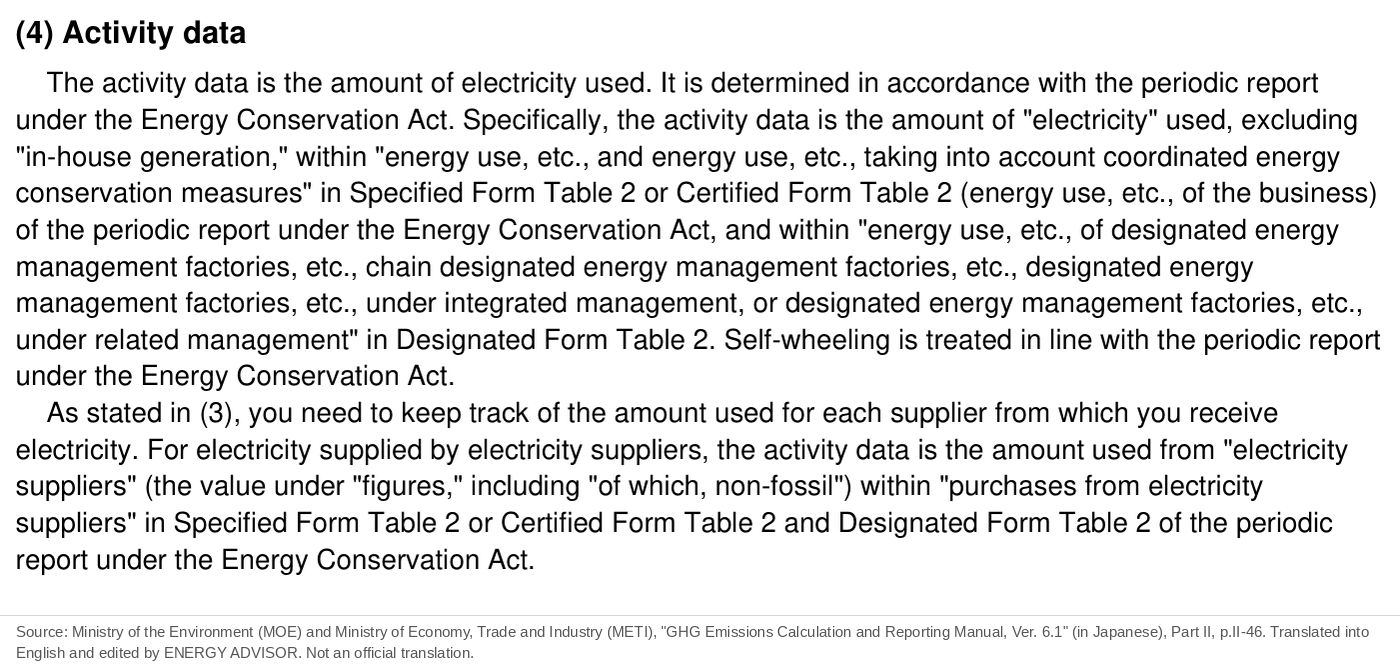
The information needed to calculate Scope 2 is already in the monthly electricity bill (meter reading notice). Bills for sites with high-voltage or extra-high-voltage supply (the voltage classes at which small to large factories and buildings receive power; households and shops are on low-voltage supply) usually show the metering period (the period of use covered), the contract demand (kW) and the electricity consumption (kWh). What you use for the calculation is not the contract demand but the electricity consumption (it may also be labeled “usage” or “amount used”).
A company with several sites receives a bill for each site, so it needs to add up the electricity consumption of all sites. A good way to begin is to take the bill for the most recent month and find where the electricity consumption field is.
The material for the calculation is already in the bill. It is basically the same task as checking the usage field when you look at your electricity bill at home.
The Basic Formula: Electricity Consumption × Emission Factor
Once you know the electricity consumption, all you need to do is multiply it by an emission factor (CO2 emissions per kWh of electricity). The calculation and reporting manual of MOE and METI also states that CO2 emissions from electricity use are calculated with the following formula:
CO2 emissions (tCO2) = electricity consumption (kWh) × emissions per unit of consumption (tCO2/kWh)
The formula itself is just multiplication, so it is not difficult. The key is whether you can prepare the right value for the “emission factor.” Next, we look at how to find it.
Finding the Emission Factor
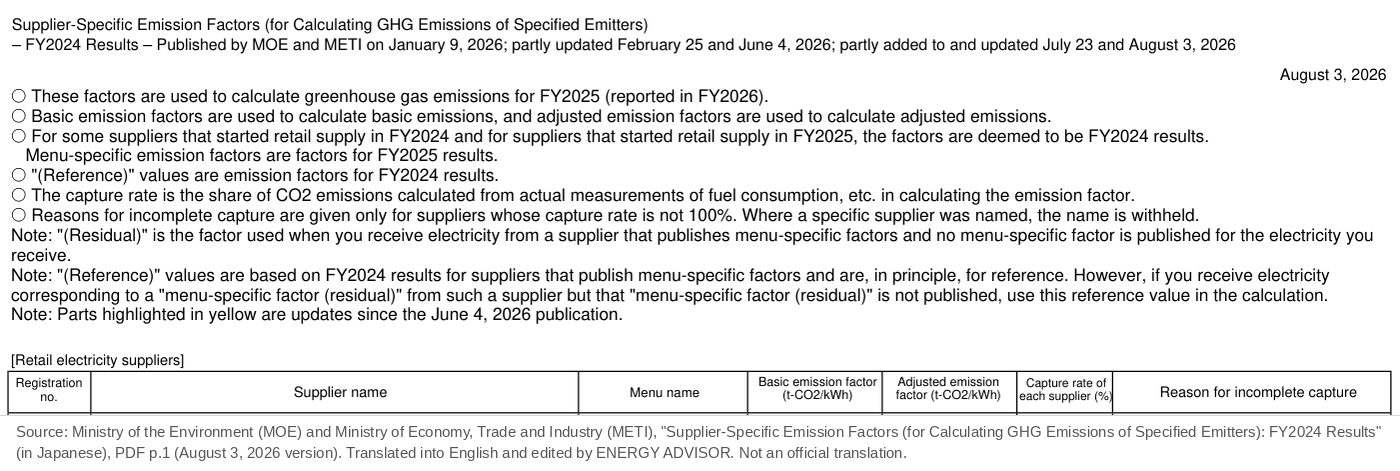
MOE and METI publish emission factors every fiscal year as “supplier-specific emission factors.” The factors for each retail electricity supplier (a company that sells electricity; see the background section of Part 1, in Japanese) are listed in a table (for suppliers that publish factors by tariff plan, factors for each plan), and anyone can check them on the publication page.
Source: MOE and METI, “Calculation Methods and List of Emission Factors” (in Japanese)
As of October 2026, the latest published factors are based on electricity suppliers’ results for FY2024 (April 2024–March 2025; Reiwa 6) (the table is titled “for submission in 2026 (Reiwa 8)”). They were published on January 9, 2026, and some entries were added or updated on February 25, June 4, July 23 and August 3. Factors based on FY2025 results (for existing suppliers) are usually published between late December and early January (FY2024 results were published on January 9, 2026) (see Part 12, in Japanese). Because the factors are updated every fiscal year, you need to check the latest published value for your company’s electricity supplier each time you calculate.
Sources: MOE, “Publication of Basic Emission Factors (Adjusted for Non-fossil Sources), Adjusted Emission Factors, etc. by Electricity Supplier for FY2024” (January 9, 2026) (in Japanese); MOE and METI, “Calculation Methods and List of Emission Factors” (update dates shown, viewed October 22, 2026) (in Japanese); MOE and METI, “Supplier-Specific Emission Factors (for Calculating GHG Emissions of Specified Emitters): FY2024 Results” (in Japanese)
Looking at this table, you will notice that for many electricity suppliers, two values are listed side by side: the “basic emission factor” and the “adjusted emission factor.” The two differ in how far environmental attributes held by the electricity company, such as non-fossil certificates, are reflected in the factor. Under the SHK system (the Mandatory Greenhouse Gas Accounting and Reporting System) based on the Act on Promotion of Global Warming Countermeasures, the calculation and reporting manual sets as the basic method that the supplier-specific or menu-specific “adjusted emission factor” is used when calculating “adjusted CO2 emissions” from electricity use.
Adjusted CO2 emissions from electricity use (tCO2) = electricity consumption (kWh) × supplier-specific adjusted emission factor or menu-specific adjusted emission factor (tCO2/kWh)
Even for electricity suppliers whose “basic” and “adjusted” values differ, calculating with this “adjusted emission factor,” according to your purpose (reporting to customers, statutory reporting and so on), is the basic response in practice.
Calculation Example: A Factory Using 300,000 kWh per Year
Let us check with concrete numbers. Suppose a factory uses 300,000 kWh of electricity per year, and the emission factor is assumed to be 0.000434 t-CO2/kWh. The calculation is as follows:
300,000 kWh × 0.000434 t-CO2/kWh = 130.2 t-CO2 (about 130 t-CO2)
The value of 0.000434 t-CO2/kWh used here is a hypothetical value for illustration and is not the actual value of any specific electricity supplier. In the table of FY2024 results (August 3, 2026 version), the factors range from 0.000000 to 0.001375 depending on the supplier and plan. For reference, the national average factor listed in the same table is 0.000423 t-CO2/kWh. (The national average factor is used, for example, to calculate the emissions to be deducted based on the volume of non-fossil certificates; it is not a substitute for the factor of your own supplier.) When you actually calculate, always check the latest published factor for the electricity supplier your company has a contract with (in the table mentioned above) and use that value.
With 12 Months of Bills, You Can Calculate Starting Today
All you need to calculate Scope 2 are two things: (1) the past 12 months of electricity bills (for all sites, if you have several), and (2) the published factor of your electricity supplier for that period. Without introducing any special equipment or system, you can get started today by gathering the bills you have.
A practical way to keep records is to create four columns in a spreadsheet such as Excel (month, electricity consumption (kWh), emission factor applied (t-CO2/kWh) and CO2 emissions (t-CO2)) and enter one row per month. Adding up 12 months automatically gives annual consumption and emissions, and you can keep recording in the same format from the next fiscal year onward. If you have several sites, adding a column for the site name so that both per-site and company-wide totals are visible will help when answering customers and when reviewing in later years.
“Calculation” may sound like a big job, but in reality it means copying figures from bills and multiplying in Excel. Entering the most recent month into the table gives you a sense of the total workload.
Relationship to the SHK System’s Calculation Manual
As confirmed in Part 3, the SHK system under the Act on Promotion of Global Warming Countermeasures is a legal reporting obligation for energy users above a certain size (in principle, businesses with energy use of 1,500 kL/year or more in crude oil equivalent), and many SMEs have no obligation to submit reports at all.
However, the calculation methods the system sets out (the formula of electricity consumption × emission factor, and how to look up the factors) are a general methodology that companies without a legal submission obligation can also use for reporting to customers and for understanding their own emissions. The formula and the way of looking up factors introduced in this article are also based on the SHK system’s calculation and reporting manual. The manual itself is published on the MOE website and is the place to check if you want more detailed calculation rules.
Source: MOE and METI, “GHG Emissions Calculation and Reporting Manual” (in Japanese)
Summary
Scope 2, that is, CO2 emissions from electricity use, can be calculated with a simple multiplication: “electricity consumption (kWh) × emission factor (t-CO2/kWh).” Electricity consumption can be found in the electricity consumption field of the monthly bill, and emission factors in the “supplier-specific emission factors” published every fiscal year by MOE and METI. Under the SHK system, the basic approach is to use the adjusted emission factor. As in the example of a factory using 300,000 kWh per year, which comes to about 130 t-CO2 with a factor of about 0.000434 t-CO2/kWh, you can calculate your company’s annual emissions starting today, as long as you gather the past 12 months of bills. If you keep monthly records in Excel, you can use them as they are for calculations in later years and for reports to customers.
Related Articles
- Part 1: What Is Supply Chain Decarbonization? (Overview: how requests arise and data on their spread)
- Part 2: Scope 1, 2 and 3 and the Carbon Footprint of Products (CFP) — Company-Wide vs. per Product
- Part 3: The Schemes Behind the Requests — SBT, CDP and GX-ETS, and How They Differ from Legal Reporting Obligations
Note: The information in this article is current as of the time of posting and may have changed by the time you read it.
This article is based on published materials from the Ministry of Economy, Trade and Industry and its Agency for Natural Resources and Energy, the Electricity and Gas Market Surveillance Commission, the Organization for Cross-regional Coordination of Transmission Operators (OCCTO) and other sources. The English translations of figures are by ENERGY ADVISOR and are not official translations. When using this information for decisions, please check the original sources. When we find an error, we correct the article and note the date of the correction.
Sources
- MOE and METI, “Supplier-Specific Emission Factors (for Calculating GHG Emissions of Specified Emitters): FY2024 Results” (published January 9, 2026; some entries added or updated on February 25, June 4, July 23 and August 3) (in Japanese). https://policies.env.go.jp/earth/ghg-santeikohyo/files/calc/r08_denki_coefficient_rev4.pdf
- MOE, press release, “Publication of Basic Emission Factors (Adjusted for Non-fossil Sources), Adjusted Emission Factors, etc. by Electricity Supplier for FY2024” (January 9, 2026) (in Japanese). https://www.env.go.jp/press/press_02235.html
- MOE and METI, “Calculation Methods and List of Emission Factors” (in Japanese). https://policies.env.go.jp/earth/ghg-santeikohyo/calc.html
- MOE and METI, “GHG Emissions Calculation and Reporting Manual, Ver. 6.1” (March 2026), Part II, Methods for Calculating GHG Emissions (in Japanese). https://policies.env.go.jp/earth/ghg-santeikohyo/files/manual/chpt2_6-1.pdf
- MOE and METI, “GHG Emissions Calculation and Reporting Manual,” top page (in Japanese). https://policies.env.go.jp/earth/ghg-santeikohyo/manual.html