As Japan moves toward carbon neutrality by 2050, an important legal obligation is imposed on the power industry by the Sophisticated Methods Act. Under this Act, retail electricity suppliers above a certain size are required to raise, step by step, the share of non-fossil sources (renewable energy, nuclear power and others) in the electricity they sell.
This article explains the background and targets of the Sophisticated Methods Act, the interim targets for each phase and the means of meeting them, based on what has been decided for Phase 3, which began in FY2026.
(Note for readers outside Japan) Japan’s fiscal year (FY) runs from April to March; FY2026 is April 2026–March 2027.
Key points
- 1The Sophisticated Methods Act was enacted in 2009. The target of a non-fossil power ratio of 44% or more in FY2030 was set by revising the evaluation criteria at a council meeting in November 2015.
- 2A policy of 60% or more in FY2040 was presented at a council meeting in December 2025.
- 3Phase 3 covers the three years FY2026–FY2028. The method of setting interim targets keeps the Phase 2 method, with three points revised.
- 4The interim target for FY2026 is an external procurement ratio of 14.8% (final value; supply-demand balance of 1.05). In May 2026, ANRE proposed correcting it to about 15.8% after finding a calculation omission.
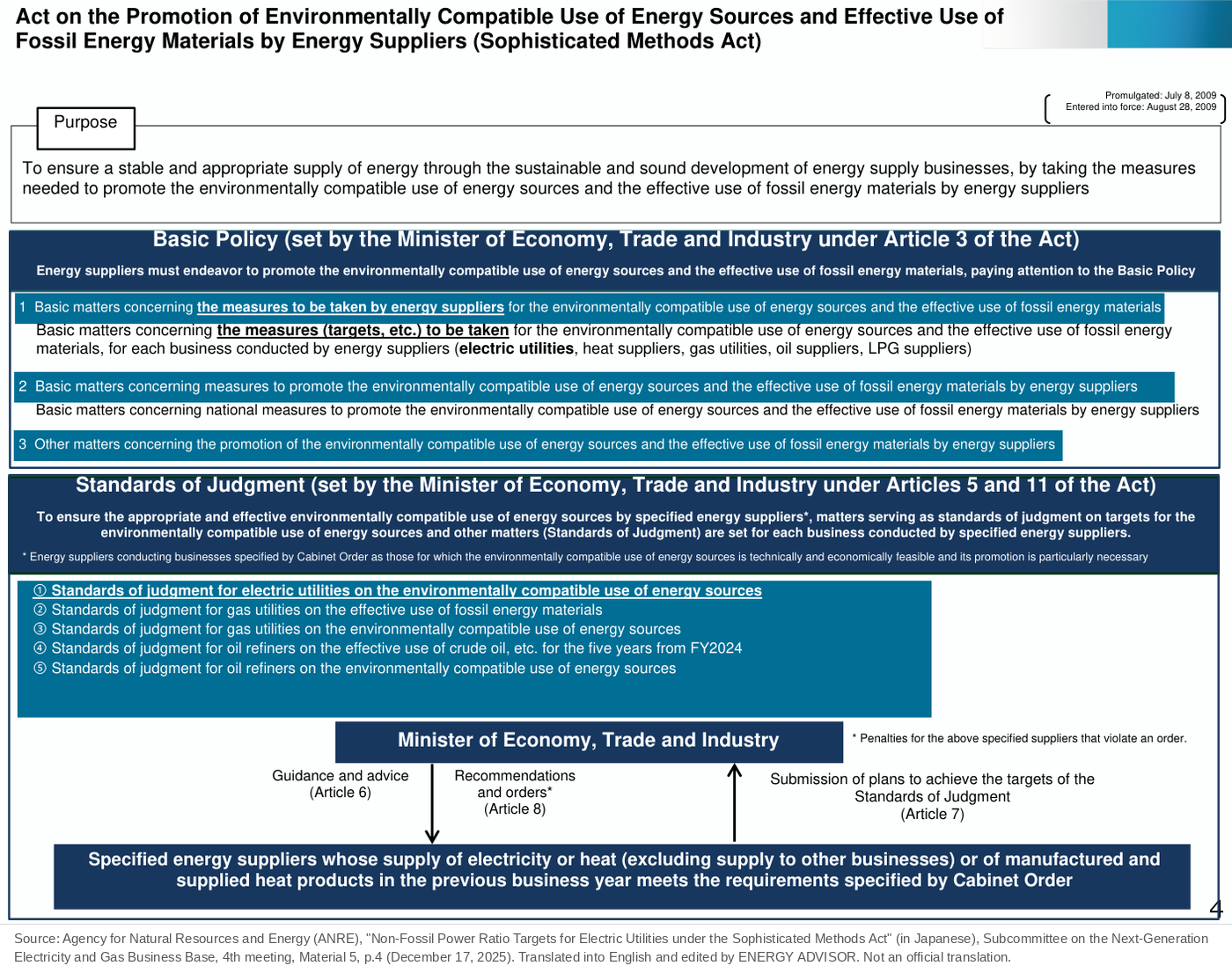
- 5The Act covers suppliers whose electricity sales in the previous fiscal year were 500 million kWh or more.
What the Sophisticated Methods Act Requires of Retail Electricity Suppliers
The Sophisticated Methods Act (official name: Act on the Promotion of Use of Non-Fossil Energy Sources and Effective Use of Fossil Energy Materials by Energy Suppliers) was enacted in 2009 (promulgated on July 8, 2009). When first enacted, its purpose was to encourage energy suppliers such as electric power companies, gas companies and oil companies to expand their use of non-fossil energy.
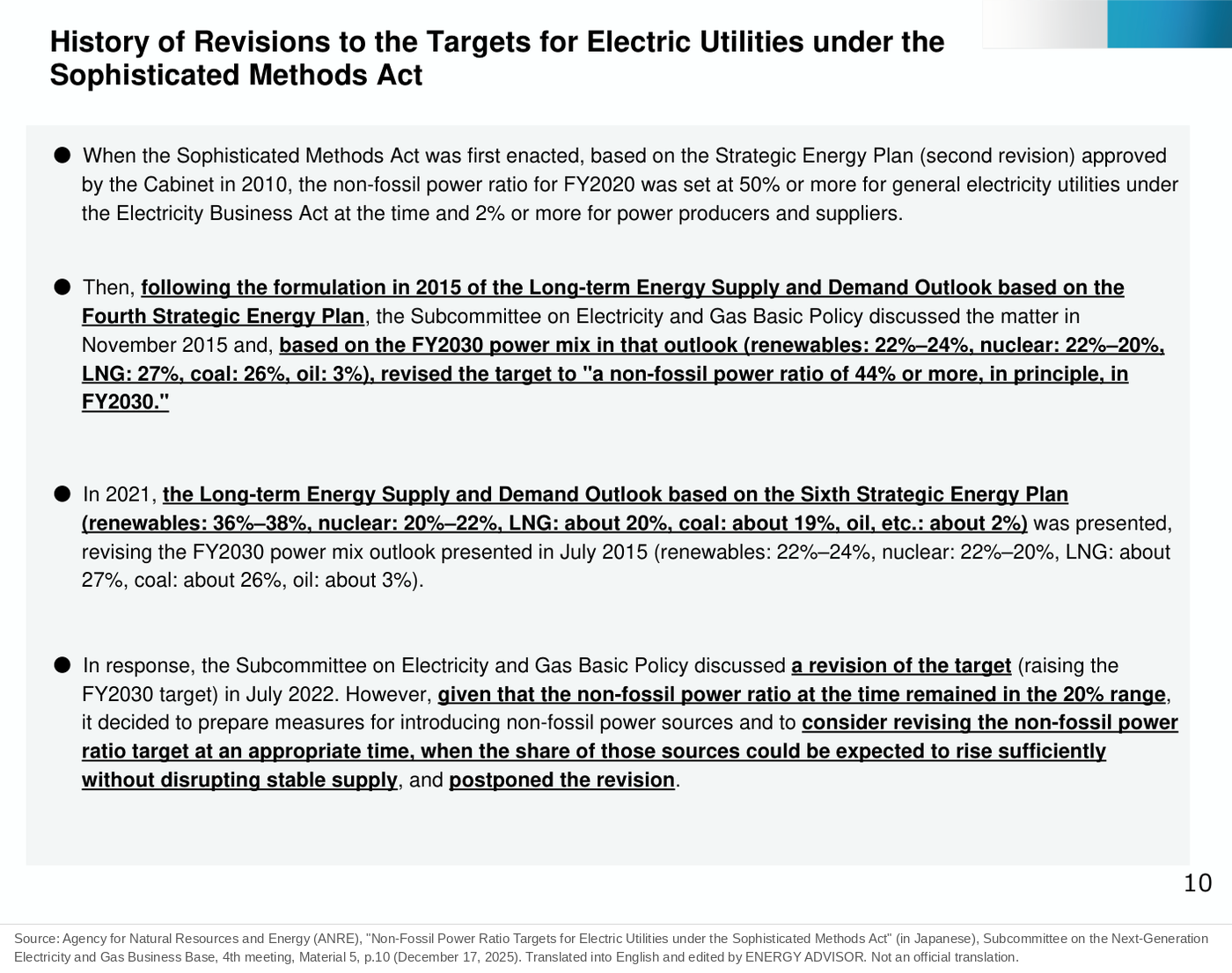
Later, around the full retail market liberalization of 2016, the targets for retail electricity suppliers became specific. At the Subcommittee on Electricity and Gas Basic Policy in November 2015, based on the Long-term Energy Supply and Demand Outlook of 2015, the evaluation criteria (a ministerial notification in which the government sets the targets that suppliers should work toward) were revised to set “a non-fossil power ratio of, in principle, 44% or more in FY2030.” Suppliers above a certain size, including new entrants, are required to meet non-fossil power ratio targets.
The Act covers retail electricity suppliers whose electricity sales in the previous fiscal year were 500 million kWh or more (including general transmission and distribution companies (GT&D companies), which operate the transmission and distribution network in each area, and registered specified transmission and distribution companies). Under this threshold, small retail electricity suppliers are not subject to the obligation.
Targets of 44% in FY2030 and 60% in FY2040
The target under the Sophisticated Methods Act is to achieve a non-fossil power ratio of 44% or more in FY2030. This target was set based on the Long-term Energy Supply and Demand Outlook of 2015.
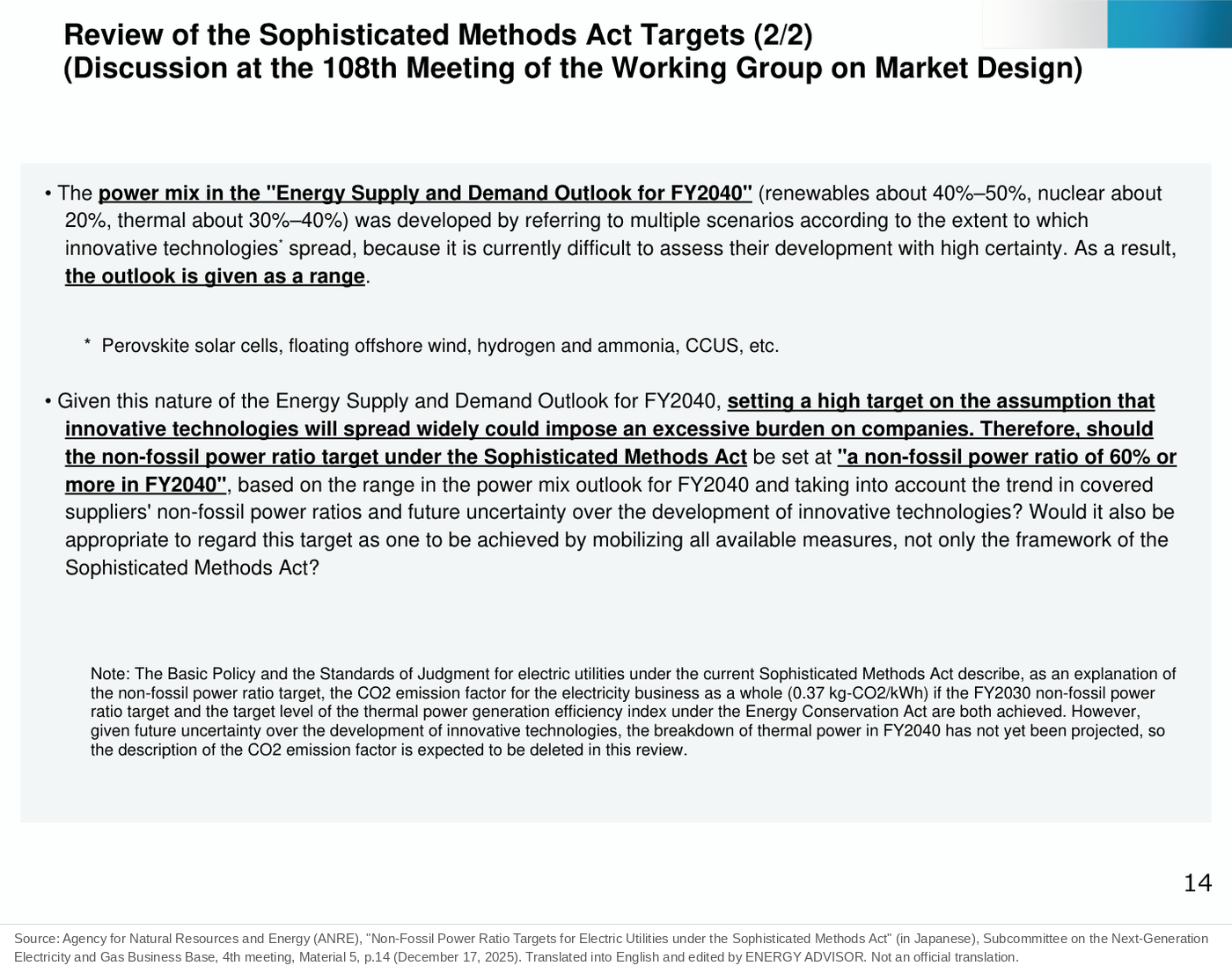
In addition, at the meeting of the Subcommittee on the Next-Generation Electricity and Gas Business Base on December 17, 2025, a policy of setting the FY2040 non-fossil power ratio at 60% or more was presented. The FY2040 target is framed as something to be achieved by mobilizing all available measures, not only the framework of the Sophisticated Methods Act. The policy is to revise the target (ministerial notification) under the Sophisticated Methods Act.
Phases and the History of Interim Targets
Under the Sophisticated Methods Act, interim targets are set in phases of three years each toward the FY2030 target. Every fiscal year, the government calculates and notifies each supplier of its “interim target value” and evaluates its achievement.
| Phase | Period | Setting of interim targets |
|---|---|---|
| Phase 1 | FY2020–FY2022 | Set with a supply-demand balance of about 1.2 as a guide |
| Phase 2 | FY2023–FY2025 | Targets set from the outlook for the supply of certificates |
| Phase 3 | FY2026–FY2028 | Keeps the Phase 2 method, with three points revised |
| Phase 4 (provisional) | FY2029 onward | To be decided |
Three terms are key to understanding how interim targets are set.
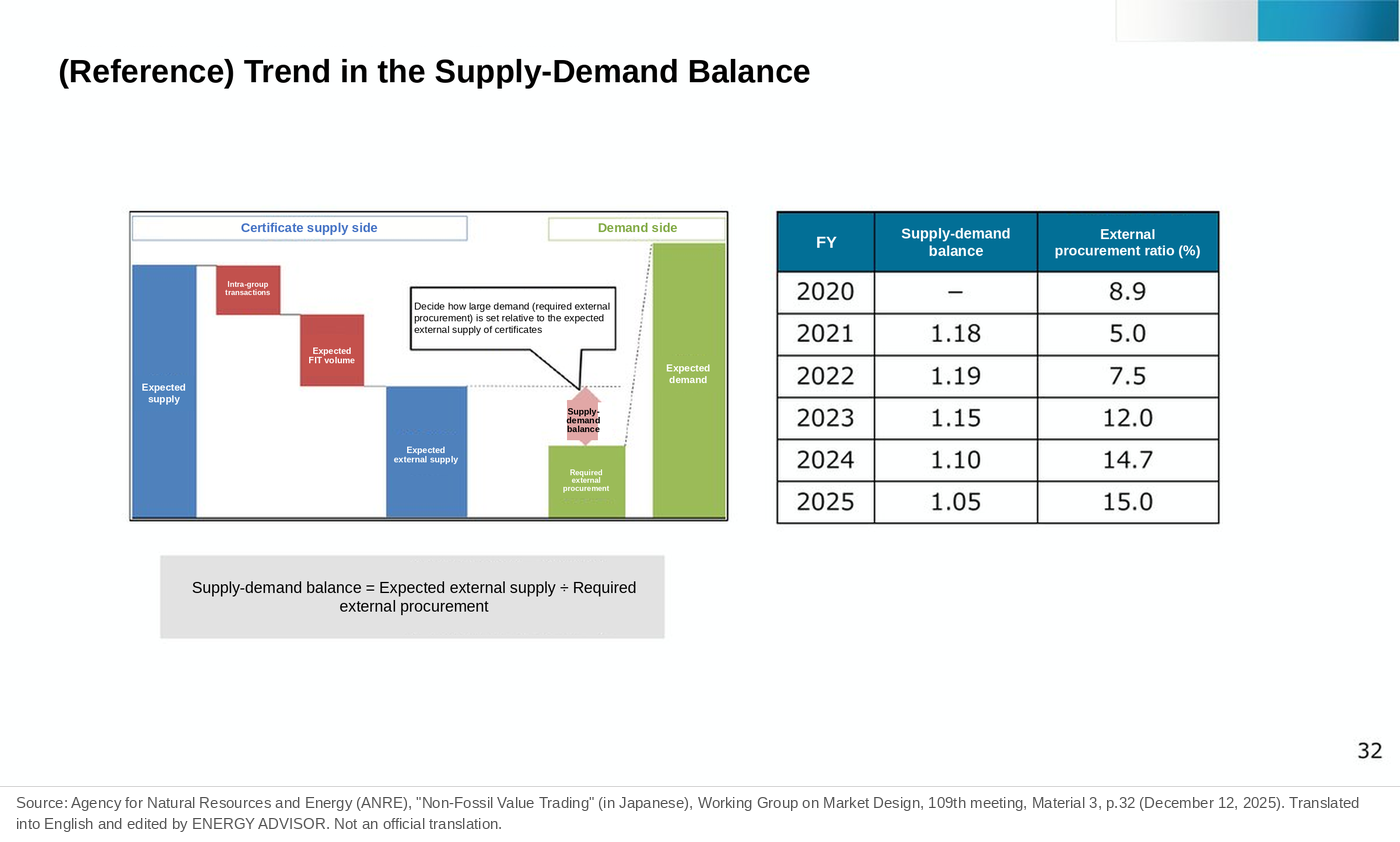
- External procurement ratio: the target level that the government sets for each fiscal year. Multiplying the expected demand (electricity sales) of retail electricity suppliers by this ratio gives the amount of non-fossil electricity that suppliers as a whole need to procure from outside, such as from the market (required external procurement).
- Expected external supply: the amount of non-fossil certificates expected to be put on the market and elsewhere.
- Supply-demand balance: expected external supply ÷ required external procurement. A value above 1 means that the supply of certificates is expected to exceed demand.
The history of the external procurement ratio and the supply-demand balance is as follows.
| Fiscal year | Supply-demand balance | External procurement ratio |
|---|---|---|
| FY2020 | – | 8.9% |
| FY2021 | 1.18 | 5.0% |
| FY2022 | 1.19 | 7.5% |
| FY2023 | 1.15 | 12.0% |
| FY2024 | 1.10 | 14.7% |
| FY2025 | 1.05 | 15.0% |
| FY2026 (final value) | 1.05 | 14.8% |
The external procurement ratio for FY2025 was initially set at 17.0%, but it was later changed to 15.0% after the method of forecasting generation from FIT sources was revised to improve the accuracy of forecasts of certificate supply (24th Interim Report, p.18 and p.20). In addition, a supply-demand balance of about 1.10 had been assumed for FY2024, but based on later survey results and other information it was estimated to come to 0.99 (same, p.11 and p.13).
Three Changes in Phase 3
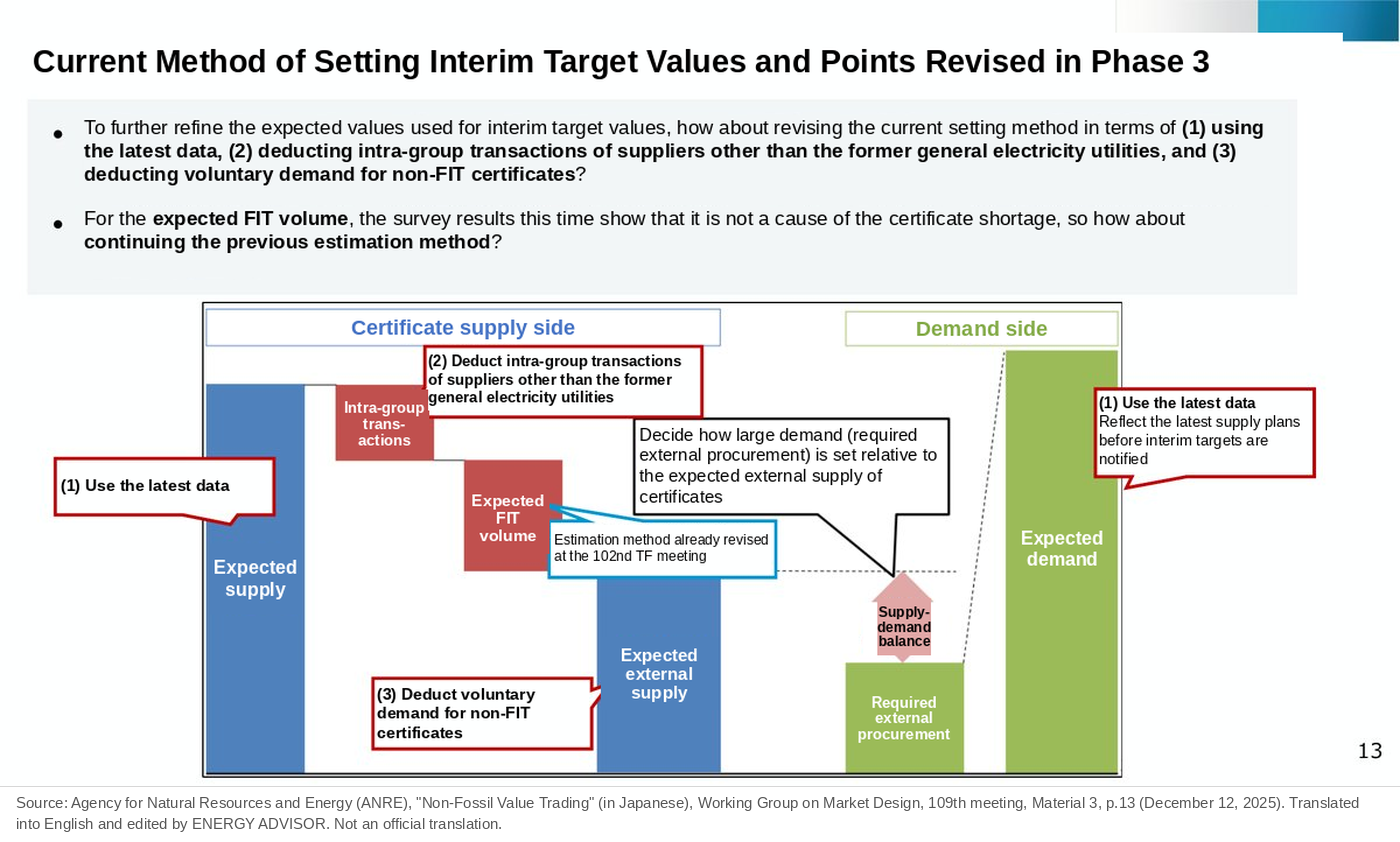
Phase 3 was set at three years (FY2026–FY2028), the same as Phases 1 and 2. The method of setting interim targets keeps the Phase 2 method of setting targets from the outlook for certificate supply, with the following three points revised.
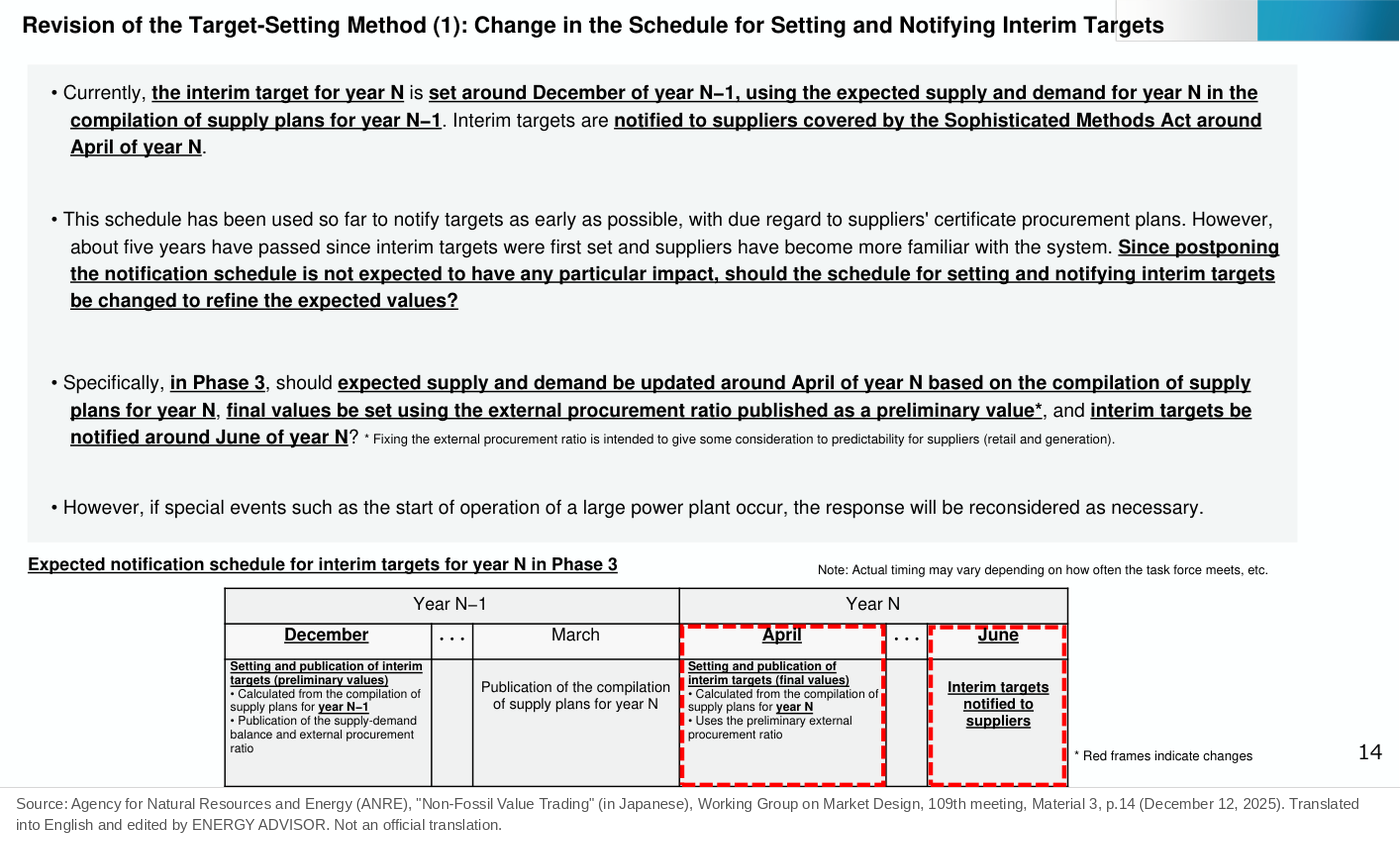
- Using the latest data and changing the timing of notification: until now, interim targets were set around December of year N−1. Under the new approach, final values are set around April of year N based on the latest Electricity Supply Plan (the plans for generation and demand that each supplier submits to the government), and interim target values are notified around June of year N.
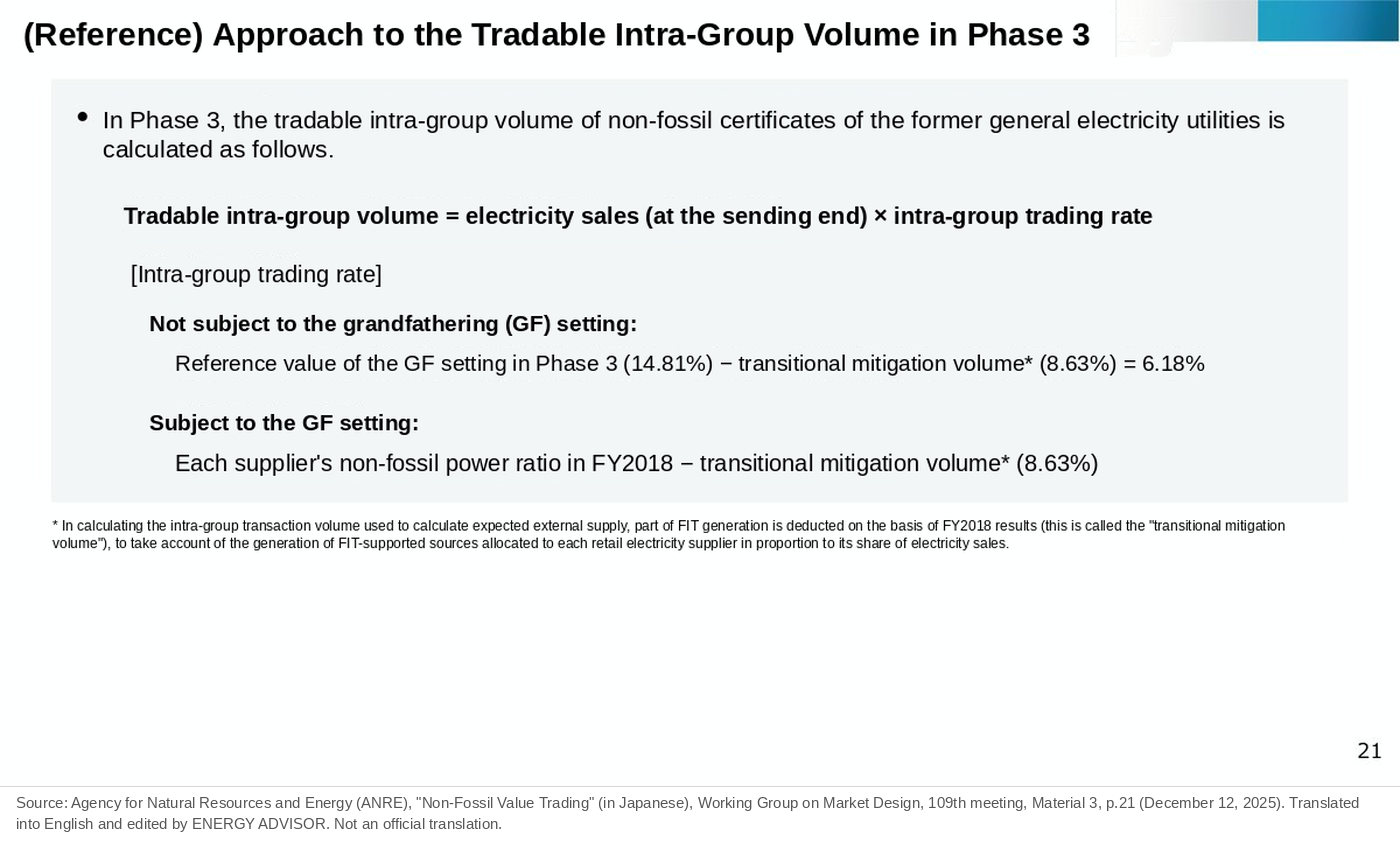
- Deduction of intra-group transactions: the volume of intra-group transactions (non-fossil value exchanged between generation and retail within a company’s own group) is now deducted from expected external supply not only for the former general electricity utilities (the ten major power companies that originally handled everything from generation to retail in each of the ten regional service areas) but also for other suppliers.
- Deduction of voluntary demand: the volume of direct trading by electricity users and of non-FIT certificate trading by retail electricity suppliers not covered by the Sophisticated Methods Act is now deducted from expected external supply.
The second and third points are revisions to estimate accurately the volume of certificates that will actually come onto the market. If expected external supply is overestimated, the target becomes too high compared with the actual supply of certificates.
Interim Target for FY2026 (Final Value)
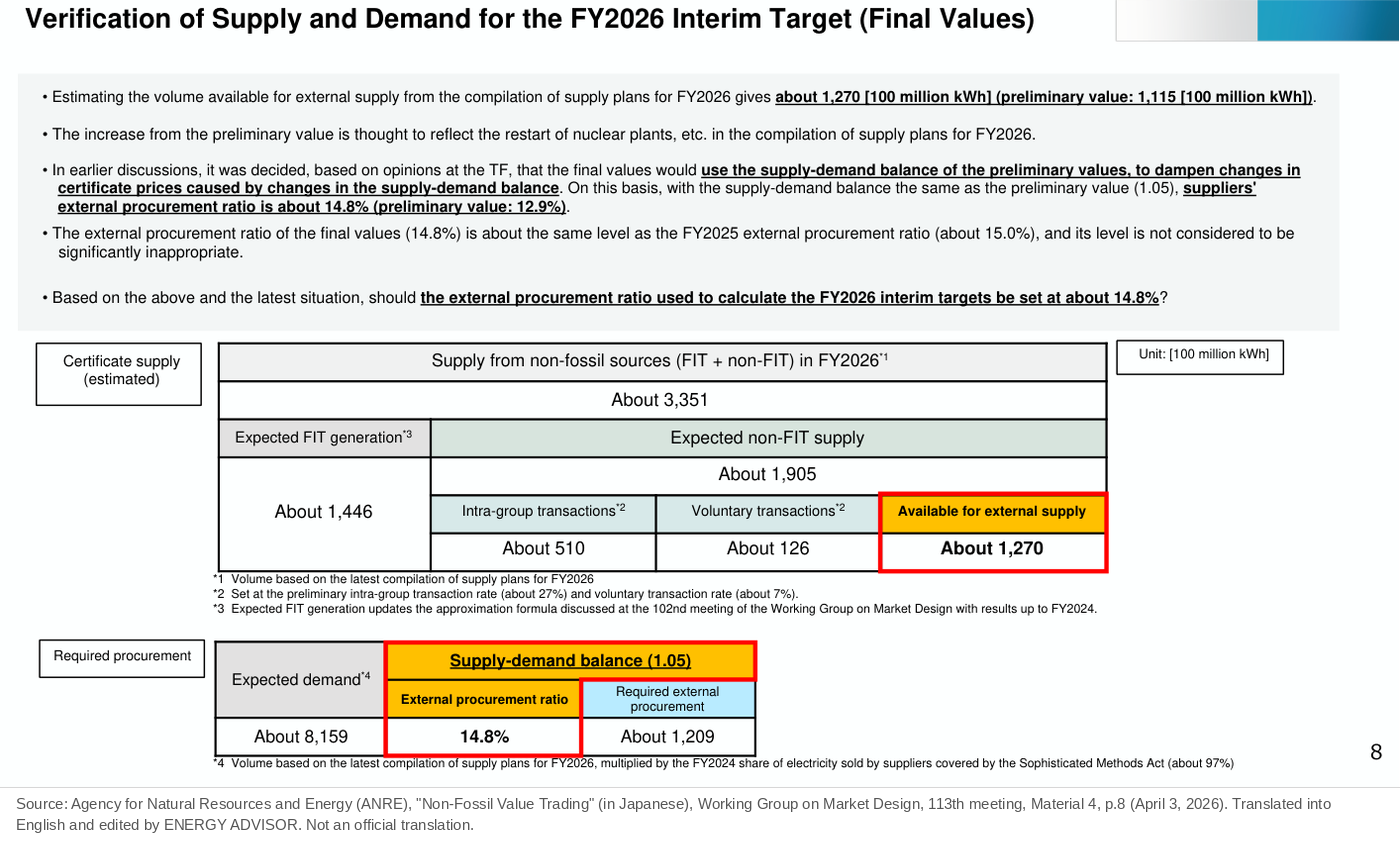
The final values of the FY2026 interim target were presented at the meeting of the Working Group on Market Design on April 3, 2026.
| Item | Preliminary value | Final value |
|---|---|---|
| Expected external supply | About 111.5 billion kWh (111.5 TWh) | About 127.0 billion kWh (127.0 TWh) |
| External procurement ratio | 12.9% | 14.8% |
| Supply-demand balance | 1.05 | 1.05 |
In the final values, expected external supply increased from the preliminary value. The material states that this is considered to be because the compilation of the FY2026 Electricity Supply Plans reflected nuclear restarts and other factors. Because the external procurement ratio is set so as to keep the supply-demand balance at 1.05, the external procurement ratio also rose from the preliminary 12.9% to 14.8%. In the final values, about 120.9 billion kWh (120.9 TWh), obtained by multiplying expected demand of about 815.9 billion kWh (815.9 TWh) by the external procurement ratio of 14.8%, is the required external procurement.
On May 13, 2026, the 1st meeting of the Working Group on Stable Power Supply was told that the lowering of the GF reference ratio (the threshold for a transitional relief that eases the interim targets of retailers with a high share of fossil generation) had not been reflected in the calculation of the final value. Recalculated, the external procurement ratio is about 15.8%, and ANRE proposed correcting the ratio used for the FY2026 interim targets to about 15.8% (Working Group on Stable Power Supply, 1st meeting, Material 9, p.5). The required external procurement above is based on the uncorrected 14.8%.
Non-Fossil Certificates as a Means of Meeting the Target
There are two broad means of achieving the non-fossil power ratio. The first is procuring electricity from a supplier’s own non-fossil sources (solar, wind, hydro, nuclear). The second is buying “non-fossil certificates” (certificates bought and sold in the non-fossil value trading markets). As a result, even retail electricity suppliers that do not own renewable energy facilities can meet the target by buying the certificates they need in the certificate markets.
The types of non-fossil certificates and their markets are covered in article 11, “Overview of Non-Fossil Value and the Three Types of Non-Fossil Certificates,” and article 17, “Japan’s Two Non-Fossil Value Markets: Renewable Energy Value Trading and Sophisticated Methods Act Compliance.”
Measures When Targets Are Not Met
Under the Sophisticated Methods Act, the government can give guidance and advice on suppliers’ efforts (Article 6 of the Act), and can also issue recommendations and orders (Article 8 of the Act). Penalties for violating an order are also provided. The government states that it will respect suppliers’ autonomy and take care not to impose an excessive burden.
For this reason, many retail electricity suppliers make plans for buying non-fossil certificates to meet their targets. However, cost issues have also arisen, for example because the price of non-FIT certificates is stuck at the price cap (article 18), and long-term procurement strategy has become an important management issue.
Summary: Phase 3 of the Sophisticated Methods Act
The Sophisticated Methods Act is a legal framework that requires Japan’s power industry to expand non-fossil sources step by step. The 44% in FY2030 is a target required of retail electricity suppliers above a certain size.
In Phase 3 (FY2026–FY2028), which began in FY2026, the method of setting interim targets keeps the Phase 2 method, with three points revised: the timing of notification, the deduction of intra-group transactions and the deduction of voluntary demand. The external procurement ratio for FY2026 is 14.8% (final value), and ANRE proposed in May 2026 to correct it to about 15.8%. A policy of 60% or more in FY2040 has also been presented, and securing supply in the non-fossil certificate markets and stable prices will be key to operating the system.
This article is based on published materials from the Ministry of Economy, Trade and Industry and its Agency for Natural Resources and Energy, the Electricity and Gas Market Surveillance Commission, the Organization for Cross-regional Coordination of Transmission Operators (OCCTO) and other sources. The English translations of figures are by ENERGY ADVISOR and are not official translations. When using this information for decisions, please check the original sources. When we find an error, we correct the article and note the date of the correction.
Sources
- ANRE, Subcommittee on the Next-Generation Electricity and Gas Business Base, Material 5 (December 17, 2025) (in Japanese): p.3 “Basic structure of the Sophisticated Methods Act” (suppliers with 500 million kWh or more of supply in the previous fiscal year; submission of plans under Article 7; guidance and advice under Article 6; recommendations and orders under Article 8; penalties for violating an order), p.4 (promulgated July 8, 2009), p.10 (revision to 44% in November 2015), p.12 (revision of the ministerial notification), p.13 (trend in the non-fossil power ratio), p.14 (60% or more in FY2040; mobilizing all available measures) (pages were read via a summary and may be off by one). https://www.meti.go.jp/shingikai/enecho/denryoku_gas/jisedai_kiban/pdf/004_05_00.pdf
- ANRE, Subcommittee on the Next-Generation Electricity and Gas Business Base, Working Group on Market Design, “24th Interim Report” (May 2026; the draft was Material 3 of the 111th meeting in February 2026) (in Japanese): p.11 and p.13 (FY2024 supply-demand balance estimated at 0.99, expected to come to 0.99), p.18 (external procurement ratio initially 17.0% on the premise of a supply-demand balance of 1.05), p.20 (changed to 15.0% after revising the method of forecasting FIT generation), p.32 (60% or more in FY2040; revision of the ministerial notification; final decision by the Subcommittee on the Next-Generation Electricity and Gas Business Base), p.33 (Phase 3 is FY2026–FY2028; Phase 4 (provisional)), pp.34–35 (the three revisions; interim target values notified around June of year N) (pages were read via a summary and may be off by one). https://www.meti.go.jp/shingikai/enecho/denryoku_gas/jisedai_kiban/system_review/pdf/20260501_2.pdf
- ANRE, Working Group on Market Design, 113th meeting, Material 4 “Non-Fossil Value Trading” (April 3, 2026) (in Japanese): pp.3–4 (approach to setting interim target values; notification schedule), p.6 (premises of the final values: expected demand × external procurement ratio, etc.), p.8 (verification of supply and demand for the FY2026 final values), p.9 (preliminary values) (pages were read via a summary and may be off by one). https://www.meti.go.jp/shingikai/enecho/denryoku_gas/jisedai_kiban/system_review/pdf/113_04_00.pdf
- ANRE, Working Group on Market Design, 109th meeting, Material 3 “Non-Fossil Value Trading” (December 12, 2025) (in Japanese): p.13 (points revised; confirmed from the text in the figures of original posts 15 and 23), p.14 (change in the setting and notification schedule), p.21 (approach to the tradable intra-group volume in Phase 3), p.32 (history of the supply-demand balance and the external procurement ratio) (p.21 and p.32 confirmed from the text in the figures). https://www.meti.go.jp/shingikai/enecho/denryoku_gas/jisedai_kiban/system_review/pdf/109_03_00.pdf
- ANRE, “Approach to the Evaluation Criteria under the Sophisticated Methods Act” (August 25, 2020) (in Japanese): pp.2–3 (guidance and advice under Article 6; recommendations and orders under Article 8; respect for suppliers’ autonomy; calculation and evaluation of interim target values). https://www.enecho.meti.go.jp/category/resources_and_fuel/koudokahou/pdf/2020_0825.pdf