In April 2026, the GX Emissions Trading System (GX-ETS), Japan’s first mandatory emissions trading system, entered full operation. A system that had been voluntary until then changed into one that requires participation by companies emitting 100,000 tonnes of CO2 or more a year.
This article explains the outline of the GX-ETS, its three phases, the covered companies, how allowances and trading work, and what companies are required to do.
Key points
- 1The GX-ETS became mandatory in April 2026. It covers companies with direct CO2 emissions of 100,000 tonnes or more a year (about 300 to 400 companies, expected to cover nearly 60% of Japan’s greenhouse gas emissions).
- 2The price band for allowances in FY2026 is an upper reference price of ¥4,300/t-CO2 and an adjustment reference price of ¥1,700/t-CO2. Both will be raised step by step toward FY2030.
- 3The system is strengthened in three phases. Paid auctions are scheduled to start for the power sector from FY2033 onward.
(Note for readers outside Japan) Japan’s fiscal year (FY) runs from April 1 to March 31 of the following year; FY2026 is April 2026–March 2027. The system is overseen by the Ministry of Economy, Trade and Industry (METI), the ministry responsible for Japan’s industrial and energy policy.
Purpose and Legal Basis of the GX-ETS
The GX-ETS (Green Transformation – Emissions Trading System) is Japan’s emissions trading system based on the Act on the Promotion of a Smooth Transition to a Decarbonized Growth-Oriented Economic Structure (GX Promotion Act). It sets “emission allowances” for the CO2 that companies emit, and companies can trade surpluses and shortfalls of allowances in a market.
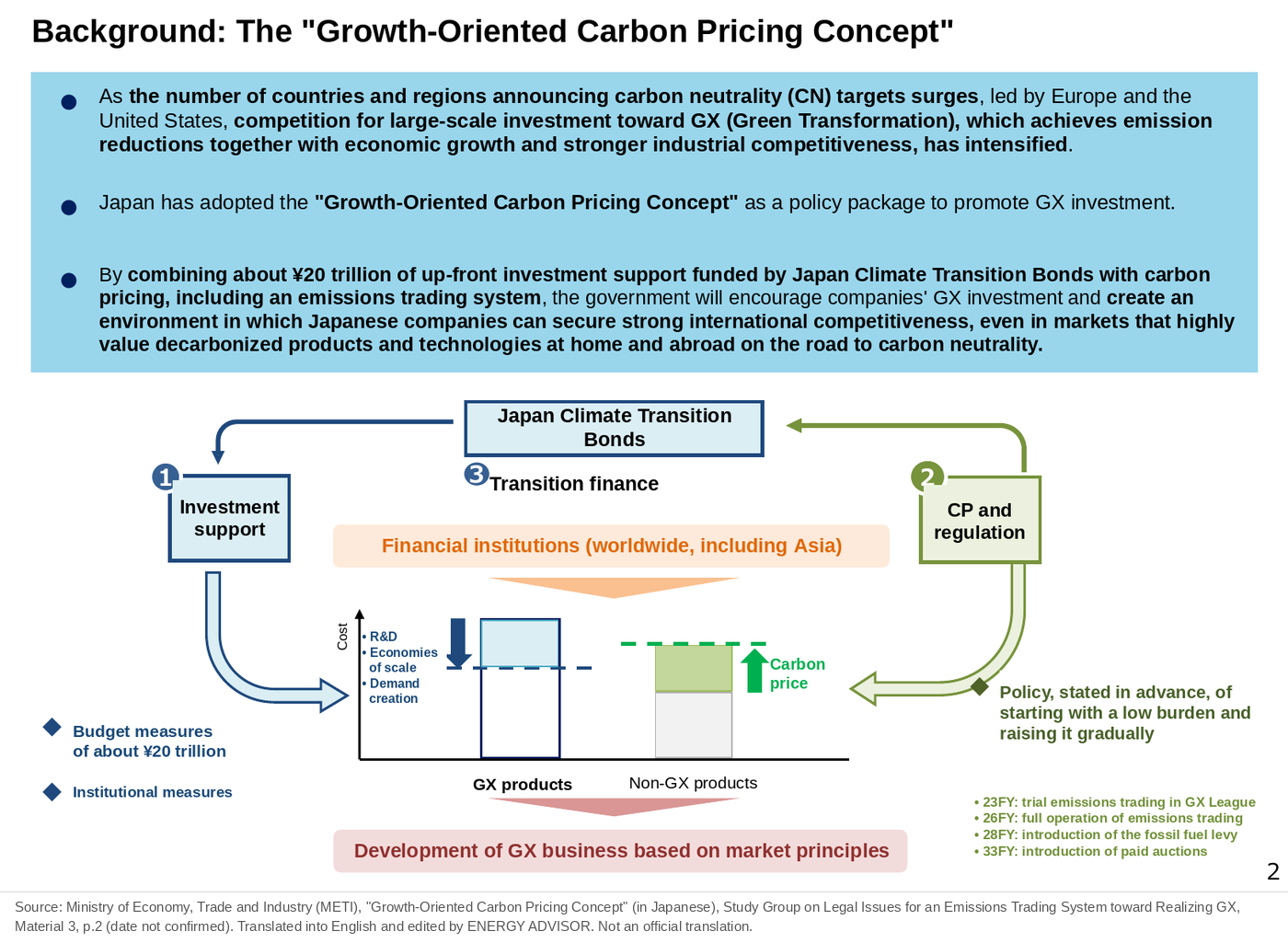
Emissions trading systems have been introduced in many countries, starting with the EU-ETS in Europe (launched in 2005). In Japan, voluntary action had long been the main approach. The GX-ETS was designed as a legally binding system to achieve the 2050 carbon neutrality target (the government’s goal of net-zero greenhouse gas emissions by 2050).
The GX Promotion Act was enacted in May 2023 and promulgated on May 19 of that month. The amended GX Promotion Act, enacted in May 2025, then provided for the system’s full operation, including mandatory emissions trading (in force from April 2026). The GX-ETS is one of the two pillars of Japan’s carbon pricing (policies that put a price on CO2 emissions). As the other pillar, a fossil fuel levy (carbon levy) is planned to be introduced from FY2028.
Three Phases: Voluntary, Mandatory and Paid
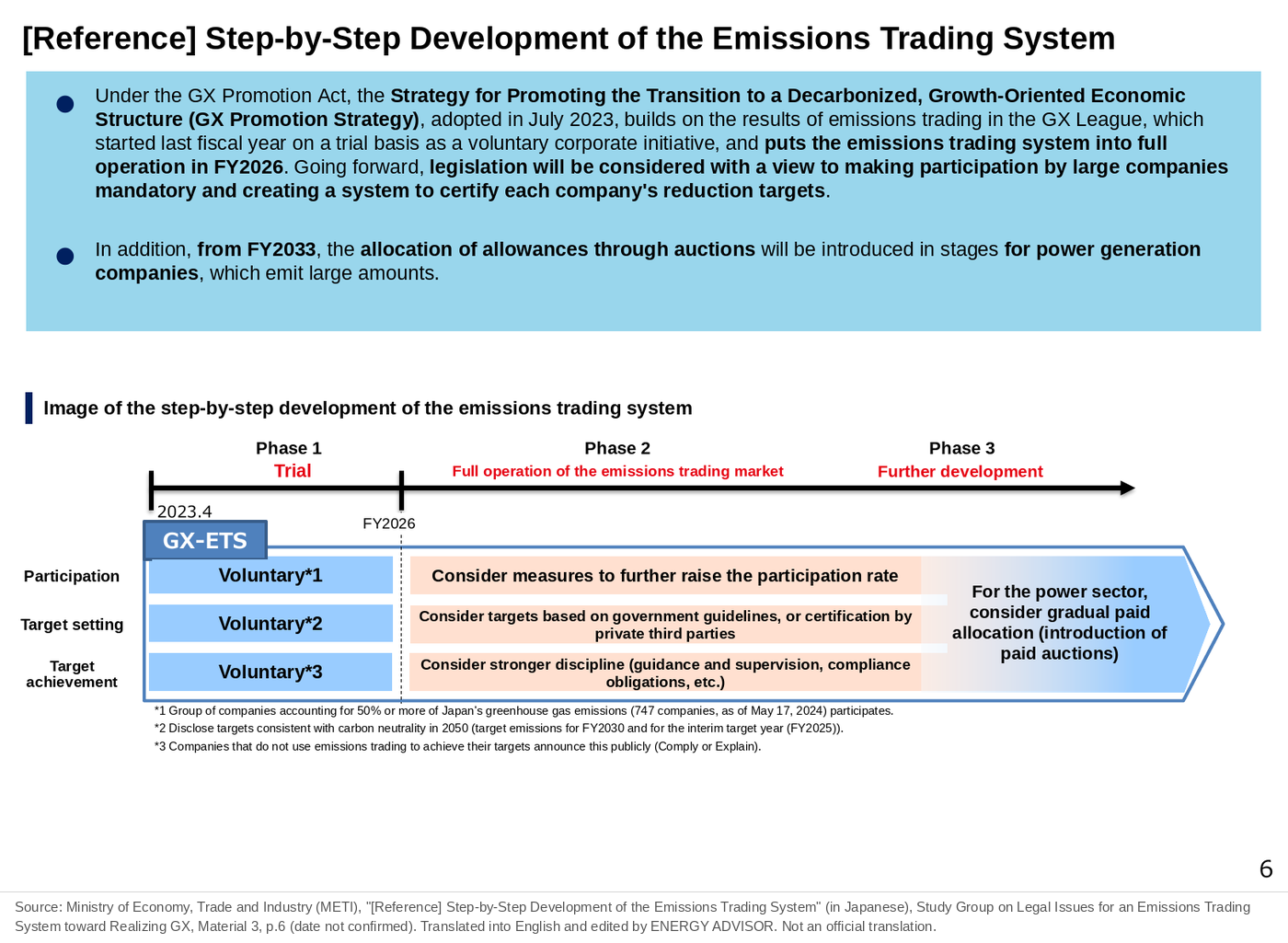
The GX-ETS is designed to be strengthened step by step over three phases. Rather than introducing strict regulation all at once, the approach gives companies time to prepare during the transition.
Phase 1 (FY2023–FY2025): Voluntary Participation in the GX League
In Phase 1, companies that supported the GX League (a government-led framework in which companies working on decarbonization take part) joined voluntarily and worked toward emission reduction targets they set themselves. A group of companies accounting for 50% or more of Japan’s greenhouse gas emissions (747 companies as of May 17, 2024) took part. There was no mandatory allocation of allowances and no penalty, and the phase was treated as a “trial.”
Phase 2 (FY2026–FY2032): Mandatory Participation and Free Allocation
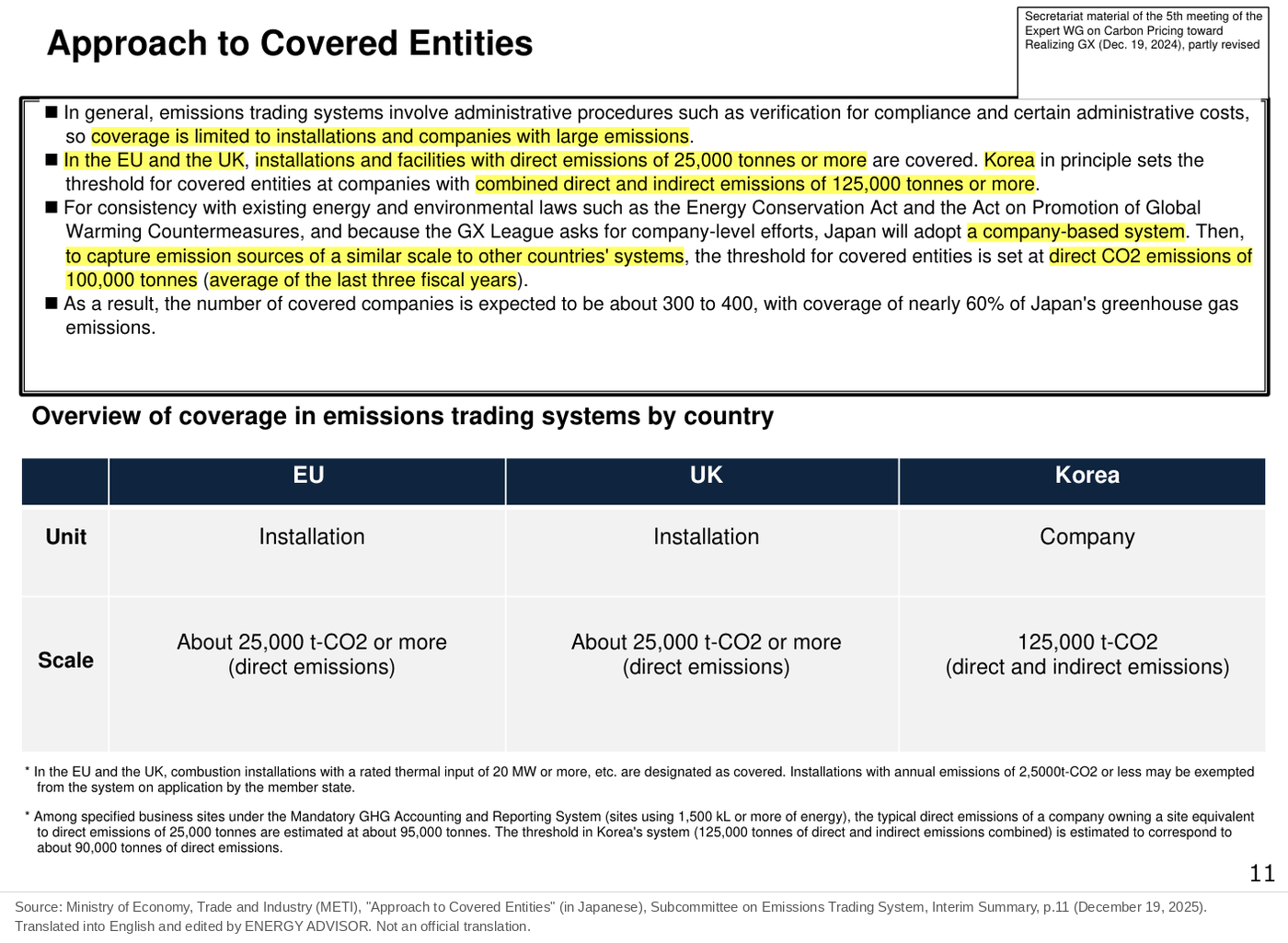
Phase 2, which started in April 2026, marks the full operation of the GX-ETS. Companies whose direct CO2 emissions average 100,000 tonnes or more over the three fiscal years up to the previous fiscal year are required to participate. (For the first year, FY2026, this is judged by the average of FY2023–FY2025.)
Covered sectors include power, steel, chemicals, cement, oil, pulp and paper, and automobiles. The system is expected to cover about 300 to 400 companies and nearly 60% of Japan’s greenhouse gas emissions (Summary report, p.11). In principle, allowances are allocated free of charge.
Phase 3 (FY2033 Onward): Gradual Expansion of Paid Auctions
In Phase 3, part of the allowances will move to paid auctions. For the power sector in particular, paid auctions are scheduled to be introduced from FY2033. This will further strengthen the incentive to cut emissions.
However, much of the detailed schedule for Phase 3 and the scope of paid allocation remain to be decided in future deliberations.
Paid allocation for the power sector is expected to be a major institutional change for the power industry, following the capacity market and the balancing market. It directly affects the cost structure of power plants and investment decisions, and articles 08 and 09 of this series explain it in detail.
Allocation of Allowances and the Trading Market
Allocation: Benchmarking and Grandfathering
In Phase 2, two main methods are used to allocate allowances. Benchmarking (a method based on the emission level of efficient companies in the same sector) is the basic method. For sectors where setting a benchmark is difficult, grandfathering (a method that applies a reduction rate to emissions in a base year) is used.
Under either method, allowances are in principle allocated free of charge during Phase 2. This step-by-step approach is similar to the early phases of the EU-ETS, and it is designed to give companies time to adapt.
Trading Market and Price Stabilization Mechanism
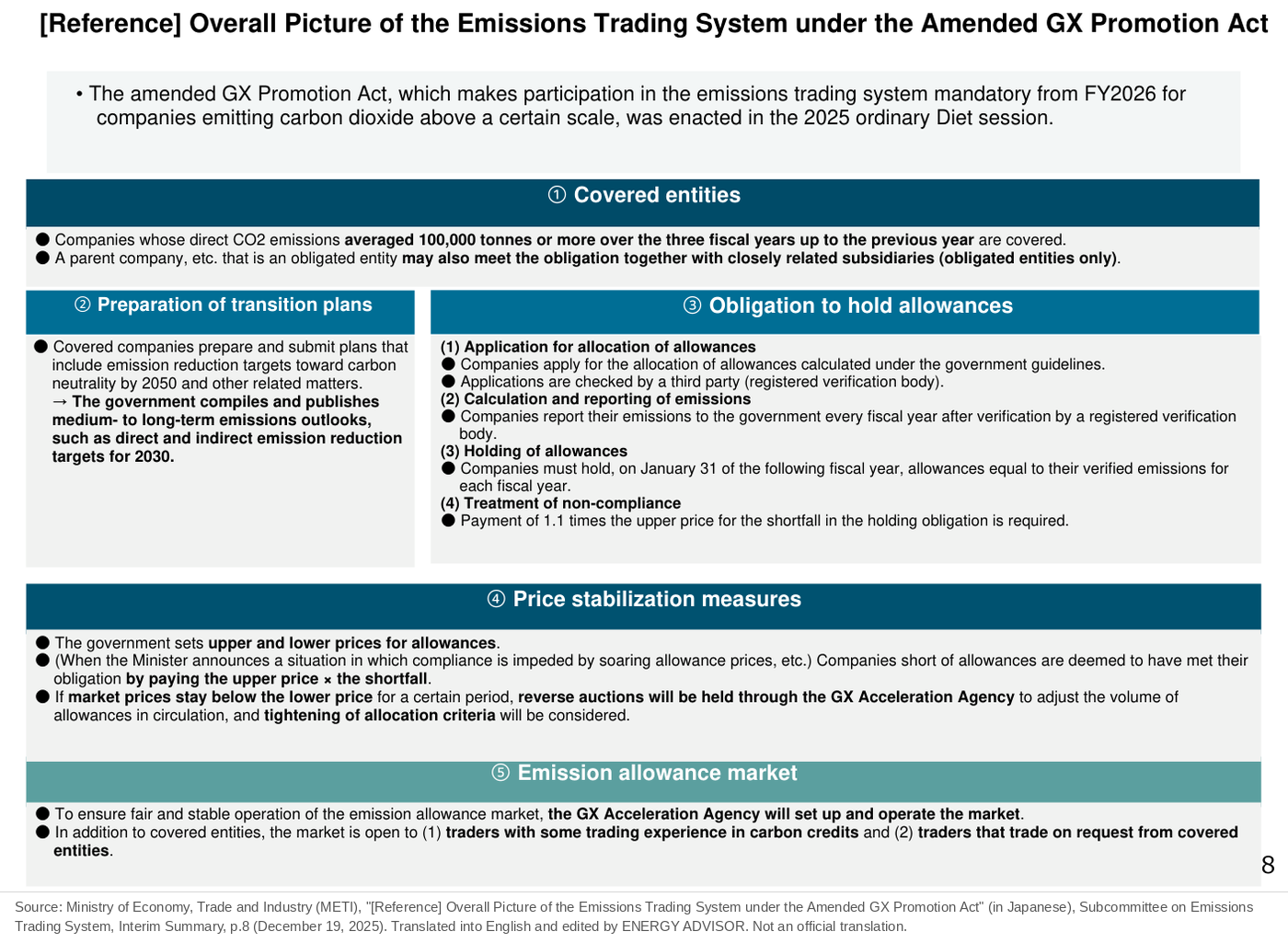
Companies with surplus allowances can sell them in the market, and companies that are short can buy them. The emission allowance market for this trading is scheduled to open around autumn of FY2027. The GX Acceleration Agency (a body established under the GX Promotion Act to operate the system) will set it up and run it. Until then, FY2026 is positioned as a period for calculating emissions and preparing for the system.
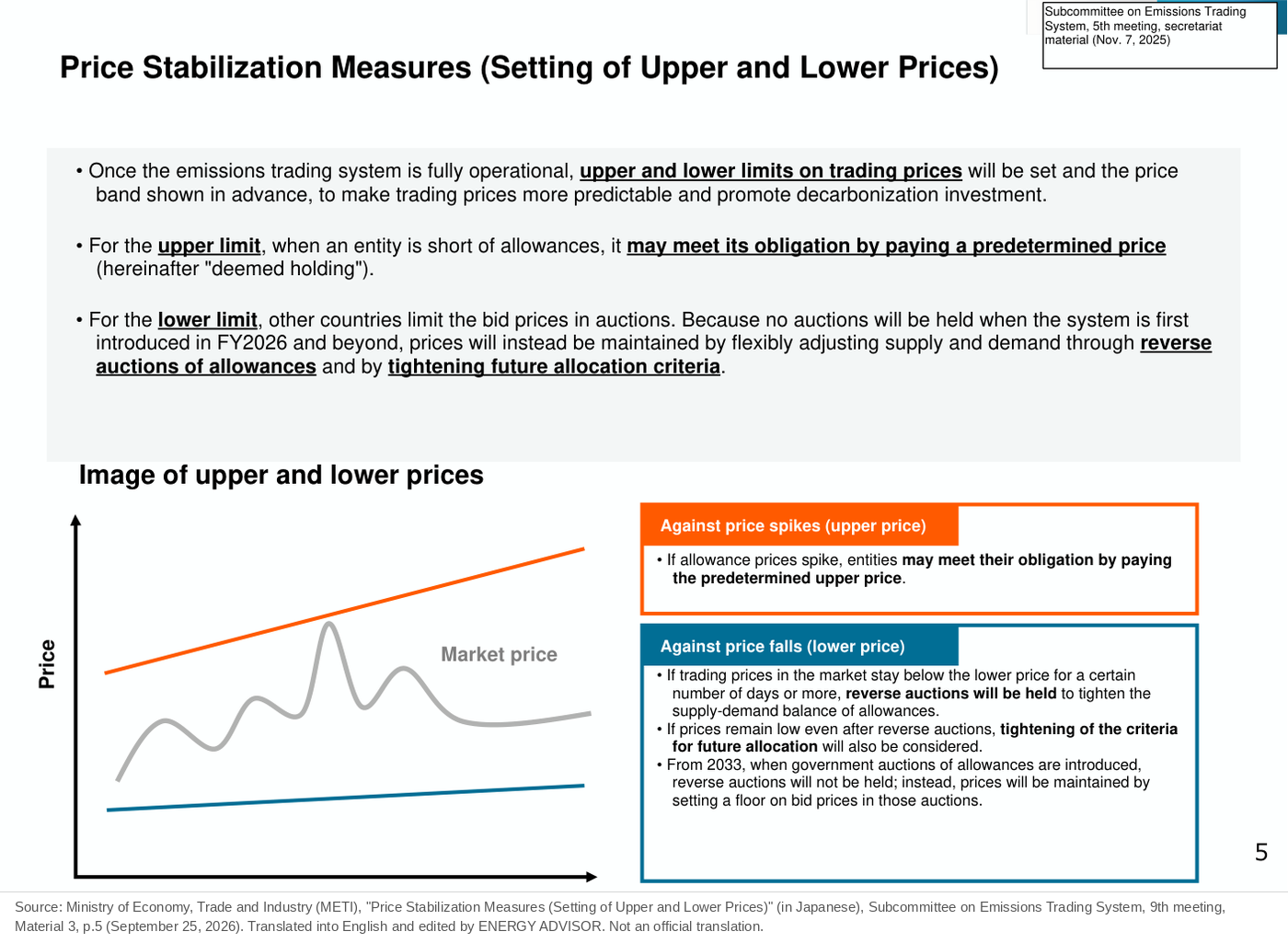
To prevent sharp rises and falls in prices, price stabilization measures will be introduced. For FY2026, allowance prices have been set and published in a ministerial notification under their official names: an upper reference price of ¥4,300/t-CO2 and an adjustment reference price of ¥1,700/t-CO2. For FY2027–FY2030, the policy is to raise them step by step to a level that adds each year’s projected inflation rate to a real price increase of 3% (set with reference to the discount rate for investment).
If the market price stays below the floor (the adjustment reference price) for a certain period, the GX Acceleration Agency will hold a reverse auction (a tender to buy back allowances), tightening the supply of allowances in circulation to adjust the supply-demand balance. When the market price exceeds the cap, a company that pays the amount of its shortfall multiplied by the upper reference price is deemed to hold that amount of allowances. For any amount not surrendered by the deadline, a non-compliance charge of 1.1 times the upper price applies.
How prices are set, and the figures, are covered in article 04, “GX-ETS Allowance Prices.”
Use of Carbon Credits
When a company is short of allowances, besides buying them in the market it can also use credits under the J-Credit Scheme (a Japanese government scheme that certifies domestic greenhouse gas reductions and removals as credits) and credits under the Joint Crediting Mechanism (JCM). However, the usage limit is set at 10% of actual annual emissions.
J-Credits are created by installing energy-saving equipment or using renewable energy, and they are traded on the Carbon Credit Market of the Tokyo Stock Exchange (opened in 2023). Article 06 explains the types of carbon credits and how to use them.
What Companies Must Do: MRV and Compliance Obligations
Covered companies must build systems for measurement, reporting and verification (MRV) of emissions. Specifically, this is a series of steps: calculating annual direct CO2 emissions, reporting them to the government, and having them checked by a registered verification body (a third party registered with METI that verifies emissions).
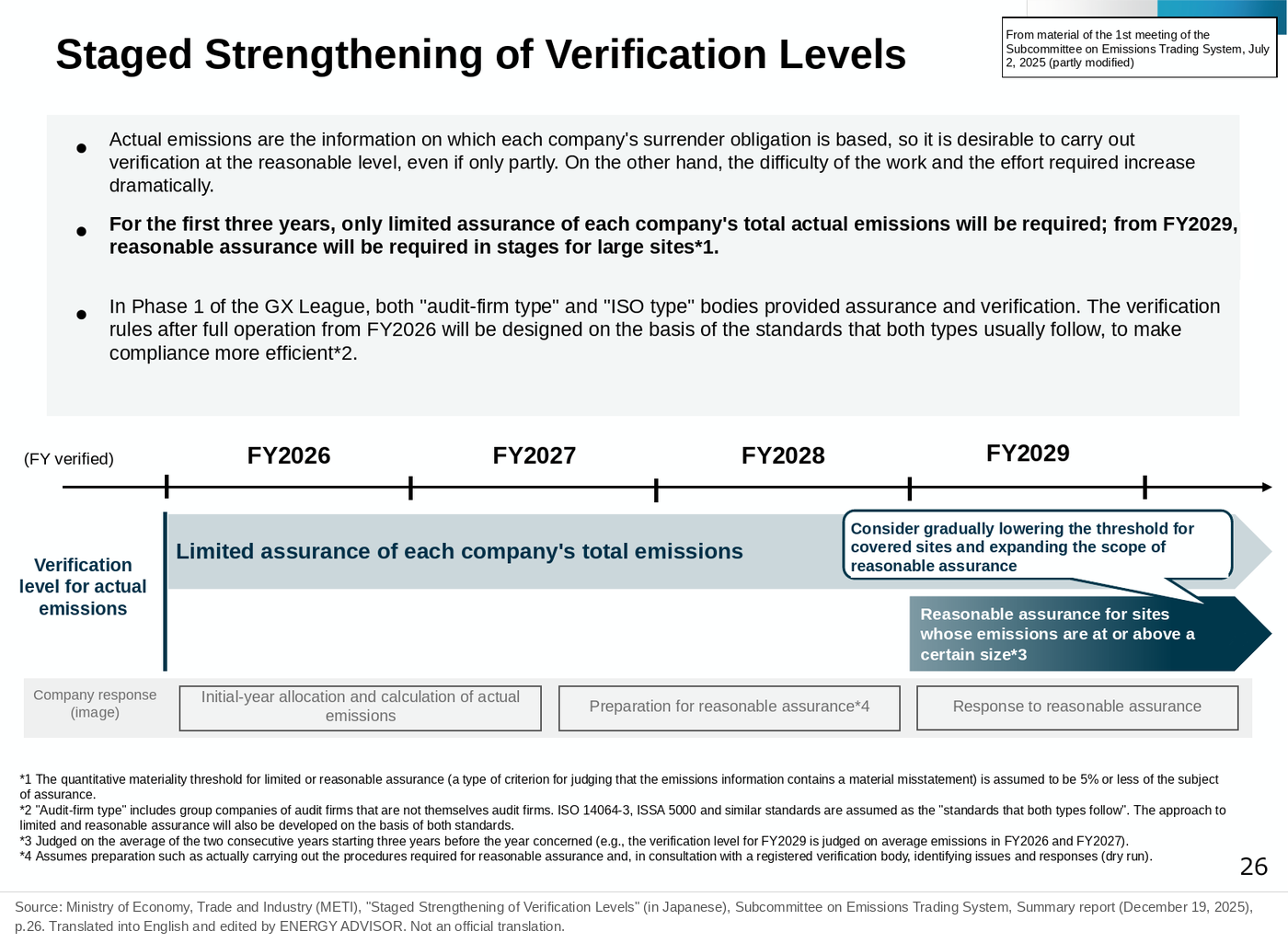
The level of verification will be strengthened in stages. For FY2026–FY2028, only “limited assurance” is required for all covered companies, which is a preparation period for them to set up their calculation systems. From FY2029 onward, “reasonable assurance” (a deeper check) is expected to be required in stages for large sites. The size of the covered sites is to be considered in the future, and sites emitting 1 million tonnes or more a year have been shown as an example.
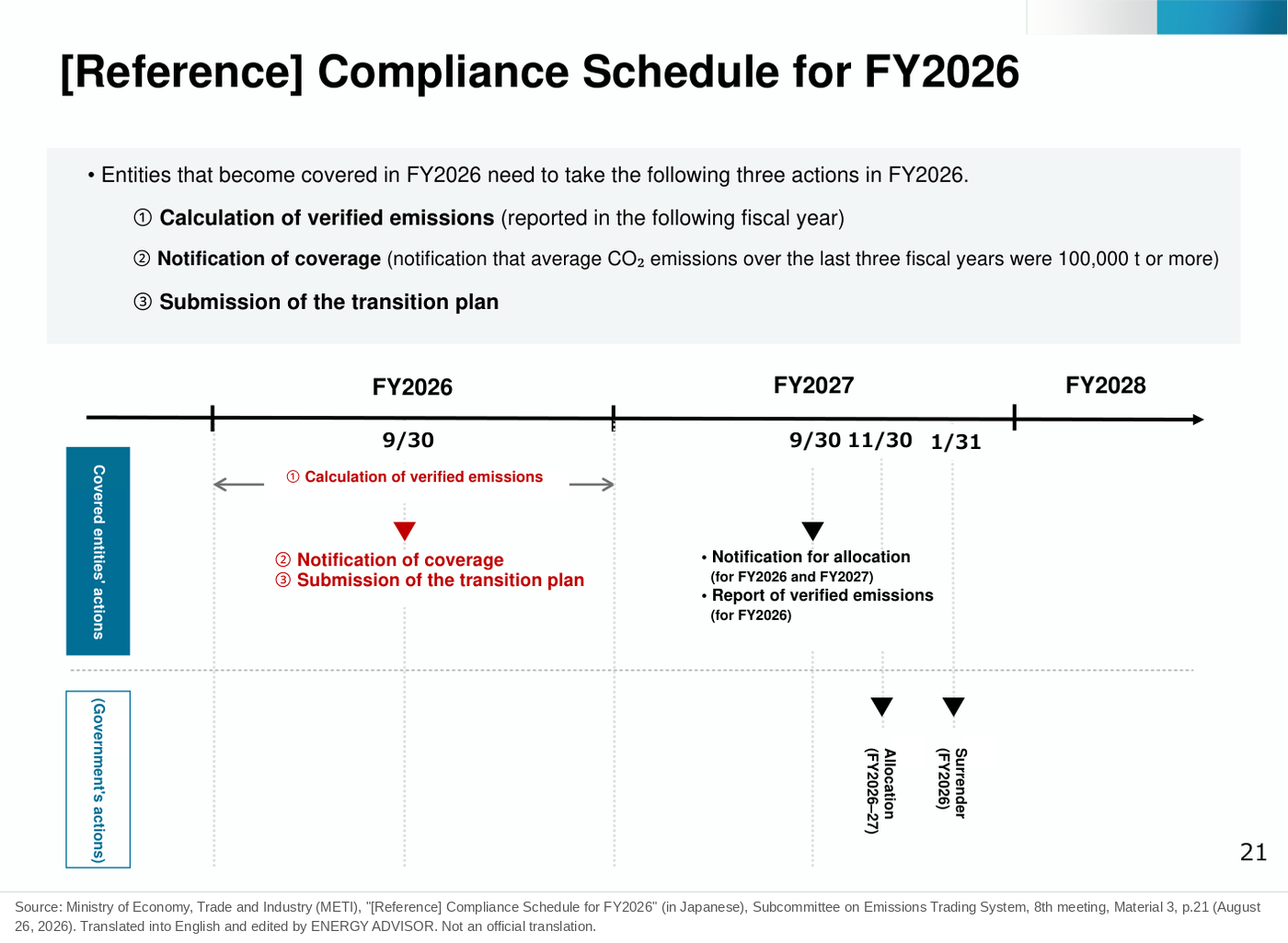
By January 31 of the following fiscal year, a company must hold allowances equal to its verified emissions. If it fails to surrender allowances (return allowances equal to its emissions) by the deadline, a non-compliance charge of the unfulfilled amount × the upper price × 1.1 is imposed. Based on the FY2026 upper reference price of ¥4,300, this works out to a non-compliance charge of about ¥4,730 per unfulfilled tonne. In addition, failure to make notifications or report emissions, or making false notifications, can be punished under the GX Promotion Act with a fine of up to ¥500,000 (Article 143, items 1 and 5).
Building MRV systems is a heavy burden, especially for companies without know-how in calculating emissions accurately. There are also SaaS tools that support the calculation and management of emissions (such as Zeroboard and booost technologies).
Summary: Start of the GX-ETS
As Japan’s first mandatory emissions trading system, the GX-ETS started Phase 2 in April 2026. It covers companies with direct CO2 emissions of 100,000 tonnes or more a year: about 300 to 400 companies, expected to cover nearly 60% of Japan’s greenhouse gas emissions.
The system is designed to be strengthened in three phases. FY2026 is a period for calculating emissions and preparing for the system. Around autumn of FY2027, the emission allowance market run by the GX Acceleration Agency will open, and from FY2033 onward paid auctions, centered on the power sector, will get fully underway. For FY2026 the price band is set at an upper reference price of ¥4,300/t-CO2 and an adjustment reference price of ¥1,700/t-CO2, and it is expected to be raised step by step.
With the GX-ETS in full operation, the first priority for covered companies is to put their emissions calculation systems in place. This series will go on to explain how allowances work, the use of carbon credits, the impact on the power industry, and more.
This article is based on published materials from the Ministry of Economy, Trade and Industry and its Agency for Natural Resources and Energy, the Electricity and Gas Market Surveillance Commission, the Organization for Cross-regional Coordination of Transmission Operators (OCCTO) and other sources. The English translations of figures are by ENERGY ADVISOR and are not official translations. When using this information for decisions, please check the original sources. When we find an error, we correct the article and note the date of the correction.
Sources
- METI, Subcommittee on Emissions Trading System, Summary report (December 19, 2025; the cover title of the PDF is “Interim Summary”) (in Japanese): pp.6–7 (paid auctions for power generation companies from FY2033); p.8 (coverage at a three-fiscal-year average of 100,000 tonnes or more; obligation to hold allowances by January 31 of the following fiscal year; compliance deemed by paying the upper price × the shortfall; 1.1 times the upper price for unfulfilled amounts); p.11 “Approach to covered entities” (about 300 to 400 covered companies; coverage of nearly 60% of emissions); p.26 (staged strengthening of verification levels; confirmed from the text in the figure); p.27 (example of “1 million tonnes or more” as the size for reasonable assurance) (pages other than p.26 were read via a summary and may be off by one). https://www.meti.go.jp/shingikai/sankoshin/sangyo_gijutsu/emissions_trading/pdf/20251219_1.pdf
- METI, Subcommittee on Emissions Trading System, 9th meeting (September 25, 2026), Material 3 “Measures Related to the Upper and Lower Prices” (in Japanese): p.4 (market to open around autumn of FY2027), p.5 (diagram of the price stabilization measures), p.6 (FY2026 prices published in a notification; method for FY2027 onward), p.8 (paying the amount multiplied by the upper reference price is deemed as holding allowances). https://www.meti.go.jp/shingikai/sankoshin/sangyo_gijutsu/emissions_trading/pdf/009_03_00.pdf
- METI, Subcommittee on Emissions Trading System, 8th meeting (August 26, 2026), Material 3 “Detailed Design of the Emission Allowance Market” (in Japanese): p.21 (compliance schedule for FY2026). https://www.meti.go.jp/shingikai/sankoshin/sangyo_gijutsu/emissions_trading/pdf/008_03_00.pdf
- METI, Study Group on Legal Issues for an Emissions Trading System toward Realizing GX, Material 3 (in Japanese): p.2 “Growth-Oriented Carbon Pricing Concept”; p.6 “Image of the Step-by-Step Development of the Emissions Trading System” (note: a group of companies accounting for 50% or more of Japan’s greenhouse gas emissions, 747 companies as of May 17, 2024, participated) (both confirmed from the text in the figures of the original post; the PDF could not be opened on October 22, 2026). https://www.meti.go.jp/shingikai/sankoshin/sangyo_gijutsu/emissions_trading/pdf/001_03_00_gx.pdf
- METI, Subcommittee on Emissions Trading System, 7th meeting, Material 3 “Levels of the Upper and Lower Prices in the Emissions Trading System (Draft)” (December 19, 2025) (in Japanese): p.13. https://www.meti.go.jp/shingikai/sankoshin/sangyo_gijutsu/emissions_trading/pdf/007_03_00.pdf
- House of Councillors, bill information (211th Diet session; GX Promotion Act promulgated May 19, 2023, Act No. 32) (in Japanese). https://www.sangiin.go.jp/japanese/joho1/kousei/gian/211/meisai/m211080211012.htm
- House of Representatives, “List of Enacted Laws”: Act on the Promotion of a Smooth Transition to a Decarbonized Growth-Oriented Economic Structure (Act No. 32, text as enacted), Supplementary Provisions Article 1 (effective date to be set by Cabinet Order) (in Japanese). https://www.shugiin.go.jp/internet/itdb_housei.nsf/html/housei/21120230519032.htm
- GX League official website, “Emissions Trading System (GX-ETS)” (in Japanese). https://gx-league.go.jp/action/gxets/
- Act on the Promotion of a Smooth Transition to a Decarbonized Growth-Oriented Economic Structure (Act No. 32 of 2023; amended text in force from April 1, 2026; viewed on e-Gov Law Search on October 22, 2026), Article 143, item 1 (failure to make the notification under Article 33(1) or making a false notification) and item 5 (failure to report emissions under Article 35(1) or making a false report): fine of up to ¥500,000 (in Japanese). https://laws.e-gov.go.jp/law/505AC0000000032