When general affairs or accounting staff at a company on a high-voltage or extra-high-voltage contract review their electricity costs and collect quotations from several new entrant retailers, they often find that each company calculates the demand charge and divides the energy charge differently. The quotations cannot simply be lined up and compared. For low-voltage household electricity there are many comparison websites, but similar tools have hardly spread for high-voltage and extra-high-voltage supply. This article explains why high-voltage and extra-high-voltage electricity prices are hard to compare, and how to compare them correctly.
Key points
- 1High-voltage and extra-high-voltage electricity prices are hard to compare by simply looking at quotations, because the method for setting contract demand and the rate structure differ.
- 2“Extra-high-voltage” is a term that, under the technical standards, refers to voltages above 7,000 V. In actual rate plans, however, customers receiving power at 20,000 V or more (roughly 2,000 kW or more in contract demand, as a guide) are generally classed as extra-high-voltage.
- 3The unit prices of new entrant retailers are, in principle, not published. The “standard tariff” published by each incumbent regional utility is one of the few benchmarks for comparison.
- 4Comparing correctly means recalculating your own actual usage under each plan’s rate structure.
- 5This article is the entry point to the whole series. Each topic is explained in detail in its own part.
Structure of This Series
This series consists of 15 articles: 14 main parts and one special edition. It mainly uses the rules of TEPCO Energy Partner (the retail arm of the major utility in the Kanto area) as examples. The special edition sets out the differences in other areas.
| Stage | Part | Title |
|---|---|---|
| Entry point | Part 1 | Why high-voltage and extra-high-voltage electricity prices are hard to compare (this article) |
| Background to the price rise | Part 2 | The 2026 spot market price surge: three causes and the summer tender for additional supply capacity |
| Background to the price rise | Part 3 | Fuel cost adjustment moves to a “one-month average” (April 2026) and the effect on bills |
| Reading contracts and bills | Part 4 | Standard tariffs: the only published price benchmark for high-voltage supply |
| Reading contracts and bills | Part 5 | How market-linked plans work and their risks: what to check before signing |
| Reading contracts and bills | Part 6 | How to read a high-voltage electricity bill: six components, and when government bill relief applies |
| Reading contracts and bills | Part 7 | Capacity contributions: a cost for future supply capacity borne by retail electricity suppliers and others since FY2024 |
| Reading contracts and bills | Part 8 | How contract demand is set: 30-minute demand under the actual-demand method and the demand charge |
| Moving forward with a review | Part 9 | Checking high-voltage quotations: five points for comparison |
| Moving forward with a review | Part 10 | What changed when the former standard tariffs ended (March 2026): consolidation into the three current plans |
| Moving forward with a review | Part 11 | Comparing by “applying past actual usage”: how it differs from forward-looking simulation |
| Moving forward with a review | Part 12 | Market exit and bankruptcy risk of new entrant retailers: how to assess a supplier before switching |
| Moving forward with a review | Part 13 | Consider electricity cost review and decarbonization together: responding to customers’ renewable energy requests |
| Moving forward with a review | Part 14 | When and how to review an electricity contract: renewal timing and internal steps |
| Special edition | – | Differences in high-voltage standard plans by area: a component-by-component guide to nine utilities |
Basics of Japan’s Power System (for Overseas Readers)
This section briefly explains the parts of Japan’s power system that this series assumes.
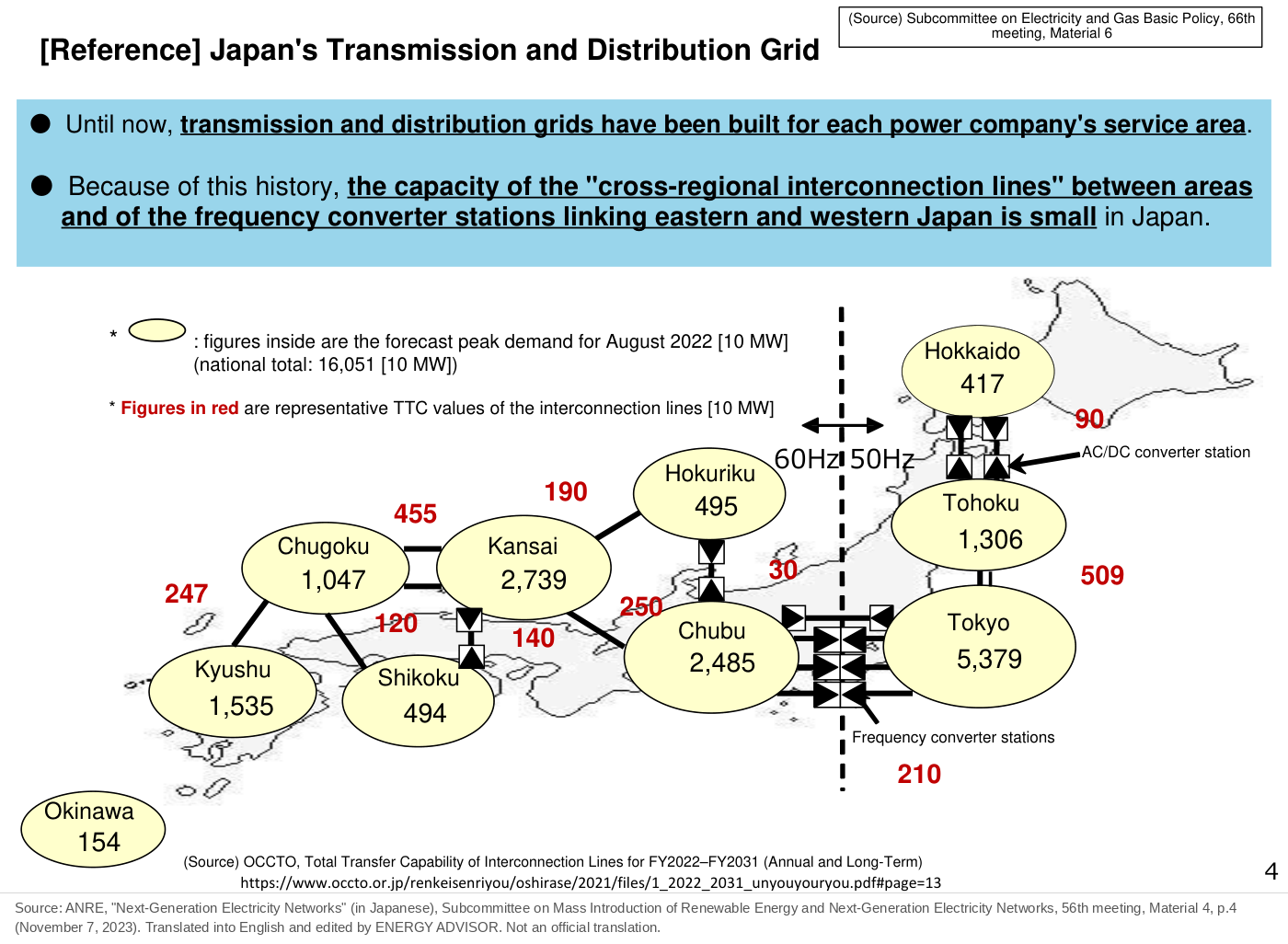
- Ten regional service areas: Japan’s power grid is operated as ten areas: Hokkaido, Tohoku, Tokyo, Chubu, Hokuriku, Kansai, Chugoku, Shikoku, Kyushu and Okinawa. The areas are linked by transmission lines called cross-regional interconnection lines (Okinawa is not connected to the other areas).
- Different frequencies in east and west: Eastern Japan (Hokkaido, Tohoku and Tokyo) runs at 50 Hz, and western Japan (from Chubu to Kyushu) runs at 60 Hz. Electricity can be sent between the 50 Hz and 60 Hz areas only through frequency converter stations (FC).
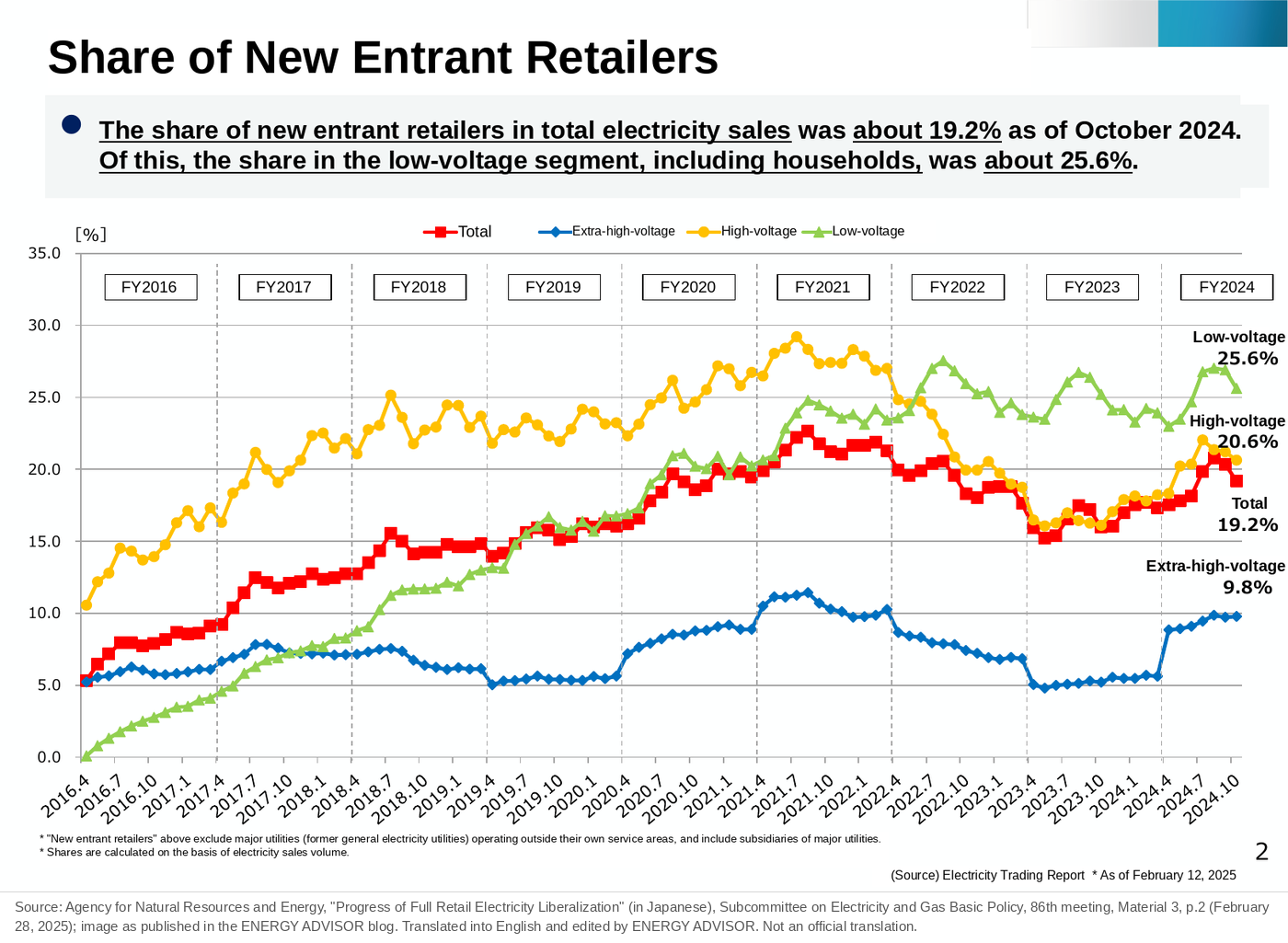
- Former general electricity utilities and new entrant retailers: Each area has a major utility that once handled everything from generation to sales (the former general electricity utilities, or incumbent regional utilities). Today, their generation, transmission and distribution, and retail businesses are separated into different companies. In contrast, electricity retailers that entered the market after retail liberalization are called “new entrant retailers.”
- General transmission and distribution companies (GT&D companies): The company that owns and operates the transmission and distribution lines in each area (TEPCO Power Grid in the Kanto area). Whichever retailer a customer has a contract with, electricity is delivered through this company’s network.
- Japan Electric Power Exchange (JEPX): The wholesale power exchange where utilities and new entrant retailers buy and sell electricity. The price in the day-ahead market (spot market), where electricity for delivery the next day is traded in 30-minute units, is the basis for market-linked electricity rates.
- Organization for Cross-regional Coordination of Transmission Operators, JAPAN (OCCTO): A body that all electricity businesses in Japan join. It coordinates supply and demand across areas and runs the “capacity market,” which secures future supply capacity, among other roles.
- Electricity and Gas Market Surveillance Commission (EGC): A regulatory body under the Ministry of Economy, Trade and Industry (METI) that monitors electricity and gas trading.
- Agency for Natural Resources and Energy (ANRE): An external agency of METI that is responsible for energy policy and the rules of the electricity business.
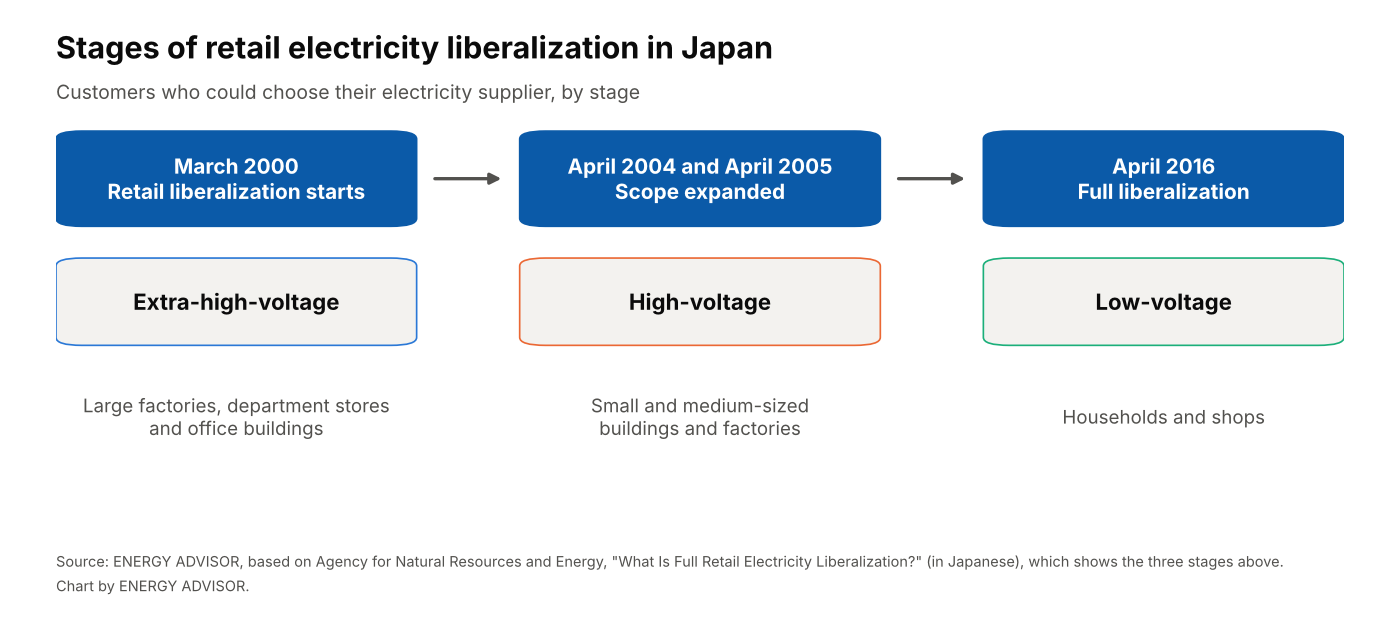
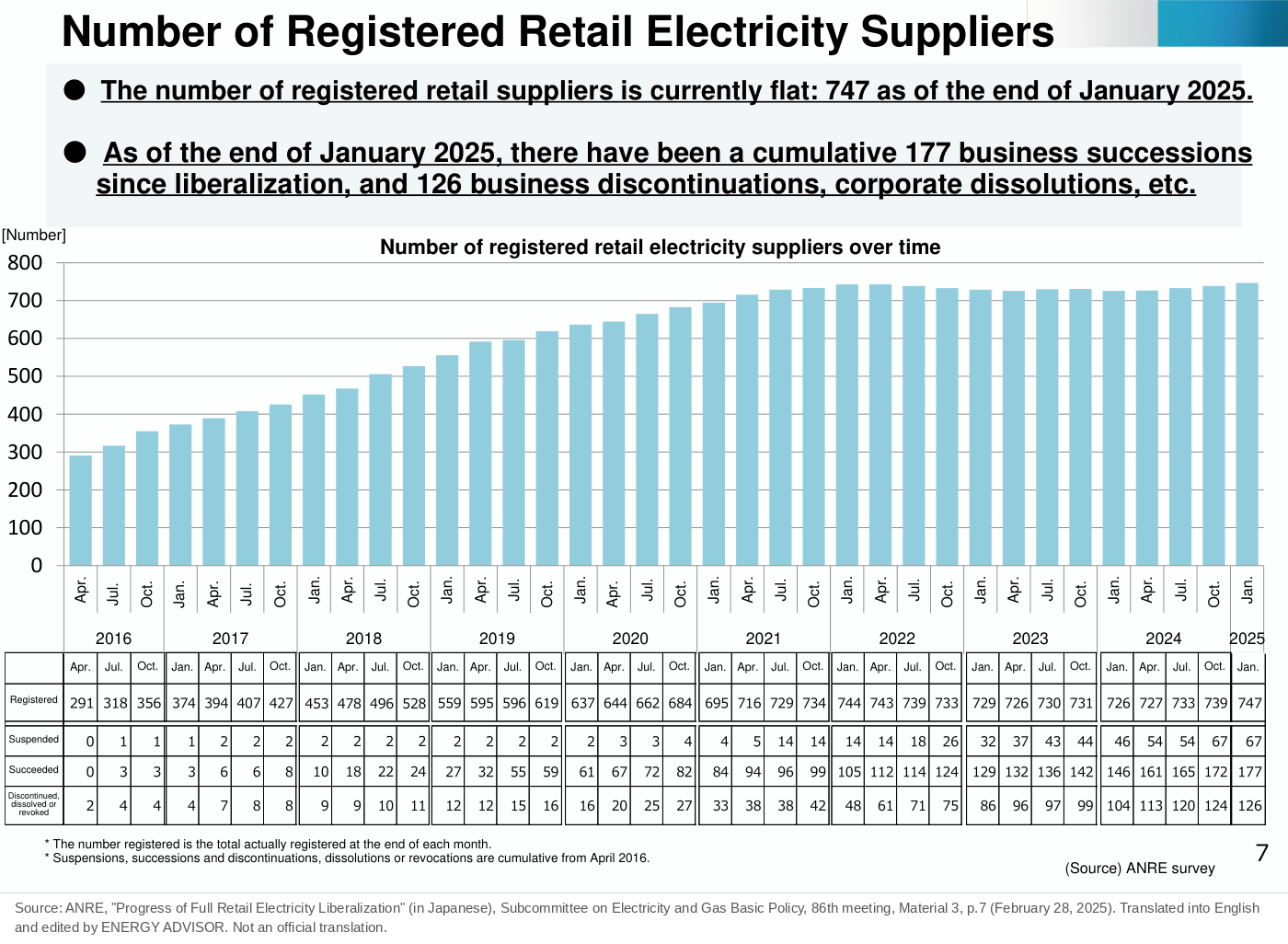
Retail electricity liberalization began with large customers and expanded in stages. In March 2000, large extra-high-voltage factories, department stores and office buildings became eligible. In April 2004 and April 2005, this expanded to small and medium-sized high-voltage factories and buildings. On April 1, 2016, low-voltage households and shops also became able to choose their electricity company, and entry into the electricity retail business was fully liberalized.
Source: Agency for Natural Resources and Energy, “What Is Full Retail Electricity Liberalization?” (in Japanese)
What High-Voltage and Extra-High-Voltage Supply Mean
High-voltage supply is the category of electricity supplied to businesses with large contract demand, such as factories, buildings and stores. The voltage categories are set by a ministerial ordinance under the Electricity Business Act (the Ministerial Ordinance Establishing Technical Standards for Electrical Equipment). For alternating current, 600 V or less is low voltage, above 600 V and up to 7,000 V is high voltage, and above 7,000 V is extra-high voltage. In the rate plans that utilities actually offer, however, customers receiving power at 20,000 V or more (roughly 2,000 kW or more in contract demand, as a guide) are generally classed as extra-high-voltage. From here on, this article uses “extra-high-voltage” in this rate-plan sense.
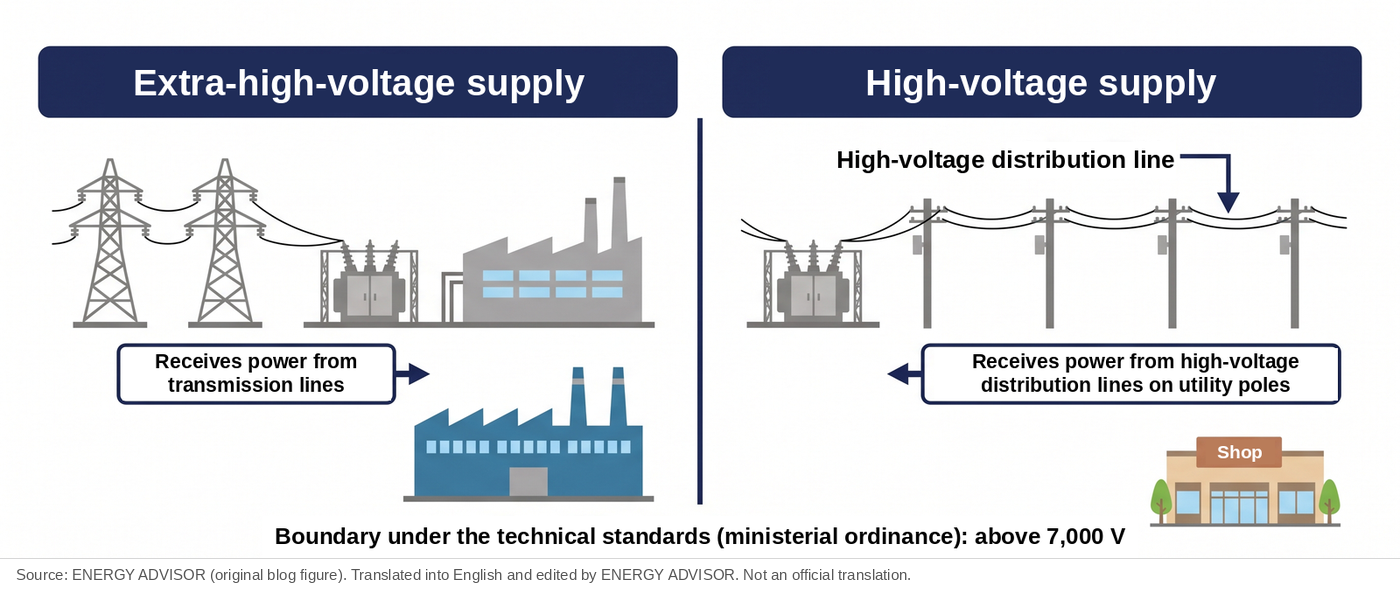
Unlike low-voltage household contracts, high-voltage and extra-high-voltage contracts often have terms set case by case, and the rate structure itself tends to be complex. This series mainly covers “high-voltage” supply (much of the mechanism also applies to extra-high-voltage supply).
Low-voltage electricity prices can easily be compared side by side on comparison websites. For high-voltage and extra-high-voltage supply, however, each contract has many individual terms, and it is difficult to build a similar comparison website.
Four Factors That Prevent Simple Comparison
When comparing quotations for high-voltage electricity, the following four factors make simple comparison difficult. The author organized these points through actual work comparing quotations.
Differences in How Contract Demand Is Calculated
For high-voltage customers with contract demand of less than 500 kW, contract demand is set every month under the actual-demand method, based on the highest 30-minute demand in the past 12 months including the current month. The actual-demand method sets contract demand based on the highest measured power use (the 30-minute demand). For 500 kW or more, contract demand is generally set by negotiation with the utility (negotiated contract demand), and some new entrant retailers use their own calculation methods. Negotiated contract demand means that contract demand is agreed through discussion with the utility. For this reason, even with the same usage, comparing unit prices alone is not a correct comparison if the method for setting contract demand differs.
Source: TEPCO Energy Partner, “How Contract Demand Is Determined” (in Japanese)
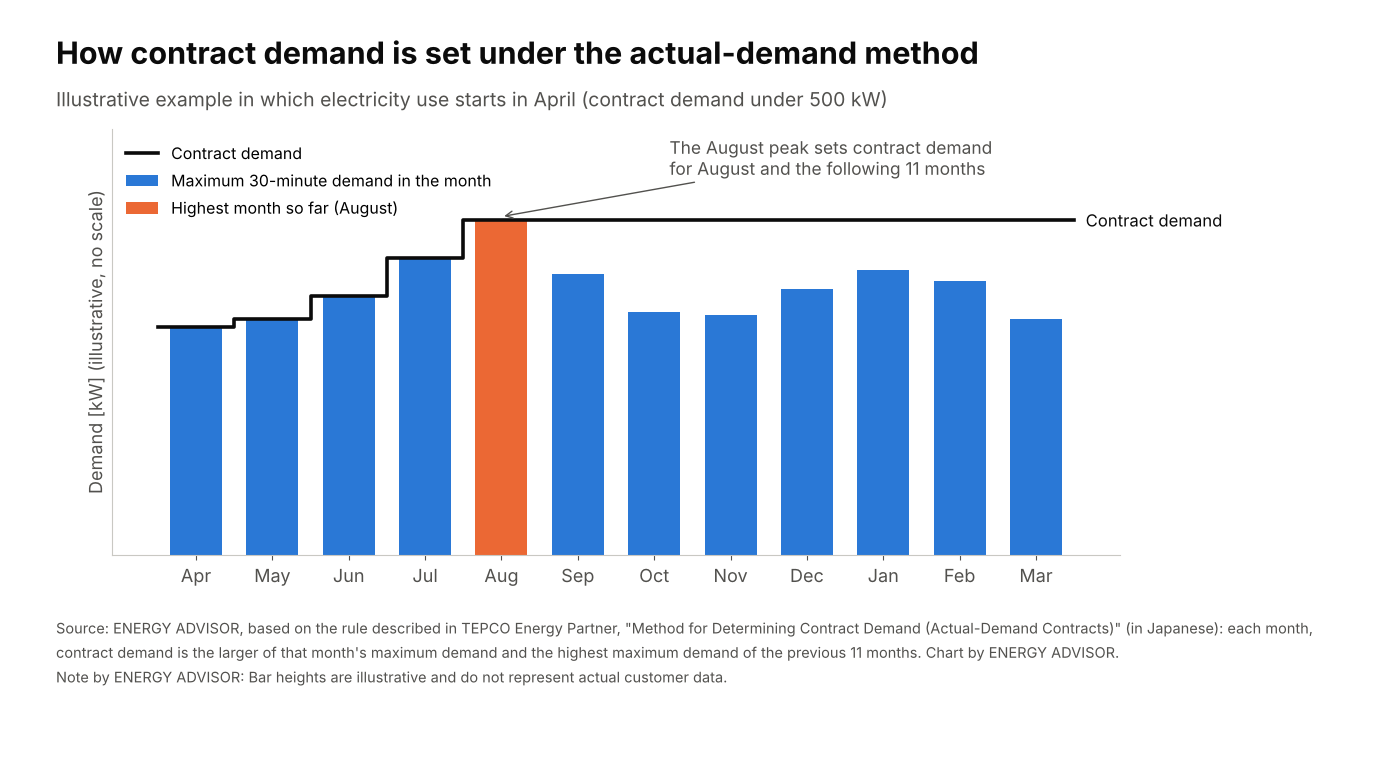
Source: TEPCO Energy Partner, “Method for Determining Contract Demand (Actual-Demand Contracts)” (in Japanese)
Variety of Rate Structures
The rate structure itself differs from company to company. There are plans whose unit prices change by season and time of day, and plans linked to prices in the wholesale electricity market. Comparing only whether unit prices are high or low may therefore lead to a wrong outlook for the amount actually paid.
No Common Quotation Format
How tax is treated, the assumed usage, and how unit prices are shown on a quotation differ by company. In other words, comparing only the savings shown on quotations may not give an accurate comparison.
Whether Plans by Load Factor Are Offered
In the range the author has seen in work comparing quotations, many new entrant retailers do not offer the detailed plan categories by season or load factor (the ratio showing how much electricity is used on average relative to contract demand) that incumbent regional utilities offer. For this reason, when switching from a standard tariff, you need to check not only unit prices but also the structure of the plan itself.
The Only Published Benchmark: The Standard Tariff
The unit prices of new entrant retailers are, in principle, not published, because contracts are basically set through individual negotiation between the supplier and the customer. On the other hand, a standard tariff is a standard rate menu for high-voltage and extra-high-voltage customers that a major regional utility (as a retail electricity supplier) publishes on its official website and elsewhere. TEPCO Energy Partner’s standard tariff has three types: the Basic Plan, the Zero Market Adjustment Plan and the Market-Linked Plan. Of these, the Market-Linked Plan calculates part or all of the energy charge in line with the JEPX spot market price. Its key feature is that the customer bears the risk of higher costs when market prices rise. Outside the TEPCO area, the major utility in each area also publishes similar standard plans (where to check in each area nationwide is set out in the special edition).
Source: TEPCO Energy Partner, “Revisions to Extra-High-Voltage and High-Voltage Standard Tariffs from April 1, 2026” (in Japanese)
Checking the Bill and the Contract
Once you can check the items on the monthly bill one by one, it becomes easier to see what drives changes in the amount. Specifically, the starting point is to break the bill into six components and check which one changed: the demand charge, the energy charge, the fuel cost adjustment, the market price adjustment (for standard tariffs), the renewable energy surcharge, and the amount corresponding to the capacity contribution.
Because the bill is paid automatically each month, there are few chances to look at the breakdown in detail. Checking it once makes it easier to trace the causes when the amount changes.
Comparing Correctly: Applying Actual Usage Data
No matter how many quotations you collect, the comparison is not correct unless the assumptions are the same. Comparing correctly means recalculating your company’s actual usage under the rate structure of each plan you are considering, and comparing them on the same basis. The amounts on quotations are each calculated on different assumptions. Only by recalculating them with the same actual usage can you compare them on the same basis.
Summary
High-voltage and extra-high-voltage electricity prices are hard to compare simply because of four factors: differences in how contract demand is calculated, the variety of rate structures, the lack of a common quotation format, and whether plans by load factor are offered. As long as new entrant retailers do not publish their unit prices, the standard tariffs of incumbent regional utilities remain one of the few benchmarks for comparison. Comparing correctly means recalculating your own actual usage under each plan.
This article is based on published materials from the Ministry of Economy, Trade and Industry and its Agency for Natural Resources and Energy, the Electricity and Gas Market Surveillance Commission, the Organization for Cross-regional Coordination of Transmission Operators (OCCTO) and other sources. The English translations of figures are by ENERGY ADVISOR and are not official translations. When using this information for decisions, please check the original sources. When we find an error, we correct the article and note the date of the correction.
Sources
- Agency for Natural Resources and Energy, “What Is Full Retail Electricity Liberalization?” (in Japanese), checked October 22, 2026. https://www.enecho.meti.go.jp/category/electricity_and_gas/electric/electricity_liberalization/what/
- TEPCO Energy Partner, “How Contract Demand Is Determined” (in Japanese). https://www.tepco.co.jp/ep/corporate/charge_c/decision01.html
- TEPCO Energy Partner, “Method for Determining Contract Demand (Actual-Demand Contracts)” (in Japanese). https://www.tepco.co.jp/ep/corporate/charge_c2/decision03.html
- TEPCO Energy Partner, “Revisions to Extra-High-Voltage and High-Voltage Standard Tariffs from April 1, 2026, Reflection of the November 1, 2026 Network Charge Revision in Electricity Rates, and Partial Revision of Supply Conditions” (in Japanese), checked October 22, 2026. https://www.tepco.co.jp/ep/corporate/plan_h/minaoshi_2026.html
- Agency for Natural Resources and Energy, “Next-Generation Electricity Networks” (in Japanese), Advisory Committee for Natural Resources and Energy, Subcommittee on Mass Introduction of Renewable Energy and Next-Generation Electricity Networks, 56th meeting, Material 4, November 7, 2023, p.4, “[Reference] Japan’s transmission and distribution network” (a map showing the cross-regional interconnection lines and the frequency converter stations linking 50 Hz and 60 Hz). https://www.meti.go.jp/shingikai/enecho/denryoku_gas/saisei_kano/pdf/056_04_00.pdf
- METI, Industrial Safety Group, Electric Power Safety Division, “Commentary on the Ministerial Ordinance Establishing Technical Standards for Electrical Equipment” (in Japanese), November 2025, commentary on Article 2 (voltage categories): low voltage is 750 V or less DC and 600 V or less AC; high voltage is above low voltage and up to 7,000 V; extra-high voltage is above 7,000 V. https://www.meti.go.jp/policy/safety_security/industrial_safety/law/files/dengikaisetsu.pdf
- Agency for Natural Resources and Energy, “Progress of Full Retail Electricity Liberalization” (in Japanese), Advisory Committee for Natural Resources and Energy, Subcommittee on Electricity and Gas Basic Policy, 86th meeting, Material 3, February 28, 2025. https://www.meti.go.jp/shingikai/enecho/denryoku_gas/denryoku_gas/pdf/086_03_00.pdf