“A customer sent us a survey about our CO2 emissions.” “We were asked for our electricity consumption and our reduction targets.” More and more small and medium-sized enterprises (SMEs), mainly in manufacturing, have had this experience. For a company of their size, the request may seem surprising, but there is a clear reason behind it. This article explains, based on public materials, why these requests arrive, how the mechanism works, and how widespread they have become.
Key points
- 1Public surveys confirm that more SMEs are being asked by their customers to measure their CO2 emissions and to cooperate in reducing them.
- 2Behind these requests are two trends: large companies are trying to measure and disclose emissions across their entire supply chain, including their suppliers, not just their own; and investors and major customers are demanding action on climate change.
- 3Even among companies that have received requests, the biggest hurdle is “the burden of expenses and costs,” and many say they do not know where to start.
- 4Free public advisory services are available. Before rushing to decide on a response, a realistic starting point is to grasp the overall picture first.
Background: Japanese Context for This Series
This series is written for Japanese SMEs and assumes Japanese rules and institutions. For overseas readers, the basic context used throughout the series is summarized here first.
- SMEs: Under Japan’s Small and Medium-sized Enterprise Basic Act, in manufacturing and similar industries, a company or sole proprietor with capital of ¥0.3 billion or less, or with 300 or fewer regular employees, is an “SME.” The thresholds are smaller for wholesale, retail and services. Treatment may differ from one program to another.
- Government agencies: The Ministry of Economy, Trade and Industry (METI) is in charge of industrial policy, and the Agency for Natural Resources and Energy (ANRE), an external agency of METI, is in charge of energy policy such as electricity and gas. The Ministry of the Environment (MOE) is in charge of climate change measures. The public system for calculating and reporting CO2 emissions is run jointly by MOE and METI.
- Fiscal year: The fiscal year (FY) of Japanese government agencies runs from April 1 to March 31 of the following year. FY2026 means April 2026 to March 2027. In the Japanese imperial era calendar, “Reiwa 8” corresponds to FY2026.
- The electricity system: Japan’s retail electricity market was liberalized in stages: extra-high-voltage supply (large factories and buildings) in 2000, and high-voltage supply (small and medium-sized factories and buildings) in 2004 and 2005. Since April 2016, all customers, including households and shops, can choose their electricity company and tariff. Companies that sell electricity are called “retail electricity suppliers.” The transmission and distribution grid is operated by the “general transmission and distribution companies” (GT&D companies), one for each of Japan’s ten regional service areas.
Sources: Small and Medium Enterprise Agency, “Definition of SMEs and Small Enterprises” (in Japanese); ANRE, “What Is Full Retail Liberalization of Electricity?” (in Japanese); ANRE, “Supply Plan Notifications of General Transmission and Distribution Companies (FY2025)” (in Japanese)
A CO2 Questionnaire Suddenly Arrives from a Customer
For many companies, the first contact with decarbonization comes in the form of a request from a customer. Specifically, this may include answering surveys or Excel questionnaires sent by the customer’s purchasing or procurement department, confirming whether the company measures and calculates its CO2 emissions, reporting specific reduction targets and progress, or obtaining environmental certifications.
According to a survey compiled by METI, the most common requests that companies actually receive from their customers differ by industry. In manufacturing, the share of companies asked for “measuring and calculating GHG emissions” or “setting specific reduction targets and reporting progress” is more than double that of other industries. In construction, a high share of companies are asked to “obtain environmental certifications.”
Source: METI, “Toward Promoting GX for SMEs” (January 2026), p. 3 (in Japanese) (original survey: “Survey on Energy Conservation and Decarbonization at SMEs,” Japan Chamber of Commerce and Industry (JCCI) and Tokyo Chamber of Commerce and Industry, June 2025)
Some questionnaires go beyond “Please tell us your CO2 emissions” and also ask “Do you have a reduction target?” and “How is your progress?” Companies need to prepare on the assumption that this will be an ongoing exchange, not a one-time answer.
Requests do not all arrive the same way. In some cases, environmental items are added when the basic transaction agreement is revised; in others, CO2 items are added to existing quality or safety surveys. The routes vary, but they have one thing in common: the request comes from “outside,” from a customer, not from the company itself.
Why Requests Reach SMEs: Emissions Across the Entire Supply Chain
The reason customers care about CO2 emissions is a trend spreading among large companies: measuring and disclosing “emissions across the entire supply chain.” This covers not only a company’s own emissions but also those of business partners related to its activities, such as raw material procurement and the transport and disposal of products.
This trend is driven by pressure from investors and major customers. In stock markets, using companies’ climate action as a factor in investment decisions is becoming more common, and rules requiring listed companies to disclose sustainability information, including greenhouse gas emissions, are also being developed. Because the disclosed emissions must include figures for the entire supply chain, including suppliers, large companies have begun asking their SME suppliers to measure emissions and cooperate in reductions.
An MOE material shows a project image in which a lead company (such as a large company) and its SME suppliers work together to cut emissions. In it, the suppliers’ emissions and the lead company’s own emissions are connected in a two-way relationship of “outreach” and “cooperation.” The overall picture is that a company can receive requests from a lead company whether it is an “upstream” or a “downstream” business partner.
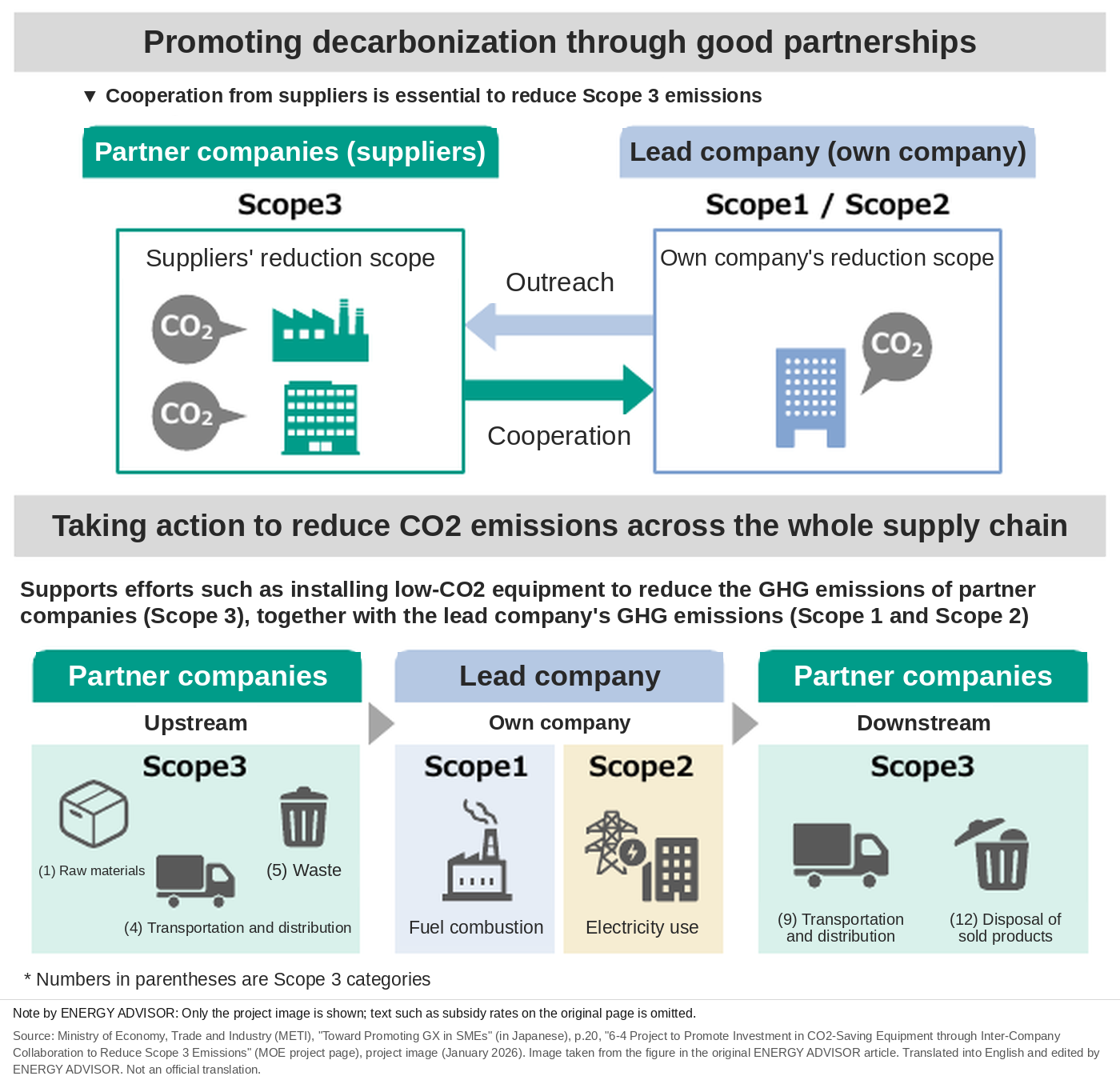
Source: METI, “Toward Promoting GX for SMEs” (January 2026), p. 20 (in Japanese)
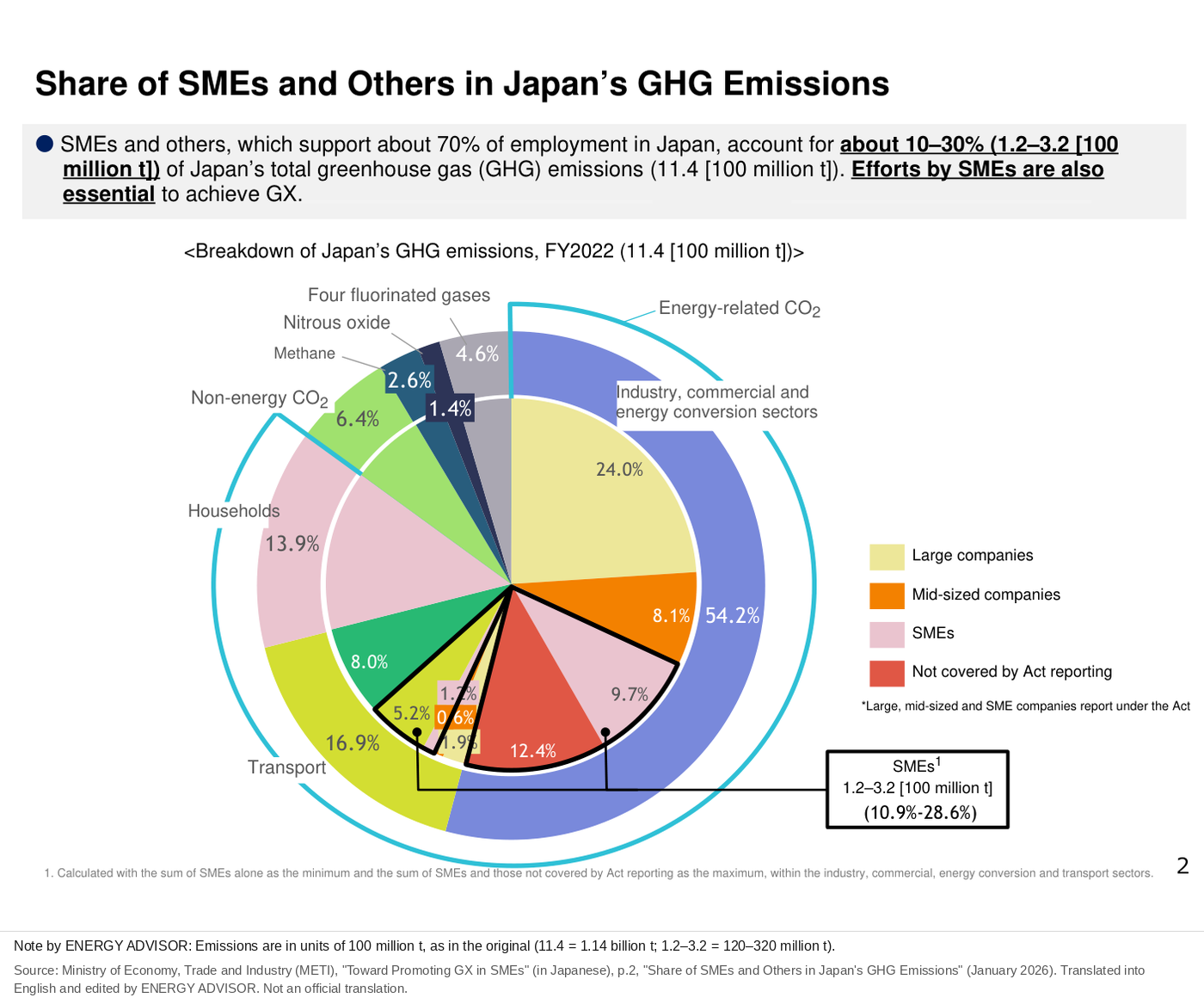
Behind these requests is the fact that large companies also need their suppliers’ data for their own disclosures. Customers are not targeting SMEs alone.
How Widespread the Requests Are: Public Statistics
The spread of these requests is not just a feeling; it can be confirmed with actual numbers. According to METI materials, the share of SMEs asked by customers to measure emissions or cooperate toward carbon neutrality rose from 8.5% in 2023 to 12.0% in 2024 (the material describes this as “about 1.5 times”).
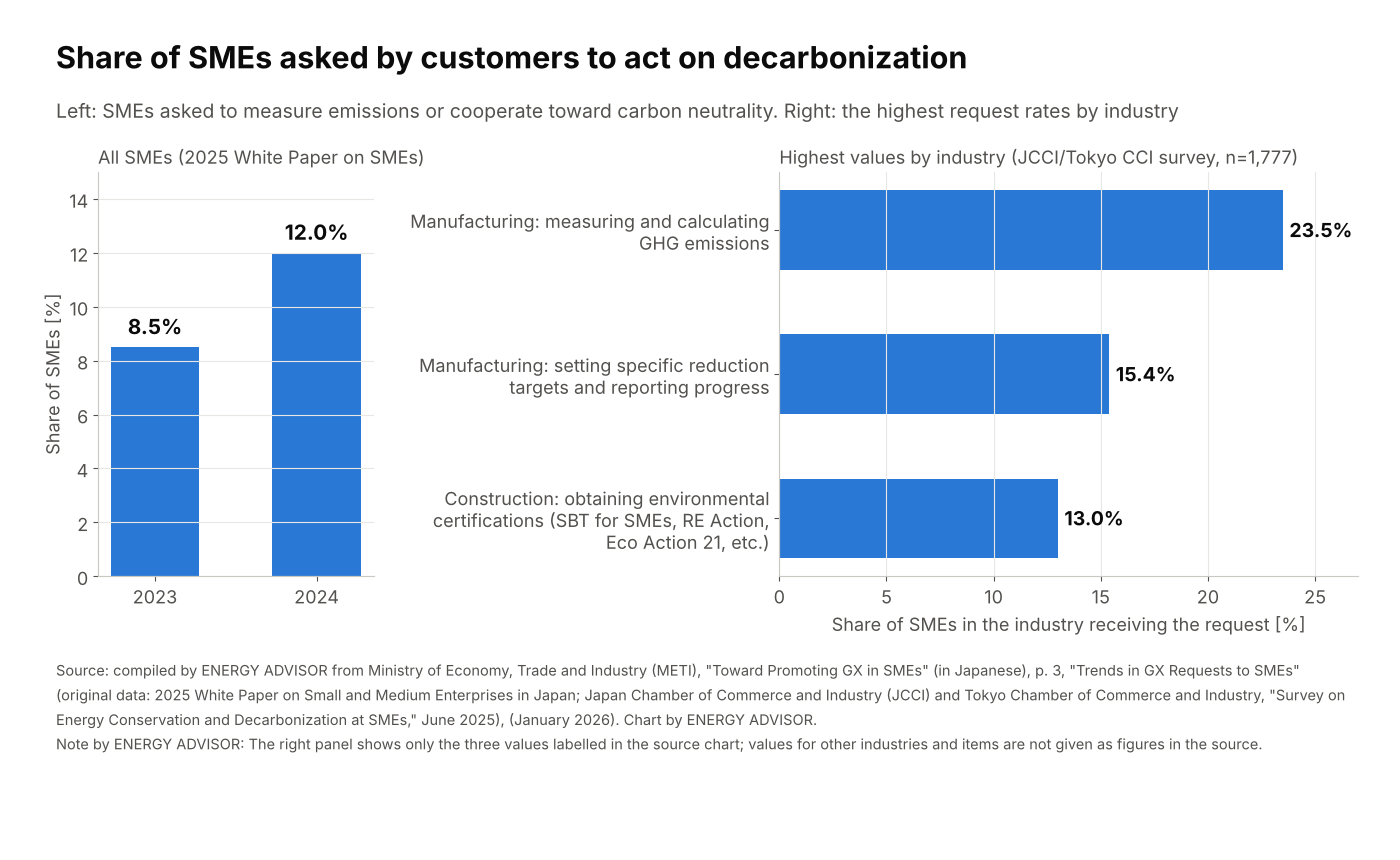
Source: METI, “Toward Promoting GX for SMEs” (January 2026), p. 3 (in Japanese) (original source: 2025 White Paper on Small and Medium Enterprises in Japan)
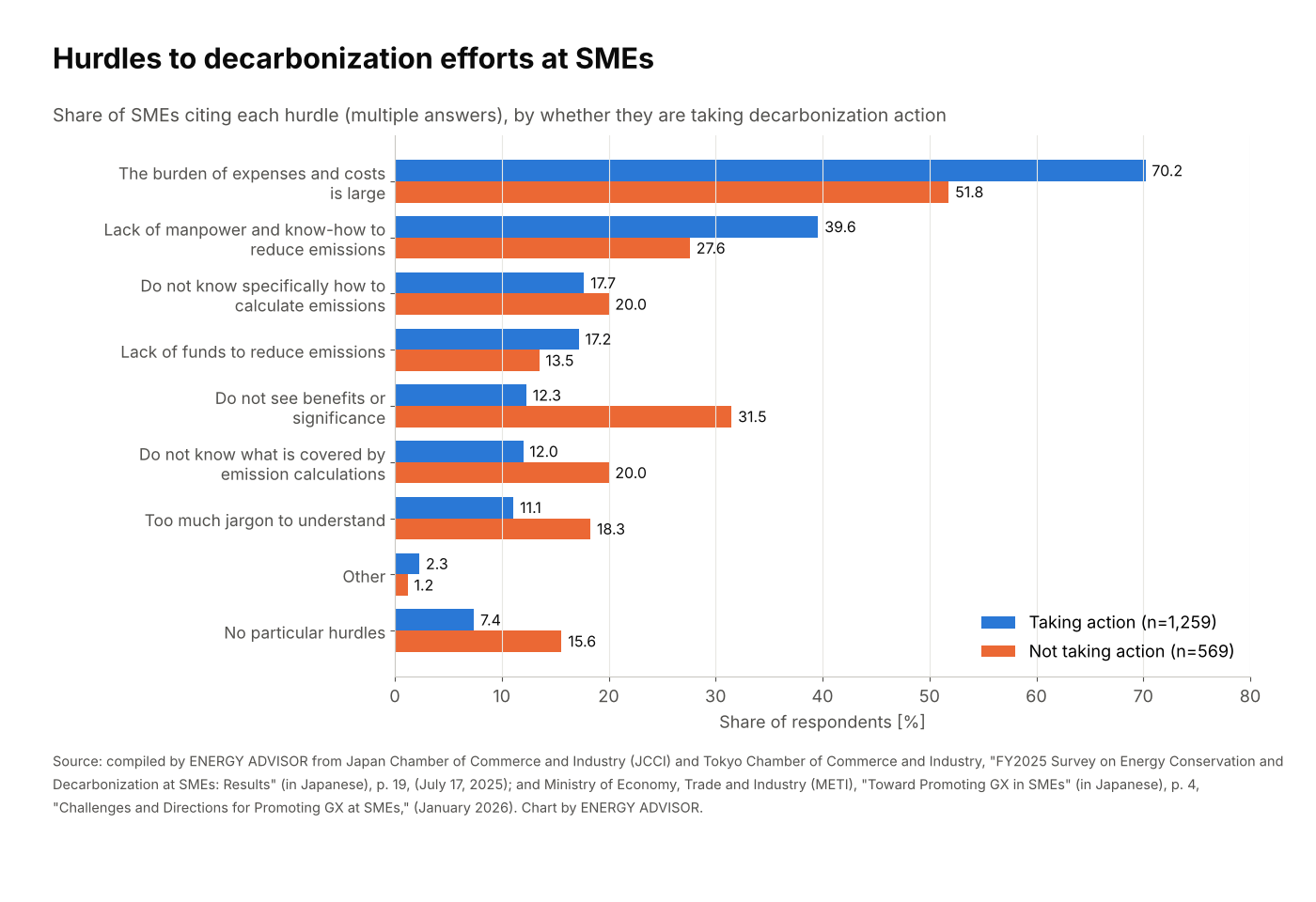
The same material also surveys the hurdles to decarbonization efforts. Among both companies that are taking action and those that are not, “the burden of expenses and costs is large” ranks highest: 70.2% of companies taking action and 51.8% of those not taking action. On the other hand, “we do not see benefits or significance” was cited by only 12.3% of companies taking action, compared with 31.5% of companies not taking action. This large gap suggests that companies that have not started are less likely to see the benefits.
Source: METI, “Toward Promoting GX for SMEs” (January 2026), p. 4 (in Japanese) (original survey: “FY2025 Survey on Energy Conservation and Decarbonization at SMEs,” JCCI and Tokyo Chamber of Commerce and Industry, July 2025)
In short, public statistics show both that requests are steadily spreading and that many companies share concerns about costs and confusion about “where to start.”
The First Response: Grasping the Overall Picture and Using Free Support
When a questionnaire has arrived, or when it becomes clear that one may arrive, the most important thing is not to rush into individual responses. Instead, grasp the overall picture: what is being asked of your company, and where you can realistically start.
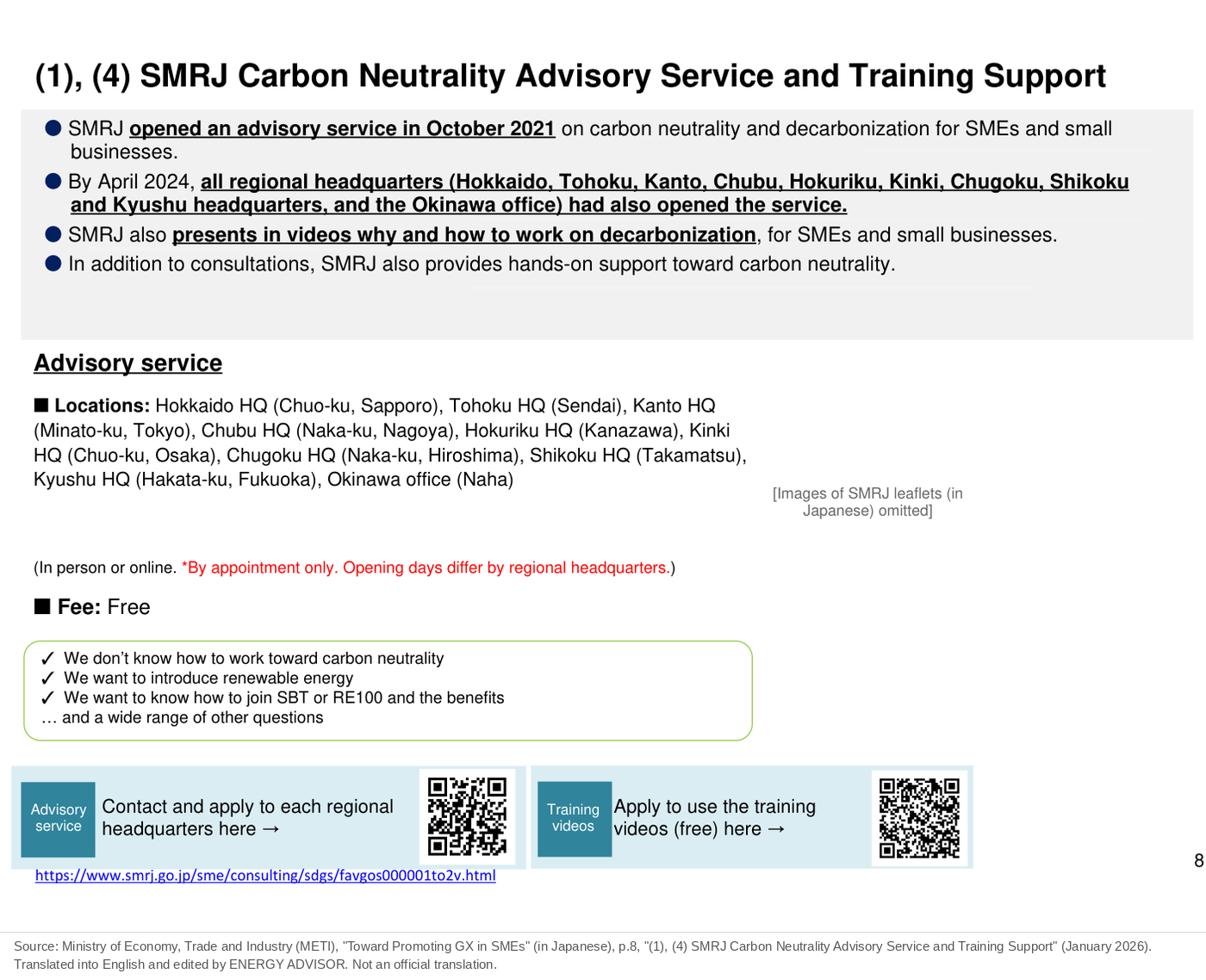
Free public advisory services are available for this purpose. The Organization for Small & Medium Enterprises and Regional Innovation, JAPAN (SMRJ), an independent administrative agency of the national government that supports SMEs, has set up an online advisory service on carbon neutrality. Its regional headquarters across Japan accept consultations in person or online (some regional headquarters offer online consultations only). The service is free and also handles early-stage questions such as “we do not know how to get started.”
Source: SMRJ, “Carbon Neutrality Advisory Services and Training Support” (in Japanese)
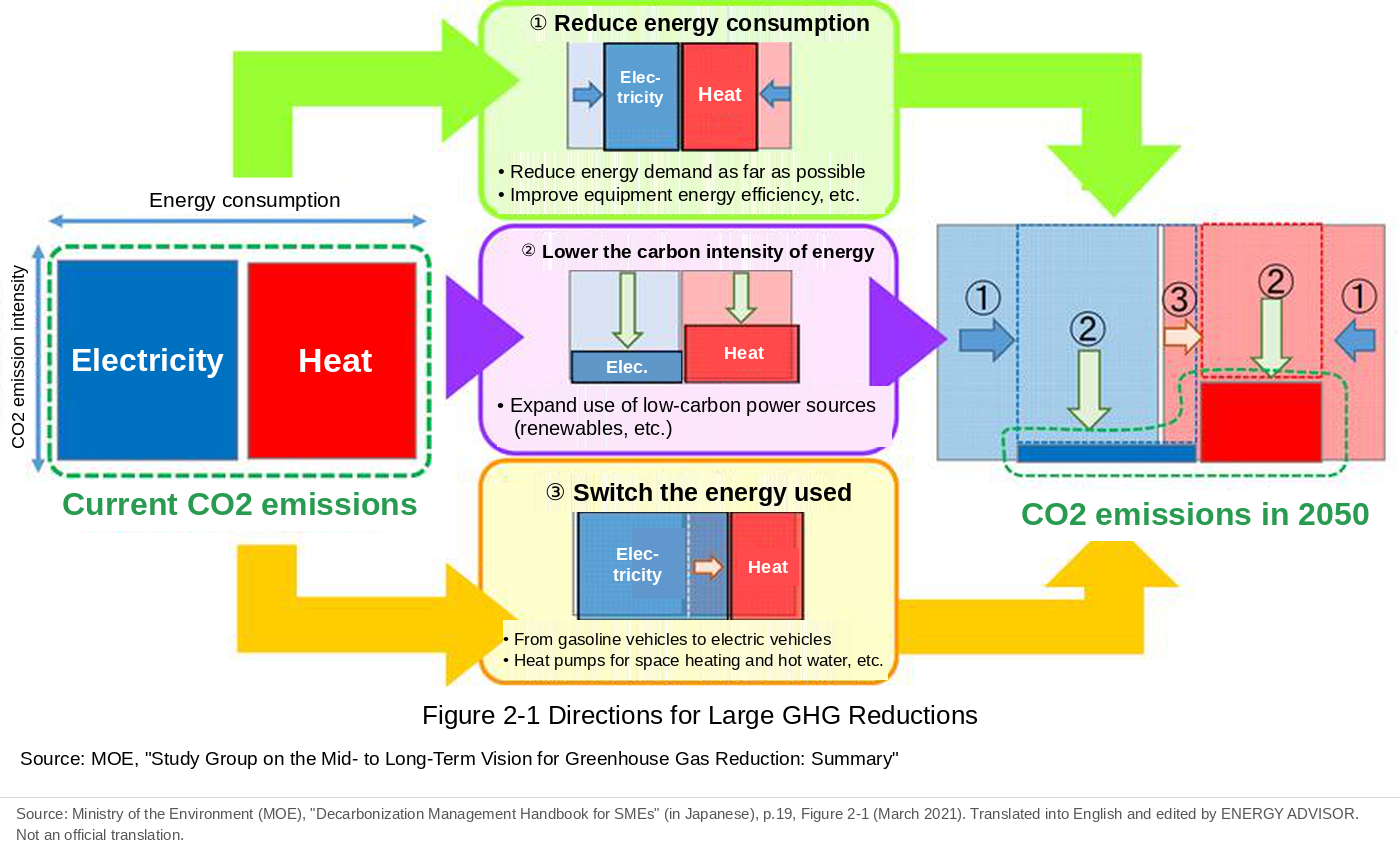
In addition, MOE has published a handbook for small and medium-sized businesses that sets out the steps for considering decarbonization management. It presents the basic directions (thorough energy conservation, lower-carbon energy and electrification) and the steps for planning. Before deciding how to answer a customer’s request, reading through these free public materials and contacting the advisory services once will make later decisions easier.
Source: MOE, “Decarbonization Management Handbook for SMEs” (in Japanese)
Before considering expensive capital investment or consulting contracts, grasping the overall picture through free services and public materials helps organize how to proceed.
Summary
Public statistics confirm that more SMEs are being asked by customers to measure their CO2 emissions and cooperate in reducing them. Behind this are large companies’ efforts to measure and disclose emissions across their entire supply chain, including suppliers, and demands from investors and major customers for climate action. For companies that receive requests, the biggest hurdle is the burden of expenses and costs, but free public advisory services and materials are available. Rather than rushing into individual responses, a realistic starting point is to grasp the overall picture first.
Note: The information in this article is current as of the time of posting and may have changed by the time you read it.
This article is based on published materials from the Ministry of Economy, Trade and Industry and its Agency for Natural Resources and Energy, the Electricity and Gas Market Surveillance Commission, the Organization for Cross-regional Coordination of Transmission Operators (OCCTO) and other sources. The English translations of figures are by ENERGY ADVISOR and are not official translations. When using this information for decisions, please check the original sources. When we find an error, we correct the article and note the date of the correction.
Sources
- METI, “Toward Promoting GX for SMEs” (January 2026) (in Japanese). https://www.meti.go.jp/policy/energy_environment/global_warming/SME/pamphlet/gx_gaiyou.pdf
- SMRJ, “Carbon Neutrality Advisory Services and Training Support” (in Japanese). https://www.smrj.go.jp/sme/sdgs/favgos000001to2v.html
- MOE, “Decarbonization Management Handbook for SMEs” (in Japanese). https://www.env.go.jp/earth/SMEs_handbook.pdf
- Small and Medium Enterprise Agency, “Definition of SMEs and Small Enterprises” (in Japanese). https://www.chusho.meti.go.jp/soshiki/teigi.html
- ANRE, “What Is Full Retail Liberalization of Electricity?” (in Japanese). https://www.enecho.meti.go.jp/category/electricity_and_gas/electric/electricity_liberalization/what/
- ANRE, “Supply Plan Notifications of General Transmission and Distribution Companies (FY2025)” (list of the ten GT&D companies) (in Japanese). https://www.enecho.meti.go.jp/category/electricity_and_gas/electricity_measures/005/2025.html