From FY2026, Phase 3 of the Act on the Promotion of Use of Non-Fossil Energy Sources and Effective Use of Fossil Energy Materials by Energy Suppliers (Sophisticated Methods Act) began. Retail electricity suppliers above a certain size are obliged to procure a certain share of the electricity they sell from non-fossil sources, and trading of “non-fossil certificates” has become an indispensable part of the institutional infrastructure as a means of meeting this obligation.
This article explains the basic idea of non-fossil value, the classification of the three types of non-fossil certificates, and how the two trading markets work. It surveys the overall picture as an entry point to understanding the environmental attribute systems of the power industry.
Key points
- 1Non-fossil value is the added environmental value of “not emitting CO2” contained in electricity generated from non-fossil sources.
- 2Non-fossil certificates come in three types (FIT, non-FIT renewable-designated and non-FIT non-designated), which differ in their uses and trading markets.
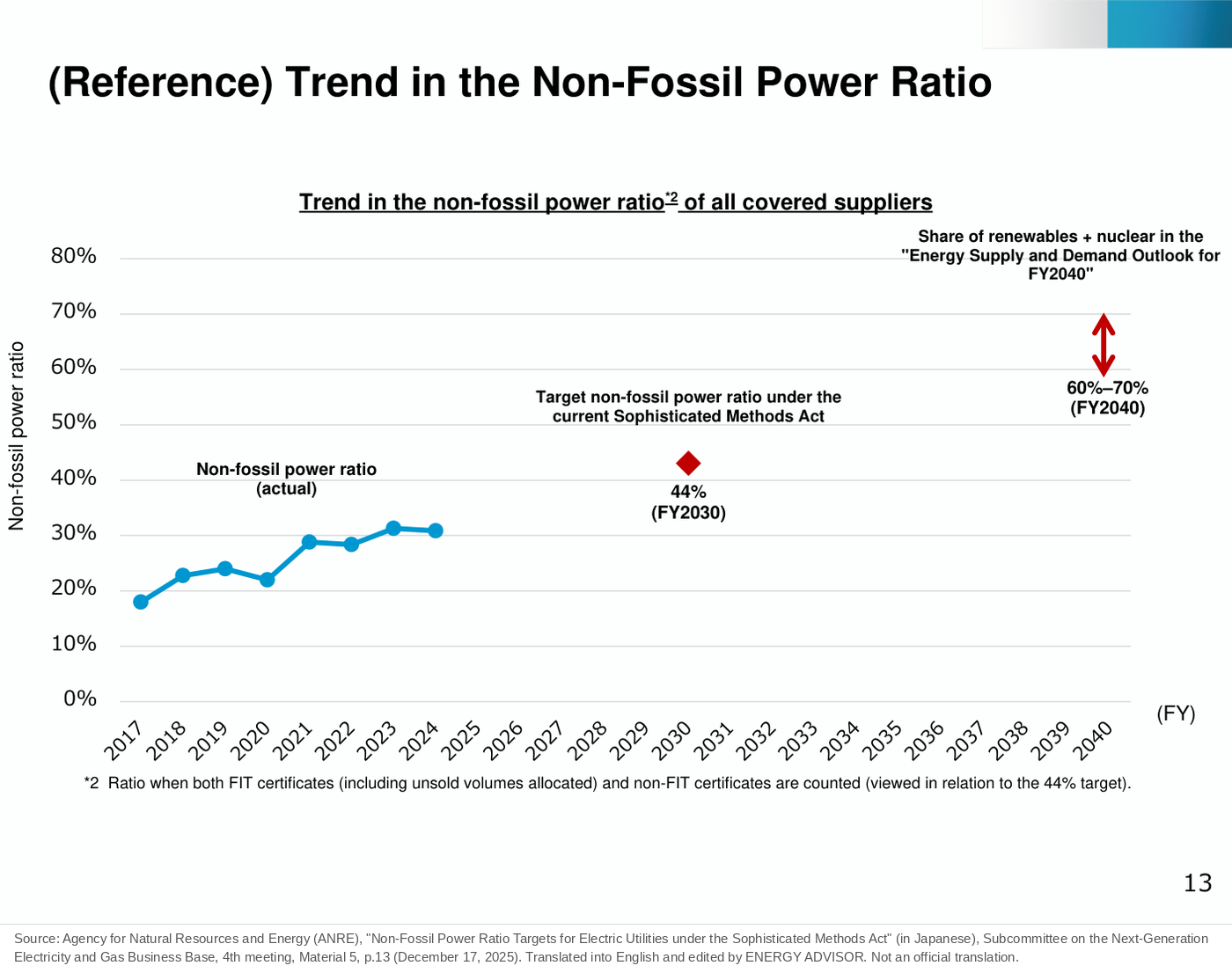
- 3The target non-fossil power ratio for FY2030 is 44% or more. A policy of 60% or more for FY2040 has been presented.
How Japan’s Power System Works (Background for Readers Outside Japan)
To understand non-fossil certificates, here is a brief explanation of how Japan’s power system works.
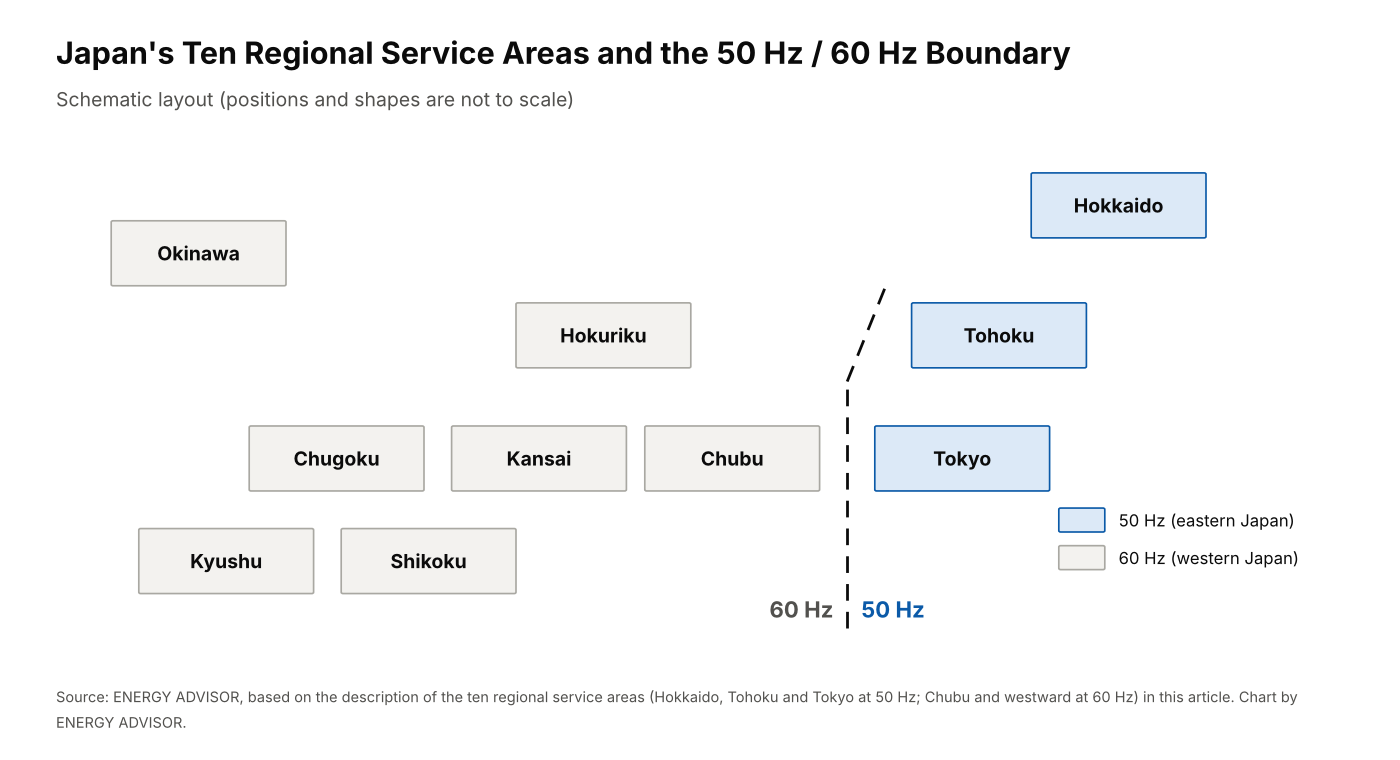
- Japan’s power grid is divided into ten regional service areas: Hokkaido, Tohoku, Tokyo, Chubu, Hokuriku, Kansai, Chugoku, Shikoku, Kyushu and Okinawa. Eastern Japan (Hokkaido, Tohoku and Tokyo) runs at 50 Hz and western Japan (Chubu and westward) at 60 Hz, so the frequency differs between east and west.
- The transmission and distribution network in each area is operated by that region’s general transmission and distribution company (GT&D company) (for example, TEPCO Power Grid).
- Since full retail market liberalization in 2016, generation, transmission and distribution, and retail have been separated into different businesses. Businesses that sell electricity to households and companies are called retail electricity suppliers. The ten companies that originally handled everything from generation to retail in each area are called “former general electricity utilities” (incumbent regional utilities). Retail electricity suppliers that entered the market later are called “new entrant retailers.”
- The Organization for Cross-regional Coordination of Transmission Operators, JAPAN (OCCTO) handles supply-demand coordination across areas and the settlement of renewable energy purchase costs, among other tasks.
- The Japan Electric Power Exchange (JEPX), Japan’s only wholesale power exchange, runs auctions of non-fossil certificates in addition to wholesale electricity trading.
- The system is overseen by the Agency for Natural Resources and Energy (ANRE) of the Ministry of Economy, Trade and Industry, and market monitoring is carried out by the Electricity and Gas Market Surveillance Commission (EGC).
- Japan’s fiscal year (FY) runs from April to March of the following year; FY2026 is April 2026–March 2027.
What Non-Fossil Value Is: Renewable Value and Zero-Emission Value
Besides its energy value as electric power, electricity has an added environmental value that comes from how it is generated. The value of “not emitting CO2” held by electricity generated from sources that do not use fossil fuels (coal, natural gas, oil) is collectively called “non-fossil value.”
Non-fossil value can be further organized into two concepts. The first is “renewable value,” the environmental value derived from renewable energy such as solar, wind, hydro, geothermal and biomass. The second is “zero-emission value,” the environmental value derived from all non-fossil sources that do not emit CO2, including nuclear and others in addition to renewables.
An important point about non-fossil value is that it can be traded separately from the energy value of the electricity itself. This mechanism allows even retail electricity suppliers that do not own renewable generation facilities to raise the non-fossil power ratio of the electricity they sell by buying non-fossil certificates in the market.
The Three Types of Non-Fossil Certificates: FIT, Non-FIT (Renewable-Designated) and Non-FIT (Non-Designated)
Non-fossil value turned into a certificate is a “non-fossil certificate.” Non-fossil certificates are classified into the following three types according to the type of generation source.
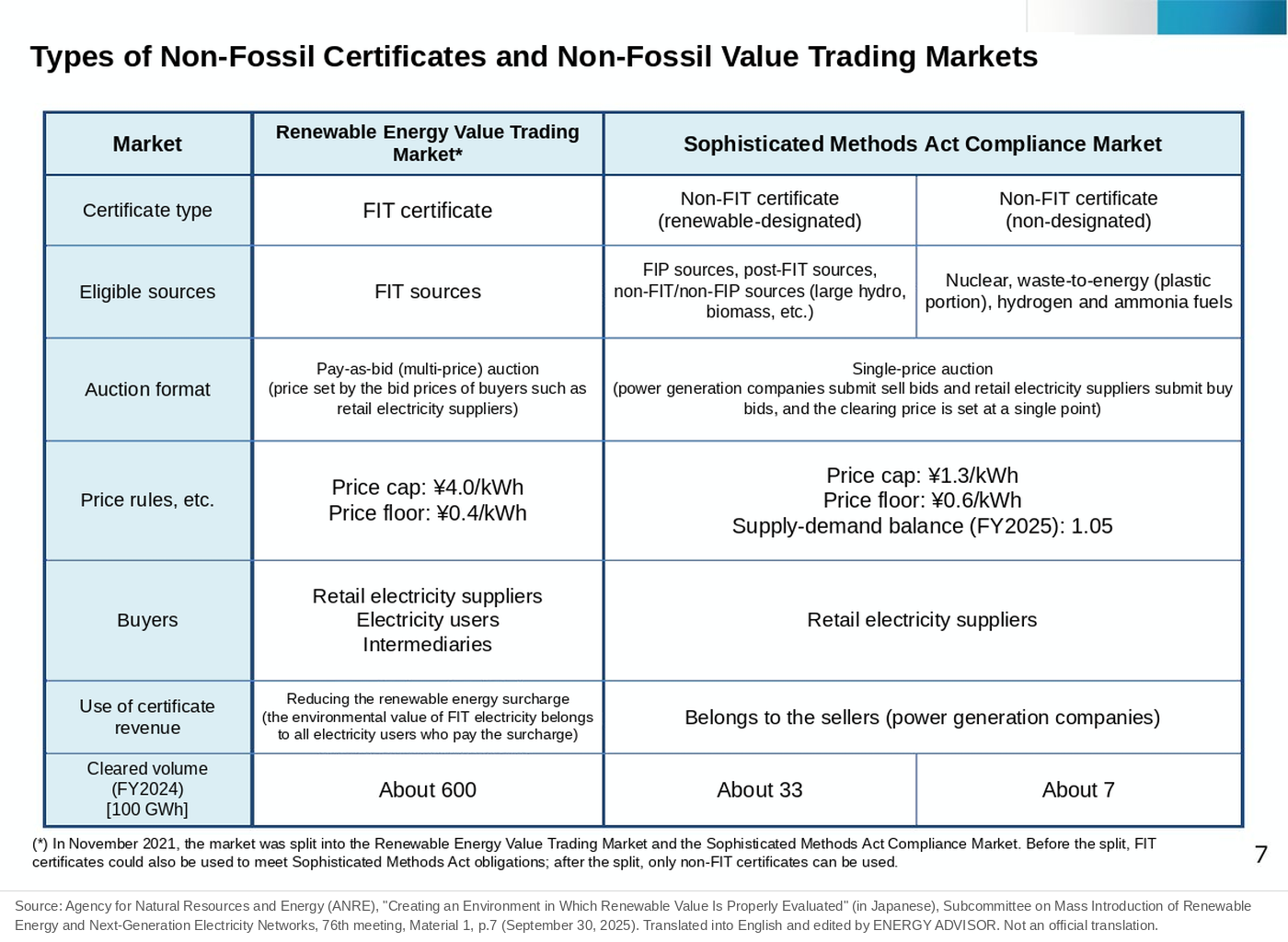
| Type | Main eligible sources | Trading market | Use for RE100 |
|---|---|---|---|
| FIT non-fossil certificate | Solar, wind, hydro, geothermal and biomass covered by the FIT scheme | Renewable Energy Value Trading Market | Allowed if tracking information is attached |
| Non-FIT non-fossil certificate (renewable-designated) | Large hydropower, post-FIT sources, FIP sources, etc. | Sophisticated Methods Act Compliance Market | Allowed if tracking information is attached |
| Non-FIT non-fossil certificate (non-designated) | Nuclear, waste-to-energy (plastic portion), hydrogen and ammonia fuels, etc. | Sophisticated Methods Act Compliance Market | Not allowed |
FIT Non-Fossil Certificates
FIT non-fossil certificates certify the environmental attributes of electricity generated from renewable energy sources covered by the Feed-in Tariff (FIT) scheme (a scheme under which electricity generated from renewables is purchased at a government-set price for a fixed period). Eligible sources are of five types: solar, wind, hydro, geothermal and biomass. These are the most widely circulated non-fossil certificates.
Under the FIT scheme, electricity generated from renewables is purchased at fixed prices by GT&D companies, and the purchase costs are borne by the public as a whole through the renewable energy surcharge (a charge paid by all electricity users in proportion to their usage). In this case, the environmental attributes (non-fossil value) of the electricity are deemed to belong to all the electricity users who pay the surcharge, and OCCTO, acting as the seller, sells them in the market as FIT non-fossil certificates. The sales revenue is used to reduce the burden of the renewable energy surcharge.
Non-FIT Non-Fossil Certificates (Renewable-Designated)
Non-FIT non-fossil certificates (renewable-designated) certify the environmental attributes of electricity generated from sources that are not covered by the FIT scheme but qualify as renewable energy. Specifically, they cover large hydropower (30 MW or more of output), sources whose purchase period under the FIT scheme has ended (so-called “post-FIT” sources), and sources under the Feed-in Premium (FIP) scheme (sources that receive a subsidy on top of the market price).
Because renewable-designated non-FIT certificates, like FIT certificates, come from renewable energy, they can also be used for international environmental initiatives such as RE100.
Non-FIT Non-Fossil Certificates (Non-Designated)
Non-FIT non-fossil certificates (non-designated) certify the environmental attributes of electricity generated from sources that are non-fossil but not designated as renewable energy. The typical eligible source is nuclear power, and they also include waste-to-energy (plastic portion) and generation using hydrogen or ammonia fuel.
These certificates have zero-emission value as a “source that does not emit CO2,” but because they do not come from renewables, they are not accepted as a means of achieving RE100. On the other hand, they can be used to calculate the non-fossil power ratio under the Sophisticated Methods Act.
Two Trading Markets: The Renewable Energy Value Trading Market and the Sophisticated Methods Act Compliance Market
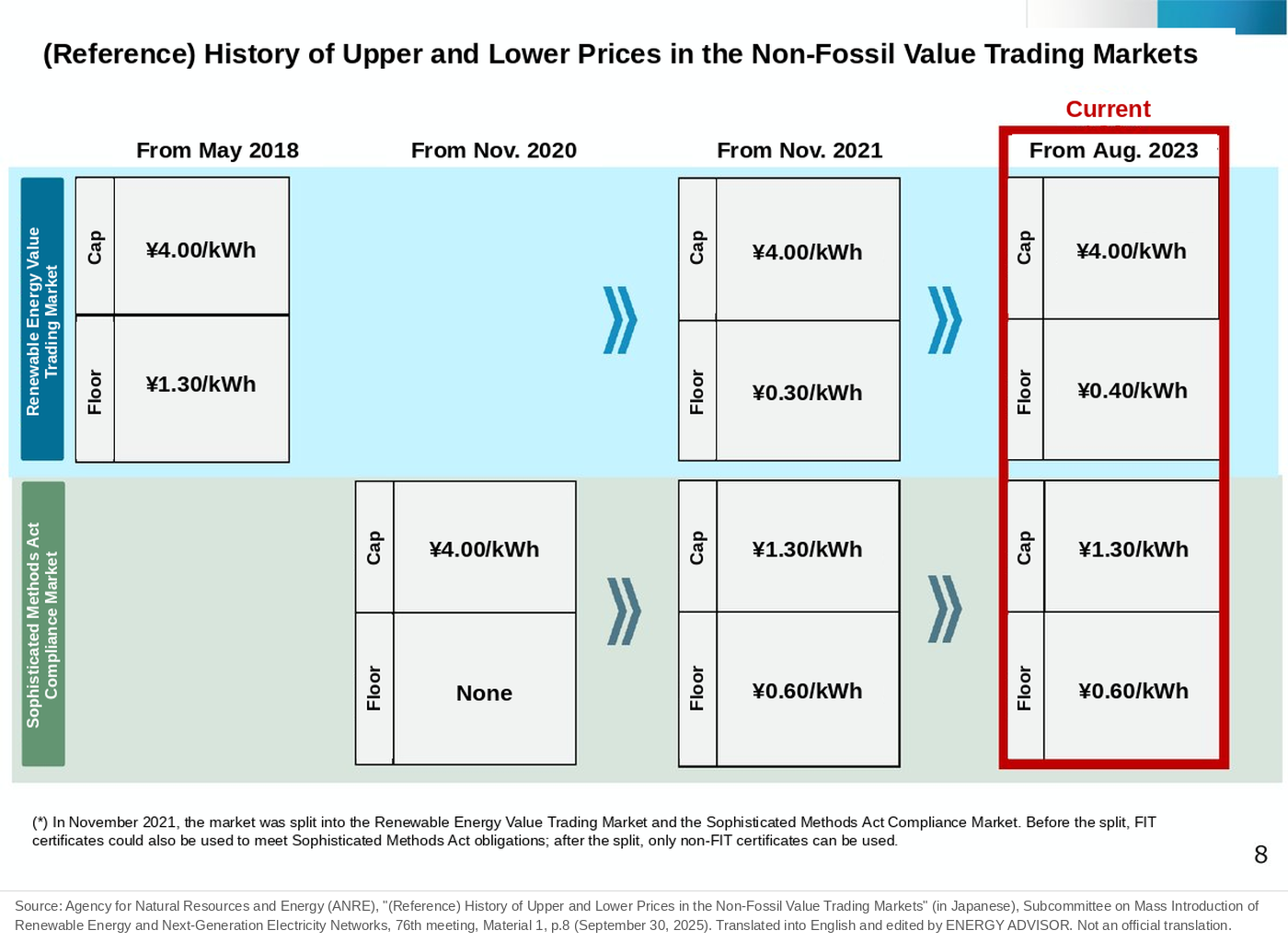
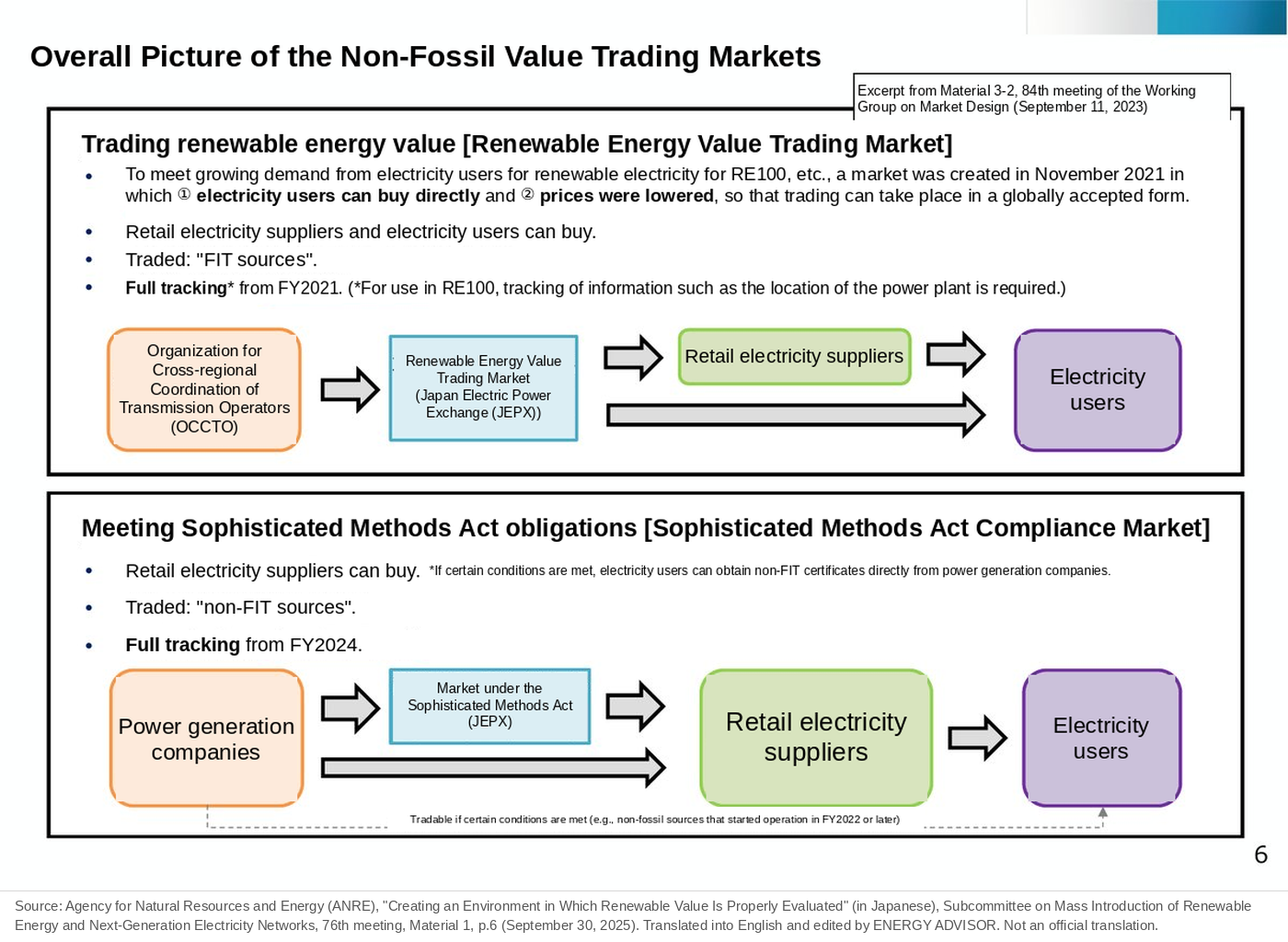
After the market restructuring in November 2021, non-fossil certificates are now traded in two separate markets. Both are run by JEPX, and trading takes place by auction four times a year (August, November, February and May).
Renewable Energy Value Trading Market
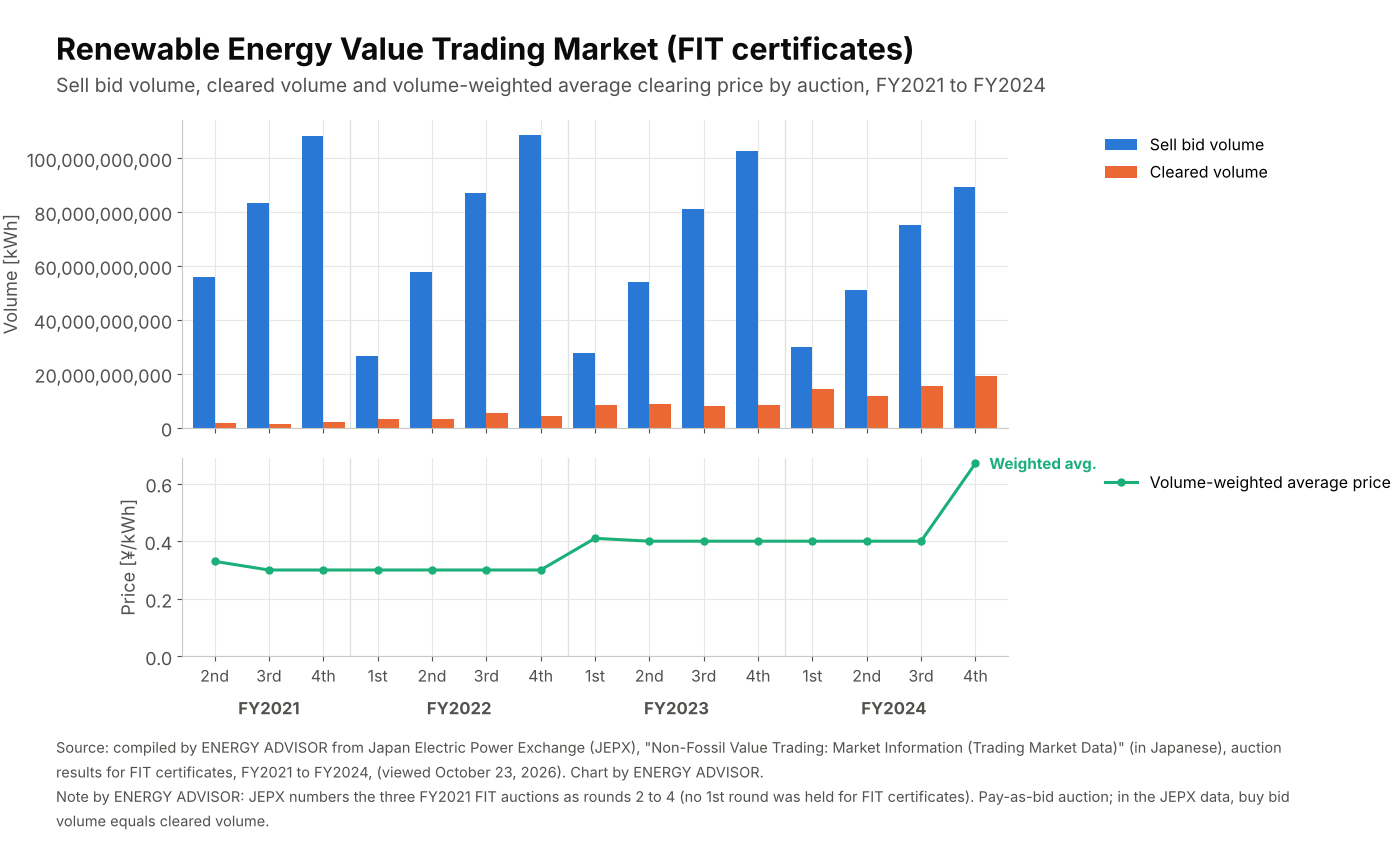
FIT non-fossil certificates are traded in the Renewable Energy Value Trading Market. A key feature of this market is that not only retail electricity suppliers but also electricity users (companies) and intermediaries can take part. It functions as a place where companies aiming to meet RE100 or CDP can procure environmental attributes themselves.
The auction format is a pay-as-bid (multi-price) auction (each winning bidder clears at its own bid price). In the first auction of FY2025 (August 2025), the cleared volume reached about 21 billion kWh (21 TWh). Except for the fourth auction of FY2024, in which there was substitute procurement, the volume-weighted average price has stayed around the price floor of ¥0.4/kWh. The first auction of FY2026 (August 2026) had a cleared volume of about 23.1 billion kWh (23.1 TWh) and a volume-weighted average of ¥0.40/kWh (JEPX market information).
Sophisticated Methods Act Compliance Market
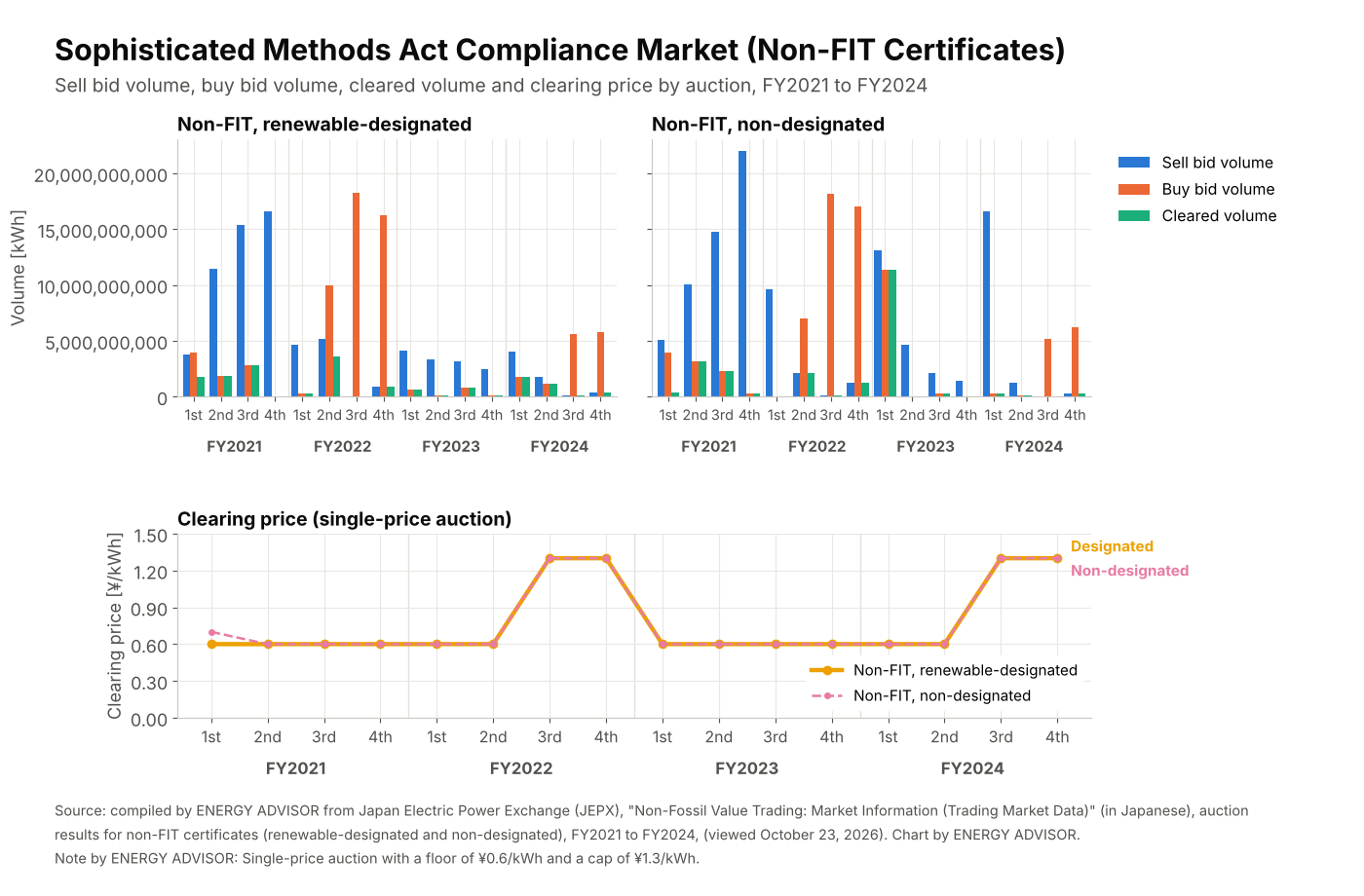
Non-FIT non-fossil certificates (both renewable-designated and non-designated) are traded in the Sophisticated Methods Act Compliance Market. Participants are in principle limited to retail electricity suppliers, and the main purpose is to meet the non-fossil power ratio targets under the Sophisticated Methods Act.
The auction format is a single-price auction (all winning bidders trade at the same clearing price). According to Material 3 of the 109th meeting of the Working Group on Market Design, the first auction of FY2025 cleared at a price other than the cap or the floor, and the second was again stuck at the price cap of ¥1.3/kWh. The clearing price for non-FIT renewable-designated certificates was ¥0.91/kWh in the first auction of FY2025 and ¥1.21/kWh in the first auction of FY2026 (JEPX market information).
Because electricity users can also take part in the Renewable Energy Value Trading Market, demand there is growing from corporate needs such as meeting RE100. The Sophisticated Methods Act Compliance Market, on the other hand, is exclusively for retailers and is directly linked to improving their generation mix.
Relationship with the Sophisticated Methods Act: Non-Fossil Power Ratio Targets and Phased Implementation
The institutional background of non-fossil certificates is the Sophisticated Methods Act, enacted in 2009. This Act obliges retail electricity suppliers whose electricity sales in the previous fiscal year were 500 million kWh or more to meet non-fossil power ratio targets.
The current target is to achieve a non-fossil power ratio of 44% or more in FY2030. In addition, a policy of 60% or more for FY2040 was presented at a council meeting (the Subcommittee on the Next-Generation Electricity and Gas Business Base) in December 2025. To meet this target, the Sophisticated Methods Act sets interim targets in stages, in phases of three years each.
| Phase | Period | Main features |
|---|---|---|
| Phase 1 | FY2020–FY2022 | Introduction of interim targets. Covers retail electricity suppliers with 500 million kWh or more a year |
| Phase 2 | FY2023–FY2025 | Interim targets raised. Achievement status evaluated and published |
| Phase 3 | FY2026–FY2028 | Keeps the Phase 2 method while revising three points. The interim target for FY2026 is an external procurement ratio of 14.8% (final value); in May 2026, ANRE proposed correcting it to about 15.8% (article 12) |
Retail electricity suppliers have two broad means of meeting this target. One is securing non-fossil sources themselves (own generation, bilateral contracts, etc.), and the other is buying non-fossil certificates in the market. The non-fossil certificate markets are positioned as important infrastructure supporting compliance with the Sophisticated Methods Act.
Main Uses of Non-Fossil Certificates
The uses of non-fossil certificates are not limited to compliance with the Sophisticated Methods Act. In recent years, with growing interest in decarbonization management among companies, the range of uses has widened.
- Compliance with the Sophisticated Methods Act: bought by retail electricity suppliers to meet their interim non-fossil power ratio targets. This is the most basic use.
- Improving CO2 emission factors: using non-fossil certificates lets a retail electricity supplier lower its adjusted CO2 emission factor. This is reflected in reporting under the Act on Promotion of Global Warming Countermeasures.
- Meeting international initiatives such as RE100 and CDP: FIT certificates and non-FIT renewable-designated certificates are accepted as a means of achieving RE100 if tracking information is attached.
- Relationship with the GX-ETS: because the GX Emissions Trading System (GX-ETS) covers only Scope 1 (direct emissions), non-fossil certificates cannot be used to meet its obligations (article 22).
Tracking information (information tracing the generation source) has been attached to all FIT non-fossil certificates since FY2021 and to all non-FIT non-fossil certificates since FY2024. Linking attribute information such as the generation method, the location of the plant and whether it is within 15 years of starting operation improves the transparency and international credibility of the certificates.
Summary: Non-Fossil Value Is a Foundational System Supporting Decarbonization of Electricity
Non-fossil value is the added environmental value of “not emitting CO2” held by electricity generated from non-fossil sources, and it consists of two concepts: renewable value and zero-emission value. Non-fossil certificates, which turn this value into certificates, are classified into three types. FIT certificates are traded in the Renewable Energy Value Trading Market, and non-FIT certificates in the Sophisticated Methods Act Compliance Market.
In Phase 3 of the Sophisticated Methods Act from FY2026, interim targets are set toward 44% in FY2030 and the policy of 60% or more in FY2040. The procurement strategy for non-fossil certificates is likely to become increasingly important for retail electricity suppliers. In addition, with the spread of RE100, understanding non-fossil certificates is also essential for corporate electricity users.
The non-fossil certificate system may look complex, but the overall picture becomes easier to grasp if it is organized along two axes: “which source it comes from” and “which market it is traded in.” This series will explore each certificate and market in detail in turn.
This article is based on published materials from the Ministry of Economy, Trade and Industry and its Agency for Natural Resources and Energy, the Electricity and Gas Market Surveillance Commission, the Organization for Cross-regional Coordination of Transmission Operators (OCCTO) and other sources. The English translations of figures are by ENERGY ADVISOR and are not official translations. When using this information for decisions, please check the original sources. When we find an error, we correct the article and note the date of the correction.
Sources
- ANRE, Subcommittee on Mass Introduction of Renewable Energy and Next-Generation Electricity Networks, 76th meeting, Material 1 “Creating an Environment in Which Renewable Value Is Properly Evaluated” (September 30, 2025) (in Japanese): p.6 (full tracking of FIT certificates from FY2021 and of non-FIT certificates from FY2024; electricity users can buy), p.7 (eligible sources of the three types of certificates; revenue from FIT certificates used to reduce the renewable energy surcharge), p.8 (history of upper and lower prices), pp.10–12 (trading of FIT and non-FIT certificates) (p.6 and p.7 confirmed from the text in the figures). https://www.meti.go.jp/shingikai/enecho/denryoku_gas/saisei_kano/pdf/076_01_00.pdf
- JEPX, “Non-Fossil Value Trading Rules” (in Japanese): Article 9 (trades of FIT certificates are concluded between OCCTO and trading participants), Article 14(4) (OCCTO places sell bids for its entire certified volume), Article 15 (multi-price and single-price). https://www.jepx.jp/nonfossil/outline/pdf/nonfossil_rules.pdf
- JEPX, “FY2026 Non-Fossil Value Trading Market Schedule” (June 25, 2026) (in Japanese). https://www.jepx.jp/nonfossil/outline/pdf/market/nf_calendar2026.pdf
- ANRE, Working Group on Market Design, 109th meeting, Material 3 “Non-Fossil Value Trading” (December 12, 2025) (in Japanese): p.6 (cleared volume of FIT certificates in the first auction of FY2025: 21 billion kWh), p.41 (the volume-weighted average price of FIT certificates was around the ¥0.4 floor except for the fourth auction of FY2024 with substitute procurement; non-FIT certificates were at the ¥1.3 cap in three of the last four auctions). https://www.meti.go.jp/shingikai/enecho/denryoku_gas/jisedai_kiban/system_review/pdf/109_03_00.pdf
- ANRE, Working Group on Market Design, 113th meeting, Material 4 “Non-Fossil Value Trading” (April 3, 2026) (in Japanese): p.8 (final values for FY2026). https://www.meti.go.jp/shingikai/enecho/denryoku_gas/jisedai_kiban/system_review/pdf/113_04_00.pdf
- JEPX, “Non-Fossil Value Trading Market Information (Market Data)” (5-year display period, table view; viewed October 22, 2026) (in Japanese): first auction of FY2025, non-FIT renewable-designated ¥0.91/kWh; first auction of FY2026, FIT cleared volume 23.12 billion kWh and volume-weighted average ¥0.40/kWh, non-FIT renewable-designated ¥1.21/kWh. https://www.jepx.jp/nonfossil/market-data/
- ANRE, Subcommittee on the Next-Generation Electricity and Gas Business Base, Material 5 (December 17, 2025) (in Japanese): p.3 (obligation covers suppliers with 500 million kWh or more of supply in the previous fiscal year), p.4 (promulgated on July 8, 2009), p.12 and p.14 (60% or more in FY2040; revision of the ministerial notification), p.13 (trend in the non-fossil power ratio). https://www.meti.go.jp/shingikai/enecho/denryoku_gas/jisedai_kiban/pdf/004_05_00.pdf
- ANRE, Subcommittee on the Next-Generation Electricity and Gas Business Base, Working Group on Market Design, “24th Interim Report” (May 2026) (in Japanese): p.32 (policy for the FY2040 target of 60% or more and revision of the ministerial notification; final decision by the Subcommittee on the Next-Generation Electricity and Gas Business Base), p.33 (Phase 3 is FY2026–FY2028; Phase 4 (provisional) from FY2029) (pages were read via a summary and may be off by one). https://www.meti.go.jp/shingikai/enecho/denryoku_gas/jisedai_kiban/system_review/pdf/20260501_2.pdf