When a company on a high-voltage or extra-high-voltage contract reviews its electricity costs and collects quotations from new entrant retailers, it often finds that each company presents unit prices and terms differently, and it is unclear where to set the benchmark for comparison. The unit prices of new entrant retailers are, in principle, not published because they are set by individual negotiation, which also makes it hard to find a basis for comparison. This article sets out the “standard tariff,” one of the few pieces of published information on high-voltage electricity.
Key points
- 1A standard tariff is a standard rate menu for high-voltage and extra-high-voltage customers that a regional utility publishes on its official website and elsewhere.
- 2TEPCO Energy Partner (TEPCO EP)’s standard tariff has three types: the Basic Plan, the Zero Market Adjustment Plan and the Market-Linked Plan.
- 3Standard tariffs are reviewed every fiscal year, and they were revised again in April 2026. In addition, unit prices will change on November 1, 2026, to reflect a revision of network charges.
- 4Why the standard tariff serves as a benchmark for comparing high-voltage electricity.
Part 1 looked at why high-voltage and extra-high-voltage electricity prices are hard to compare, and introduced the term “standard tariff” as the benchmark for comparison. From this part, the aim is to be able to read contracts and bills on your own, starting with a detailed look at the standard tariff itself.
What a Standard Tariff Is
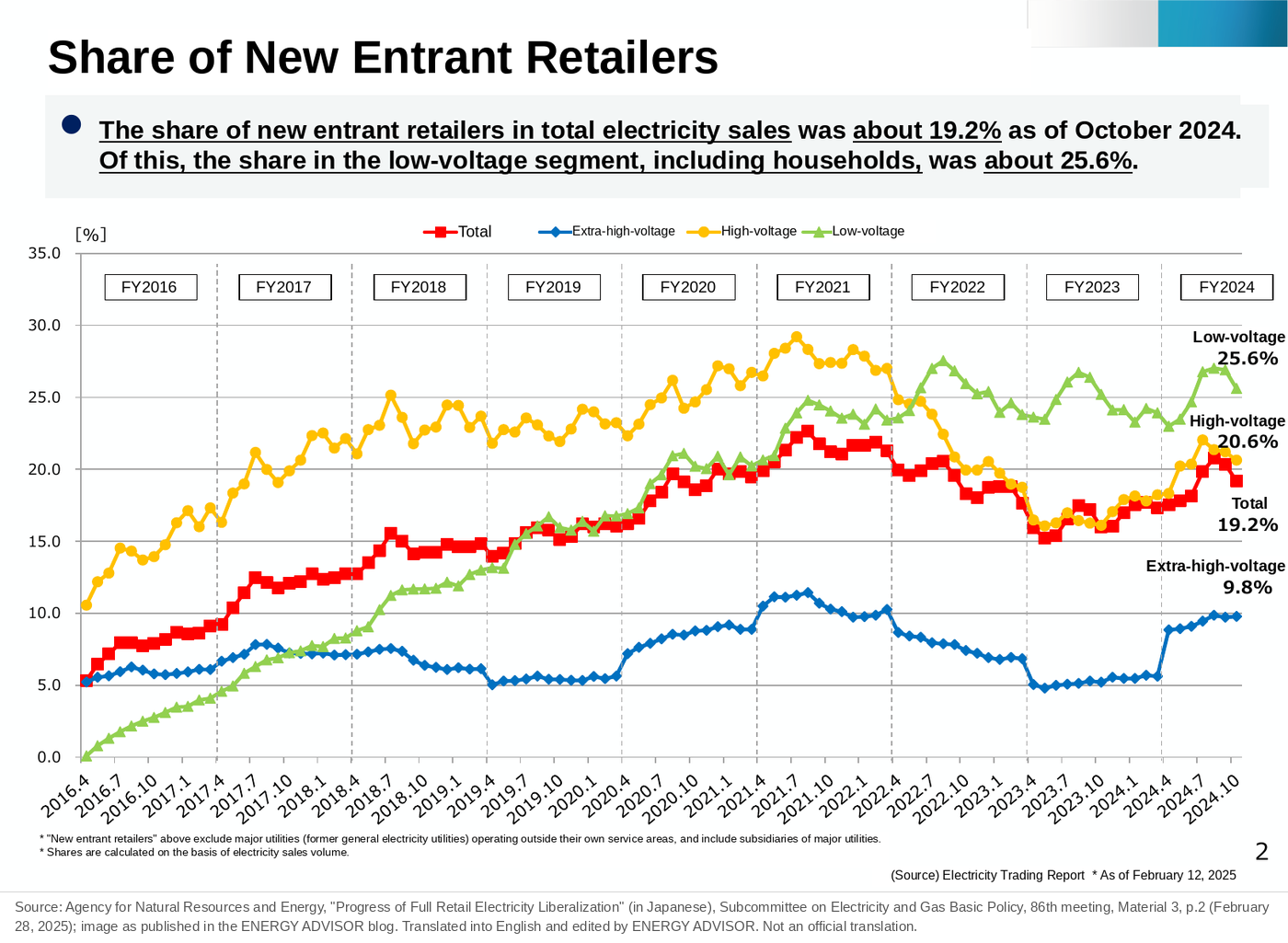
A standard tariff is a standard rate menu for high-voltage and extra-high-voltage customers that a major regional utility (retail electricity supplier) originating from one of the former general electricity utilities publishes on its official website and elsewhere. The former general electricity utilities are the major utilities that once handled everything from generation to sales in each area. While the unit prices that new entrant retailers (electricity retailers that entered the market after retail liberalization) offer through individual negotiation are not published, the standard tariff is one of the few pieces of published information that anyone can check.
Many high-voltage and extra-high-voltage contracts with new entrant retailers have terms set through individual negotiation between the supplier and the customer, so the unit prices are shared only between the parties and cannot be checked from outside. For this reason, the published unit prices of standard tariffs are one of the few reference materials for companies considering a contract.
When examining quotations from new entrant retailers, simply placing the standard tariff’s unit prices alongside them makes it easier to see where your own contract currently stands.
Example Unit Prices
For reference, the unit prices of the high-voltage Basic Plan (Kanto area) effective April 1, 2026 were a demand charge of ¥2,530.00 per kW and an energy charge of ¥17.43 per kWh (a single rate with no time-of-day periods, tax included). From November 1, 2026, the demand charge will be ¥2,651.50 per kW and the energy charge ¥17.47 per kWh. This reflects in electricity rates the revision, on November 1, 2026, of the network charges (fees for using the transmission and distribution network, which are included in electricity rates) set by the general transmission and distribution companies (GT&D companies, which own and operate the transmission and distribution network in each area). The network charge revision results from the GT&D companies applying to the government to change their revenue forecasts, in order to reflect during the period rises in prices and labor cost rates and higher interest rates that could not be foreseen at the start of the first regulatory period (FY2023–FY2027; Japan’s fiscal year runs from April to March). (TEPCO Power Grid applied to the Minister of Economy, Trade and Industry for approval of the change on July 10, 2026.)
TEPCO EP’s rate table also lists unit prices for each area from Hokkaido to Kyushu, in addition to Kanto (pp.4–6 of the rate table from November 1, 2026). Differences from the standard plans of the major utility in each area are covered in the special edition.
| High-voltage, Kanto area (tax included) | Effective April 1, 2026 | From November 1, 2026 |
|---|---|---|
| Basic Plan, demand charge | ¥2,530.00/kW | ¥2,651.50/kW |
| Basic Plan, energy charge | ¥17.43/kWh | ¥17.47/kWh |
| Zero Market Adjustment Plan, demand charge | ¥2,720.00/kW | ¥2,846.50/kW |
| Zero Market Adjustment Plan, energy charge | ¥17.21/kWh | ¥17.26/kWh |
| Market-Linked Plan, demand charge | ¥1,500.00/kW | ¥1,608.57/kW |
| Market-Linked Plan, energy charge (morning, daytime, evening / night) | ¥15.18 / ¥15.00/kWh | ¥15.18 / ¥15.00/kWh |
(None of these include the fuel cost adjustment rate or the market price adjustment rate.)
Source: TEPCO Energy Partner, “FY2026 Electricity Rate Table (Extra-High-Voltage and High-Voltage)” (in Japanese), effective April 1, 2026, pp.4–5; TEPCO Energy Partner, “Electricity Rate Table (Extra-High-Voltage and High-Voltage)” (in Japanese), from November 1, 2026, pp.4–5; TEPCO Energy Partner, “Reflection of the Network Charge Revision in the Company’s Electricity Rates and Partial Revision of Supply Conditions” (in Japanese), August 31, 2026
The Three Plans of the Standard Tariff
Since FY2024, TEPCO Energy Partner’s standard tariff has offered three types: the Basic Plan, the Zero Market Adjustment Plan and the Market-Linked Plan. The three plans are described as differing in how they reflect the fuel cost adjustment and wholesale electricity market prices. In TEPCO EP’s rate list, the Basic Plan shows both a fuel cost adjustment rate and a market price adjustment rate, the Zero Market Adjustment Plan shows only a fuel cost adjustment rate, and the Market-Linked Plan shows only a market price adjustment rate (the differences between the plans are also set out in a table in Part 11). Of these, the Market-Linked Plan reflects changes in wholesale electricity market prices directly in electricity charges, so the burden may increase sharply when market prices surge. Care is needed when choosing it.
Source: TEPCO Energy Partner, “Revisions to Extra-High-Voltage and High-Voltage Standard Tariffs from April 1, 2026” (in Japanese); TEPCO Energy Partner, “List of Fuel Cost Adjustment Rates and Other Rates” (in Japanese), checked October 22, 2026
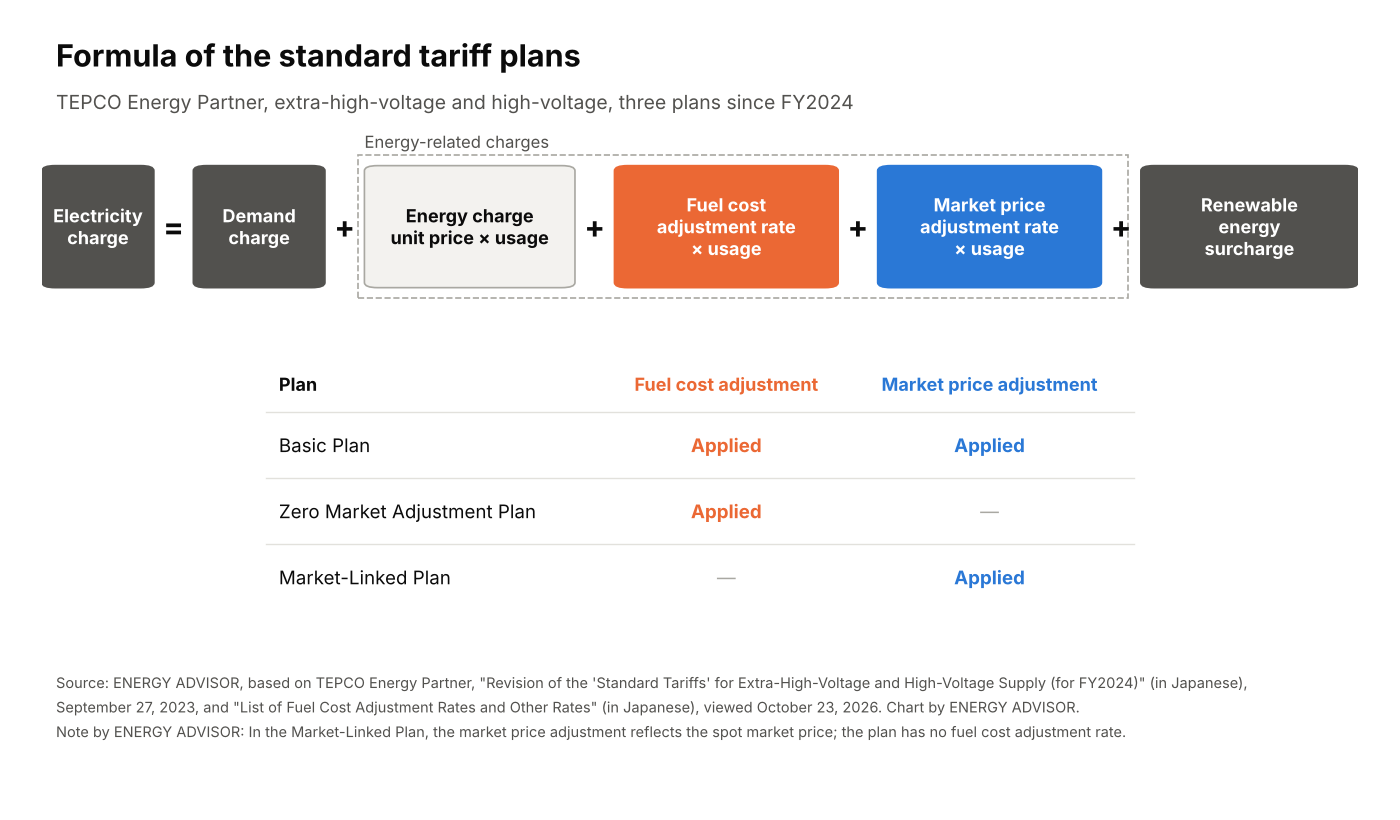
Source: TEPCO Energy Partner, “Revision of the ‘Standard Tariffs’ for Extra-High-Voltage and High-Voltage Supply (for FY2024)” (in Japanese), September 27, 2023
The 2026 Revision of the Standard Tariff
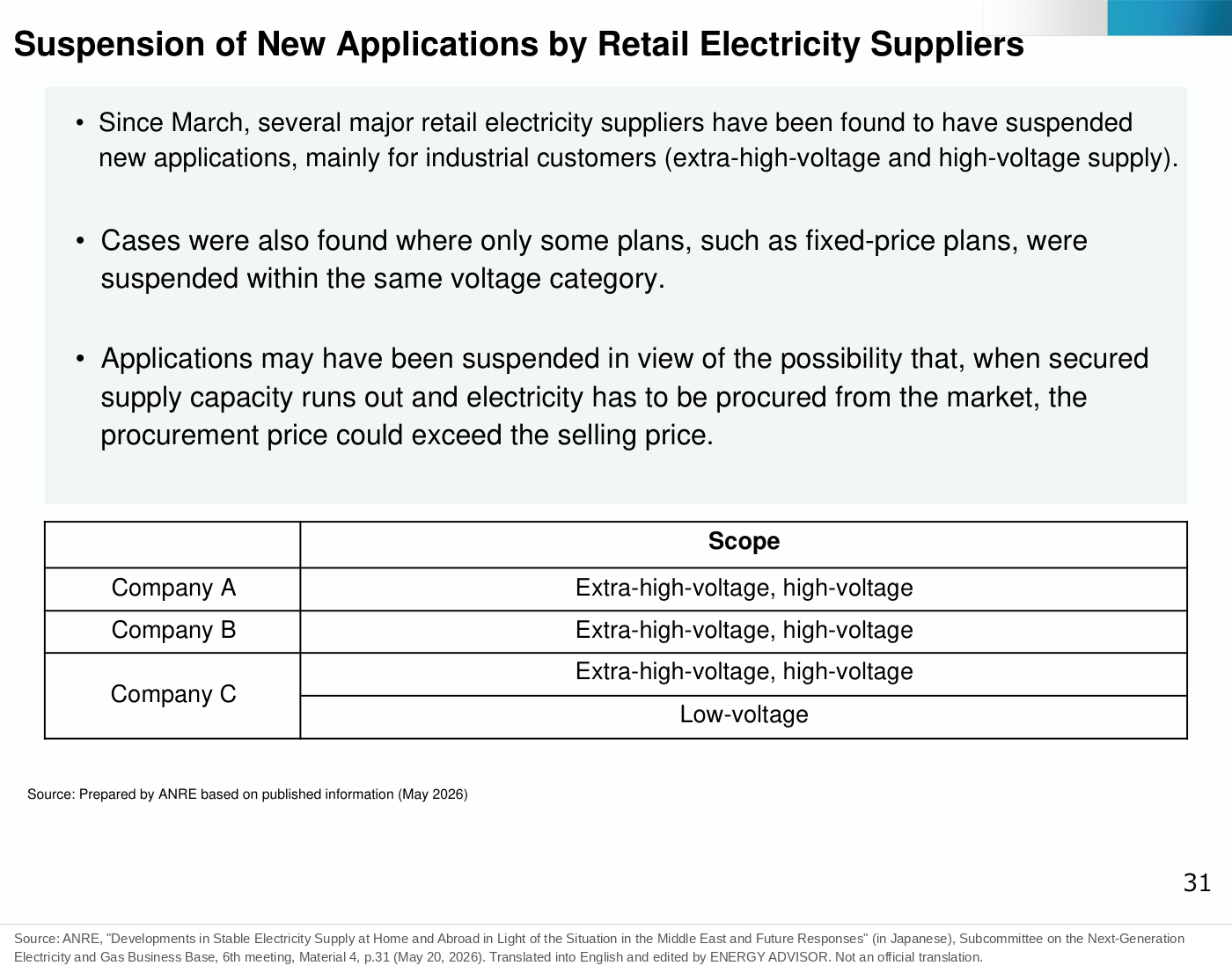
TEPCO EP’s former standard tariffs (those from FY2023 or earlier) ended at the end of March 2026, and the standard tariff was revised on April 1, 2026. In addition, once the planned supply volume cap is reached, applications for plans other than the Market-Linked Plan will close, and only the Market-Linked Plan will be accepted.
Source: TEPCO Energy Partner, “Revisions to Extra-High-Voltage and High-Voltage Standard Tariffs from April 1, 2026” (in Japanese)
Even if you do not remember switching contracts, your terms may have changed because of a revision of the standard tariff. It is important to review what is on your bill regularly.
Why the Standard Tariff Serves as a Benchmark
As long as new entrant retailers do not publish their unit prices, the standard tariff is one of the few pieces of published information for checking the price level of high-voltage electricity. However, placing the standard tariff’s unit prices directly alongside a new entrant retailer’s quotation does not give a correct comparison, because the method for setting contract demand and the rate structure differ. For this reason, you need to recalculate your own actual usage under each plan’s rate structure, as seen in Part 1.
Also, because standard tariffs are reviewed every fiscal year, what you checked once may not remain valid the next fiscal year. In fact, standard tariffs were reviewed in both FY2025 and FY2026. In FY2026, unit prices also change in the middle of the fiscal year, on November 1, 2026, to reflect the revision of network charges. For this reason, when using the standard tariff as a benchmark, it is important to be clear about the point in time you checked (the effective date of the unit prices).
Source: TEPCO Energy Partner, “Revisions to Extra-High-Voltage and High-Voltage Standard Tariffs from April 1, 2025” (in Japanese)
Summary
A standard tariff is a benchmark rate menu that a regional utility publishes for high-voltage and extra-high-voltage customers. TEPCO Energy Partner’s standard tariff has three types, the Basic Plan, the Zero Market Adjustment Plan and the Market-Linked Plan, and it was revised again in April 2026. On November 1, 2026, unit prices will change to reflect the revision of network charges. While new entrant retailers do not publish their unit prices, the standard tariff is worth checking as a benchmark for comparison. This article used TEPCO Energy Partner as the example, but in other areas the major utility in each area also publishes similar standard plans (where to check in each area nationwide is set out in the special edition).
This article is based on published materials from the Ministry of Economy, Trade and Industry and its Agency for Natural Resources and Energy, the Electricity and Gas Market Surveillance Commission, the Organization for Cross-regional Coordination of Transmission Operators (OCCTO) and other sources. The English translations of figures are by ENERGY ADVISOR and are not official translations. When using this information for decisions, please check the original sources. When we find an error, we correct the article and note the date of the correction.
Sources
- TEPCO Energy Partner, “Revisions to Extra-High-Voltage and High-Voltage Standard Tariffs from April 1, 2026, Reflection of the November 1, 2026 Network Charge Revision in Electricity Rates, and Partial Revision of Supply Conditions” (in Japanese), checked October 22, 2026. https://www.tepco.co.jp/ep/corporate/plan_h/minaoshi_2026.html
- TEPCO Energy Partner, “FY2026 Electricity Rate Table (Extra-High-Voltage and High-Voltage)” (in Japanese), effective April 1, 2026, pp.4–5. https://www.tepco.co.jp/ep/corporate/plan_h/pdf/2026minaoshisiryou.pdf
- TEPCO Energy Partner, “Electricity Rate Table (Extra-High-Voltage and High-Voltage)” (in Japanese), from November 1, 2026, pp.4–5. https://www.tepco.co.jp/ep/corporate/plan_h/pdf/202611minaoshisiryou.pdf
- TEPCO Energy Partner, “Reflection of the Network Charge Revision in the Company’s Electricity Rates and Partial Revision of Supply Conditions” (in Japanese), August 31, 2026. https://www.tepco.co.jp/ep/notice/pressrelease/2026/pdf/26×3101.pdf
- TEPCO Energy Partner, “Revisions to Extra-High-Voltage and High-Voltage Standard Tariffs from April 1, 2025” (in Japanese). https://www.tepco.co.jp/ep/corporate/plan_h/minaoshi_2025.html
- TEPCO Energy Partner, “Revision of the ‘Standard Tariffs’ for Extra-High-Voltage and High-Voltage Supply (for FY2024)” (in Japanese), September 27, 2023. https://www.tepco.co.jp/ep/notice/pressrelease/2023/1666212_8668.html
- TEPCO Power Grid, “Application for Approval of Changes to the ‘Revenue Forecast for Network Services'” (in Japanese), July 10, 2026 (reflects during the period rises in prices and labor cost rates and higher interest rates that could not be foreseen at the start of the first regulatory period (FY2023–FY2027); the new network charges are scheduled to apply from November 1, 2026). https://www.tepco.co.jp/pg/company/press-information/press/2026/pdf/26×2301.pdf
- Electricity and Gas Market Surveillance Commission (EGC), “Formal Recommendation on the Treatment of Rising Prices and Business Returns under the Revenue Cap System” (in Japanese), January 14, 2026 (clarifies that increases in prices and other costs are included in the revenue forecast, and allows them to be included during the regulatory period). https://www.egc.meti.go.jp/info/public/pdf/20260114a.pdf
- Agency for Natural Resources and Energy, “Developments in Stable Electricity Supply at Home and Abroad in Light of the Situation in the Middle East and Future Responses” (in Japanese), Subcommittee on the Next-Generation Electricity and Gas Business Base, May 20, 2026, Material 4. https://www.meti.go.jp/shingikai/enecho/denryoku_gas/jisedai_kiban/pdf/006_04_00.pdf
- Agency for Natural Resources and Energy, “Progress of Full Retail Electricity Liberalization” (in Japanese), Subcommittee on Electricity and Gas Basic Policy, 86th meeting, Material 3, February 28, 2025. https://www.meti.go.jp/shingikai/enecho/denryoku_gas/denryoku_gas/pdf/086_03_00.pdf