Last time, we confirmed that Scope 2 emissions can be calculated simply by multiplying electricity consumption by an emission factor. This “emission factor” is not actually a single fixed number. Even for the same electricity supplier, the figure you should refer to changes depending on the purpose and the tariff plan. This article looks in depth at how the system works.
Key points
- 1There are two types of emission factors, the “basic emission factor” and the “adjusted emission factor.” They differ in how far they reflect environmental attributes (non-fossil certificates and the like).
- 2From the figures published in March 2025, the basic emission factor has been labeled “adjusted for non-fossil sources.” The unadjusted value formerly called the basic emission factor is now distinguished as the “unadjusted emission factor.”
- 3Some electricity suppliers publish different emission factors for each tariff plan they offer. This is because the amount of environmental attributes linked to each plan differs.
- 4Suppliers that publish menu-specific factors also have a “residual” factor that applies to electricity other than the specific plans, and this factor tends to be higher than the supplier’s overall average.
- 5Even with the same electricity consumption, the choice of electricity supplier and plan changes the calculated CO2 emissions themselves.
In this series, “SMEs and Decarbonization,” we have looked so far (up to Part 4) at why customers ask for emissions reports (Part 1, in Japanese), the framework of Scope 1, 2 and 3 for counting emissions (Part 2, in Japanese), the difference between voluntary frameworks such as SBT and CDP and legal reporting obligations (Part 3, in Japanese), and the Scope 2 formula itself (Part 4, in Japanese). This time, we look at how the “emission factor” used in that formula is constructed under the system.
What the Emission Factor Means: The Number Used in Part 4
As confirmed last time, Scope 2 emissions are calculated by multiplying “electricity consumption (kWh) × emission factor (t-CO2/kWh).” The emission factor used here is a value showing how much CO2 emission accompanies each kWh of electricity supplied by an electricity supplier.
As part of the SHK system (the Mandatory Greenhouse Gas Accounting and Reporting System) under the Act on Promotion of Global Warming Countermeasures, the Ministry of the Environment (MOE) and the Ministry of Economy, Trade and Industry (METI) publish emission factors for each retail electricity supplier every fiscal year. Last time, we treated this factor as “a number to look up and use in the multiplication,” but in fact there are several types of published emission factors, each with a different character. First, we look at the “basic emission factor” and the “adjusted emission factor,” which always appear in the table.
From here, we look into why two columns of numbers appear in the table.
Basic and Adjusted Emission Factors: Why One Supplier Has Two Numbers
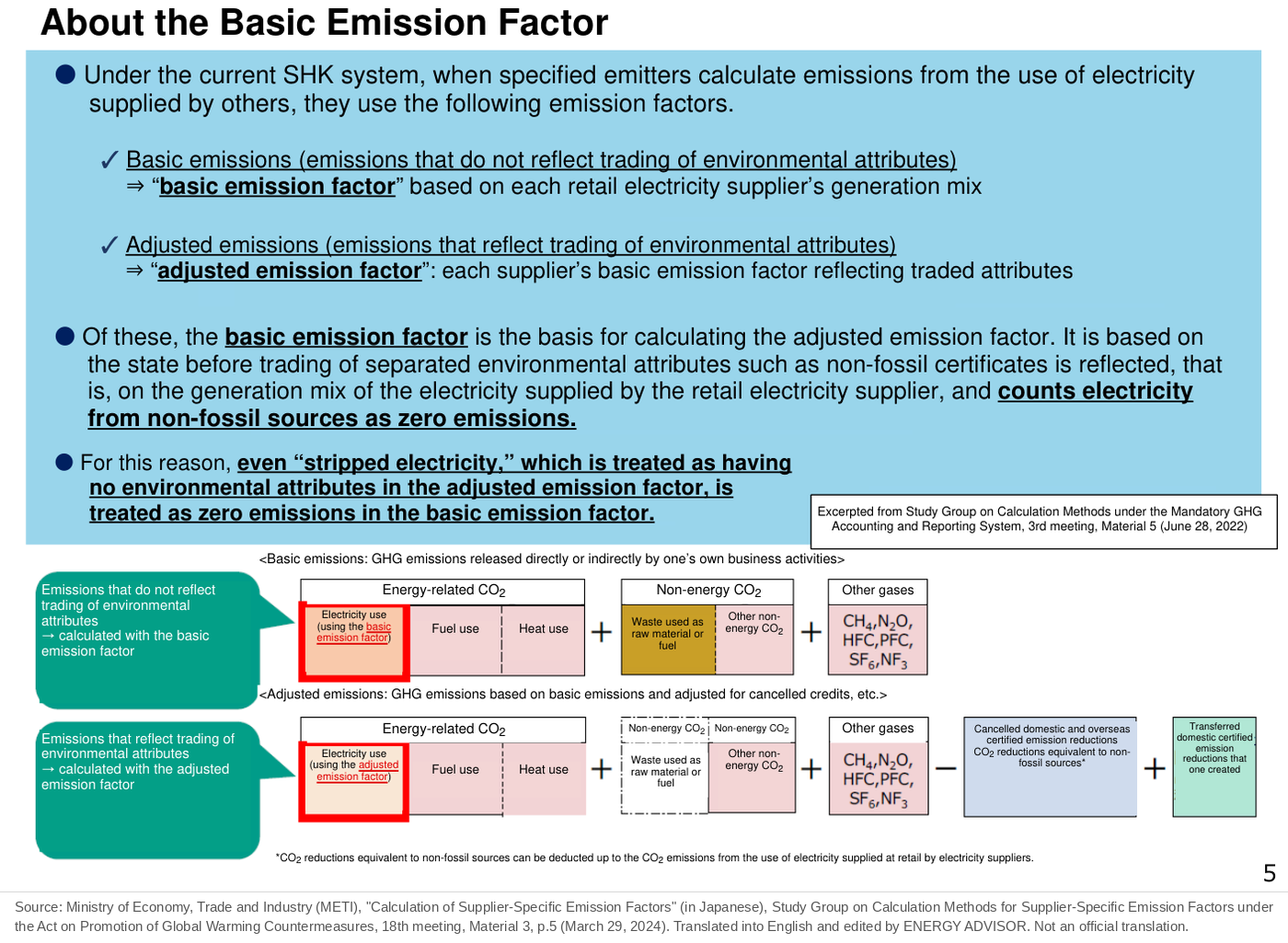
The basic emission factor and the adjusted emission factor both show CO2 emissions per kWh of electricity supplied by an electricity supplier. They differ in how far they reflect environmental attributes such as non-fossil certificates (certificates that separate from the electricity itself the “zero-CO2” value of electricity from sources that do not use fossil fuels, such as renewables and nuclear; covered in detail in Part 9, in Japanese).
The basis of the system is a ministerial notice issued by METI, the Agency for Natural Resources and Energy (ANRE) and MOE to electricity suppliers. This notice divides the calculation of factors into three stages. The value with no adjustment for certificates or the like at all is the “unadjusted emission factor.” Adding adjustments for the Feed-in Tariff (FIT) scheme and for procurement from non-FIT non-fossil sources such as nuclear, and deducting domestically certified emission reductions, gives the “basic emission factor.” Deducting overseas certified emission reductions as well gives the “adjusted emission factor.”
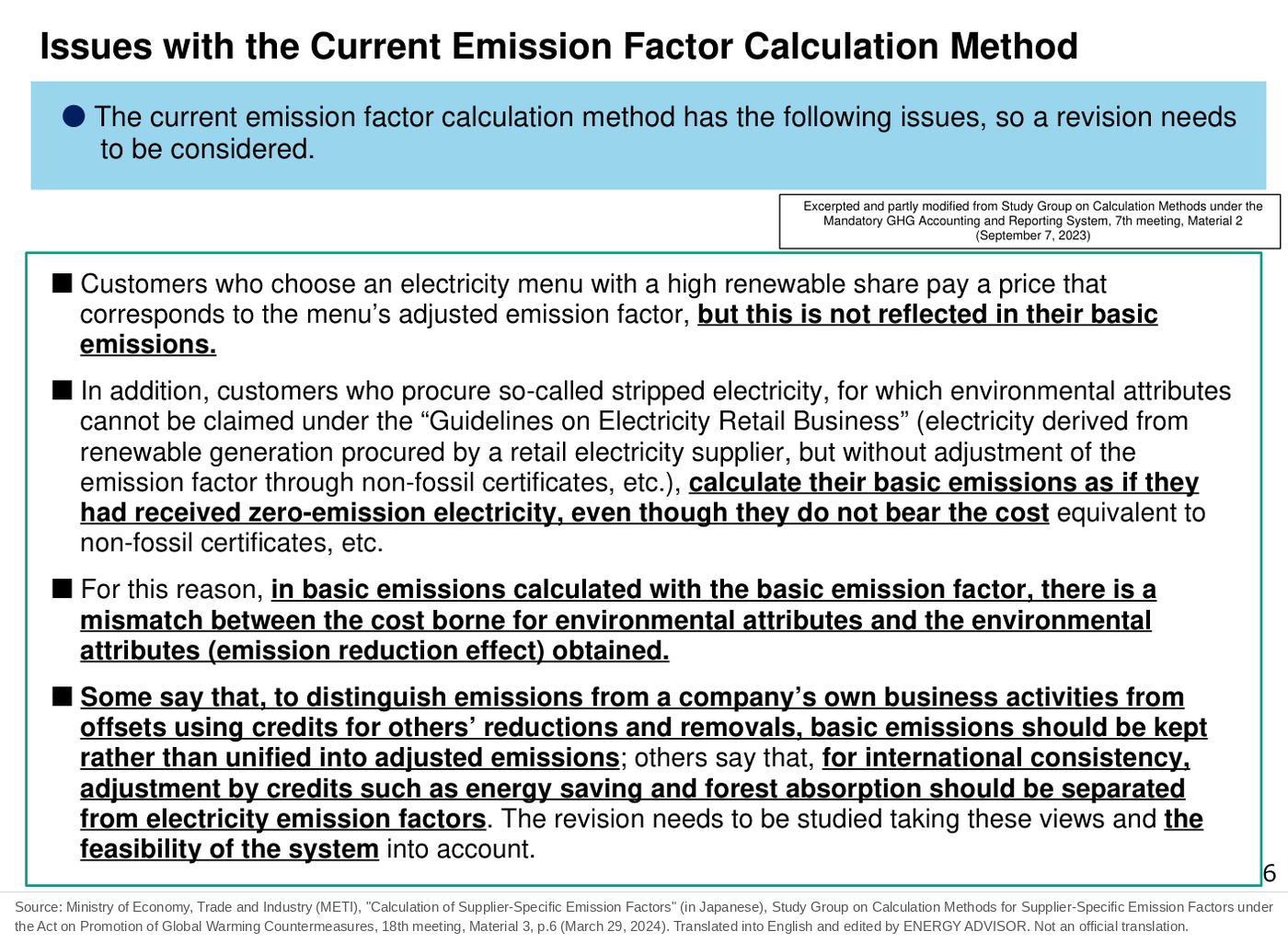
The point to note here is that the basic emission factor is not “a raw number that reflects no certificates at all.” The basic emission factor reflects transactions in non-fossil certificates (both FIT and non-FIT), regardless of the type of power source. On the other hand, for domestic credit and certification schemes such as the J-Credit Scheme (credits for emission reductions from energy conservation or renewables, certified by the government) and the Green Energy CO2 Reduction Equivalent Certification Scheme (equivalent to the so-called Green Power Certificate), only those derived from renewable electricity are reflected. Portions based on non-renewable sources, such as nuclear, are not reflected in the basic emission factor. In addition, certified volumes based on the green heat methodology are not reflected in the calculation of the basic emission factor, except for those covered by transitional measures. The adjusted emission factor additionally reflects transactions in non-renewable domestic credits and overseas certified emission reductions.
Sources: MOE, “Publication of Basic Emission Factors (Adjusted for Non-fossil Sources), Adjusted Emission Factors, etc. by Electricity Supplier for FY2023 (Partial Additions and Updates)” (March 18, 2025) (in Japanese); METI, Study Group on Calculation Methods for Supplier-Specific Emission Factors under the Act on Promotion of Global Warming Countermeasures (18th meeting), Material 3, “Calculation of Supplier-Specific Emission Factors” (March 29, 2024), p. 7 (in Japanese)
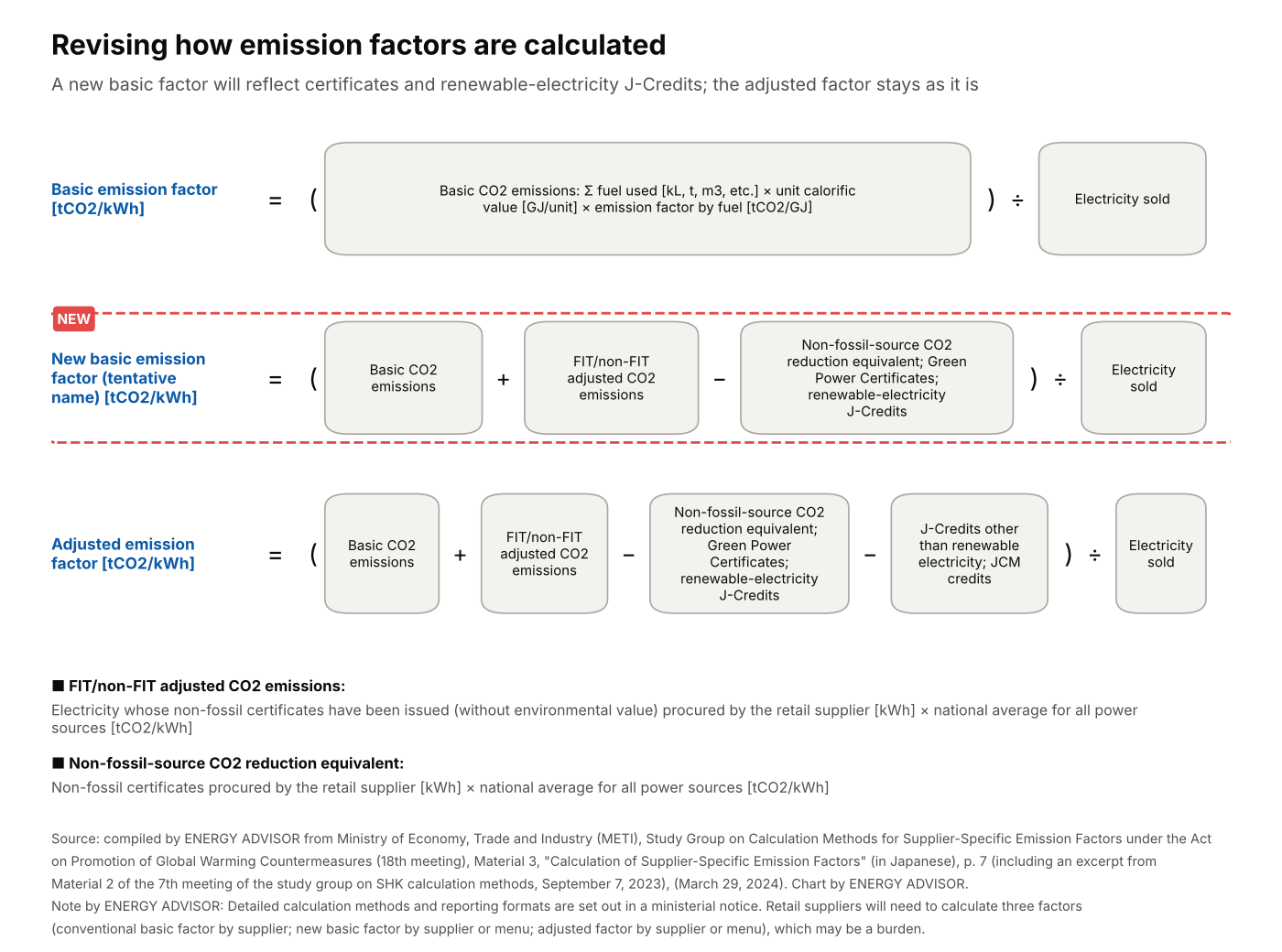
This revision has applied since the figures published in March 2025 (results for FY2023, April 2023–March 2024). The publicly available table lists only two columns, the basic emission factor and the adjusted emission factor; there is no column for the unadjusted emission factor. When calculating adjusted CO2 emissions under the SHK system, as confirmed last time, the basic method is to use the supplier-specific or menu-specific adjusted emission factor.
Despite its name, the “basic” factor is not a raw number that reflects no certificates at all; certificates from renewable sources are already reflected in it.
Menu-Specific Emission Factors: Why the Number Changes Within the Same Electricity Company
In the emission factor table, you may see several rows under the same electricity supplier’s name. This is because the supplier publishes different emission factors for each tariff plan.
The reason is that environmental attributes such as non-fossil certificates are handled separately from the electricity itself, and the system lets the electricity supplier choose which plan to link them to. An electricity supplier can preferentially combine non-fossil certificates and the like with specific tariff plans it expects customers to want (such as effectively renewable electricity plans) and publish an emission factor dedicated to that plan. Plans combined with many certificates have low factors, and other plans have relatively high factors.
This can be confirmed in the actual published materials. In the table of FY2024 results (August 3, 2026 version), several rows are listed for TEPCO Energy Partner, Inc. The plans combined with non-fossil certificates and the like have both basic and adjusted emission factors of 0.000000, while the row for other electricity (the residual) shows 0.000452. The supplier-wide value listed for reference is 0.000421.
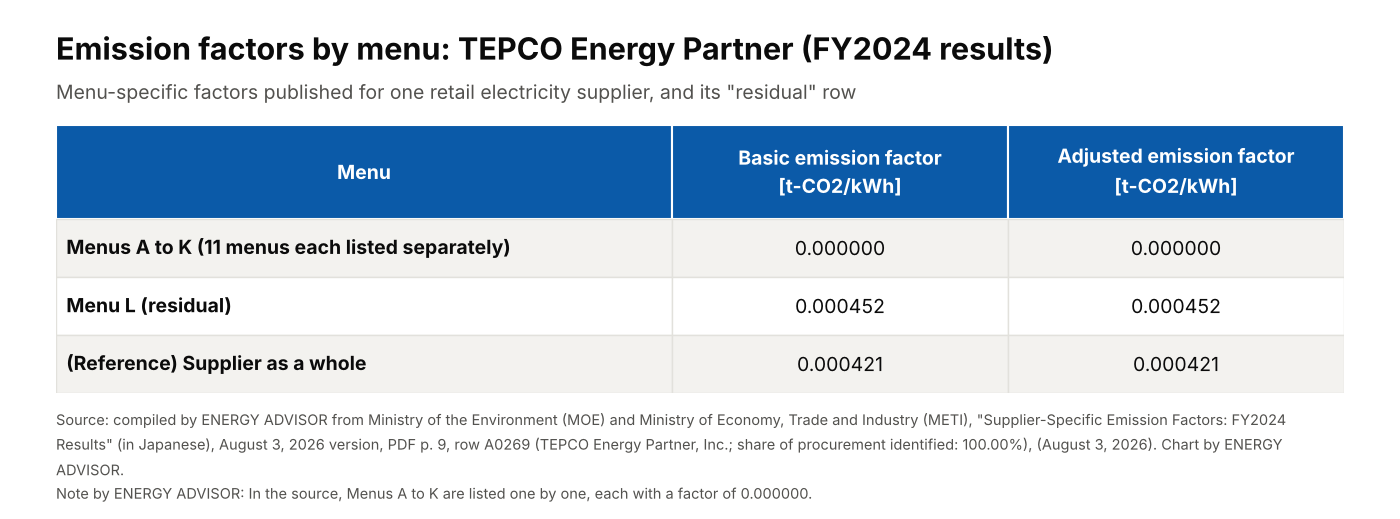
In other words, even if the electricity supplier is the same, a different plan means a different row in the table to refer to. You need to check the plan name shown on your company’s bill or contract and find the matching row in the table.
The Residual: The Other Side of Menu-Specific Factors
Note the label “(residual)” in the example above. This is the factor applied to the electricity a supplier provides to its other customers after it has preferentially combined environmental attributes with specific tariff plans. Under the system, it is called “a factor created from the residual,” and it means the emission factor of the electricity remaining after plans with high environmental attributes, such as effectively renewable electricity plans, are deducted. In English, it can be described as a residual factor.
The reason this mechanism arises is simple. The total amount of non-fossil certificates and the like held by an electricity supplier is limited. If those limited environmental attributes are allocated heavily to specific plans, the environmental attributes that can be allocated to the remaining electricity become thinner by that amount. In the TEPCO Energy Partner example, the residual factor (0.000452) was higher than the supplier-wide reference value (0.000421), in line with this logic. As a result of shifting the portion with high environmental attributes to specific plans, the residual factor comes out higher than the supplier’s average.
This “residual” plays a role similar to the residual mix used under the international GHG Protocol for electricity that has not been allocated certificates, but the calculation rules, such as the treatment of FIT electricity, are not the same. When responding to an international framework such as CDP, covered in Part 3, you need to check which rules the requested figure should be based on.
Many companies that use electricity on a standard contract without choosing a plan are effectively using this “residual” factor. Knowing which factor your company is currently using improves the accuracy of your answers to customers.
Practical Implications: Your Choice of Supplier and Plan Directly Affects Scope 2
From the above, one practical consequence follows. Because Scope 2 emissions are determined by “electricity consumption × emission factor,” even with the same electricity consumption, a different electricity supplier or tariff plan means a different emission factor, and therefore different calculated CO2 emissions. Even within the same electricity supplier, an effectively renewable electricity plan has a low factor, while a standard plan has the residual factor. In other words, the choice of electricity supplier and plan is not merely a matter of price; it affects your company’s Scope 2 emissions themselves. It is worth keeping in mind as an approach separate from energy conservation efforts that reduce consumption.
Steps to Look Up Your Electricity Supplier’s Factor
Finally, here are the steps to actually look up the emission factor of the electricity supplier and plan your company has a contract with.
- Open the MOE and METI “Calculation Methods and List of Emission Factors” page.
- Download the PDF or Excel file of the latest published “supplier-specific emission factors” (as of October 2026, the FY2024 results “for submission in 2026 (Reiwa 8),” published on January 9, 2026, with some entries added or updated on February 25, June 4, July 23 and August 3).
- Find the name of the electricity supplier your company has a contract with in the table.
- If the supplier publishes factors by plan, check the row that matches the tariff plan name on your electricity bill or contract. If you cannot tell which row applies, you can ask the electricity supplier, or use the “residual” row or the supplier-wide reference row in the table.
- Depending on your purpose, check the value of either the basic emission factor (adjusted for non-fossil sources) or the adjusted emission factor. For calculating adjusted CO2 emissions under the SHK system, use the adjusted emission factor.
Source: MOE and METI, “Calculation Methods and List of Emission Factors” (in Japanese)
Summary
The emission factor is not a single fixed number. There are two types, the basic emission factor and the adjusted emission factor, depending on how far environmental attributes are reflected, and the adjusted emission factor is used for adjusted CO2 emissions under the SHK system. From the figures published in March 2025, the basic emission factor has been labeled “adjusted for non-fossil sources.” Some electricity suppliers publish different factors for each tariff plan, and behind this, the “residual” factor applied to electricity other than the specific plans comes out higher by the amount of environmental attributes deducted. Keep in mind that, even with the same electricity consumption, the choice of electricity supplier and plan affects your company’s Scope 2 emissions themselves.
Related Articles
- Part 1: What Is Supply Chain Decarbonization? — How Customers Come to Ask for CO2 Emissions Reports
- Part 2: Scope 1, 2 and 3 and the Carbon Footprint of Products (CFP) — Company-Wide CO2 vs. CO2 per Product
- Part 3: The Schemes Behind the Requests — SBT, CDP and GX-ETS, and How They Differ from Legal Reporting Obligations
- Part 4: Calculating Scope 2 in Practice — CO2 Emissions from Electricity Consumption
Note: The information in this article is current as of the time of posting and may have changed by the time you read it.
This article is based on published materials from the Ministry of Economy, Trade and Industry and its Agency for Natural Resources and Energy, the Electricity and Gas Market Surveillance Commission, the Organization for Cross-regional Coordination of Transmission Operators (OCCTO) and other sources. The English translations of figures are by ENERGY ADVISOR and are not official translations. When using this information for decisions, please check the original sources. When we find an error, we correct the article and note the date of the correction.
Sources
- METI, ANRE and MOE, “Calculation and Publication of Unadjusted, Basic and Adjusted Emission Factors by Electricity Supplier” (ministerial notice of November 25, 2024, No. 20241120G-1, etc.) (in Japanese). https://www.enecho.meti.go.jp/category/electricity_and_gas/electric/gwc/pdf/241125tsutatsumerged.pdf
- MOE, press release, “Publication of Basic Emission Factors (Adjusted for Non-fossil Sources), Adjusted Emission Factors, etc. by Electricity Supplier for FY2023 (Partial Additions and Updates)” (March 18, 2025) (in Japanese). https://www.env.go.jp/press/press_04629.html
- MOE, press release, “Publication of Basic Emission Factors (Adjusted for Non-fossil Sources), Adjusted Emission Factors, etc. by Electricity Supplier for FY2024” (January 9, 2026) (in Japanese). https://www.env.go.jp/press/press_02235.html
- MOE and METI, “Supplier-Specific Emission Factors (for Calculating GHG Emissions of Specified Emitters): FY2024 Results” (published January 9, 2026; some entries added or updated on February 25, June 4, July 23 and August 3) (in Japanese). https://policies.env.go.jp/earth/ghg-santeikohyo/files/calc/r08_denki_coefficient_rev4.pdf
- MOE and METI, “Calculation Methods and List of Emission Factors” (in Japanese). https://policies.env.go.jp/earth/ghg-santeikohyo/calc.html
- METI, Study Group on Calculation Methods for Supplier-Specific Emission Factors under the Act on Promotion of Global Warming Countermeasures (18th meeting), Material 3, “Calculation of Supplier-Specific Emission Factors” (March 29, 2024) (in Japanese). https://www.meti.go.jp/shingikai/energy_environment/ontaiho_haisyutsu/pdf/018_03_00.pdf
- ANRE, Working Group on Market Design, “The Non-Fossil Value Trading Market” (review of the non-fossil value trading market) (in Japanese). https://www.meti.go.jp/shingikai/enecho/denryoku_gas/denryoku_gas/seido_kento/pdf/057_03_01.pdf