When SMEs receive a request about CO2 emissions from a customer, the first thing many are unsure about is “what to answer, and in what unit.” Some requests say “Please tell us your company-wide emissions,” while others say “Please tell us the CO2 emissions per unit of this product.” These are completely different tasks. This article sorts out, based on public primary sources, Scope 1, 2 and 3, the basic categories for counting CO2 emissions, and the “carbon footprint of products (CFP),” which counts emissions per product.
Key points
- 1Companies count their CO2 emissions in three categories, Scope 1, Scope 2 and Scope 3, following an international accounting standard called the GHG Protocol.
- 2“Category 1” of the Scope 3 emissions that large companies calculate includes emissions from what they buy from their SME suppliers. This is the very structure that creates requests from large companies to SMEs to report their emissions.
- 3Scope 1, 2 and 3 are calculated “per company,” whereas the CFP is calculated “per unit of product.” The calculation approach and the scope covered are different.
- 4The work required and how to answer differ completely depending on whether a customer’s request asks about “company-wide emissions” or “the CO2 of this product.” Telling the two apart is the core of this article.
- 5When unsure where to start, companies generally begin with Scope 1 and 2, their own direct emissions.
In Part 1 of this series, “SMEs and Decarbonization,” we confirmed that more SMEs are being asked by customers to report emissions and cooperate in reductions, and that behind this is the mechanism by which large companies measure CO2 emissions across their entire supply chain. This time, we look more closely at the units in which these “emissions across the entire supply chain” are counted, and at how company-level calculation works.
Scope 1, 2 and 3: The GHG Protocol
There is a widely used international accounting standard for counting companies’ CO2 emissions. The GHG Protocol is an international standard for calculating and reporting greenhouse gas emissions, developed by the World Resources Institute (WRI) and the World Business Council for Sustainable Development (WBCSD). Japan’s Ministry of the Environment (MOE) and Ministry of Economy, Trade and Industry (METI) also set out calculation methods in line with this standard in their guidelines.
The GHG Protocol divides the greenhouse gas emissions from a company’s activities into three categories (Scopes) by source. MOE’s Green Value Chain Platform (an MOE website that publishes methods for calculating supply chain emissions) explains them as follows:
Scope 1: Direct emissions of greenhouse gases by the company itself (fuel combustion, industrial processes). Scope 2: Indirect emissions from the use of electricity, heat or steam supplied by others. Scope 3: Indirect emissions other than Scope 1 and Scope 2 (emissions of other companies related to the company’s activities).
Source: MOE Green Value Chain Platform, “Basic Approach to Calculating Supply Chain Emissions” (in Japanese)
In other words, Scope 1 is the direct emissions from burning fuel in a company’s own factories and company vehicles, and Scope 2 is the emissions that arise indirectly from using electricity and heat the company has purchased. Both of these are emissions from “the company’s own activities” and are relatively easy to picture.
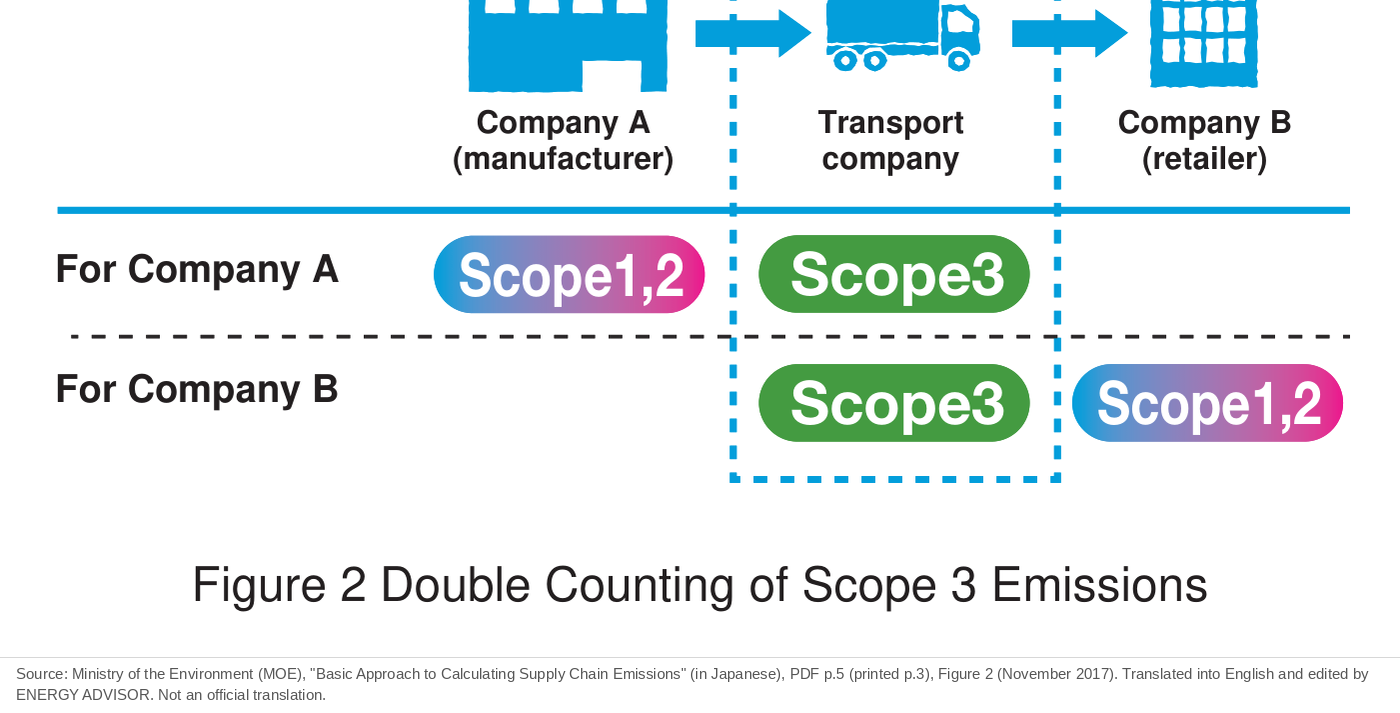
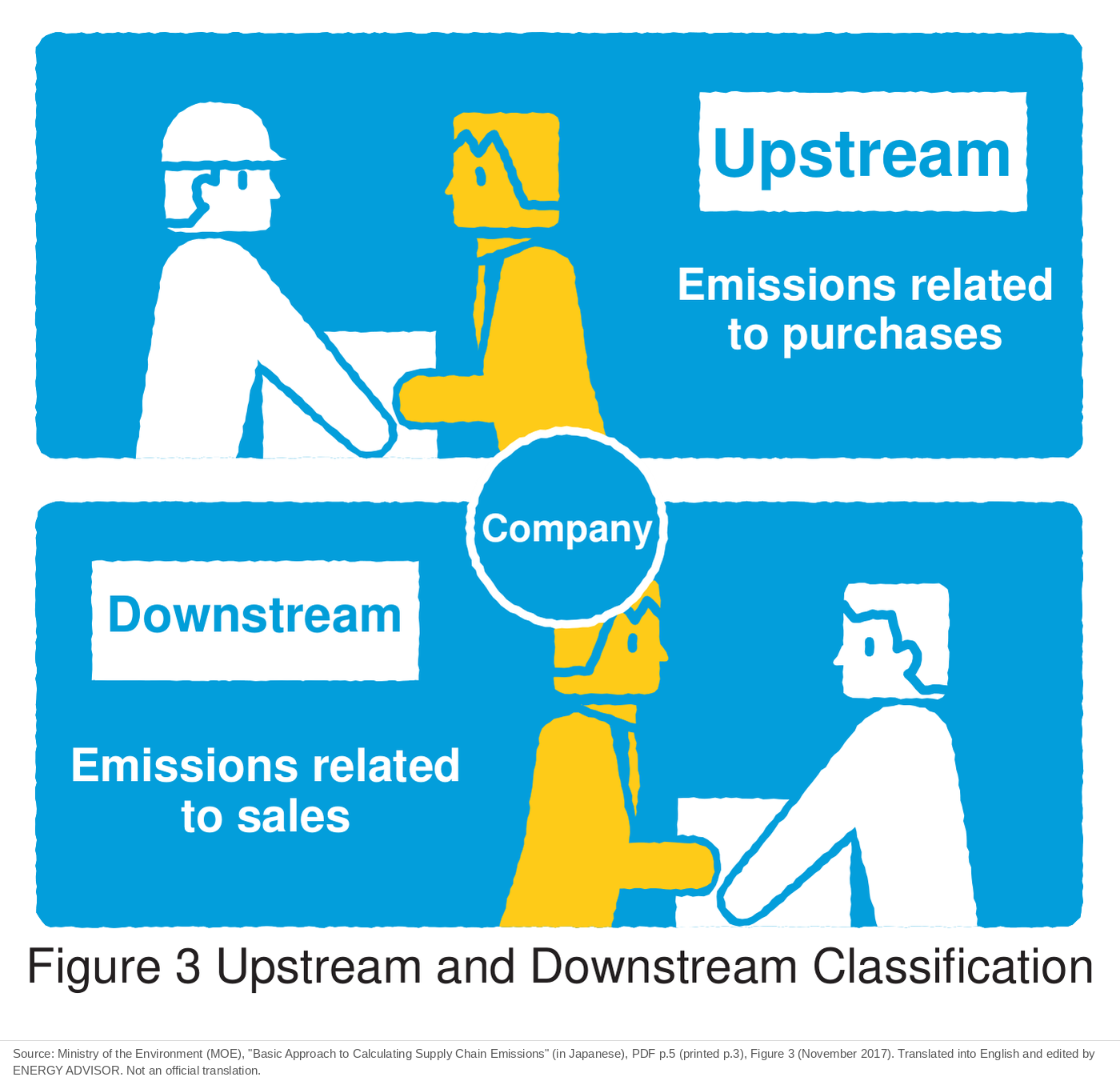
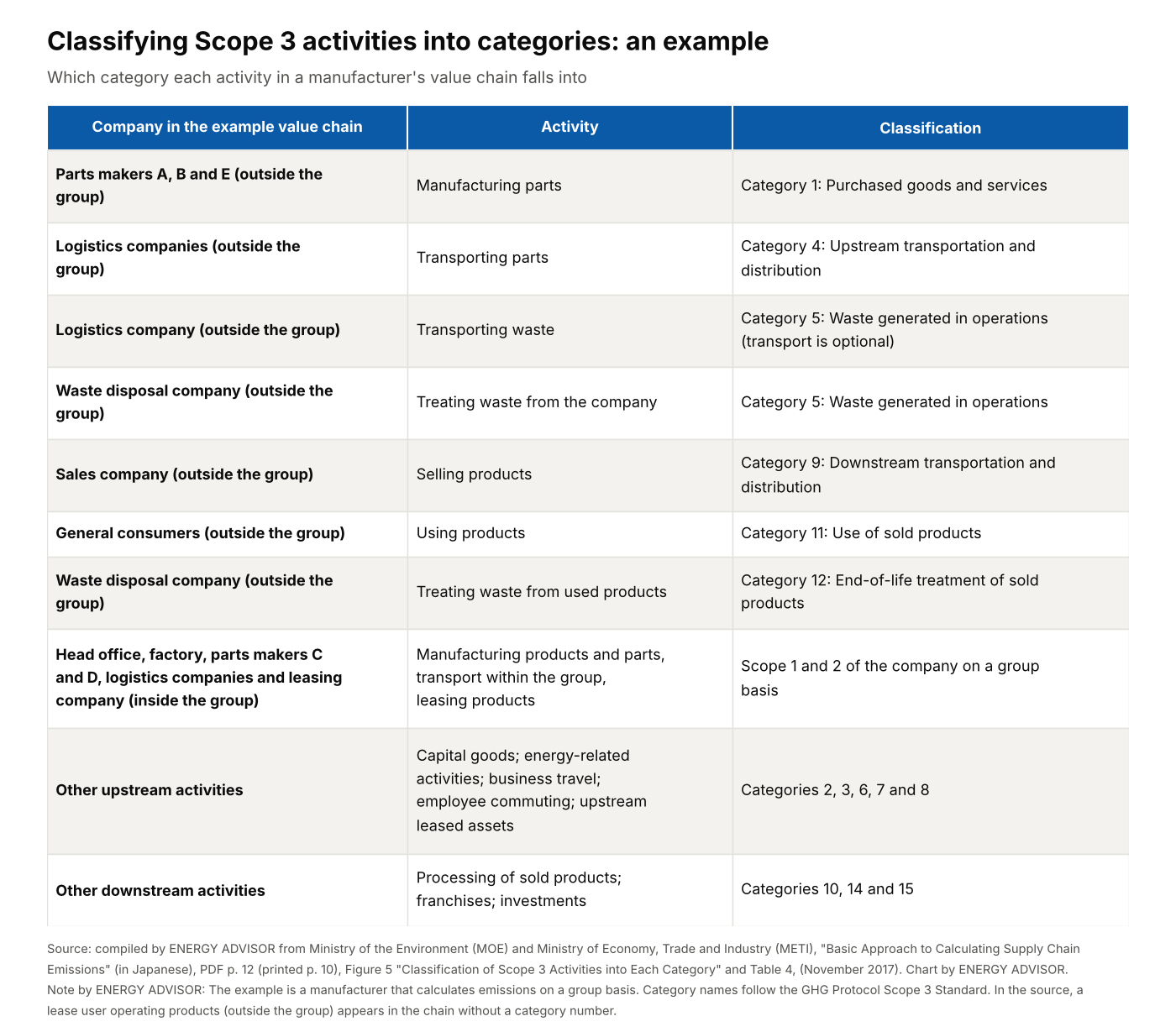
Scope 3, by contrast, refers not to the company’s own emissions but to the emissions of “other companies” related to its business activities. It treats the emissions of countless parties outside the company, such as raw material suppliers, logistics companies that transport products, customers who use the products and businesses that handle disposal, as a single figure linked across the entire supply chain. The GHG Protocol’s Scope 3 Standard further divides Scope 3 into 15 categories.
Source: MOE Green Value Chain Platform, “What Are Scope 3 Emissions?” (in Japanese)
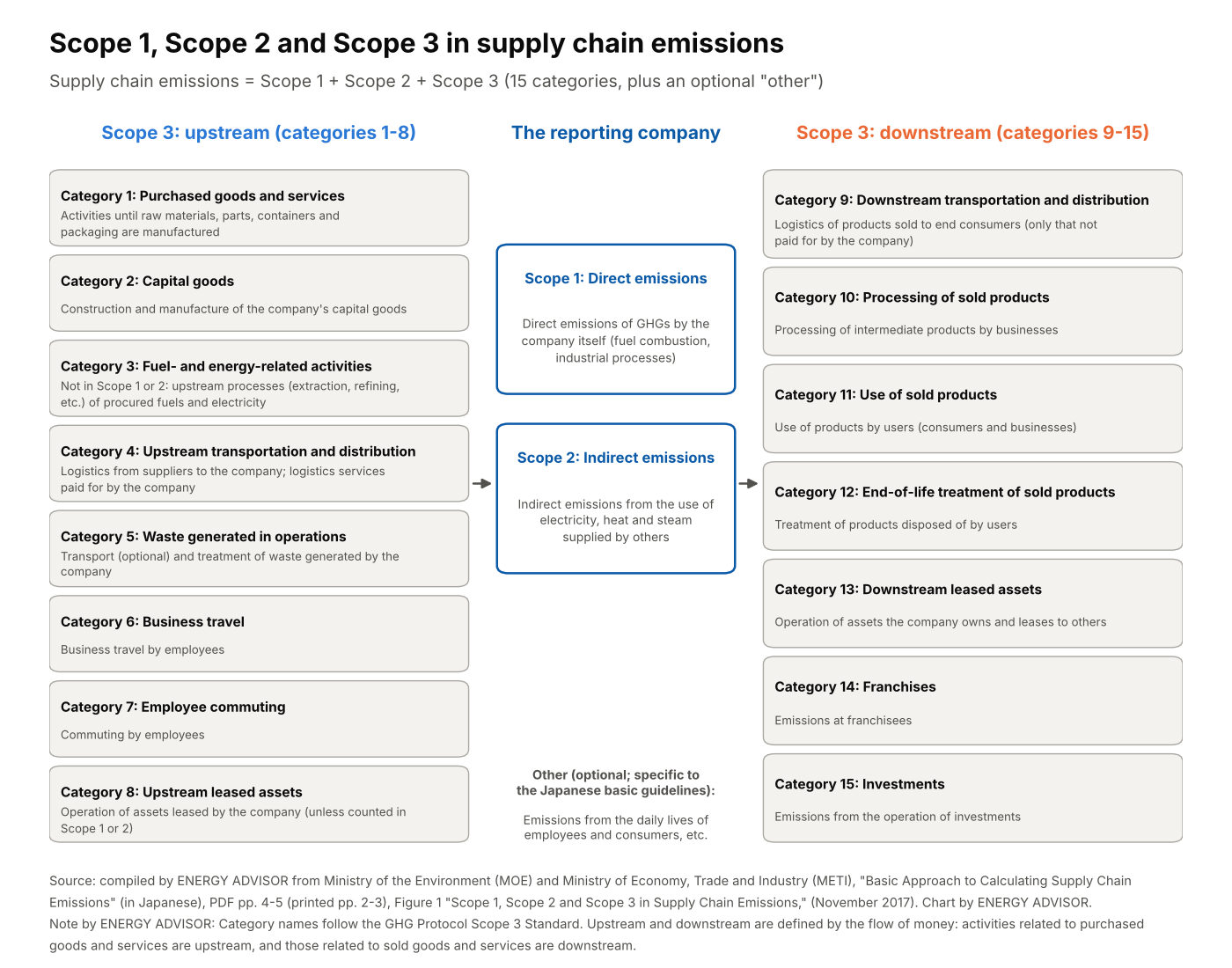
Source: MOE Green Value Chain Platform, “Basic Approach to Calculating Supply Chain Emissions” (in Japanese)
The terms Scope 1, 2 and 3 are simply numbers that classify “whether the emission source is the company itself or another company, and where it is.” Rather than memorizing what each number means, the starting point is to grasp the broad frame: “1 and 2 are about your own company; 3 includes your business partners.”
The Source of the Requests: Large Companies’ Scope 3 Category 1
Of the 15 Scope 3 categories, “Category 1” is especially relevant to SMEs. The GHG Protocol’s Scope 3 Standard defines Category 1 as “purchased goods and services,” which includes procurement of raw materials, outsourced packaging and procurement of consumables.
Source: MOE Green Value Chain Platform, “What Are Scope 3 Emissions?” (in Japanese)
The structure at work here can be summarized as follows.
A large company tries to calculate and disclose its supply chain emissions (Scope 1 + Scope 2 + Scope 3). This large company buys parts, raw materials and supplies from SME suppliers. Under the GHG Protocol’s definitions, this purchasing itself is an emission source in “Category 1 (purchased goods and services)” from the large company’s point of view.
In other words, the amount of CO2 an SME supplier’s factory emitted while making a product is recorded in the large company’s books as part of its own Scope 3 Category 1. The more accurately a large company tries to measure and disclose its supply chain emissions, the more it needs emissions data from each of its suppliers. When a large customer asks an SME to “report your emissions” or “work on reductions,” this arises from this accounting need; it is neither a sudden whim nor an excessive demand. The situation confirmed in Part 1, that “more SMEs are being asked by customers to cooperate,” can be understood as a consequence of this accounting structure.
The reason customers ask even about your company’s emissions lies in this way of counting “Category 1.” It is data they cannot do without for their calculations.
Company-Level Calculation (Scopes) and Product-Level Calculation (CFP) Are Different
What follows is the most important point of this article. Scope 1, 2 and 3, as explained so far, are all calculations that “take a company (a legal entity or business site) as the unit and add up one year of emissions linked to that company.” What is counted is the “whole company,” and the answer is a single figure: “how many t-CO2 Company A emits per year.”
There is, however, another type of customer request. It asks about emissions per product: “How much CO2 is emitted to make one unit (or 1 kg, or one lot) of this product?” The term for the result of this product-level calculation is the carbon footprint of products (CFP). The Carbon Footprint Guidelines (May 2023) of METI and MOE define the CFP as follows:
The amount of GHG emissions over the entire life cycle of a product or service, from raw material procurement to disposal and recycling, converted into CO2 emissions, and the figure shown on the product or the system for showing it.
Source: METI and MOE, “Carbon Footprint Guidelines” (May 2023) (in Japanese)
In other words, a Scope counts “the total emissions for one year, with the company as an organization as the unit,” while the CFP counts “the emissions of one unit of a product, from its creation to its disposal, with the product as the unit.” The unit of calculation and the way the period and processes are bounded are based on entirely different approaches.
This difference is a major fork in the road in practice when responding to customer requests. If the request is “Please tell us your company’s annual CO2 emissions (Scope 1 and 2, and Scope 3 if possible),” this is a company-level calculation, built up from one year of the company’s energy and fuel use. If, on the other hand, the request is “Please tell us the CO2 emissions per unit of this part (CFP),” a completely different calculation is needed, covering the entire life cycle (or part of it) of a specific product. Even when the words are the same, “please tell us your CO2,” the data to collect and the calculation framework differ depending on whether it is per company or per product. When you receive a request, it is essential to first identify which type it is.
Sometimes a customer’s request says only “CO2 emissions,” and it is hard to tell whether it is about the whole company or a specific product. When in doubt, the reliable way to start is to ask the requester, “Is this about our company’s total emissions, or about a specific product?”
The table below summarizes the difference between the two types.
| Item | Scope 1, 2 and 3 (per company) | CFP (per product) |
|---|---|---|
| Unit counted | Company (legal entity or business site) | One unit of product (1 kg, one lot, etc.) |
| Period and scope | Total for one year | From raw material procurement to disposal and recycling (up to shipment for intermediate products such as parts) |
| Main data | One year of electricity and fuel consumption, etc. | Energy and raw material data for each process of that product |
| Example request | “Please tell us your company’s annual CO2 emissions.” | “Please tell us the CO2 emissions per unit of this part.” |
Overview of the CFP: Scope and International Standards
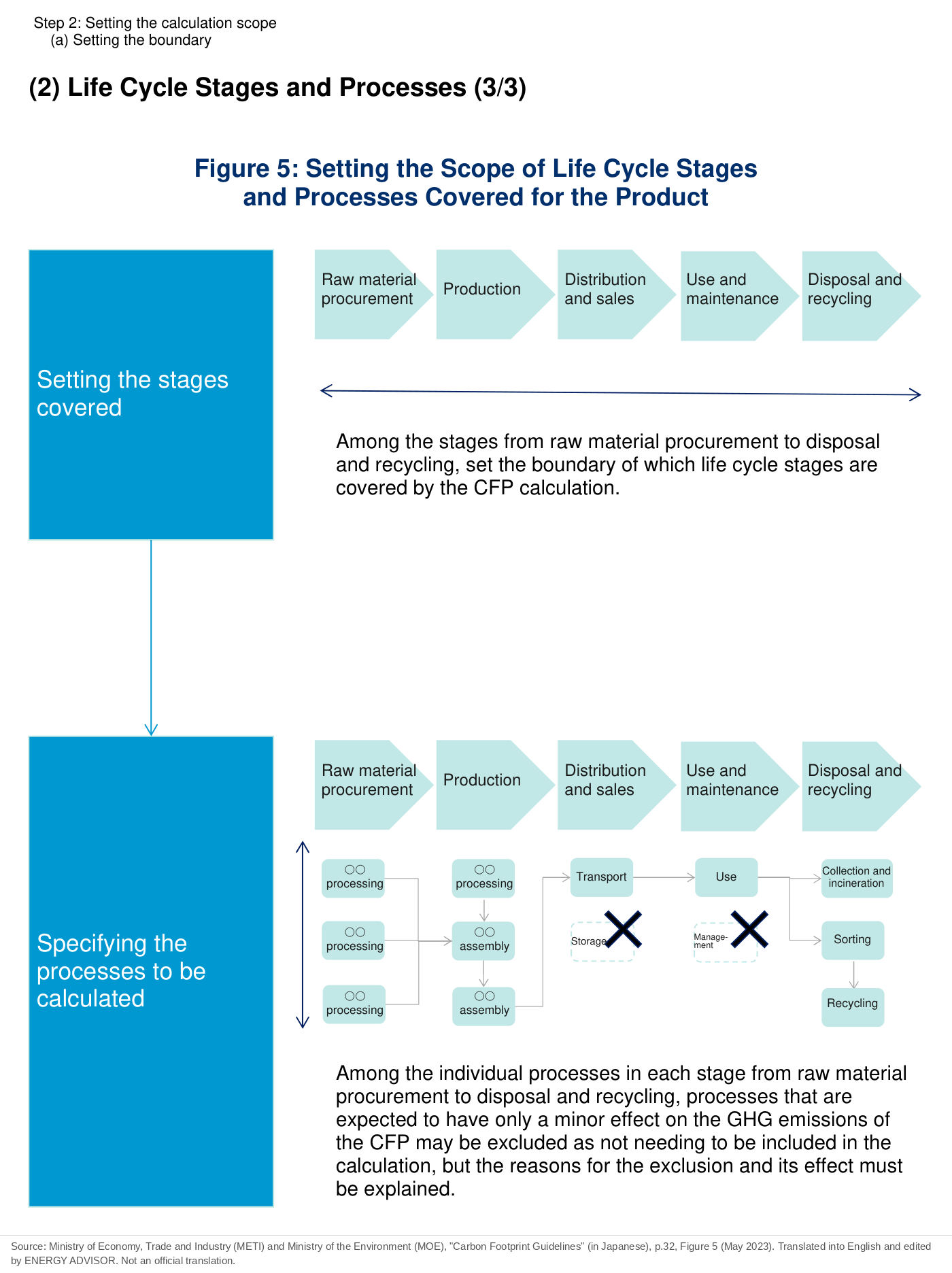
Let us look at the CFP in a little more detail. The Carbon Footprint Labeling Guide (February 2025) of METI and MOE explains the scope of the CFP as emissions over the entire life cycle of a product. A final product covers raw material procurement through disposal and recycling (cradle to grave), and an intermediate product such as a part covers raw material procurement through manufacturing and shipment (cradle to gate).
Source: MOE and METI, “Carbon Footprint Labeling Guide” (February 2025) (in Japanese)
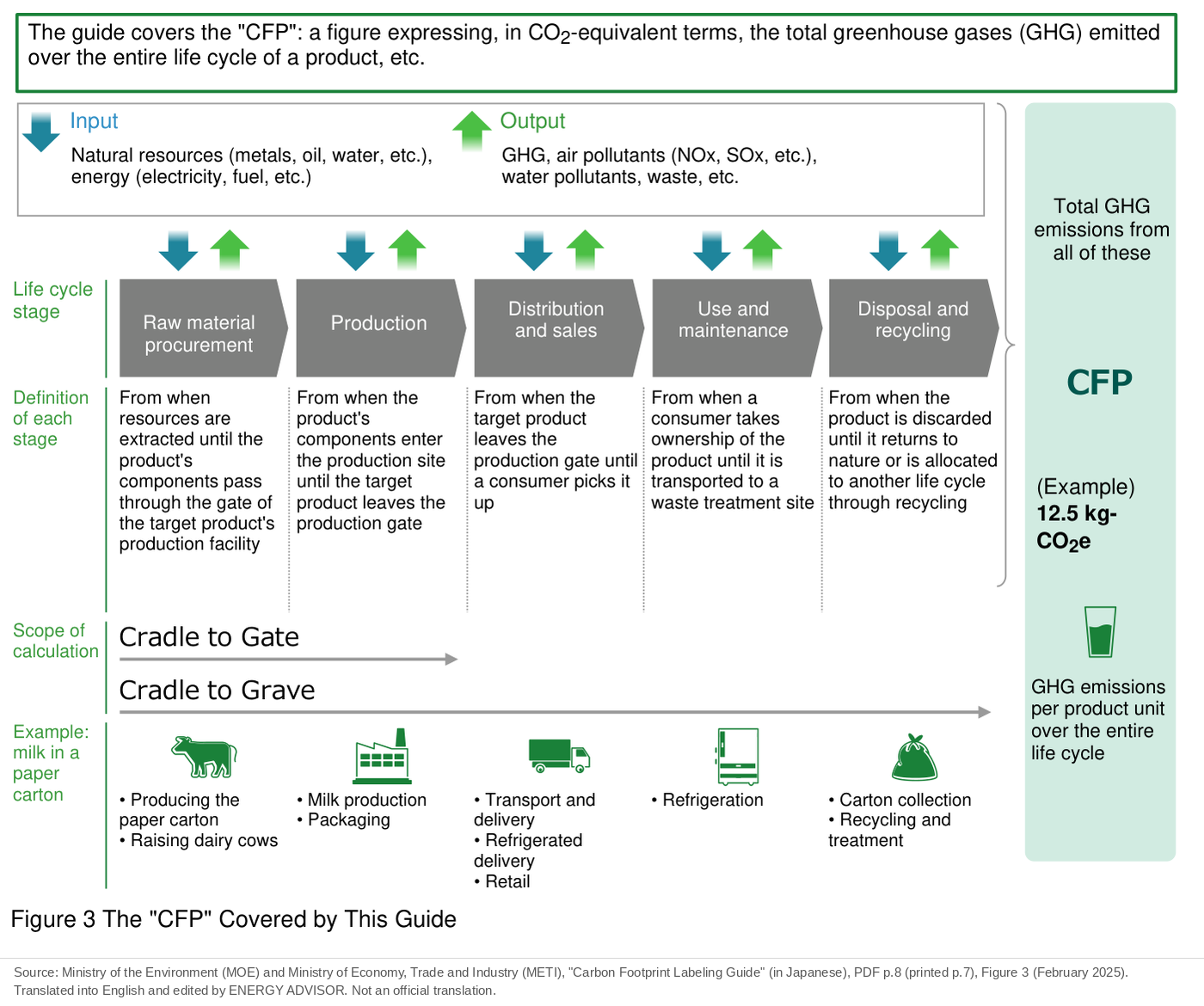
Source: MOE and METI, “Carbon Footprint Labeling Guide” (February 2025) (in Japanese)
Methods for calculating the CFP have also been standardized internationally. The METI and MOE guidelines position ISO 14067, an international standard set by the International Organization for Standardization (ISO), as the main reference standard for CFP calculation. In Japan, JIS Q 14067 was established on March 26, 2026 as the Japanese Industrial Standard (JIS) corresponding to this ISO standard. Work is under way so that the CFP can be calculated on a shared basis in Japan and overseas.
Sources: METI and MOE, “Carbon Footprint Guidelines” (May 2023) (in Japanese); METI, “Establishment of a JIS for Calculating the Carbon Footprint of Products” (March 26, 2026) (in Japanese)
Because the CFP requires adding up data for every process from raw materials to disposal for each product, the range of data to collect is wider than for a company-level Scope 1 and 2 calculation, and calculation is generally more difficult. When a customer asks for a CFP, it is usually an individual request covering a specific product or part. Whether and how to respond is considered case by case, based on the product’s position and the relationship with the customer.
Where to Start: Scope 1 and 2
So far, we have looked at two different types of calculation: company-level Scope 1, 2 and 3, and the product-level CFP. Next, we look at what your company should start on before receiving any specific request from a customer.
The place to start is measuring your own Scope 1 and 2. The reason is simple: Scope 1 and 2 are calculations that can be completed with your own activities alone, using data your company can obtain, namely electricity and fuel consumption. Scope 3 and the CFP, by contrast, require data from outside the company, such as from business partners and logistics companies, and are a step harder to calculate.
If a customer’s request asks for “company-wide Scope 1 and 2 emissions,” you respond according to the company-level calculation approach covered in this article. If, on the other hand, it asks for “the CFP of a specific product,” a separate task looking at the product’s entire life cycle is needed. The first step is therefore to identify exactly what the request is asking.
Summary
Following the GHG Protocol, an international standard, companies count their CO2 emissions in three categories: Scope 1, their own direct emissions; Scope 2, emissions from purchased electricity and heat; and Scope 3, emissions of other companies related to their business activities. When a large company tries to calculate “Category 1 (purchased goods and services)” of its Scope 3, it needs emissions data from its SME suppliers, and this is the very structure that creates reporting requests from customers to SMEs. The carbon footprint of products (CFP), which counts emissions per unit of product, is an entirely separate framework from company-level Scope calculation and covers the product’s entire life cycle, from raw material procurement to disposal and recycling. When you receive a request from a customer, the starting point for an efficient response is to first identify whether it is about the whole company or a specific product. What your company should start on first is generally measuring Scope 1 and 2, which can be completed with your own data alone.
Related Articles
Note: The information in this article is current as of the time of posting and may have changed by the time you read it.
This article is based on published materials from the Ministry of Economy, Trade and Industry and its Agency for Natural Resources and Energy, the Electricity and Gas Market Surveillance Commission, the Organization for Cross-regional Coordination of Transmission Operators (OCCTO) and other sources. The English translations of figures are by ENERGY ADVISOR and are not official translations. When using this information for decisions, please check the original sources. When we find an error, we correct the article and note the date of the correction.
Sources
- MOE Green Value Chain Platform, “What Are Scope 1 and 2 Emissions?” (in Japanese). https://www.env.go.jp/earth/ondanka/supply_chain/gvc/estimate_02.html
- MOE Green Value Chain Platform, “What Are Scope 3 Emissions?” (in Japanese). https://www.env.go.jp/earth/ondanka/supply_chain/gvc/estimate_03.html
- MOE and METI, “Basic Approach to Calculating Supply Chain Emissions” (November 2017) (in Japanese). https://www.env.go.jp/earth/ondanka/supply_chain/gvc/files/tools/supply_chain_201711_all.pdf
- METI and MOE, “Carbon Footprint Guidelines” (May 2023) (in Japanese). https://www.meti.go.jp/shingikai/energy_environment/carbon_footprint/pdf/20230526_3.pdf
- MOE and METI, “Carbon Footprint Labeling Guide” (February 2025) (in Japanese). https://www.env.go.jp/content/000286660.pdf
- METI, “Establishment of a JIS for Calculating the Carbon Footprint of Products” (March 26, 2026) (in Japanese). https://www.meti.go.jp/policy/economy/hyojun-kijun/jiskouji/pdf/2026032301-4.pdf