To advance Japan’s decarbonization (Green Transformation (GX): the shift from an economy centered on fossil fuels to a decarbonized economy), new carbon markets created through cooperation between the government and the private sector are being launched one after another. In 2023, the Tokyo Stock Exchange (TSE, Japan’s main stock exchange) opened the Carbon Credit Market, and the GX-ETS trading market is scheduled to open around autumn of FY2027.
(Note for readers outside Japan) Japan’s fiscal year (FY) runs from April to March; FY2027 is April 2027–March 2028.
This article explains two important trading platforms, the Carbon Credit Market of the Tokyo Stock Exchange and the GX-ETS trading market: how each works, how their roles differ, and how the two markets relate to each other.
Key points
- 1The TSE Carbon Credit Market opened in October 2023 as Japan’s first exchange for trading J-Credits. Cumulative trading volume reached 1 million tonnes in September 2025.
- 2The GX-ETS emission allowance market is scheduled to be opened by the GX Acceleration Agency around autumn of FY2027, for trading the emission allowances of covered companies.
- 3The two markets differ in character: the TSE market is “results-based” and the GX-ETS market is “obligation-based.”
- 4The two markets complement each other and are the two wheels supporting Japan’s carbon market.
Overall Picture of Japan’s Carbon Market: Two Trading Markets
To achieve the carbon neutrality that Japan is aiming for, mechanisms that promote CO2 emission reductions by companies and organizations are essential. For this reason, the government has set up two trading platforms: a carbon credit market and an emission allowance market.
The former has already begun to function, and preparations for the latter are under way toward its opening around autumn of FY2027. Both play the role of giving companies an economic motive to cut emissions and promoting the growth of the carbon market.
The TSE Carbon Credit Market: An Exchange for J-Credits
Market Opening and J-Credits
In October 2023, the Tokyo Stock Exchange opened Japan’s first exchange market for carbon credits. The market handles J-Credits, issued under the J-Credit Scheme.
J-Credits are emission reductions from installing renewable energy generation equipment or energy-saving equipment, or removals through proper forest management, that the government has certified and turned into quantified certificates. One credit is issued for each tonne of CO2 reduced or removed.
Types and Features of J-Credits
There are three main types of J-Credits. The first is credits from renewable power generation, which certify CO2 reductions by renewable energy generation equipment such as solar and wind.
The second is credits from energy saving, which certify CO2 reductions from making lighting, air conditioning and similar equipment more energy-efficient. The third is credits from forest removals, which certify CO2 absorption through proper forest management such as thinning and planting.
Trading Method and Volume
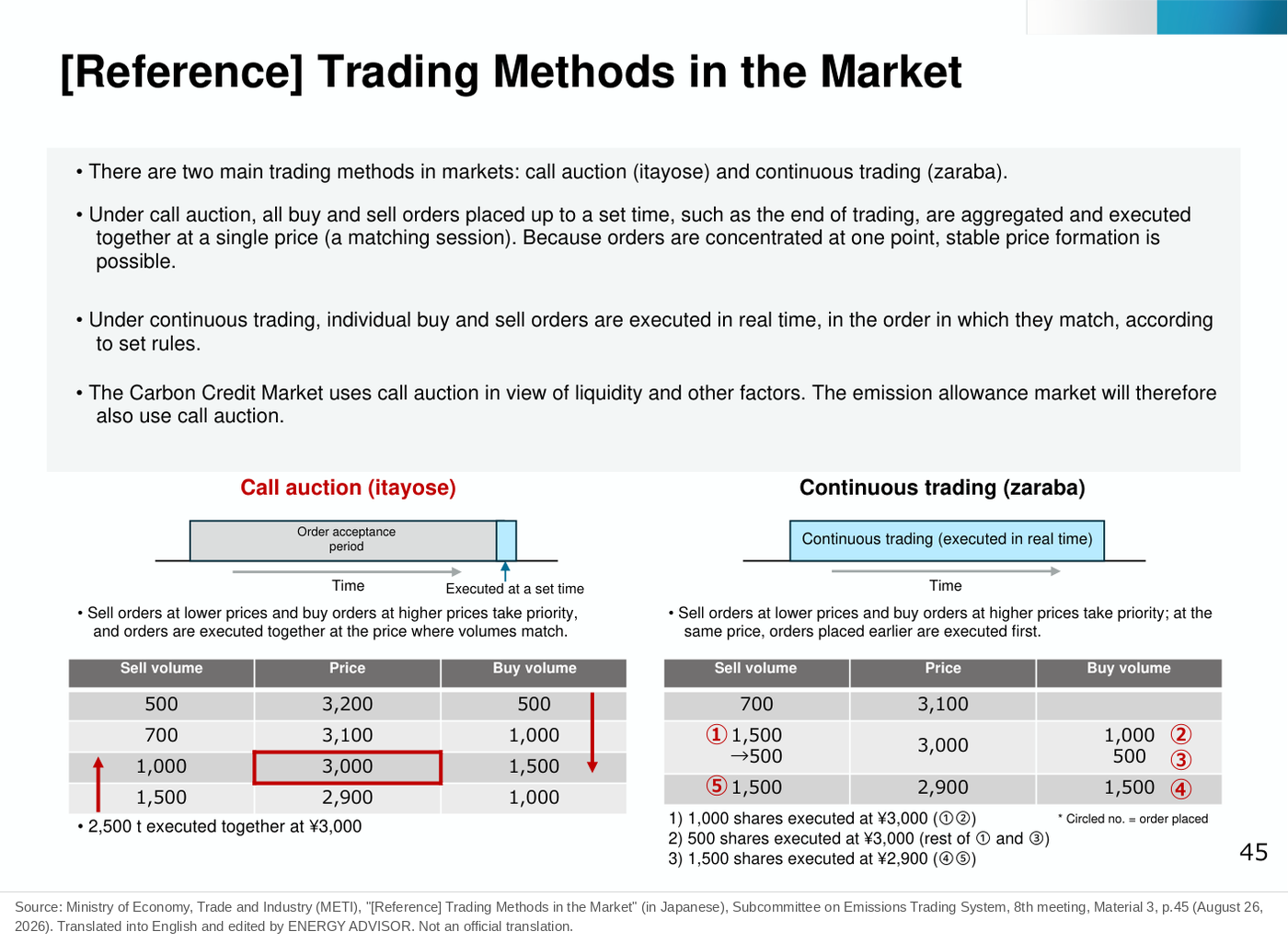
On the TSE Carbon Credit Market, the main method is a call auction with limit orders (a method in which the exchange matches sellers’ and buyers’ orders at set times to execute trades). Sellers and buyers place orders specifying their prices, and a trade is executed when the prices match. This achieves transparent trading and fair price discovery.
Trading in the market has grown steadily. In September 2025, the cumulative trading volume of J-Credits reached 1 million tonnes. There are 362 market participants (as of October 16, 2026).
J-Credit Price Ranges
J-Credit prices vary with the type of credit and market conditions. From the market opening (October 11, 2023) to September 30, 2026, the volume-weighted average prices of executed trades per tonne were ¥2,983 for energy saving, ¥4,666 for renewable energy (electricity) and ¥5,396 for forests (JPX, “Traded Price and Volume”). The price of energy-saving J-Credits had risen to about ¥5,300 as of August 2025 (7th meeting of the Subcommittee, Material 3, p.9). These prices depend on factors such as the scarcity and quality of the credits and the needs of buying companies. More and more companies are buying these credits to achieve their own carbon neutrality and sustainability targets.
The GX-ETS Trading Market: A Platform for Trading Allowances
Outline of the GX-ETS Trading Market
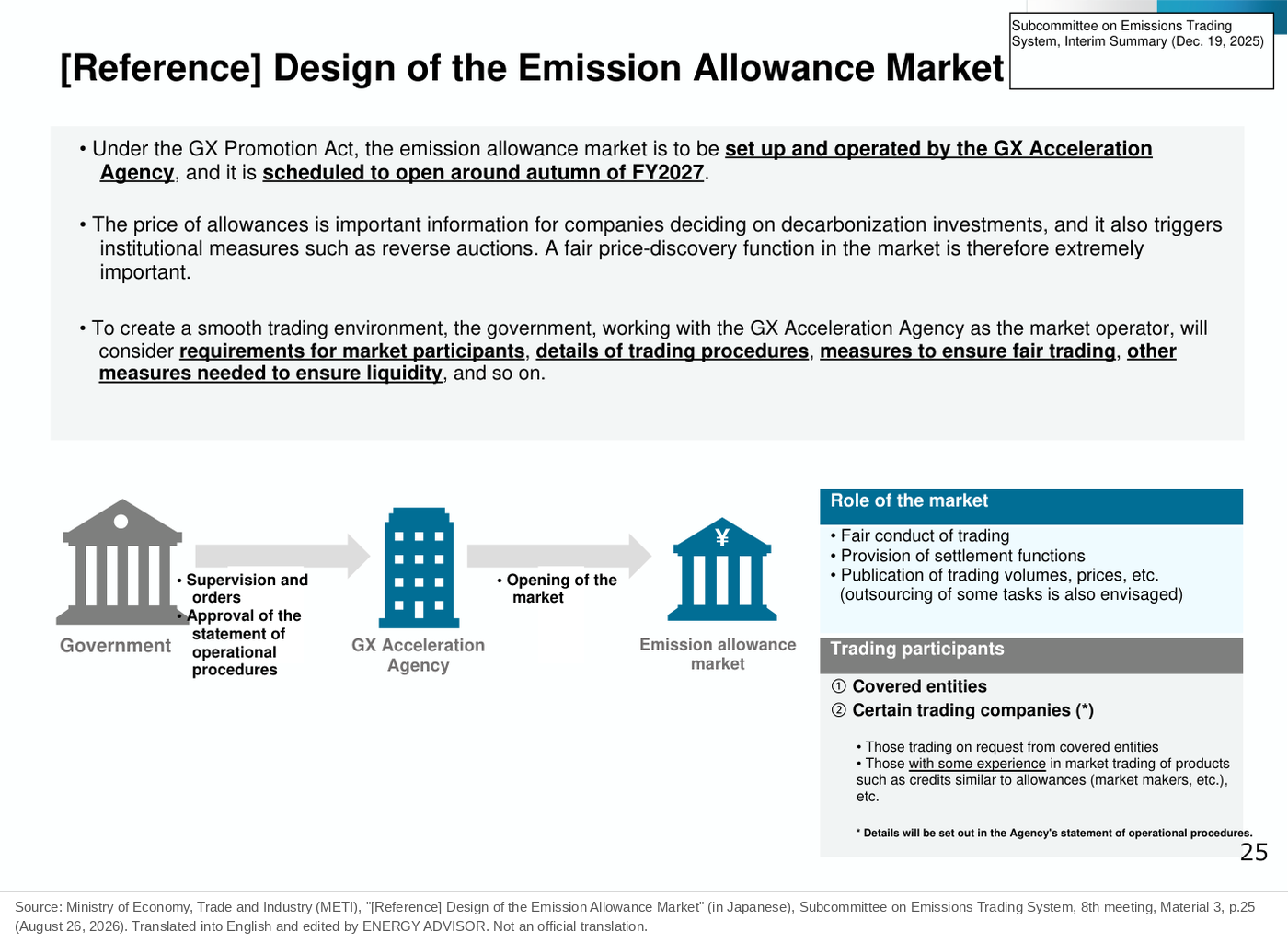
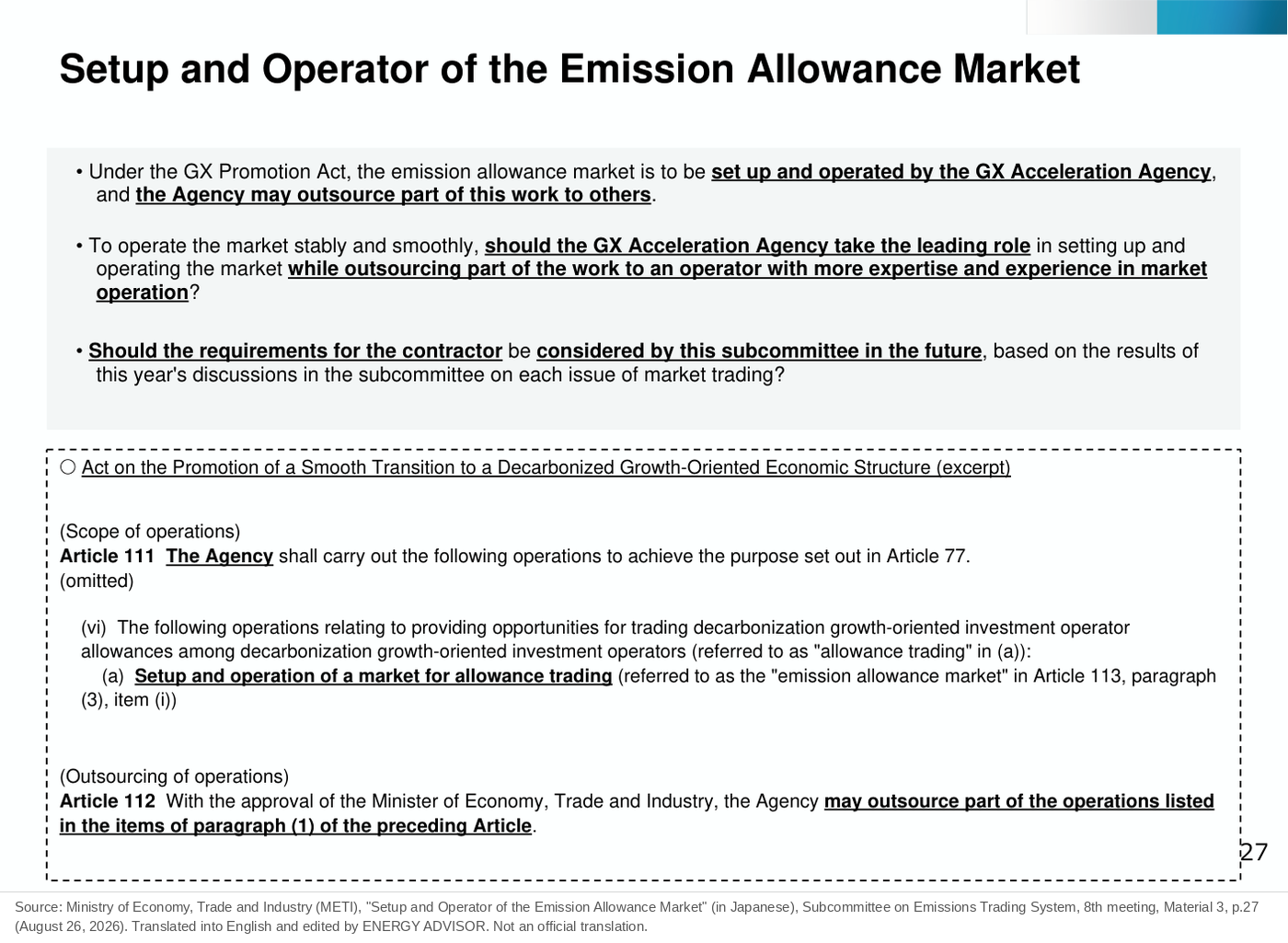
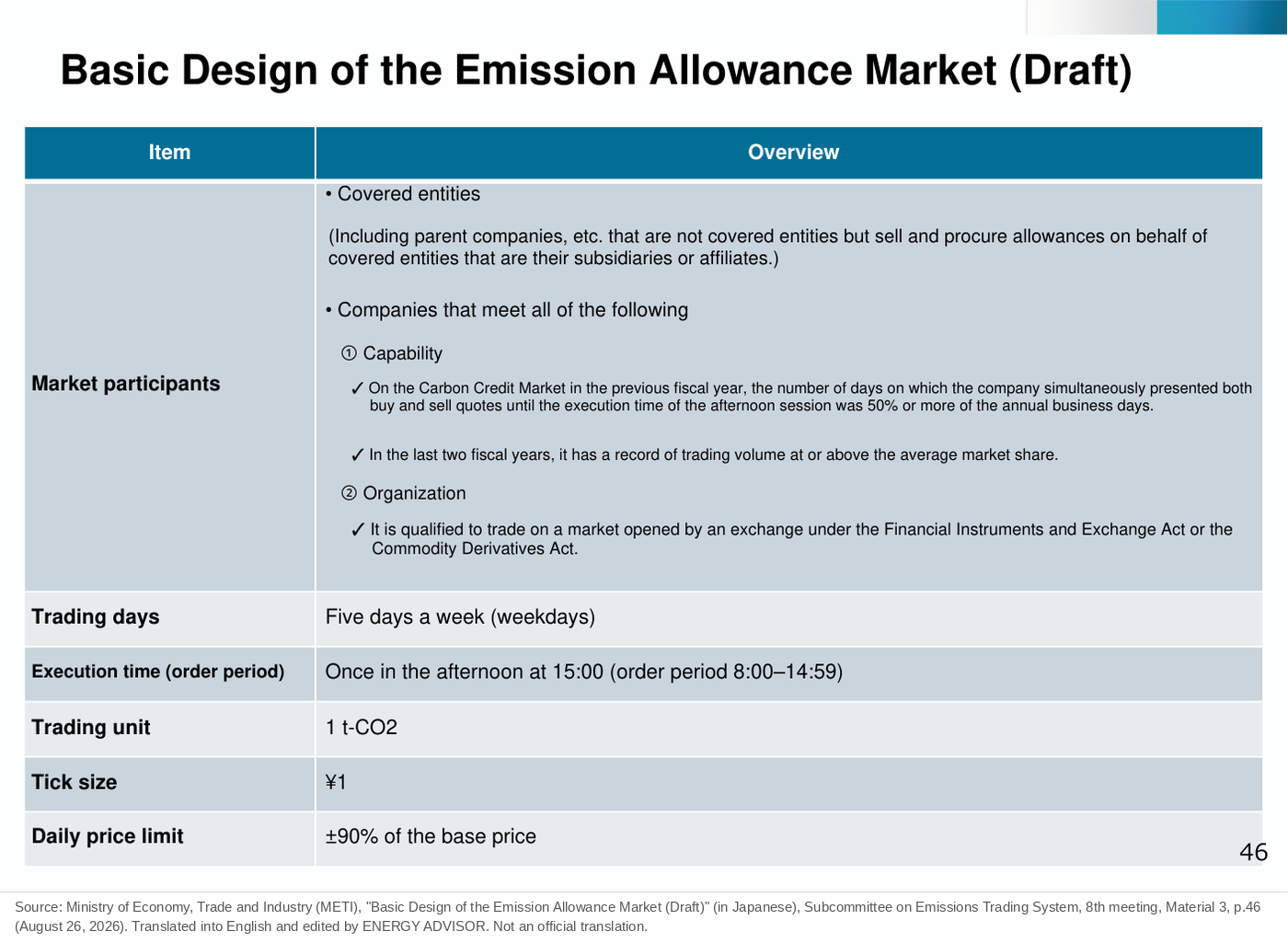
The GX Emissions Trading System (GX-ETS) emission allowance market is a new emission allowance market scheduled to open around autumn of FY2027, to be set up and operated by the GX Acceleration Agency. This market has a different character from the TSE Carbon Credit Market. Under the draft basic design, trading will take place five days a week, by call auction (itayose) once a day (a method that executes all orders collected over a set period at a single price), with a trading unit of 1 tonne (8th meeting of the Subcommittee, Material 3, p.43 and p.46).
Whereas the TSE market trades credits created from past emission reduction results, the GX-ETS market will be a mechanism for allocating and trading emission allowances in advance to meet emission reduction obligations.
Emission Allowances and the Allocation Mechanism
Covered companies in the GX-ETS receive annual emission allowances from the government free of charge. These allowances function as a “permitted volume” for meeting legally mandated emission reduction obligations.
If a company manages to cut its actual emissions, it can sell its surplus allowances to other companies. Conversely, if reductions do not progress and it is short of allowances, it needs to buy allowances from other companies. Through this mechanism, the incentive works in favor of the companies that cut emissions most efficiently.
Price Collar and Price Stabilization Mechanism
The GX-ETS market has price stabilization measures to prevent excessive swings in allowance prices. For FY2026, under their official names, an upper reference price of ¥4,300/t-CO2 and an adjustment reference price of ¥1,700/t-CO2 are set, and the policy for FY2027–FY2030 is to raise them step by step to a level that takes into account a real 3% plus the inflation rate.
When the market price exceeds the cap, a company that pays the amount of its shortfall multiplied by the upper reference price is deemed to hold that amount of allowances. If the price stays below the floor for a certain period, the GX Acceleration Agency will hold a reverse auction, tightening the supply of allowances in circulation to adjust the supply-demand balance. Article 04 covers this in detail.
Covered Companies and Sectors
The main participants in the GX-ETS trading market will be energy-intensive industries. Specifically, the focus is on industries that emit large amounts of CO2, such as manufacturing, power generation and chemicals.
Relationship Between the Two Markets
Division of Roles Between the TSE Market and the GX-ETS Market
At first glance the two markets look like the same carbon market, but in fact their roles are clearly divided. The TSE Carbon Credit Market turns emission reductions and removals that have already been achieved into credits, so purchases are mainly for offsetting (compensating for a company’s own emissions with reductions elsewhere).
The GX-ETS trading market, on the other hand, is for trading allowances to meet legal emission reduction obligations. In other words, there is an essential difference: the TSE market is “results-based” and the GX-ETS market is “obligation-based.”
The two markets do not compete; rather, they complement each other. J-Credits can also be used to meet GX-ETS obligations, up to 10% of actual annual emissions (article 06).
Summary: Toward the Development of the Carbon Market
For Japan to realize GX, the TSE Carbon Credit Market and the GX-ETS trading market each play an important role. The former is already building a steady trading record.
Preparations for the latter are also under way toward its opening around autumn of FY2027, and it will be a framework that promotes companies’ emission reductions with greater enforcement power.
This article is based on published materials from the Ministry of Economy, Trade and Industry and its Agency for Natural Resources and Energy, the Electricity and Gas Market Surveillance Commission, the Organization for Cross-regional Coordination of Transmission Operators (OCCTO) and other sources. The English translations of figures are by ENERGY ADVISOR and are not official translations. When using this information for decisions, please check the original sources. When we find an error, we correct the article and note the date of the correction.
Sources
- Japan Exchange Group (JPX), “Carbon Credit Market” (officially opened on October 11, 2023; cumulative trading volume of 1 million tonnes reported in the news of September 8, 2025) (in Japanese). https://www.jpx.co.jp/equities/carbon-credit/
- JPX, “Carbon Credit Market Participants” (362 participants as of October 16, 2026) (in Japanese). https://www.jpx.co.jp/equities/carbon-credit/participants/index.html
- JPX, “Traded Price and Volume” (October 11, 2023 to September 30, 2026; volume-weighted average price by type) (in Japanese). https://www.jpx.co.jp/equities/carbon-credit/daily/nlsgeu000006ltge-att/TradedPriceandVolume.pdf
- METI, Subcommittee on Emissions Trading System, 8th meeting (August 26, 2026), Material 3 “Detailed Design of the Emission Allowance Market” (in Japanese): p.25 (role of the market and trading participants), p.27 (set up and operated by the GX Acceleration Agency), p.43 (number of trading days and frequency of sessions), p.45 (call auction (itayose) and continuous trading), p.46 (basic design of the emission allowance market (draft)) (pages were read via a summary and may be off by one). https://www.meti.go.jp/shingikai/sankoshin/sangyo_gijutsu/emissions_trading/pdf/008_03_00.pdf
- METI, Subcommittee on Emissions Trading System, 9th meeting (September 25, 2026), Material 3 “Measures Related to the Upper and Lower Prices” (in Japanese): p.4 (emission allowance market to open around autumn of FY2027), p.8 (payment at the upper price). https://www.meti.go.jp/shingikai/sankoshin/sangyo_gijutsu/emissions_trading/pdf/009_03_00.pdf
- METI, Subcommittee on Emissions Trading System, Summary report (December 19, 2025; the cover title of the PDF is “Interim Summary”) (in Japanese): p.8 (compliance deemed by paying the upper price × the shortfall), pp.18–19 (eligible carbon credits and the 10% limit) (pages were read via a summary and may be off by one). https://www.meti.go.jp/shingikai/sankoshin/sangyo_gijutsu/emissions_trading/pdf/20251219_1.pdf
- METI, Subcommittee on Emissions Trading System, 7th meeting (December 19, 2025), Material 3 “Levels of the Upper and Lower Prices in the Emissions Trading System (Draft)” (in Japanese): p.9 (price of energy-saving J-Credits about ¥5,300 as of August 2025), p.13. https://www.meti.go.jp/shingikai/sankoshin/sangyo_gijutsu/emissions_trading/pdf/007_03_00.pdf