Phase 2 of the GX Emissions Trading System (GX-ETS) entered full operation in April 2026, and attention has turned to how allowance prices are set. For covered companies, the allowance price means the cost per tonne of emissions, and it is an important indicator directly linked to management decisions and investment plans.
This article explains the level of allowance prices in the GX-ETS, how the price stabilization mechanism (price collar) works, a comparison with the EU-ETS, and the effect on corporate management. The explanations of prices that appear in other articles of this series are gathered in this article.
(Note for readers outside Japan) Japan’s fiscal year (FY) runs from April to March; FY2026 is April 2026–March 2027.
Key points
- 1GX-ETS allowance prices for FY2026, under their official names, are an upper reference price of ¥4,300/t-CO2 and an adjustment reference price of ¥1,700/t-CO2 (published in a ministerial notification).
- 2The upper price was calculated from the median of the coal-to-gas fuel-switching cost over the last 10 years, and the lower price from the average price of energy-saving J-Credits over the period before their price surge.
- 3By FY2030, the prices will be raised step by step to an upper reference price of ¥4,840 and an adjustment reference price of ¥1,913 (in real terms).
- 4The revision formula adds a real price increase of 3% plus the projected inflation rate to the previous year’s price.
GX-ETS Allowance Prices: The FY2026 Level
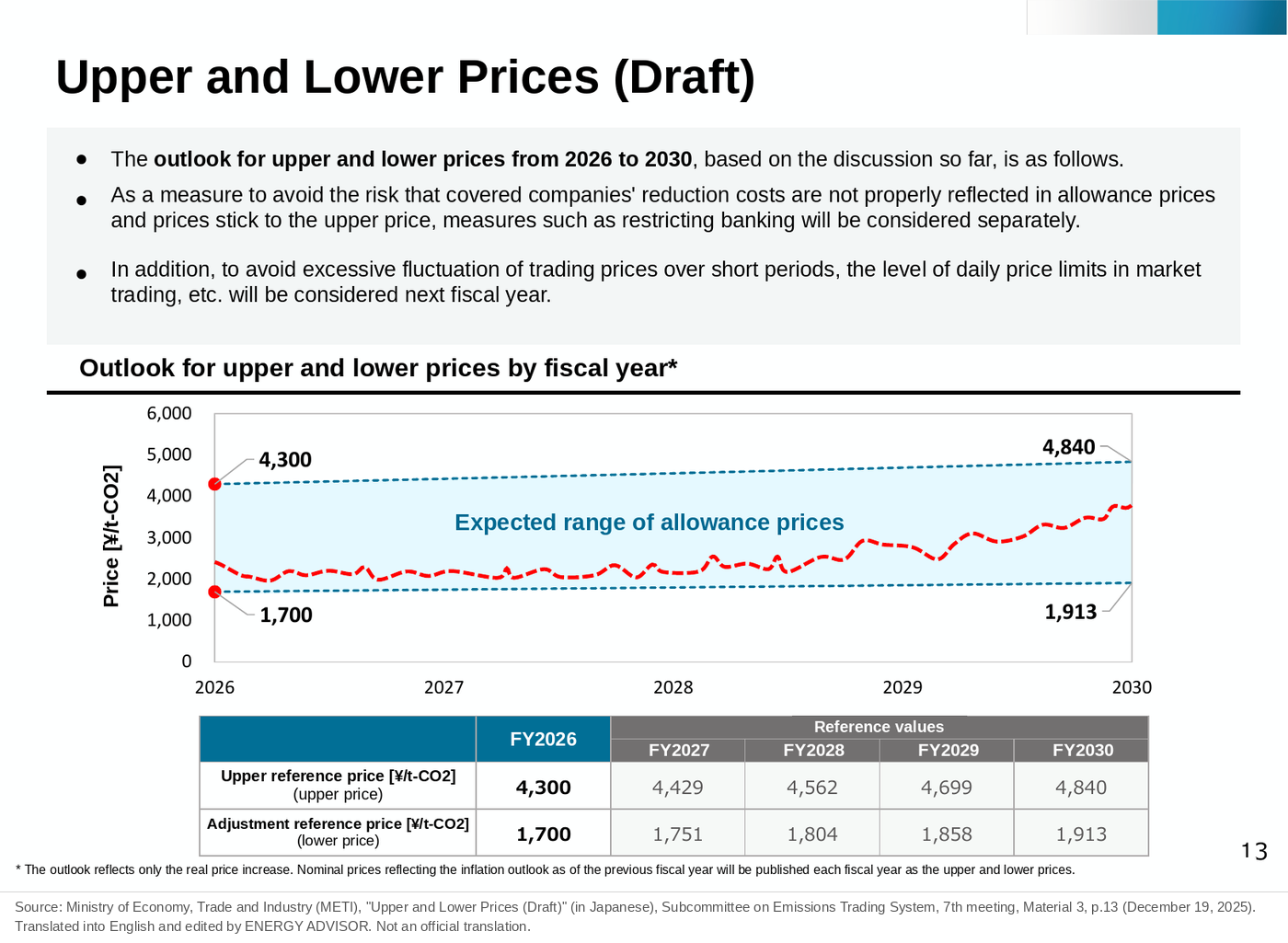
In Phase 2 of the GX-ETS (FY2026–FY2032), allowances are in principle allocated to covered companies free of charge. However, as a price stabilization measure for trading surpluses and shortfalls of allowances in the market, an upper reference price of ¥4,300/t-CO2 and an adjustment reference price of ¥1,700/t-CO2 (their official names) have been set and published in a ministerial notification.
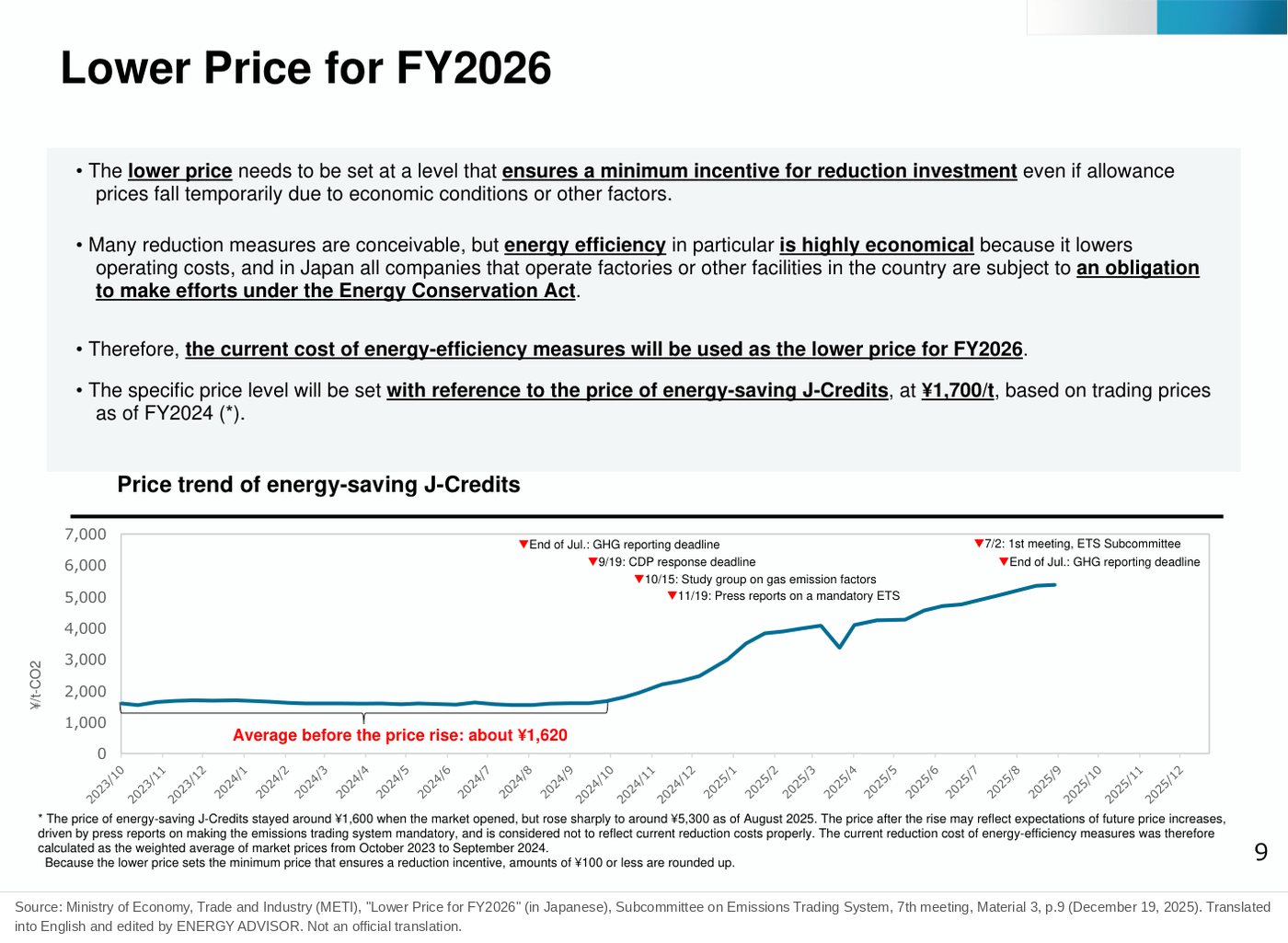
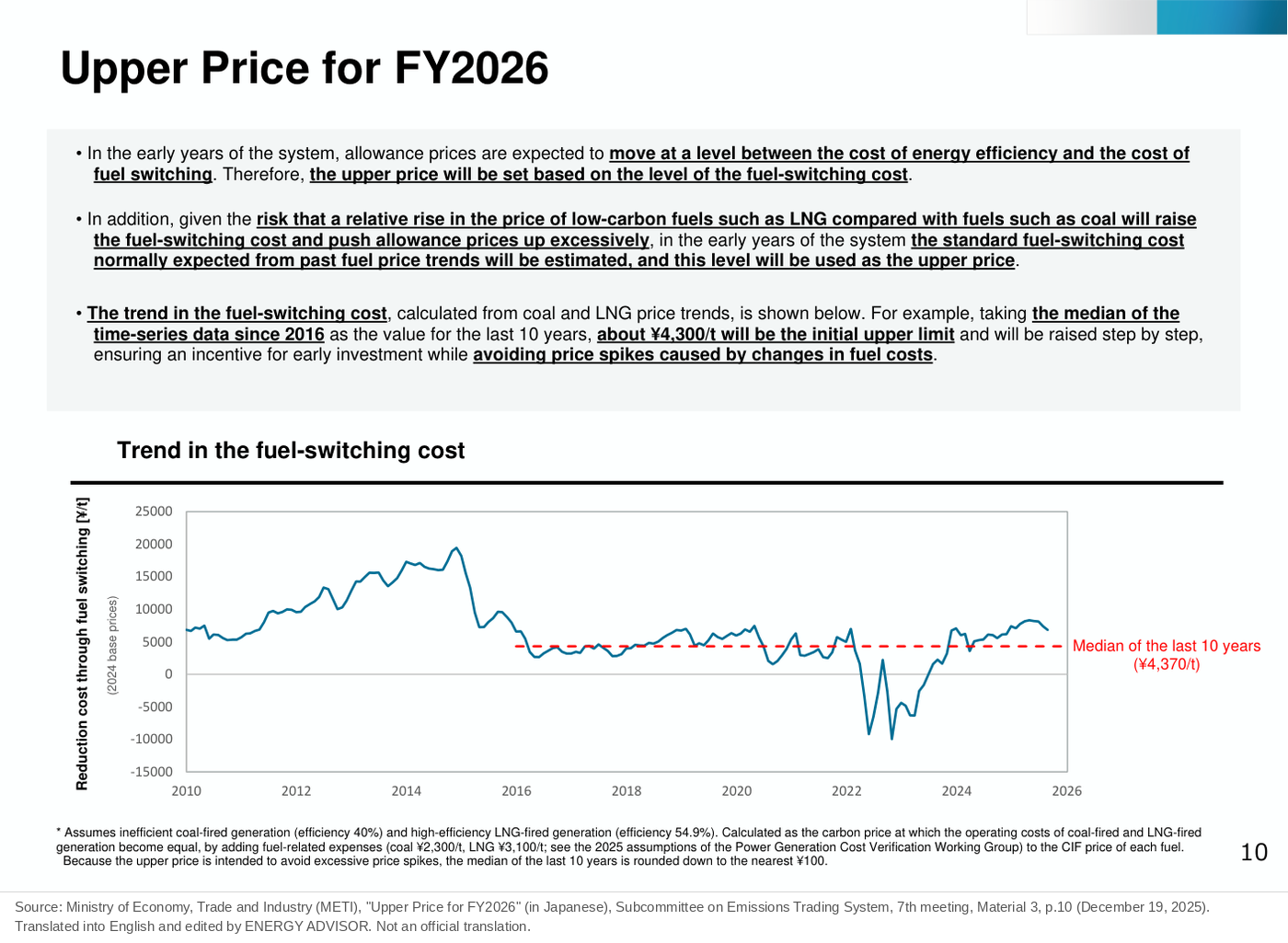
The FY2026 upper reference price of ¥4,300 was calculated by rounding down, to the nearest ¥100, the median of the coal-to-gas fuel-switching cost over the last 10 years (since 2016) (about ¥4,370/tonne). The floor of ¥1,700 was calculated by rounding up, to the nearest ¥100, the average price of energy-saving J-Credits (credits for CO2 reductions from energy saving, certified by the government) over the period before their price surge (about ¥1,620). These are designed with a balance in mind: promoting companies’ investment in emission reduction while avoiding an excessive burden on business from a sharp increase in costs.
For FY2027–FY2030, prices are expected to be raised step by step.
| Fiscal year | Upper reference price (¥/t-CO2) | Adjustment reference price (¥/t-CO2) |
|---|---|---|
| FY2026 (published) | 4,300 | 1,700 |
| FY2027 (reference value, not final) | 4,429 | 1,751 |
| FY2028 (outlook) | 4,562 | 1,804 |
| FY2029 (outlook) | 4,699 | 1,858 |
| FY2030 (outlook) | 4,840 | 1,913 |
The values from FY2027 onward are in real terms (excluding inflation). Nominal prices, which add the inflation rate to these, will be published in a notification every fiscal year before the fiscal year starts. As of October 2026, the nominal price for FY2027 has not yet been published.
How the Price Stabilization Mechanism (Price Collar) Works
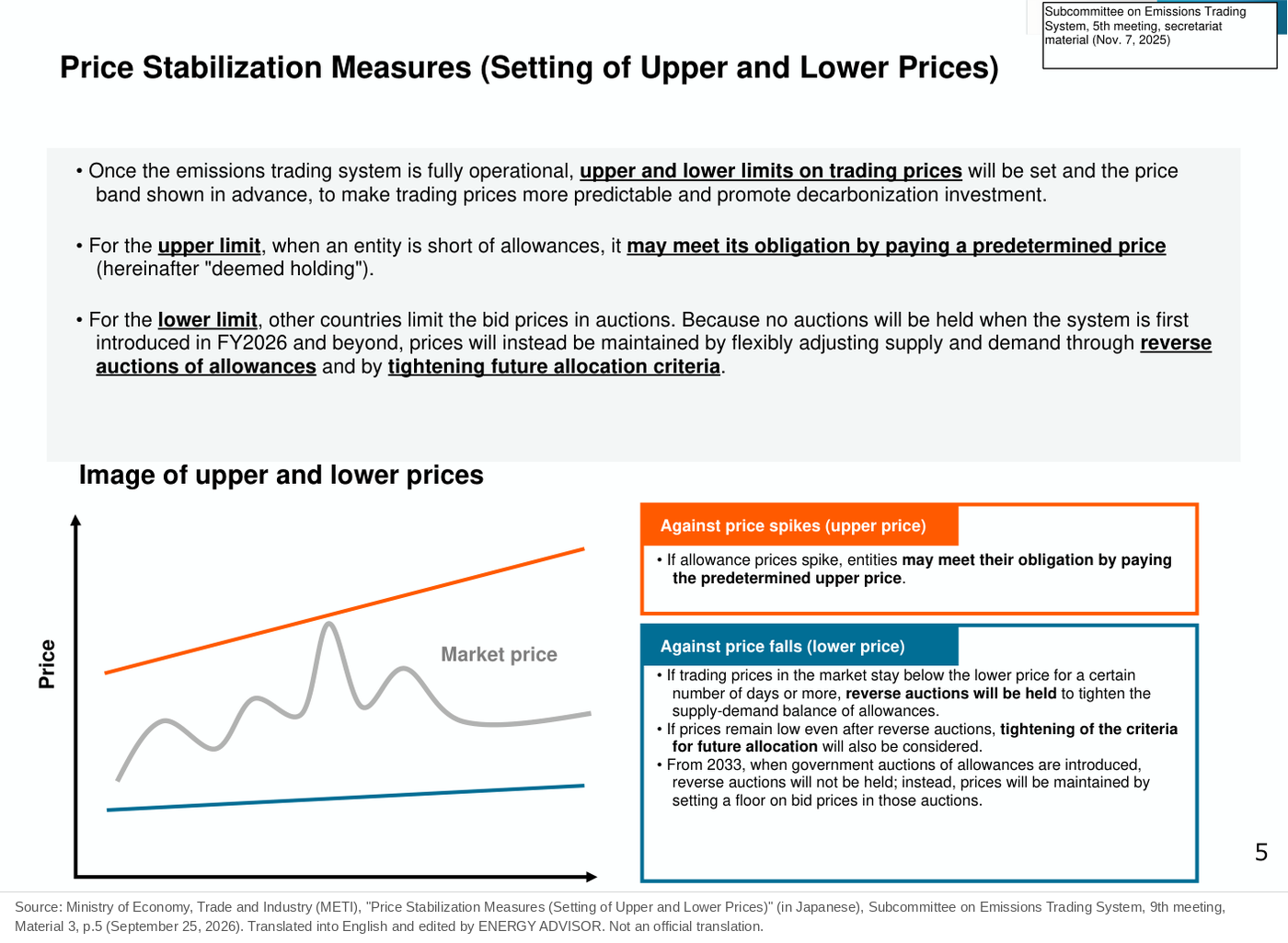
A price stabilization mechanism (price collar) sets an upper and a lower limit on the market price of allowances to prevent sharp rises and falls. In the GX-ETS, it consists of two mechanisms: the upper price and the lower price.
Role of the Upper Price
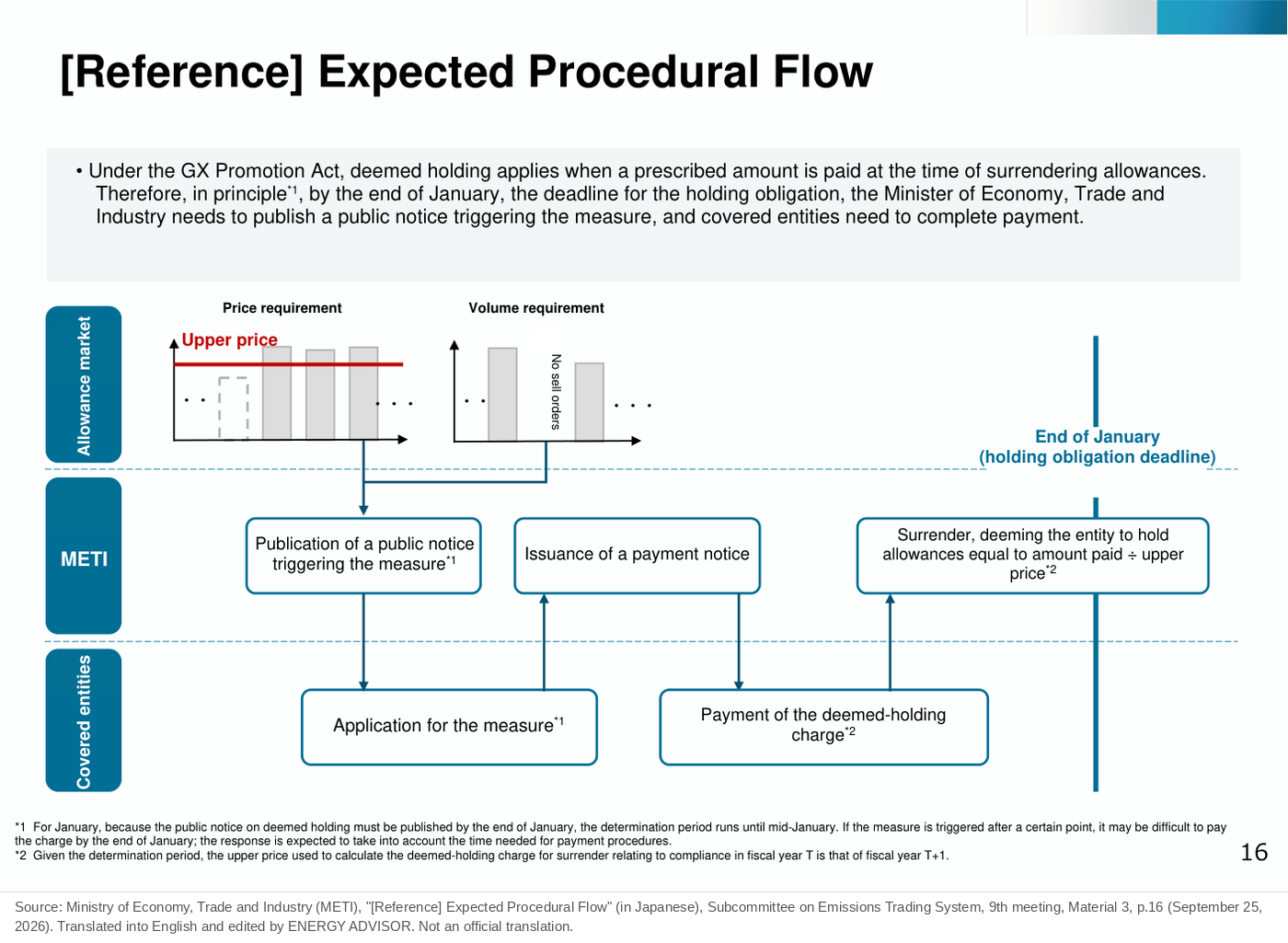
When the market price of allowances exceeds the cap (FY2026: upper reference price of ¥4,300/t-CO2), a company that is short of allowances is deemed to hold that amount of allowances if it pays the amount of its shortfall multiplied by the upper reference price. This keeps companies’ procurement costs within a predictable range.
Role of the Lower Price
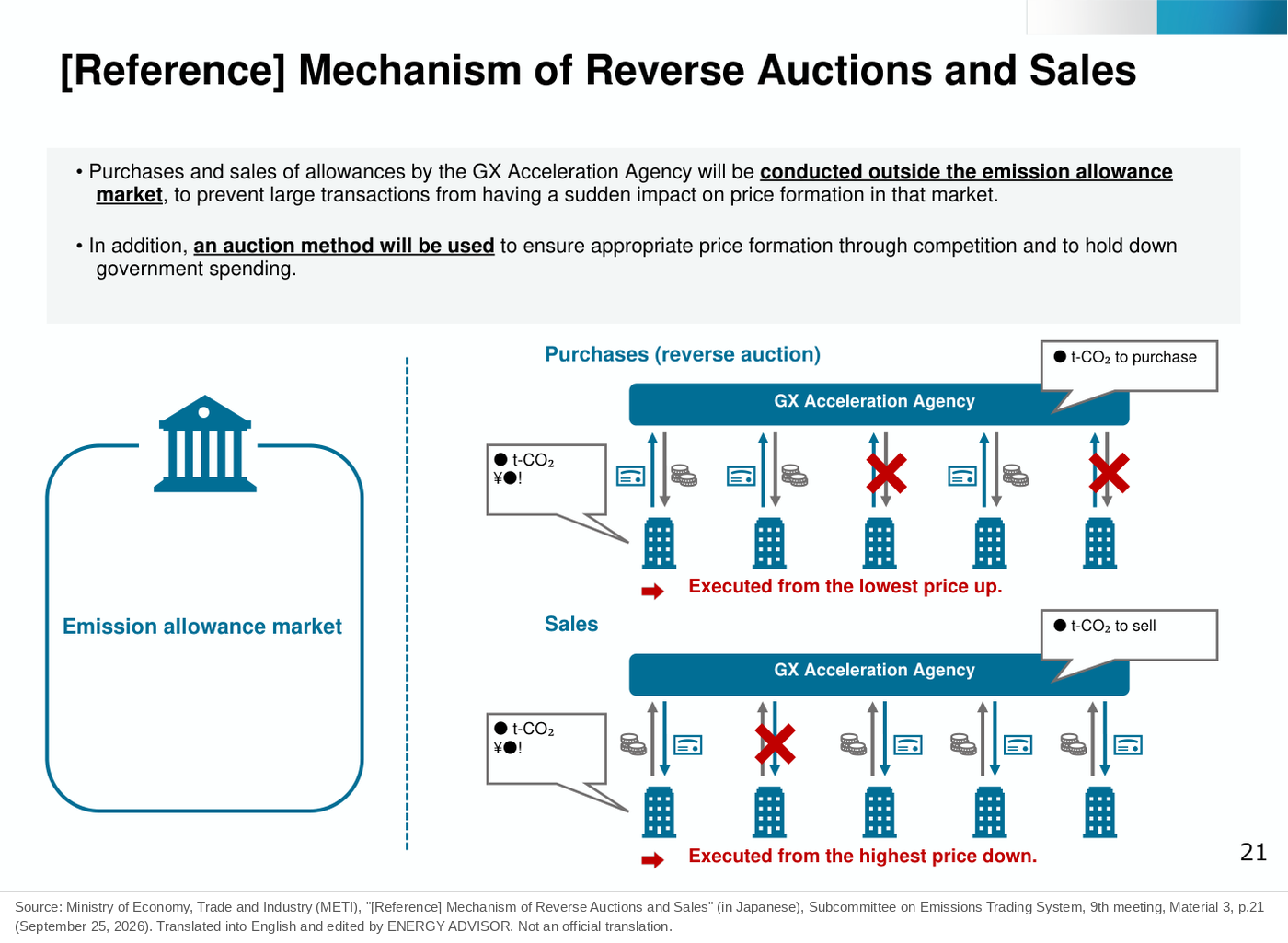
The lower price (FY2026: adjustment reference price of ¥1,700/t-CO2) has the role of preventing the market from “falling through the floor.” If the market price stays below the floor for a certain period, the GX Acceleration Agency (the body that operates the system) will hold a reverse auction (a tender to buy back allowances), tightening the supply of allowances in circulation to adjust the supply-demand balance. If prices remain low for longer than a certain period, strengthening the allocation criteria will also be considered. Keeping prices at a certain level secures the economic incentive for investment in emission reduction. When auctions are introduced from FY2033 onward, the design is to hold no reverse auctions and instead maintain the price by setting a floor on auction bid prices.
Annual Adjustment: Real 3% Plus Inflation
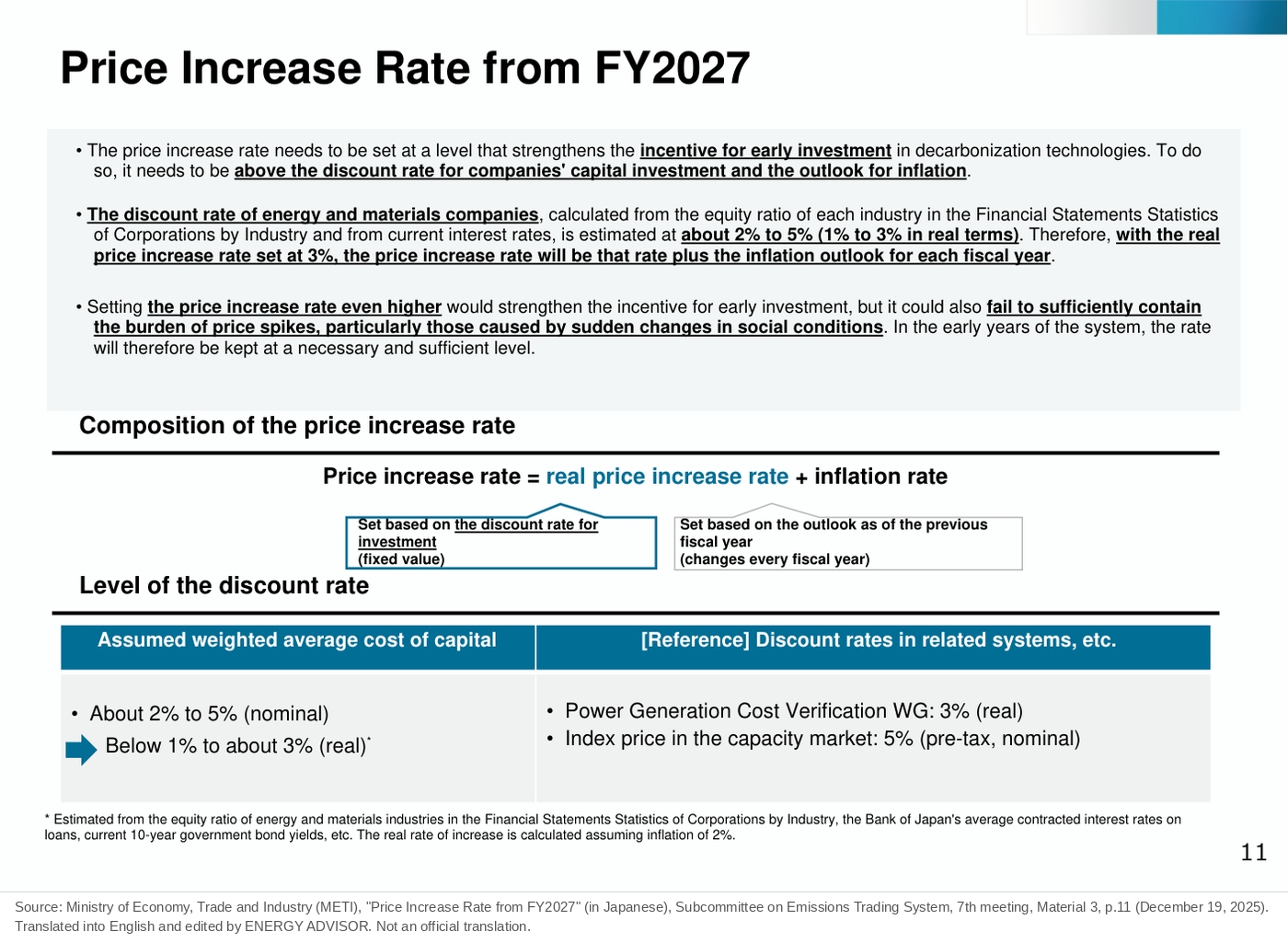
From FY2027 onward, the upper reference price and the adjustment reference price will be raised step by step to a level that adds a real price increase of 3% plus the projected inflation rate to the previous year’s price. The real 3% was set as a level above the discount rate for investment by energy and materials companies (about 1–3% in real terms), to secure an incentive for early investment in decarbonization technologies. For the inflation rate, the outlook for the next fiscal year’s Corporate Goods Price Index (CGPI) (an index of price movements of goods traded between companies), which the government publishes around December each year, is used.
This design lets companies draw up long-term emission reduction plans that factor in future price increases. It is a structure in which costs rise step by step in a predictable way, rather than through sudden increases.
Comparison with the EU-ETS: How Prices Are Raised
To understand the price level of Japan’s GX-ETS, a comparison with the earlier EU-ETS (the European Union’s emissions trading system, launched in 2005) is useful. Japan’s GX-ETS is designed to set the upper and lower prices and the annual increase in advance, and to raise prices step by step.
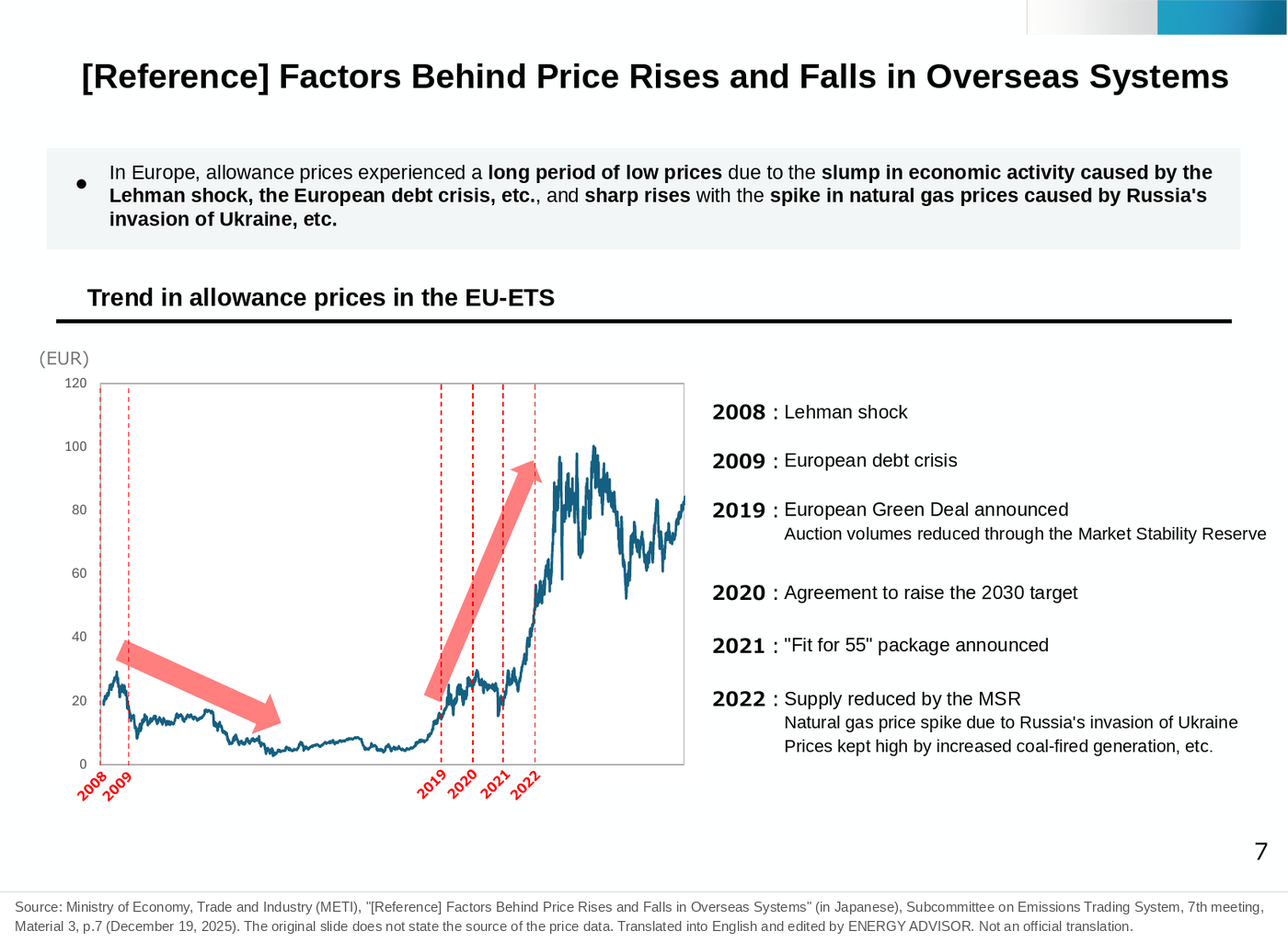
Looking at the price history of the EU-ETS, there was criticism in the early years that prices were too low and gave only a weak incentive to cut emissions. The figure on p.7 of Material 3 of the 7th meeting of the Subcommittee shows that the EU-ETS allowance price stayed low for a long time after the Lehman shock (2008) and the European financial crisis (2009), and then rose after the implementation of the Market Stability Reserve (MSR) (a mechanism that sets aside part of the allowances when too many are in circulation) (2019), the raising of the 2030 target, the surge in natural gas prices in 2022, and other events. How fast the initial price band is raised is an important point that determines the effectiveness of the system.
Effect of Allowance Prices on Corporate Management
For covered companies, the allowance price means an additional cost per tonne of CO2 emitted. If a company emitting 100,000 tonnes of CO2 a year bought all of its allowances in the market, at the upper price this would cost about ¥0.43 billion a year.
However, because allowances are allocated free of charge in Phase 2, the amount that actually has to be bought in the market is limited to the excess over the allocation. A company that succeeds in cutting emissions can also sell its surplus in the market and earn revenue.
Relation to the Non-Compliance Charge System
If a company cannot hold allowances equal to its verified emissions by the deadline (January 31 of the following fiscal year), a non-compliance charge of the unfulfilled amount × the upper price × 1.1 is imposed. Based on the FY2026 upper reference price of ¥4,300, the charge is about ¥4,730 per unfulfilled tonne. Failing to secure allowances leads to a penalty above the upper price. In addition, failure to make notifications or report emissions, or making false notifications, can be punished under the GX Promotion Act with a fine of up to ¥500,000 (Article 143, items 1 and 5).
This non-compliance charge system works as an economic enforcement mechanism that pushes companies to manage their allowances properly and to work on cutting emissions.
Summary: Outlook for Allowance Prices
GX-ETS allowance prices for FY2026 are set at an upper price of ¥4,300/t-CO2 and a lower price of ¥1,700/t-CO2. The price stabilization mechanism (price collar) curbs sharp market swings and is designed to give companies a predictable business environment. From FY2027 onward, prices will be raised step by step every year, by 3% plus the projected inflation rate, through a notification published before each fiscal year starts.
Movements in allowance prices are directly linked to covered companies’ capital investment plans and energy procurement strategies. Companies need to draw up medium- to long-term emission reduction plans while checking the price notification each fiscal year.
This article is based on published materials from the Ministry of Economy, Trade and Industry and its Agency for Natural Resources and Energy, the Electricity and Gas Market Surveillance Commission, the Organization for Cross-regional Coordination of Transmission Operators (OCCTO) and other sources. The English translations of figures are by ENERGY ADVISOR and are not official translations. When using this information for decisions, please check the original sources. When we find an error, we correct the article and note the date of the correction.
Sources
- METI, Subcommittee on Emissions Trading System, 7th meeting (December 19, 2025), Material 3 “Levels of the Upper and Lower Prices in the Emissions Trading System (Draft)” (in Japanese): p.2 (from FY2033 onward, no reverse auctions and a floor on bid prices); p.7 “[Reference] Factors behind price surges and falls in overseas systems” (history of EU-ETS allowance prices; confirmed from the text in the figure); p.9 (floor: average over the period before the surge, about ¥1,620); p.10 (cap: median over the last 10 years, about ¥4,370; history of fuel-switching costs; input data from the 2025 Power Generation Cost Verification Working Group); p.11 (real price increase of 3%; discount rate); p.13 (values for FY2027–FY2030; confirmed from the text in the figure) (pages other than p.7 and p.13 were read via a summary and may be off by one). https://www.meti.go.jp/shingikai/sankoshin/sangyo_gijutsu/emissions_trading/pdf/007_03_00.pdf
- METI, Subcommittee on Emissions Trading System, 9th meeting (September 25, 2026), Material 3 “Measures Related to the Upper and Lower Prices” (in Japanese): p.5 (diagram of the price stabilization measures), p.6 (FY2026 prices published in a notification; method from FY2027 onward; FY2027 reference values not final), p.8 (paying the amount multiplied by the upper reference price is deemed as holding allowances), p.16 (procedural flow of deemed holding), p.21 (mechanism of reverse auctions and sales). https://www.meti.go.jp/shingikai/sankoshin/sangyo_gijutsu/emissions_trading/pdf/009_03_00.pdf
- METI, Subcommittee on Emissions Trading System, Summary report (December 19, 2025; the cover title of the PDF is “Interim Summary”) (in Japanese): p.8 (if prices stay below the floor for longer than a certain period, strengthening the allocation criteria will be considered; holding by January 31 of the following fiscal year; compliance deemed by paying the upper price × the shortfall; 1.1 times the upper price for unfulfilled amounts). https://www.meti.go.jp/shingikai/sankoshin/sangyo_gijutsu/emissions_trading/pdf/20251219_1.pdf
- Act on the Promotion of a Smooth Transition to a Decarbonized Growth-Oriented Economic Structure (Act No. 32 of 2023; amended text in force from April 1, 2026; viewed on e-Gov Law Search on October 22, 2026), Article 143, item 1 (failure to make the notification under Article 33(1) or making a false notification) and item 5 (failure to report emissions under Article 35(1) or making a false report): fine of up to ¥500,000 (in Japanese). https://laws.e-gov.go.jp/law/505AC0000000032