Toward carbon neutrality by 2050, carbon credit trading is expanding rapidly in Japan. With the introduction of the GX Emissions Trading System (GX-ETS), companies that are short of emission allowances can now make up the shortfall with carbon credits.
This article explains how carbon credits work, the J-Credit Scheme and the Joint Crediting Mechanism (JCM) available in Japan, and how credits are actually used in the GX-ETS. It gathers information useful for companies considering emission reduction projects or drawing up carbon neutrality strategies.
Key points
- 1Carbon credits are a mechanism that makes greenhouse gas reductions and removals “visible” and transferable.
- 2In Japan, the two main types of carbon credits are J-Credits (domestic) and JCM credits (international).
- 3In the GX-ETS, eligible carbon credits can be used to meet obligations for up to 10% of actual annual emissions.
- 4The Carbon Credit Market of the Tokyo Stock Exchange opened in October 2023, and its cumulative trading volume reached 1 million tonnes in September 2025.
What Carbon Credits Are: Making Reductions and Removals “Visible”
A carbon credit is a mechanism that quantitatively evaluates greenhouse gas emission reductions or removals and quantifies 1 tonne of CO2 reduced or removed as one credit. Reduced or removed CO2 cannot be seen, but turning it into credits makes it, for the first time, a “product” that can be traded in a market.
Suppose a company cuts its CO2 emissions by 100 tonnes every year by installing energy-saving equipment. If it can prove this reduction, it can be certified for 100 credits. If the company does not need the reduction itself, it can sell these credits to another company, and the buying company can count the purchased credits as its own reduction results.
Carbon credits are an important tool for helping companies achieve carbon neutrality. In areas where cutting their own emissions is difficult, they can reach their targets quickly by buying credits. At the same time, companies that carry out reduction projects earn revenue from selling credits, which encourages further investment.
However, the quality of credits differs depending on the issuing body. Whether the issuer is reliable and whether the method of measuring reductions is scientific are important points. For this reason, countries have set up “certification standards.”
Japan’s Carbon Credit Schemes: J-Credits and the JCM
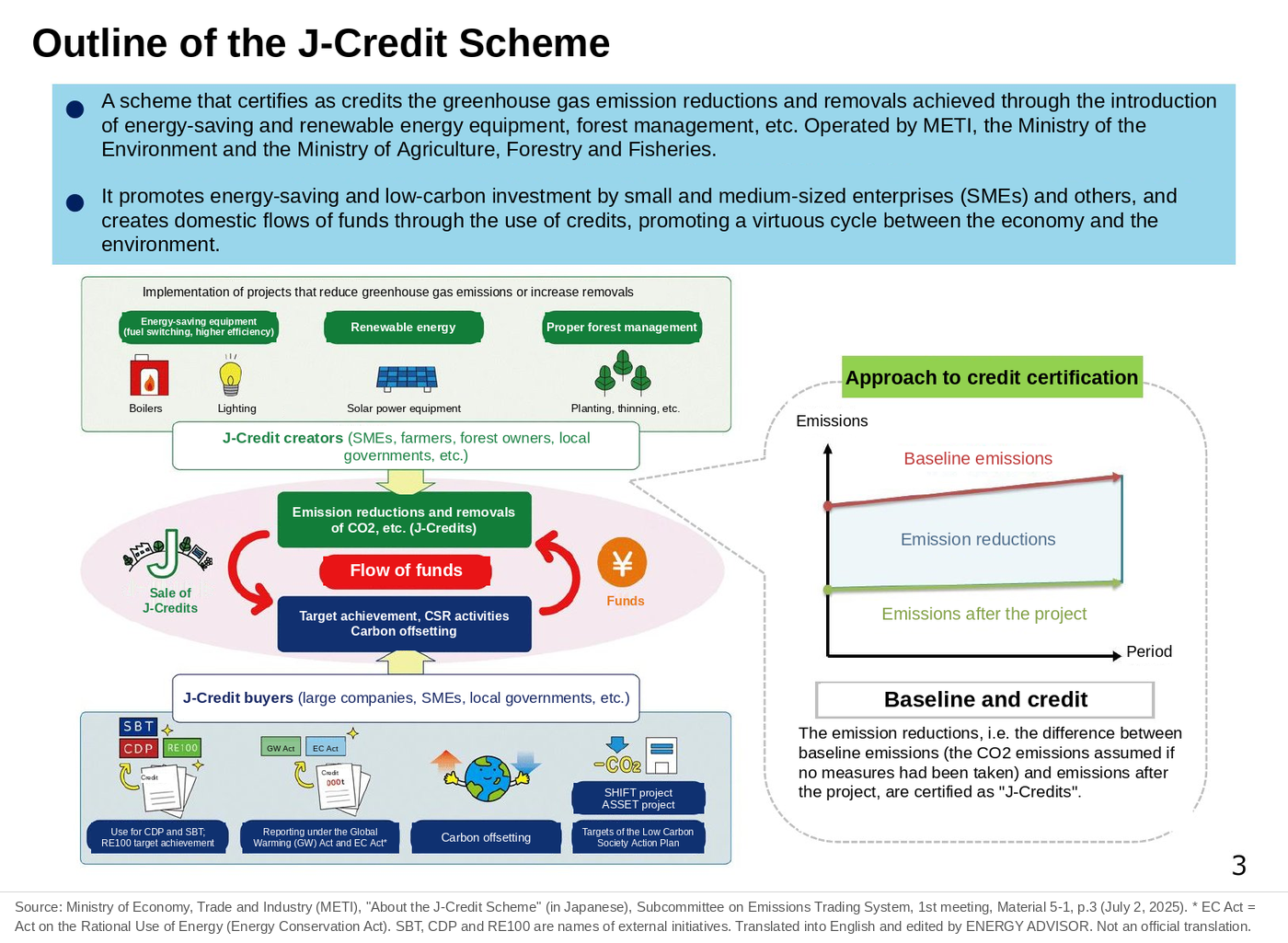
The core of the carbon credits available in Japan is a domestic scheme called the J-Credit Scheme (a Japanese government scheme that certifies emission reductions and removals as credits). It is run jointly by three ministries, the Ministry of Economy, Trade and Industry (METI), the Ministry of the Environment (MOE) and the Ministry of Agriculture, Forestry and Fisheries, and it certifies and manages credits generated by projects in Japan.
Projects covered by the J-Credit Scheme are wide-ranging. Besides installing energy-saving equipment such as upgrades to LED lighting and high-efficiency air conditioning, renewable energy (power and heat) such as solar and biomass, and removals through forest management, there are also credits from agriculture and industrial processes, so many sectors can take part.
The other pillar is the Joint Crediting Mechanism (JCM). This is a program that transfers Japan’s advanced technologies and products to developing countries and achieves emission reductions there. The reductions are shared between Japan and the partner country, and the share Japan receives can be used as “JCM credits.”
Japan has signed bilateral documents on the JCM with 32 countries (MOE, “Joint Crediting Mechanism (JCM),” viewed October 22, 2026). Through the international deployment of industrial technologies in which Japan is strong, such as solar power systems, energy-saving equipment and methane gas recovery technology, it is a two-way mechanism in which Japanese companies also obtain credits while supporting carbon neutrality in developing countries.
JCM credits that can be used in the GX-ETS are limited to those that comply with the Mandatory Greenhouse Gas Accounting and Reporting System (SHK system: a system that requires emitters above a certain size to report their emissions) under the Act on Promotion of Global Warming Countermeasures. Under the SHK system, JCM credits derived from activities in or before 2020 cannot be used unless they meet requirements such as the issuance date.
Use of Credits in the GX-ETS
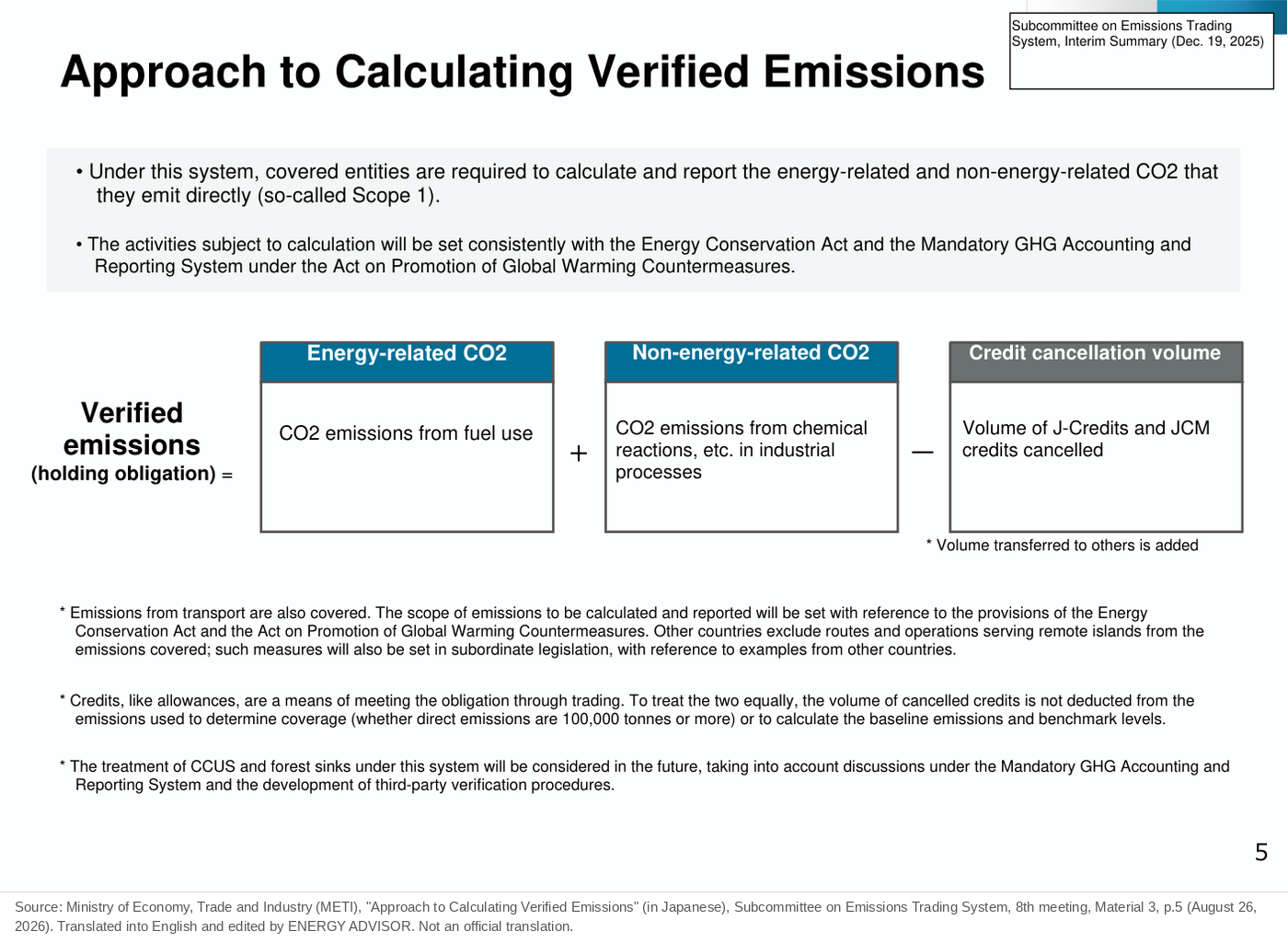
In the GX-ETS, which started in April 2026, carbon credits play an important role. If a covered company’s actual emissions are lower than its allocated allowances, it can sell the surplus allowances. Conversely, if it is short, it is allowed to make up the shortfall with “eligible carbon credits.”
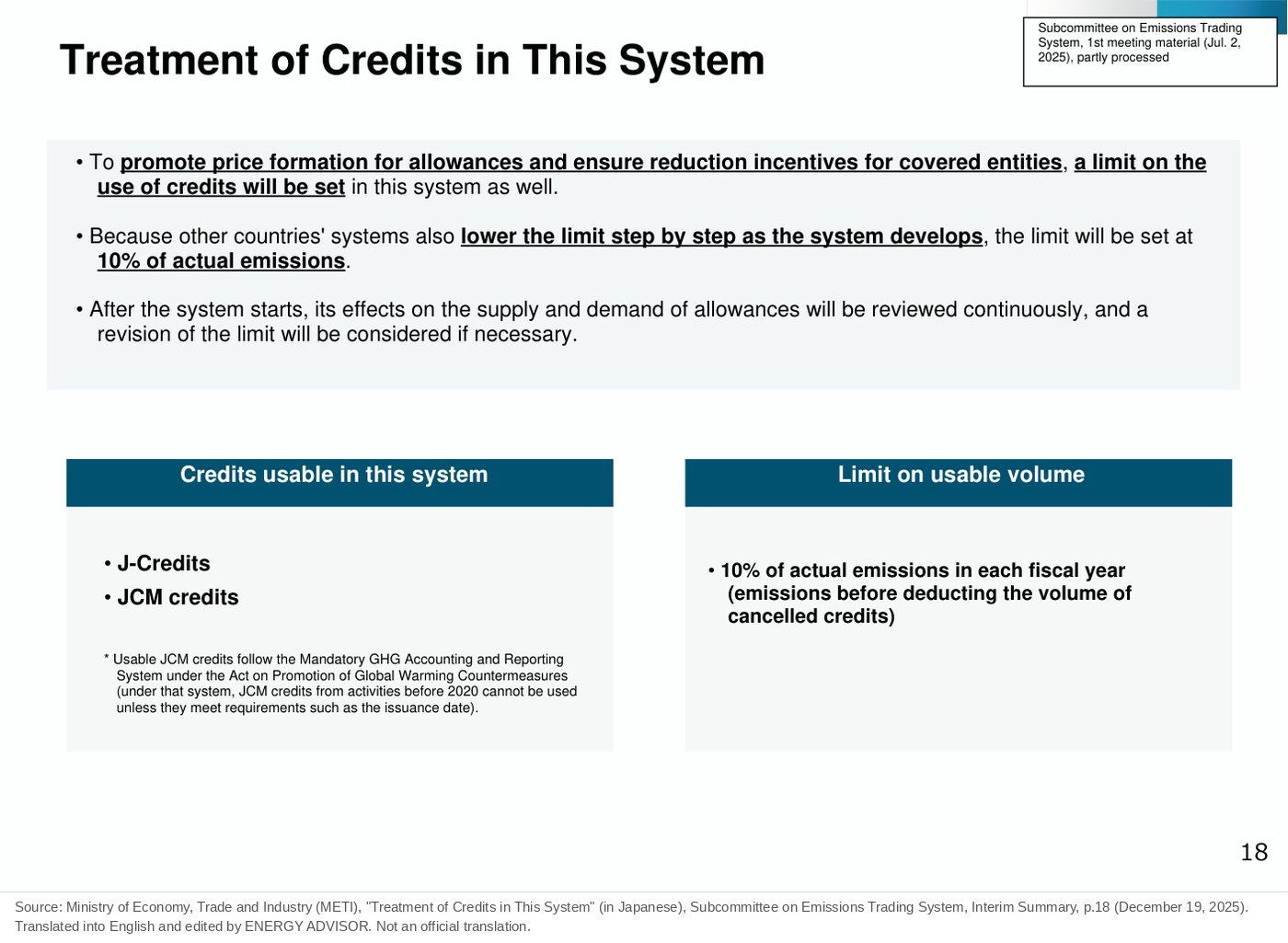
The important concept here is “eligible carbon credits.” Not all carbon credits can be used in the GX-ETS. Only specific credits recognized by the government can be applied to allowance obligations through “credit cancellation” (a procedure that cancels credits so they can never be used again). At present, J-Credits and JCM credits are recognized as eligible carbon credits.
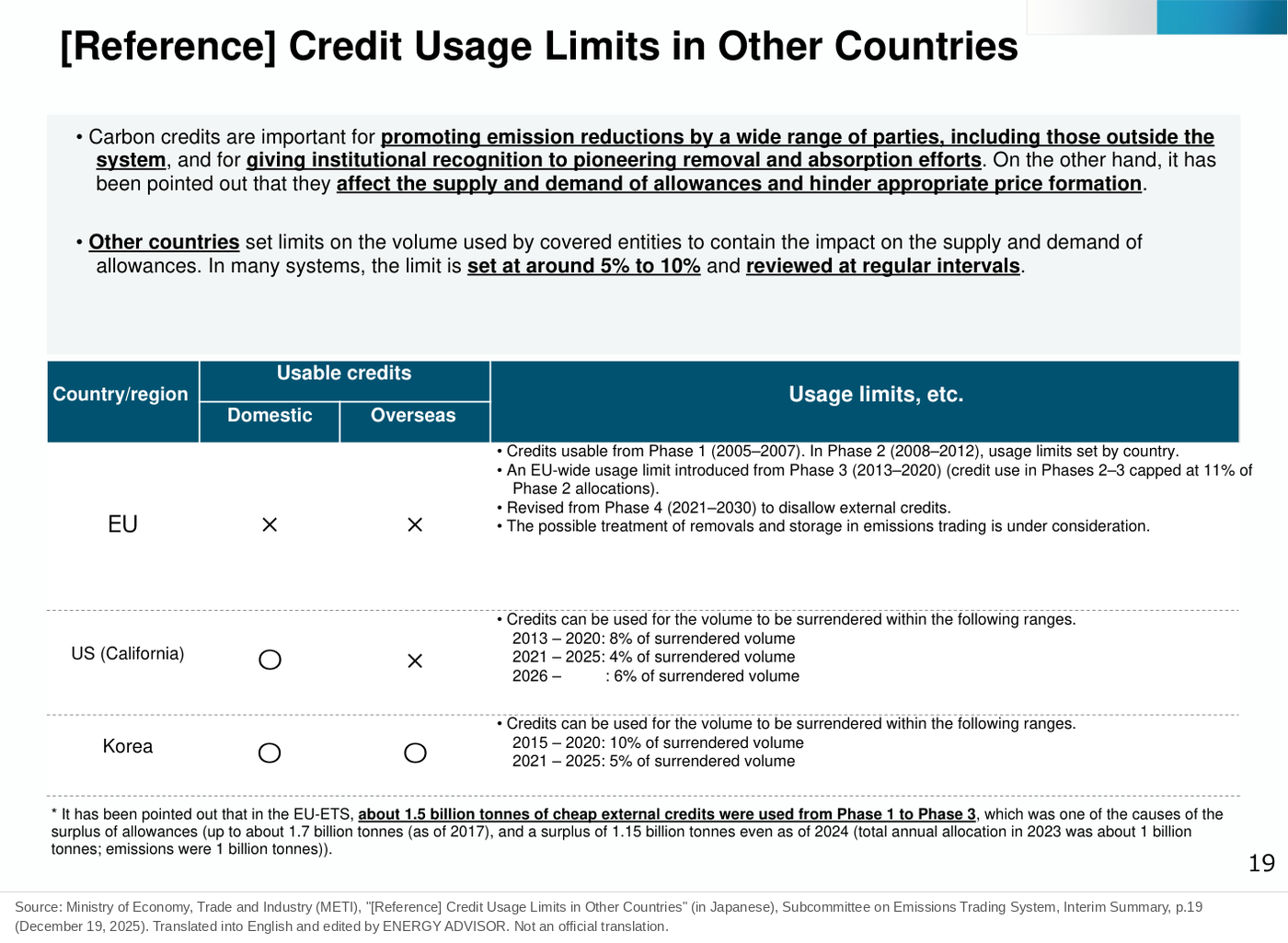
There is a usage limit on eligible carbon credits. The amount of credits a company can use to meet its obligation is up to 10% of its actual emissions for that fiscal year. In other countries, the EU-ETS in Phases 2 and 3 set a credit usage limit of 11% of Phase 2 allocations, California 4–8% of the surrendered amount, and Korea 5–10% of the surrendered amount (Summary report, p.19). In Phase 4 of the EU-ETS (2021–2030), the use of international credits is not allowed (European Commission).
Under this system design, companies need balanced carbon neutrality strategies. In the short term, they can speed up reaching their targets by buying eligible credits, but in the medium to long term, transforming their own business models and investing in reductions are essential.
The TSE Carbon Credit Market and How Trading Works
In October 2023, Japan Exchange Group (JPX) opened the Carbon Credit Market of the Tokyo Stock Exchange (TSE). This is an exchange market that intermediates the buying and selling of J-Credits, securing transparency and liquidity of trading. In September 2025, the cumulative trading volume of J-Credits reached 1 million tonnes. Article 05 covers how the market works.
The advantage of market trading is that sellers and buyers are easily matched. In direct trading it takes time to find a suitable counterparty, but through an exchange, trades are executed quickly. In addition, because trading prices are published, a market price is formed.
On the other hand, market prices are subject to changes in supply and demand. If supply increases as reduction technologies spread, prices fall; conversely, if allowances become tighter, demand rises and prices go up.
Summary: Overall Picture of Carbon Credits
Carbon credits are a mechanism that quantifies greenhouse gas reductions and removals and makes them transferable between companies. In Japan, the two main schemes are the J-Credit Scheme, certified by METI, MOE and the Ministry of Agriculture, Forestry and Fisheries, and the international JCM.
With the introduction of the GX-ETS, the place of credits in companies’ carbon neutrality strategies has become clearer. While cutting their own emissions remains the basis, companies can respond flexibly with eligible credits (up to 10% of annual emissions), especially in areas where cuts are difficult. With the development of the TSE Carbon Credit Market, the trading environment is also quickly taking shape.
This article is based on published materials from the Ministry of Economy, Trade and Industry and its Agency for Natural Resources and Energy, the Electricity and Gas Market Surveillance Commission, the Organization for Cross-regional Coordination of Transmission Operators (OCCTO) and other sources. The English translations of figures are by ENERGY ADVISOR and are not official translations. When using this information for decisions, please check the original sources. When we find an error, we correct the article and note the date of the correction.
Sources
- METI, Subcommittee on Emissions Trading System, Summary report (December 19, 2025; the cover title of the PDF is “Interim Summary”) (in Japanese): p.18 “Treatment of credits in this system” (eligible carbon credits are J-Credits and JCM credits, up to 10% of actual emissions; JCM credits must comply with the SHK system, and credits from activities in or before 2020 cannot be used unless they meet requirements such as the issuance date); p.19 “[Reference] Credit usage limits in other countries” (EU: 11% of Phase 2 allocations in Phases 2–3; California: 8% in 2013–2020, 4% in 2021–2025 and 6% from 2026; Korea: 10% in 2015–2020 and 5% in 2021–2025) (pages were read via a summary and may be off by one). https://www.meti.go.jp/shingikai/sankoshin/sangyo_gijutsu/emissions_trading/pdf/20251219_1.pdf
- METI, Subcommittee on Emissions Trading System, 8th meeting (August 26, 2026), Material 3 “Detailed Design of the Emission Allowance Market” (in Japanese): p.5 (calculation of verified emissions and treatment of cancelled credit volumes), p.6 (treatment of credits). https://www.meti.go.jp/shingikai/sankoshin/sangyo_gijutsu/emissions_trading/pdf/008_03_00.pdf
- METI, Subcommittee on Emissions Trading System, 1st meeting (July 2, 2025), Material 5-1 “About the J-Credit Scheme” (in Japanese): p.3 (outline of the scheme), p.6 (trend in certified volume; results as of March 10, 2022) (both confirmed from the text in the figures of the original post). https://www.meti.go.jp/shingikai/sankoshin/sangyo_gijutsu/emissions_trading/pdf/001_05_01.pdf
- METI, Study Group on Legal Issues for an Emissions Trading System toward Realizing GX, Material 3, p.2 “Growth-Oriented Carbon Pricing Concept” (in Japanese). https://www.meti.go.jp/shingikai/sankoshin/sangyo_gijutsu/emissions_trading/pdf/001_03_00_gx.pdf
- MOE, “Joint Crediting Mechanism (JCM)” (bilateral documents on the JCM signed with 32 countries; viewed October 22, 2026) (in Japanese). https://www.env.go.jp/earth/jcm/index.html
- European Commission, “Updated information on exchange and international credits’ use in the EU ETS” (May 25, 2021; international credits not allowed in Phase 4). https://climate.ec.europa.eu/news-other-reads/news/updated-information-exchange-and-international-credits-use-eu-ets-2021-05-25_en
- Japan Exchange Group, “Carbon Credit Market” (opened in October 2023; cumulative trading volume of 1 million tonnes reached in September 2025) (in Japanese). https://www.jpx.co.jp/equities/carbon-credit/
- J-Credit Scheme official website (in Japanese). https://japancredit.go.jp/