Emission allowances under the GX Emissions Trading System (GX-ETS) are a “right” to emit CO2 for covered companies, and they form the core of the system. Understanding how allowances are allocated and the trading rules is essential for covered companies to manage their emissions properly.
This article explains the basic mechanism of allowances, the difference between benchmarking and grandfathering, the process of market trading and surrender, and banking and the price stabilization mechanism.
(Note for readers outside Japan) Japan’s fiscal year (FY) runs from April to March; FY2026 is April 2026–March 2027.
Key points
- 1GX-ETS emission allowances are CO2 emission allowances that the government allocates to covered companies. One allowance = 1 tonne of CO2.
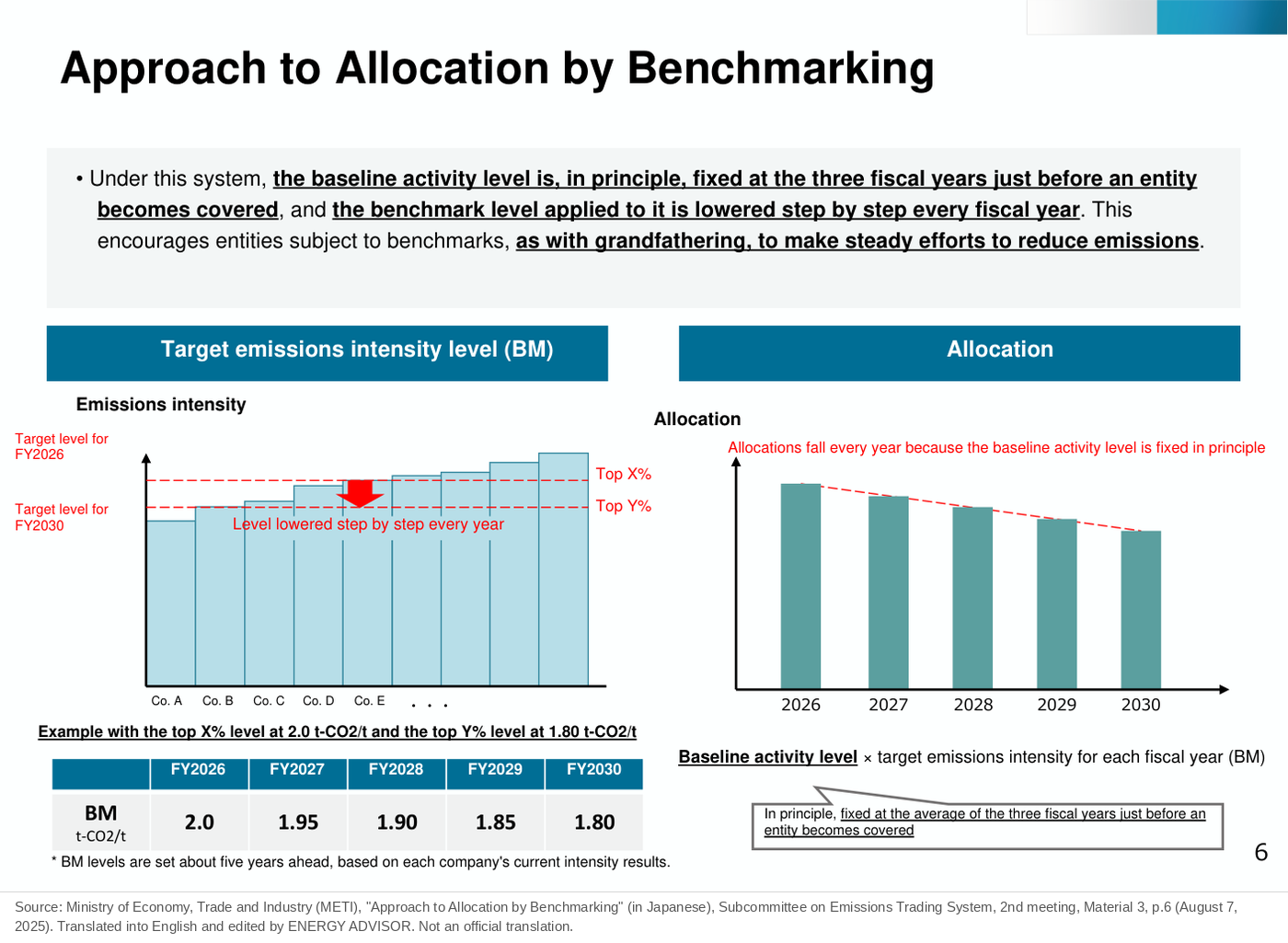
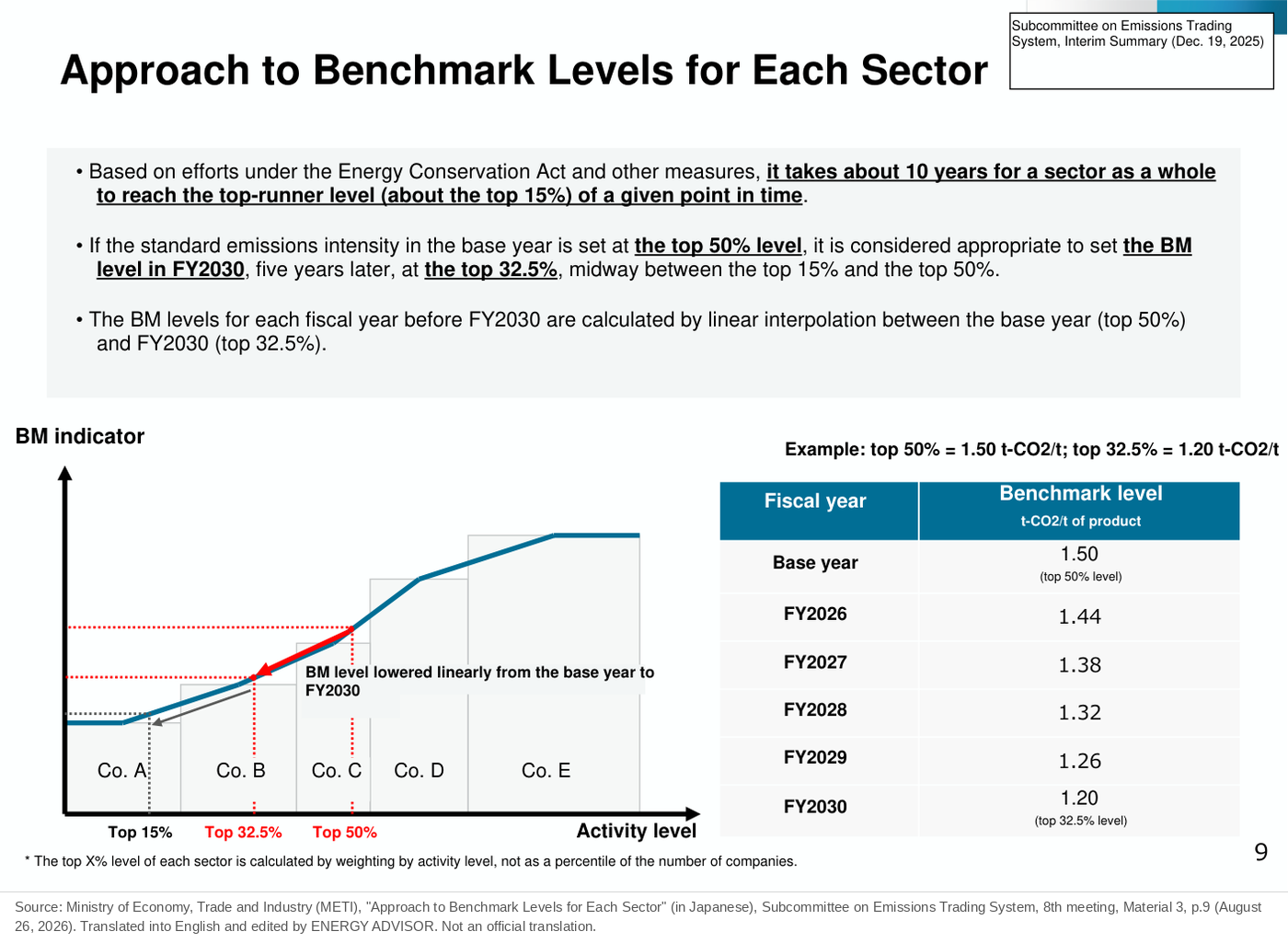
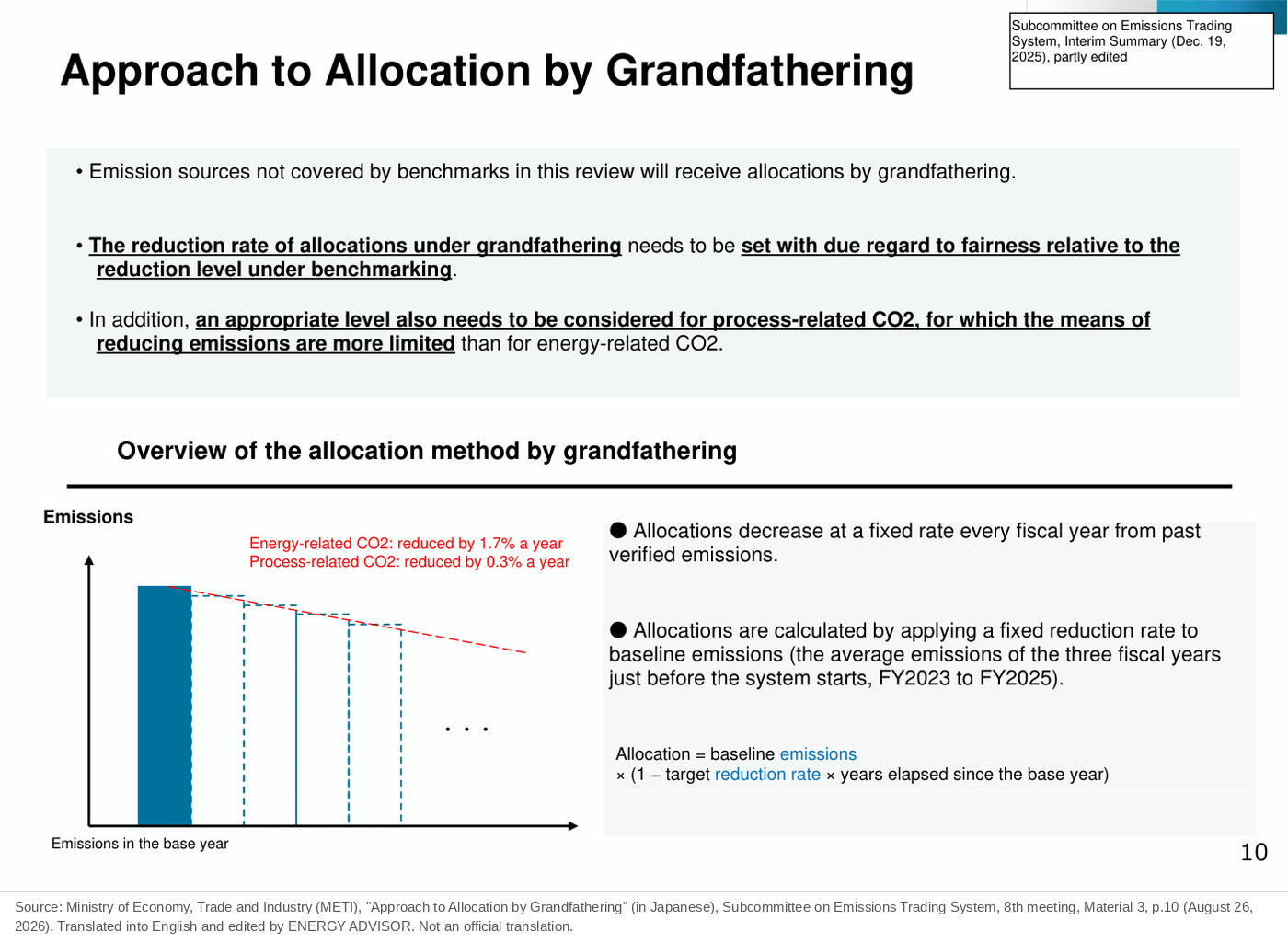
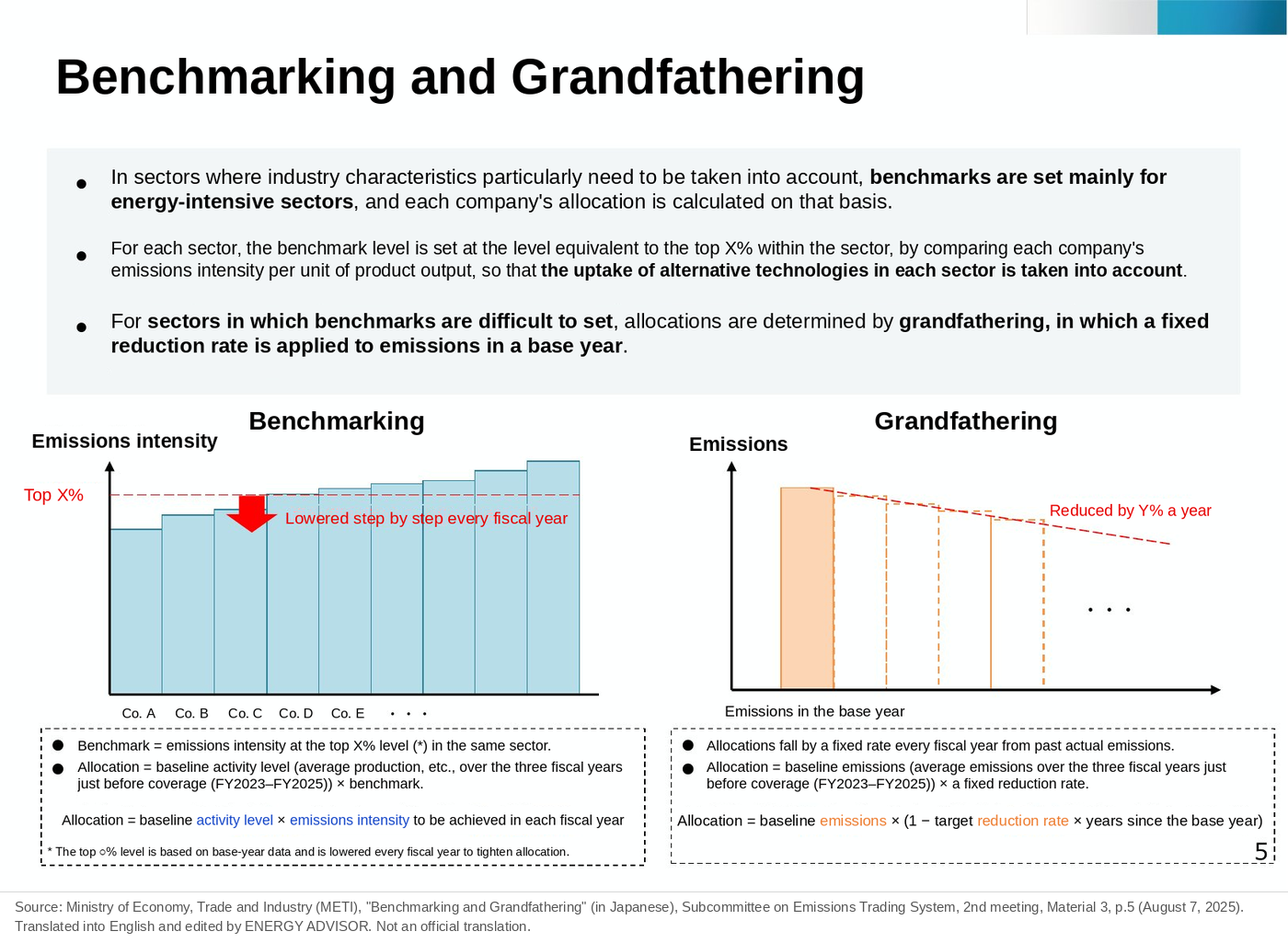
- 2Benchmarking is the basic allocation method (the top 50% within a sector in the base year, and the top 32.5% in FY2030). For sectors where setting a benchmark is difficult, grandfathering is used (reduction rates of 1.7% a year for energy-related CO2 and 0.3% a year for process CO2).
- 3The trading market is scheduled to open around autumn of FY2027 and will be run by the GX Acceleration Agency.
- 4For any amount not surrendered by the deadline, a non-compliance charge of the upper price × 1.1 applies.
What an Emission Allowance Is: A “Right” to Emit CO2
In the GX-ETS (Green Transformation Emissions Trading System), an emission allowance is a “right” to emit CO2 that the government allocates to covered companies. One allowance means the right to emit 1 tonne of CO2. Companies emit CO2 within the allowances allocated to them for each fiscal year, and return allowances equal to their emissions.
In Phase 2 (FY2026–FY2032), covered companies are those whose direct CO2 emissions average 100,000 tonnes or more over the three fiscal years up to the previous fiscal year. About 300 to 400 companies are covered, expected to account for nearly 60% of Japan’s greenhouse gas emissions (Summary report, p.11). These companies receive allowances from the government, in principle free of charge, and use them to manage their own emissions. Through the design of the allowance system, companies gain an incentive to cut emissions, and CO2 reductions are achieved efficiently through the market mechanism.
Allocation Methods: Benchmarking and Grandfathering
Benchmarking as the Basic Method
Benchmarking is a method that sets allocations based on the emissions intensity (emissions per unit of output) of efficient companies in the same sector. It has been judged appropriate to set the benchmark (BM) level for the base year at the top 50% of each sector, and the BM level for FY2030, five years later, at the top 32.5%, the midpoint between the top 15% and the top 50%. Each company’s allocation is calculated by multiplying the benchmark value (emissions intensity) by its baseline activity level (the volume of business, such as production).
Sectors covered by the Working Group on Manufacturing Benchmarks include oil refining, steel, chemicals (petrochemicals, soda, carbon black), pulp and paper, cement, lime production, aluminum, rubber products, flat glass, glass bottles and automobiles, and specific benchmark indicators are being considered for each sector. The power sector is discussed separately by the Working Group on Power-Sector Benchmarks (Summary report, p.6).
Use of Grandfathering
For sectors where benchmarking is difficult to apply, grandfathering is used (baseline emissions × (1 − target reduction rate × number of years elapsed since the baseline)). This method fixes emissions in the three years just before the start of the system as the baseline and applies a set reduction rate from there. The reduction rate is 1.7% a year for energy-related CO2 (CO2 from burning fuel) and 0.3% a year for process CO2 (CO2 released from raw materials in production processes, such as the decomposition of limestone used as a raw material for cement) (8th meeting of the Subcommittee, Material 3, p.10).
Grandfathering is simple to calculate and easy to implement, but it tends to give a relatively weaker incentive to cut emissions.
How Allowances Are Traded and Surrendered
Adjusting Surpluses and Shortfalls Through Market Trading
If a company’s allocated allowances exceed its emissions, it can sell the surplus in the market. Conversely, a company whose allocation falls short can buy the shortfall in the market. This lets a market mechanism work: companies that succeed in cutting emissions can earn a profit, and companies that find cuts difficult can obtain the allowances they need.
The trading market is scheduled to open around autumn of FY2027 and will be run by the GX Acceleration Agency (a body under the jurisdiction of the Ministry of Economy, Trade and Industry that operates the system). The market is not intended for financial investment. At the start, trading will in principle be based on actual compliance needs, and participation by parties other than covered companies will be limited to the minimum necessary (8th meeting of the Subcommittee, Material 3, p.32). Securing market transparency and liquidity allows allowances to be allocated efficiently.
Surrender Deadline and Non-Compliance Charge
Each company is obliged to hold, by January 31 of the following fiscal year, allowances equal to its verified emissions for each fiscal year. If any part of this obligation is unfulfilled, the company is charged a non-compliance charge of the upper price × 1.1 (about ¥4,730 per unfulfilled tonne, assuming the FY2026 upper reference price of ¥4,300). This creates a mechanism that strongly discourages companies from exceeding their emissions.
Because of the surrender mechanism, companies need to manage their emissions strictly throughout the year. In addition, failure to make notifications or report emissions, or making false notifications, can be punished under the GX Promotion Act with a fine of up to ¥500,000 (Article 143, items 1 and 5).
Banking and the Price Stabilization Mechanism
Carrying Over Surplus Allowances
Banking is a mechanism for carrying allowances not used in one fiscal year over to later fiscal years. For the GX-ETS, measures such as limiting banking are to be considered separately, to prevent the price from sticking to the cap because companies’ reduction costs are not properly reflected in the allowance price (7th meeting of the Subcommittee, Material 3, p.13). The materials for the 9th meeting of the Subcommittee (September 2026) also list “measures to make banking appropriate” as one of the issues for consideration (9th meeting of the Subcommittee, Material 3, p.4).
Curbing Volatility Through the Price Stabilization Mechanism
Price stabilization measures have been introduced to prevent sharp rises and falls in the market price of allowances. For FY2026, the upper reference price is ¥4,300/t-CO2 and the adjustment reference price is ¥1,700/t-CO2, and both have been published in a ministerial notification (a formal public announcement by the minister in the Official Gazette). From FY2027 onward, prices will be published in a notification before the start of each fiscal year, at a level that adds a real price increase of 3% and the projected inflation rate to the previous year’s price. The reference values excluding inflation for FY2027 are an upper reference price of ¥4,429 and an adjustment reference price of ¥1,751, and they are not yet final. For FY2030, the outlook is an upper reference price of ¥4,840 and an adjustment reference price of ¥1,913 (in real terms).
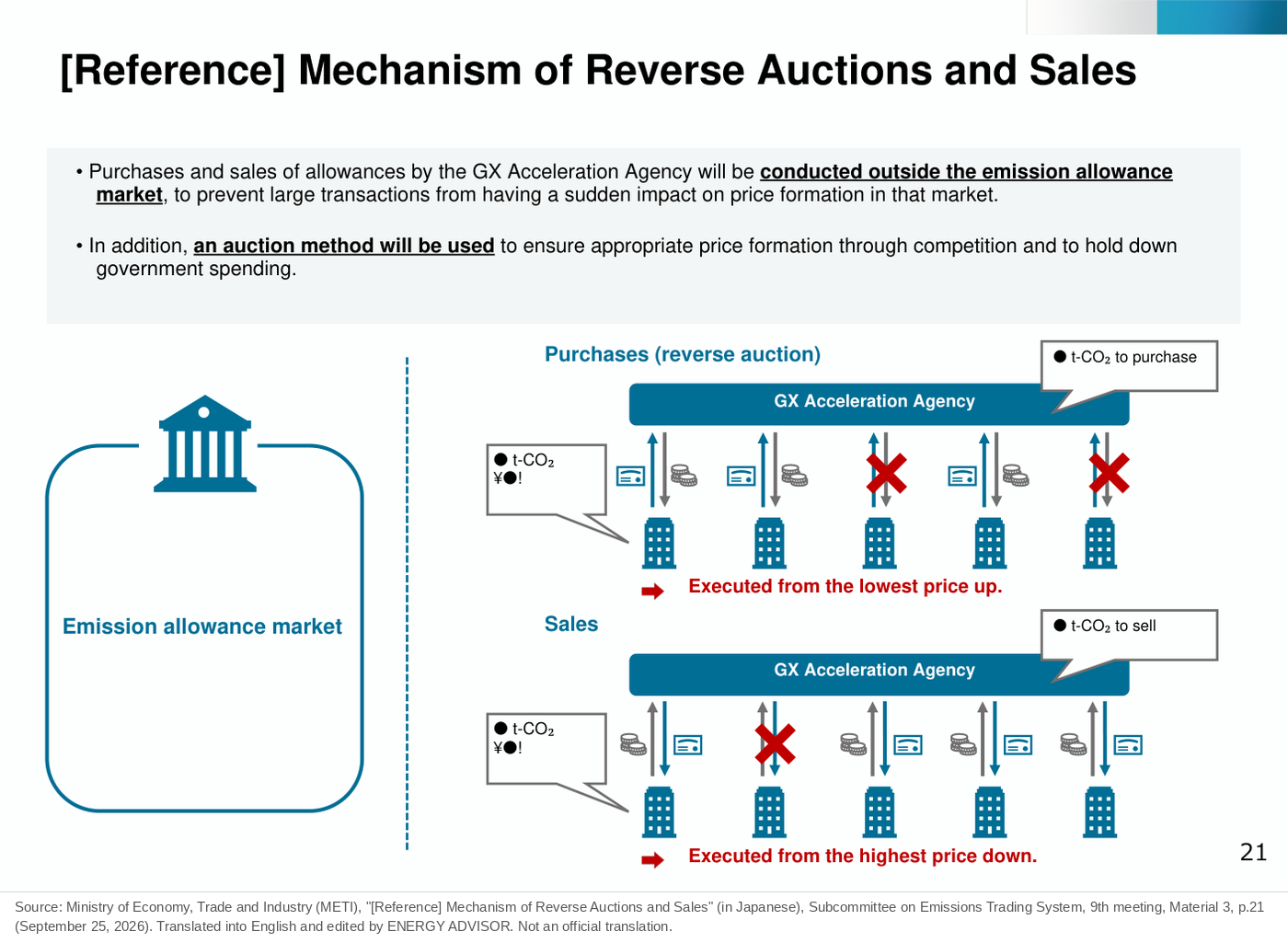
When the market price exceeds the cap, a company that pays the amount of its shortfall multiplied by the upper reference price is deemed to hold that amount of allowances. If the price stays below the floor for a certain period, the GX Acceleration Agency will hold a reverse auction (a tender to buy back allowances), tightening the supply of allowances in circulation to adjust the supply-demand balance. If prices remain low for longer than a certain period, strengthening the allocation criteria will also be considered (Summary report, p.8). Article 04 covers this in detail.
Summary: Understanding How Allowances Work
The GX-ETS allowance system is not a uniform emission reduction order from the government. It is designed to achieve efficient CO2 reductions through the market mechanism. Companies manage their emissions on their own within their allocated allowances, and adjust surpluses and shortfalls through trading in the market.
In Phase 2, allowances are basically allocated free of charge, but in Phase 3 (from FY2033), paid auctions are scheduled to be introduced for power generation companies. The price stabilization measures also give companies predictability for their medium- to long-term business plans.
This article is based on published materials from the Ministry of Economy, Trade and Industry and its Agency for Natural Resources and Energy, the Electricity and Gas Market Surveillance Commission, the Organization for Cross-regional Coordination of Transmission Operators (OCCTO) and other sources. The English translations of figures are by ENERGY ADVISOR and are not official translations. When using this information for decisions, please check the original sources. When we find an error, we correct the article and note the date of the correction.
Sources
- METI, Subcommittee on Emissions Trading System, Summary report (December 19, 2025; the cover title of the PDF is “Interim Summary”) (in Japanese): p.6 (sectors for which benchmark formulas are being considered; Working Group on Power-Sector Benchmarks); p.8 (if the market price stays below the floor for longer than a certain period, strengthening the allocation criteria will be considered along with reverse auctions; obligation to hold allowances by January 31 of the following fiscal year; compliance deemed by paying the upper price × the shortfall; 1.1 times the upper price for unfulfilled amounts); p.11 (about 300 to 400 covered companies; coverage of nearly 60%); pp.31–32 (grandfathering formula; baseline emissions as the average of the three fiscal years just before coverage); p.65 (BM levels: top 50%, top 32.5% in FY2030) (pages were read via a summary and may be off by one). https://www.meti.go.jp/shingikai/sankoshin/sangyo_gijutsu/emissions_trading/pdf/20251219_1.pdf
- METI, Subcommittee on Emissions Trading System, 2nd meeting (August 7, 2025), Material 3 “Methods for Calculating Allocations by Benchmarking and Grandfathering” (in Japanese): p.5 (comparison of the two methods; confirmed from the text in the figure), p.6 (approach to allocation by benchmarking). https://www.meti.go.jp/shingikai/sankoshin/sangyo_gijutsu/emissions_trading/pdf/002_03_00.pdf
- METI, Subcommittee on Emissions Trading System, 8th meeting (August 26, 2026), Material 3 “Detailed Design of the Emission Allowance Market” (in Japanese): p.9 (sector BM levels; linear interpolation before FY2030), p.10 (grandfathering: reductions of 1.7% a year for energy-related CO2 and 0.3% a year for process CO2; source is the Summary report), p.32 (basic approach to market participants: not a market for financial investment) (pages were read via a summary and may be off by one). https://www.meti.go.jp/shingikai/sankoshin/sangyo_gijutsu/emissions_trading/pdf/008_03_00.pdf
- METI, Subcommittee on Emissions Trading System, 7th meeting (December 19, 2025), Material 3 “Levels of the Upper and Lower Prices in the Emissions Trading System (Draft)” (in Japanese): p.13 (outlook for the upper and lower prices; measures such as limiting banking to be considered separately; confirmed from the text in the figure). https://www.meti.go.jp/shingikai/sankoshin/sangyo_gijutsu/emissions_trading/pdf/007_03_00.pdf
- METI, Subcommittee on Emissions Trading System, 9th meeting (September 25, 2026), Material 3 “Measures Related to the Upper and Lower Prices” (in Japanese): p.4 (market to open around autumn of FY2027; “measures to make banking appropriate” among the issues for consideration), p.6 (FY2026 prices published in a notification; FY2027 reference values not final), p.8 (payment at the upper price), p.21 (mechanism of reverse auctions and sales). https://www.meti.go.jp/shingikai/sankoshin/sangyo_gijutsu/emissions_trading/pdf/009_03_00.pdf
- Act on the Promotion of a Smooth Transition to a Decarbonized Growth-Oriented Economic Structure (Act No. 32 of 2023; amended text in force from April 1, 2026; viewed on e-Gov Law Search on October 22, 2026), Article 143, item 1 (failure to make the notification under Article 33(1) or making a false notification) and item 5 (failure to report emissions under Article 35(1) or making a false report): fine of up to ¥500,000 (in Japanese). https://laws.e-gov.go.jp/law/505AC0000000032