Japan’s carbon pricing strategy consists of two pillars: the GX Emissions Trading System (GX-ETS) and the carbon levy. The GX-ETS handles allowance trading among large emitters, while the carbon levy is a mechanism that asks for a broad contribution at the fossil fuel supply stage.
This article explains the carbon levy scheduled to be introduced from FY2028: its basic mechanism, how it differs from the GX-ETS, the introduction schedule and the effect on companies.
(Note for readers outside Japan) Japan’s fiscal year (FY) runs from April to March; FY2028 is April 2028–March 2029.
Key points
- 1Its official name is the fossil fuel levy (Article 11 of the GX Promotion Act as enacted). It is commonly called the “carbon levy.”
- 2It will be introduced from FY2028 (Reiwa 10). A levy based on CO2 emissions will be collected from fossil fuel importers and others.
- 3The GX-ETS (from FY2026, covering large direct emitters) and the fossil fuel levy (from FY2028, collected upstream) form the two pillars of carbon pricing.
- 4The revenue will be used to redeem the Japan Climate Transition Bonds and so goes to decarbonization investment.
What the Carbon Levy Is: A Charge on Fossil Fuels
The carbon levy, officially called the fossil fuel levy, is a system that imposes a levy based on CO2 emissions when fossil fuels are imported, among other points. It is a measure based on Article 11 of Japan’s GX Promotion Act (Act on the Promotion of a Smooth Transition to a Decarbonized Growth-Oriented Economic Structure), and it will be introduced from FY2028 (Reiwa 10). The text as enacted states that, from FY2028, the Minister of Economy, Trade and Industry will collect the levy for each set period from fossil fuel extractors and importers (businesses that extract or import fossil fuels), and that fossil fuel extractors and importers must pay the levy (Article 11). The amended text in force from April 2026 contains the same provision in Article 11.
(Note) Legally, the “levy” is not a tax. It is a charge collected under the GX Promotion Act. However, because it asks for a broad contribution in proportion to the volume of fossil fuels, it is similar in character to carbon taxes in other countries.
It applies to importers and extractors of fossil fuels such as coal, oil and natural gas. The charge falls on the upstream part of the energy supply chain, such as oil wholesalers, gas companies and trading companies. It will be volume-based according to the CO2 emission factor of each fossil fuel, so the more a fuel emits, the heavier the charge.
In the existing energy tax system, the Petroleum and Coal Tax (an existing tax on the import or extraction of crude oil, petroleum products, natural gas and coal) has been the general one. The details of the system design, including the relationship between the carbon levy and existing taxes, will be decided in future deliberations.
Differences from the GX-ETS: Coverage, Mechanism and Purpose
Under the GX Promotion Act, the carbon levy and the GX-ETS are designed as the two pillars of carbon pricing. The two may look similar, but they have entirely different mechanisms and roles.
Features of the GX-ETS
The GX-ETS is an emissions trading system. It allocates emission allowances to large emitters and allows trading within those allowances. It covers companies whose direct CO2 emissions (Scope 1) average 100,000 tonnes or more over the three fiscal years up to the previous fiscal year. About 300 to 400 companies are covered, expected to account for nearly 60% of Japan’s greenhouse gas emissions (Summary report, p.11).
In the GX-ETS, a company that exceeds its allocated allowances must buy allowances from other companies. Companies that succeed in cutting emissions can sell their surplus allowances, so the incentive to cut CO2 works through the market mechanism.
Contrast with the Carbon Levy
The carbon levy, on the other hand, asks for a broad, thin contribution at the fossil fuel supply stage. Whereas the GX-ETS focuses on large direct emitters, the carbon levy covers a wider range. Because it applies to fossil fuel suppliers such as oil wholesalers and gas companies, its effect spreads indirectly to many more downstream companies.
The mechanisms are also fundamentally different. The GX-ETS is a market-based approach through trading of allowances, while the carbon levy aims to secure revenue reliably through a volume-based charge.
Design perspective: the GX-ETS emphasizes incentives that encourage large companies to cut emissions, while the carbon levy is characterized by securing revenue and spreading the burden across a wide range of companies.
Introduction Schedule and Use of Revenue
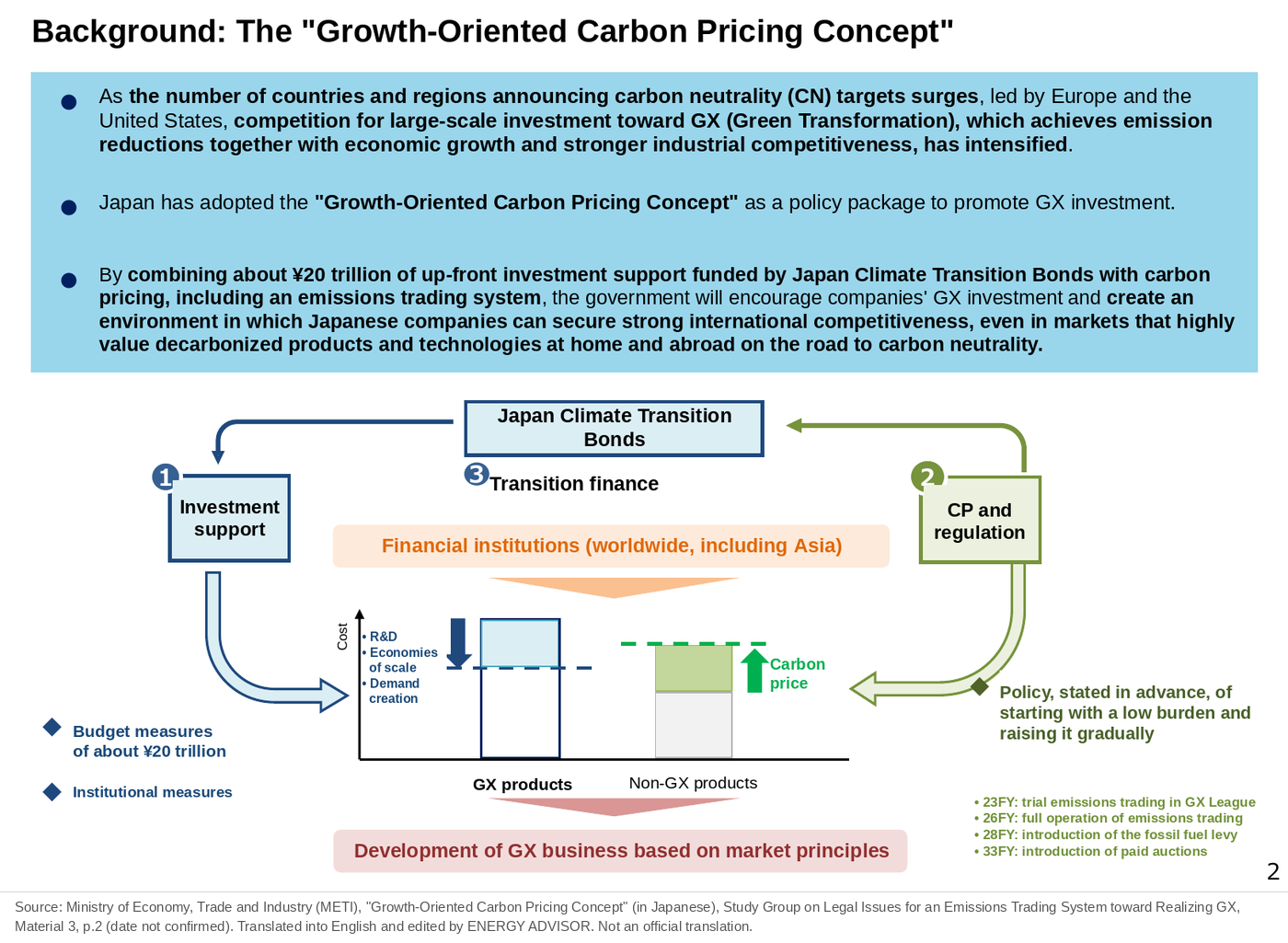
The carbon levy is scheduled to be introduced from FY2028. The policy has been stated in advance that, rather than starting at a high level all at once, it will start with a low burden and be raised gradually (Study Group on Legal Issues, Material 3, p.2). This step-by-step approach gives companies time to respond through management decisions, introduction of new technologies and switching to low-carbon energy.
The revenue is to be used for purposes such as redeeming the Japan Climate Transition Bonds (bonds the government issues to fund decarbonization investment; their legal name is the Decarbonized Growth-Oriented Economic Structure Transition Bonds) (GX Promotion Act, Article 8(2)). The bonds may be issued only in each fiscal year from FY2023 to FY2032 (Reiwa 5 to 14) (same Act, Article 7), and they are used for about ¥20 trillion of up-front investment support over 10 years (Summary report, p.6; Study Group on Legal Issues, Material 3, p.2). In other words, it is a mechanism that uses the revenue from charges on fossil fuels for investment toward carbon neutrality.
Effect on Companies and Adjustment for the Double Burden
A concern with introducing both the GX-ETS and the carbon levy is the problem of a double burden. A company covered by the GX-ETS that already has an emission reduction obligation will also bear the carbon levy. As of October 2026, the mechanism for adjusting the double burden has not been confirmed in primary sources.
The effect on companies in general will be indirect, through higher costs of fossil fuels. As the purchase costs of oil and gas rise, they may eventually be passed through to product prices and service charges.
International Comparison: Carbon Pricing Trends Worldwide
Carbon pricing is not a measure limited to Japan. Some countries in Europe have already introduced carbon taxes.
The European Union (EU) has introduced the Carbon Border Adjustment Mechanism (CBAM: a mechanism that imposes on the CO2 embedded in imported goods a cost equivalent to that inside the EU), and it has applied in full since January 2026. For this reason, responding to carbon pricing has become essential for exporters to the EU to stay competitive.
Japan’s carbon levy and GX-ETS have been designed with reference to earlier examples in Europe while matching the realities of the Japanese economy.
Summary: The Two-Pillar Structure of Carbon Pricing
The carbon levy and the GX-ETS are the two pillars of Japan’s carbon pricing strategy. The GX-ETS gives large emitters an incentive to cut emissions, and the carbon levy promotes the shift of the whole economy to carbon neutrality through a broad charge at the fossil fuel supply stage.
Companies need to start preparing now for the introduction in FY2028. At the same time, until the details of the double-burden adjustment are decided, it is important to check policy developments regularly.
This article is based on published materials from the Ministry of Economy, Trade and Industry and its Agency for Natural Resources and Energy, the Electricity and Gas Market Surveillance Commission, the Organization for Cross-regional Coordination of Transmission Operators (OCCTO) and other sources. The English translations of figures are by ENERGY ADVISOR and are not official translations. When using this information for decisions, please check the original sources. When we find an error, we correct the article and note the date of the correction.
Sources
- METI, Study Group on Legal Issues for an Emissions Trading System toward Realizing GX, Material 3, p.2 “Growth-Oriented Carbon Pricing Concept” (about ¥20 trillion of up-front investment support; “the policy of starting with a low burden and raising it gradually is stated in advance”; introduction of the fossil fuel levy in FY2028; confirmed from the text in the figure of the original post; the PDF could not be opened on October 22, 2026) (in Japanese). https://www.meti.go.jp/shingikai/sankoshin/sangyo_gijutsu/emissions_trading/pdf/001_03_00_gx.pdf
- House of Representatives, “List of Enacted Laws”: Act on the Promotion of a Smooth Transition to a Decarbonized Growth-Oriented Economic Structure (Act No. 32 of 2023, text as enacted), Article 7 (issuance of the Decarbonized Growth-Oriented Economic Structure Transition Bonds, FY2023–FY2032), Article 8(2) (fossil fuel levy and specified operator charge used to redeem the bonds), Article 11 (fossil fuel levy: collected by the Minister of Economy, Trade and Industry from fossil fuel extractors and importers from FY2028) (in Japanese). https://www.shugiin.go.jp/internet/itdb_housei.nsf/html/housei/21120230519032.htm
- METI, Subcommittee on Emissions Trading System, Summary report (December 19, 2025; the cover title of the PDF is “Interim Summary”) (in Japanese): p.6 (up-front investment support using the “GX Economic Transition Bonds,” about ¥20 trillion over 10 years; fossil fuel levy from FY2028), p.8 (GX-ETS coverage: three-fiscal-year average of 100,000 tonnes or more), p.11 (about 300 to 400 covered companies; coverage of nearly 60%) (pages were read via a summary and may be off by one). https://www.meti.go.jp/shingikai/sankoshin/sangyo_gijutsu/emissions_trading/pdf/20251219_1.pdf
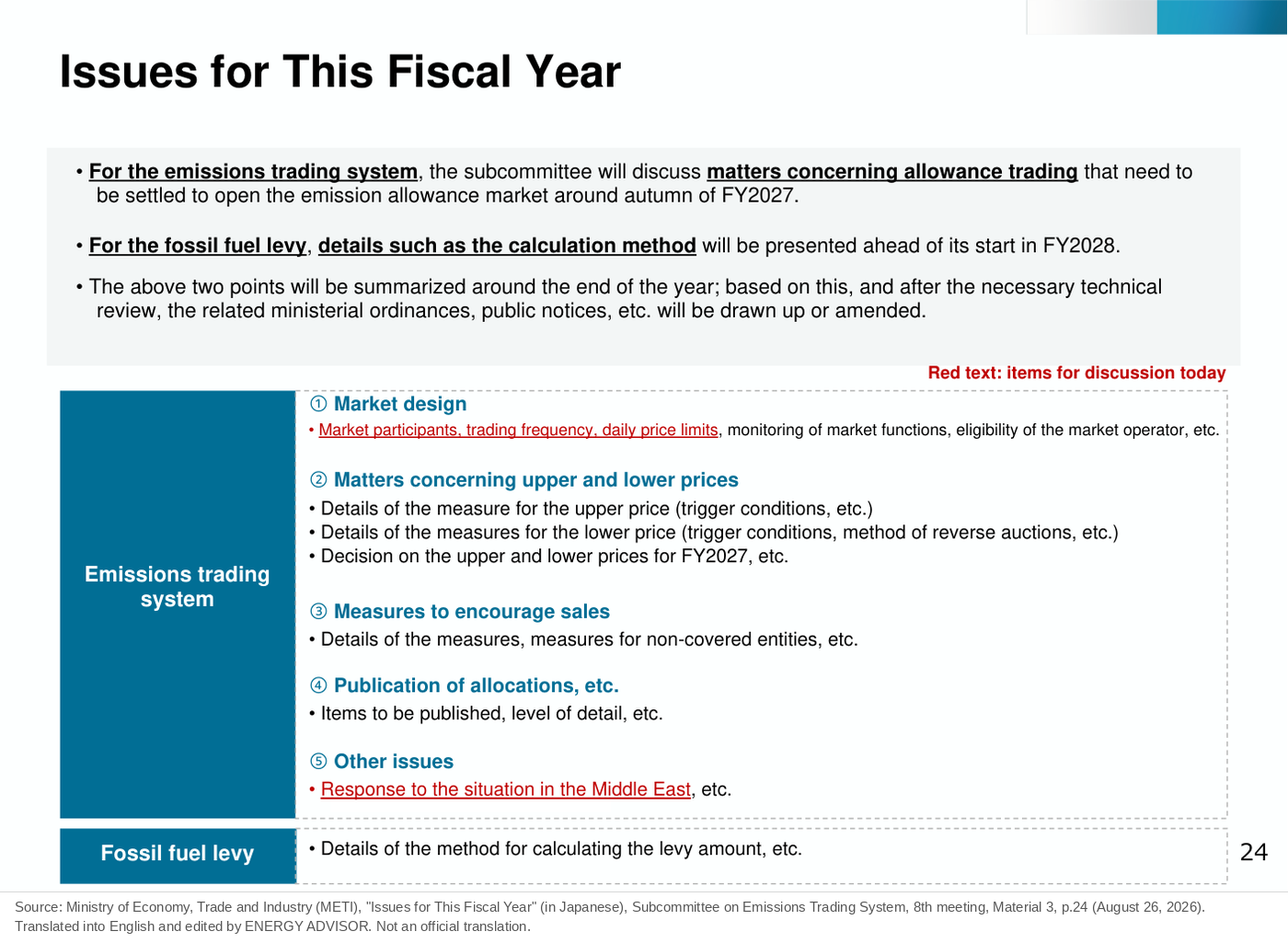
- METI, Subcommittee on Emissions Trading System, 8th meeting (August 26, 2026), Material 3 “Detailed Design of the Emission Allowance Market” (in Japanese): p.24 (issues for this fiscal year: market opening around autumn of FY2027 and preparations for introducing the fossil fuel levy in FY2028). https://www.meti.go.jp/shingikai/sankoshin/sangyo_gijutsu/emissions_trading/pdf/008_03_00.pdf
- European Commission (Directorate-General for Taxation and Customs Union), “Carbon Border Adjustment Mechanism” (transitional period 2023–2025; definitive period from January 1, 2026). https://taxation-customs.ec.europa.eu/carbon-border-adjustment-mechanism_en
- Act on the Promotion of a Smooth Transition to a Decarbonized Growth-Oriented Economic Structure (Act No. 32 of 2023; amended text in force from April 1, 2026; viewed on e-Gov Law Search on October 22, 2026), Article 11 (fossil fuel levy: collected by the Minister of Economy, Trade and Industry from fossil fuel extractors and importers from FY2028), Article 15 (reduction of the fossil fuel levy, etc.) (in Japanese). https://laws.e-gov.go.jp/law/505AC0000000032