The GX Emissions Trading System (GX-ETS, Green Transformation Emissions Trading System) started in FY2023 as an important measure toward carbon neutrality in Japan. For the power industry, its impact will become more serious in stages. In particular, in Phase 2, which got fully underway in FY2026, power generation companies have newly been brought in as covered companies, and the cost structure of thermal power is about to change significantly.
This article sets out how the GX-ETS affects power generation companies and retail electricity suppliers, and how it changes management strategies across the power industry. It explains the issues and responses at the implementation stage, from the move to paid allowances to the spread of price effects.
(Note for readers outside Japan) Japan’s fiscal year (FY) runs from April to March; FY2026 is April 2026–March 2027. Since full retail market liberalization in 2016, generation, transmission and distribution, and retail have been separate businesses in Japan. Power generation companies produce and sell electricity. Retail electricity suppliers sell electricity to households and businesses. One of the places where the two trade is the day-ahead market (spot market) of the Japan Electric Power Exchange (JEPX), Japan’s only wholesale power exchange. In the day-ahead market, electricity for delivery the next day is traded the day before. The capacity market is a market that pays for securing future generating capability (kW). The Supply and Demand Balancing Market (balancing market) is a market for trading balancing capacity that matches supply and demand on a timescale of seconds to minutes.
Key points
- 1In Phase 2 of the GX-ETS (from FY2026), power generation companies with direct emissions of 100,000 tonnes or more are subject to the obligation. In Phase 2, allowances are in principle allocated free of charge.
- 2From Phase 3 (from FY2033), paid auctions will be introduced for the power sector.
- 3Higher costs of thermal power spread to retailers through the wholesale market. Emission factors differ greatly between coal-fired and LNG-fired plants, so the degree of impact differs.
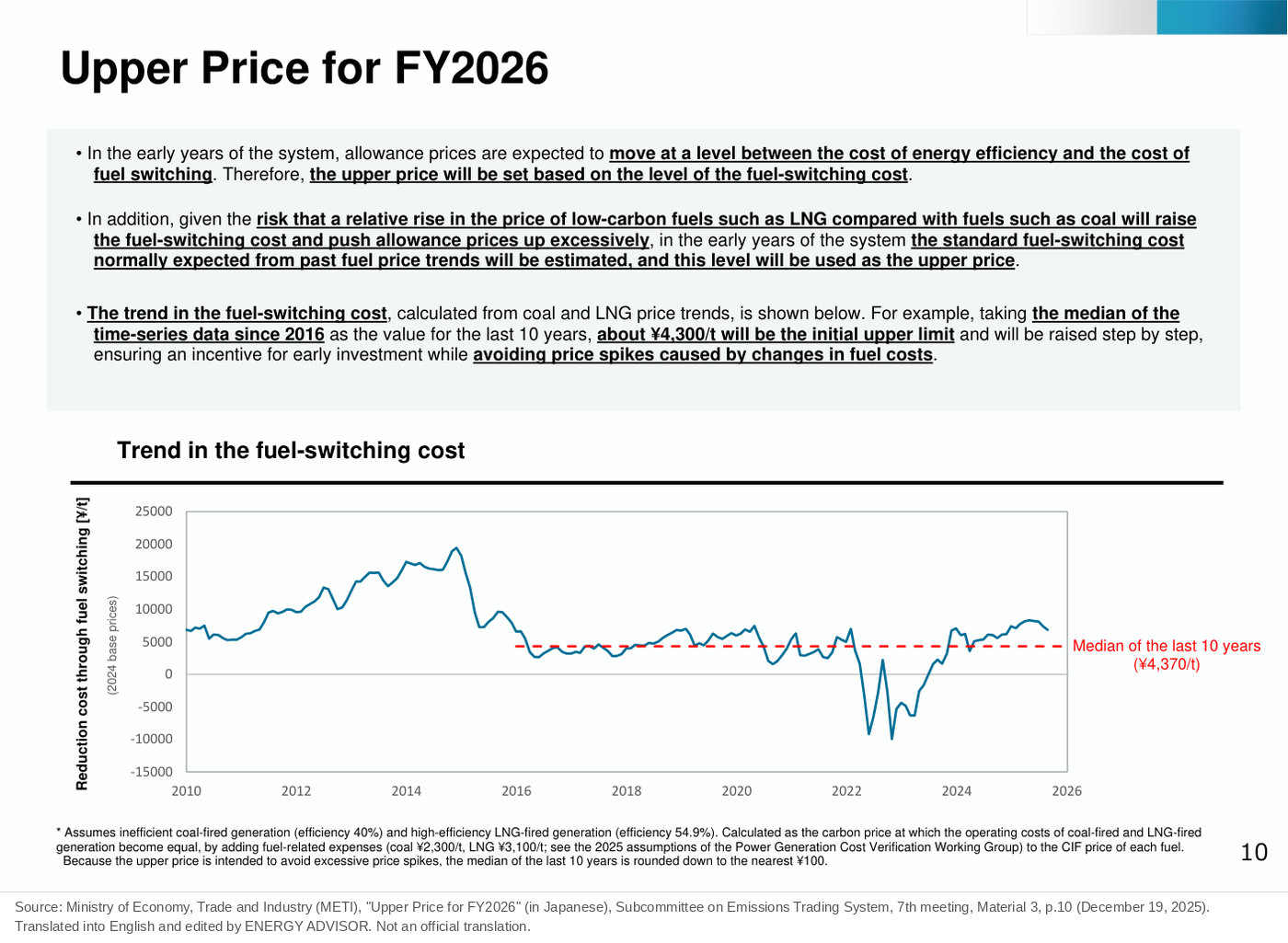
- 4For FY2026, the upper reference price is ¥4,300/t-CO2 and the adjustment reference price is ¥1,700/t-CO2.
The GX-ETS and the Power Industry: Coverage and Scope of Impact
The GX-ETS is Japan’s emissions trading system, introduced in stages since FY2023. The system as a whole is divided into three phases, and the range of covered companies and the method of allocating allowances expand over time.
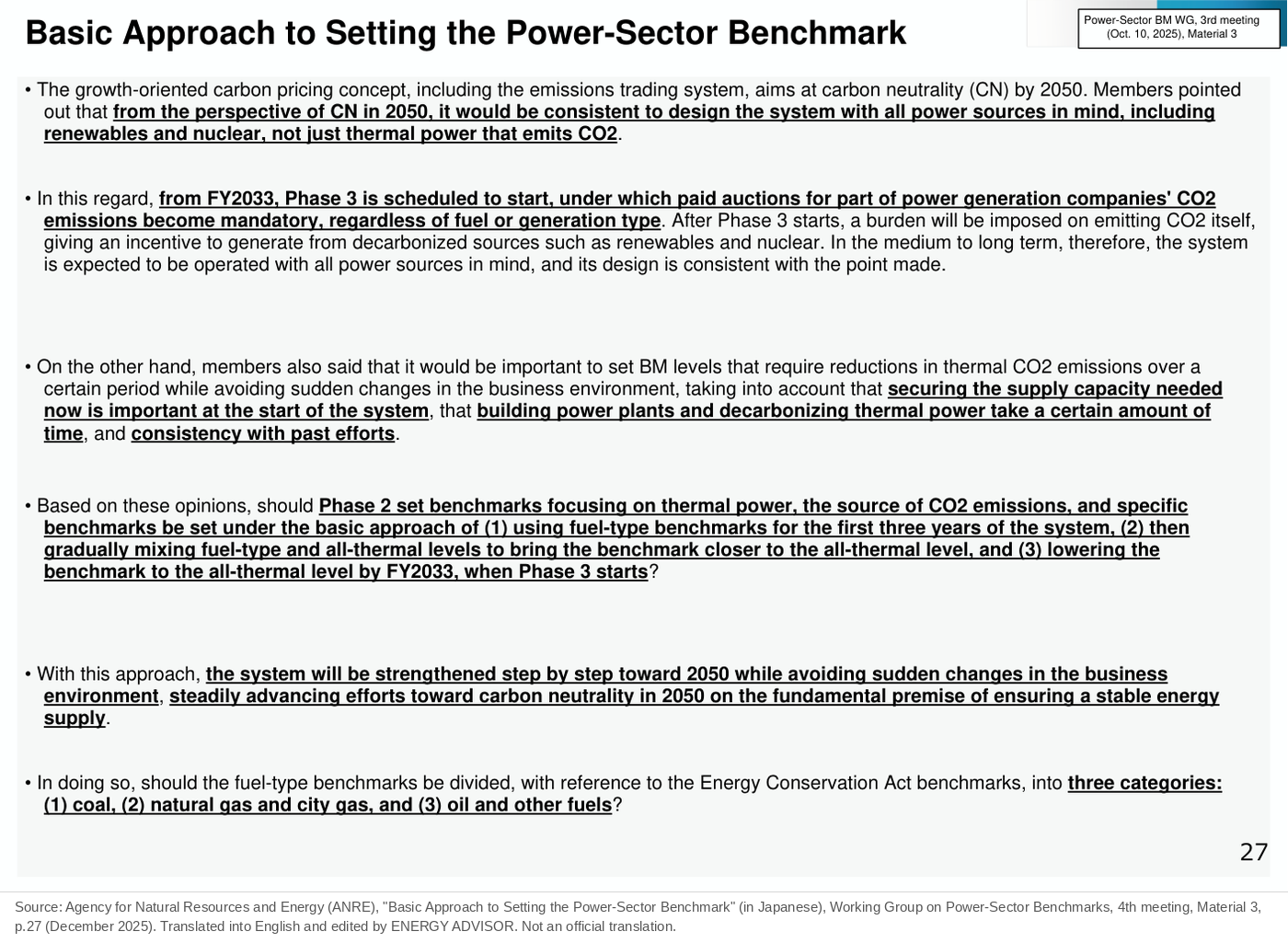
Phase 1 (FY2023–FY2025) was a trial stage in which companies supporting the GX League took part voluntarily and worked toward emission reduction targets. In Phase 2 (FY2026–FY2032), on the other hand, power generation companies whose direct CO2 emissions average 100,000 tonnes or more over the three fiscal years up to the previous fiscal year have been brought in as obligated entities. With this, the power industry has become an industry directly affected by the emissions trading system.
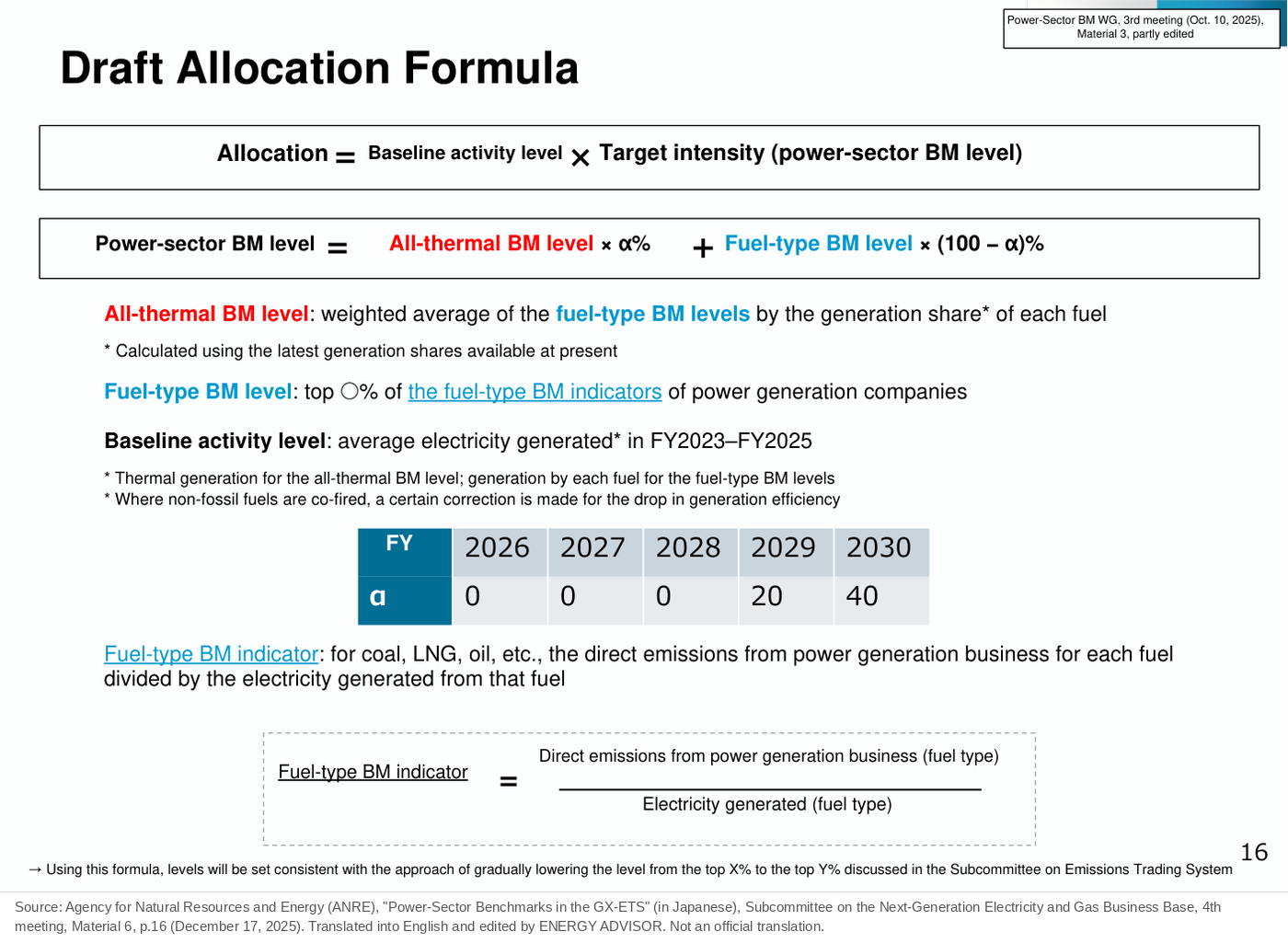
An important point is that, in Phase 2, allowances are in principle allocated to power generation companies free of charge. For the power sector, the Working Group on Power-Sector Benchmarks is considering the formula for the benchmark (an allocation method that uses the emission level of efficient generation as the standard). At the 4th meeting of the Working Group in December 2025, a draft formula combining an all-thermal benchmark with benchmarks for each fuel type was presented, with the weight of the all-thermal benchmark set at 0%, 0%, 0%, 20% and 40% for FY2026–FY2030 (4th meeting of the Working Group on Power-Sector Benchmarks, Material 3, p.29). In Phase 3 (FY2033 onward), by contrast, paid auctions are scheduled to be introduced for power generation companies. Under the GX Promotion Act as enacted, from FY2033 (Reiwa 15) the Minister of Economy, Trade and Industry allocates allowances, for a fee or free of charge, to specified operators (certain power generation companies defined by the Act) (Article 15), collects a specified operator charge (the charge these companies pay for allowances allocated for a fee) (Article 16), and sets the price of paid allowances by tender (Article 17). In the amended text in force from April 2026, the same provisions are in Articles 27 to 29. Because this greatly affects long-term business plans, it is the point power generation companies are watching most closely.
Impact on Power Generation Companies: Changes in the Cost Structure of Thermal Power
For power generation companies, the most important point is how the cost structure of thermal power will change. At present, most of the cost consists of fuel costs (coal, LNG, oil) and O&M costs, but as allowances become paid, the cost of buying allowances will be added.
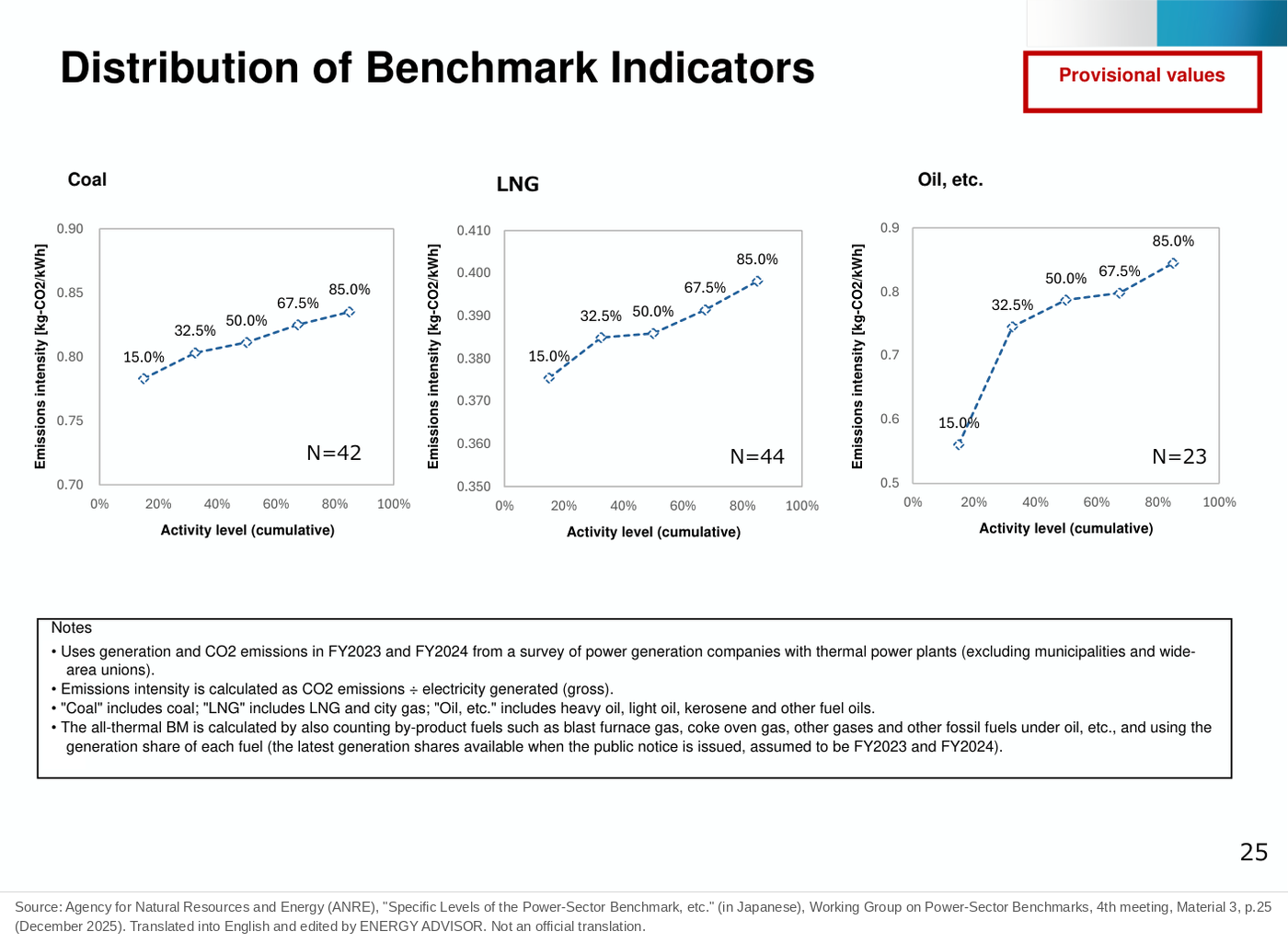
The cost of allowances is directly linked to the size of each plant type’s emission factor (CO2 emissions per unit of generation). Because coal-fired plants emit more CO2 than LNG-fired plants to produce the same amount of electricity, the cost of allowances per unit of generation is also larger. Materials of the Working Group on Power-Sector Benchmarks also show that the distribution of emissions intensity differs greatly by fuel type (4th meeting of the Working Group on Power-Sector Benchmarks, Material 3, p.25; the figures are provisional values). The FY2026 allowance prices, under their official names, are an upper reference price of ¥4,300/t-CO2 and an adjustment reference price of ¥1,700/t-CO2. The larger the annual generation, the greater the impact on business. From FY2027 onward, prices will be raised step by step to a level that adds a real price increase of 3% plus the projected inflation rate, and the upper reference price is expected to rise to ¥4,840 by FY2030 (in real terms; the nominal price for FY2027 had not been published as of October 2026).
In practice, even companies receiving free allocation in Phase 2 need to start reviewing their business structures now, ahead of the paid-auction stage from FY2033.
Spread to Retail Electricity Suppliers and Impact on Electricity Prices
Higher allowance costs for power generation companies spread to retail electricity suppliers through the day-ahead market of JEPX. If generation costs rise, power generation companies have no choice but to raise wholesale prices, and as a result the procurement costs of retailers increase.
In the EU emissions trading system (EU-ETS), full paid allocation for the power sector (Phase 3, from 2013) has been introduced. If generation costs rise, the effect spreads to retailers through wholesale prices, so retailers need to review their procurement portfolios.
Particularly important is retailers’ procurement strategy. As the cost of buying electricity from thermal power rises, the value of electricity from renewable energy and nuclear power, which are relatively “zero-emission sources,” increases. Here the relationship with non-fossil certificates also needs to be sorted out. A non-fossil certificate is a certificate of the environmental attributes of electricity from renewable and nuclear sources, and it is a system separate from GX-ETS allowances (articles 11 and 22).
For retailers, the current priority issues are reducing dependence on thermal power and securing non-fossil sources. Renewable procurement through power purchase agreements (PPAs: contracts in which a generator and a customer or other party agree to buy and sell electricity over a long term) and wider use of nuclear power are important options.
Responses and Strategies Required of the Power Industry
Responding to the GX-ETS requires different strategies for power generation companies and retailers.
For power generation companies, three responses are important. First, reviewing the thermal power portfolio. A shift in emphasis to LNG-fired plants with lower emission factors, or drawing up phased retirement plans, is needed. Second, accelerating investment in renewable energy and nuclear power. To prepare for the paid-auction stage from FY2033, the business structure needs to be transformed starting now. Third, maintaining cost competitiveness in the capacity market and the balancing market. Offer strategies that assume allowance costs need to be developed.
The response of retailers is equally urgent. Gradually reducing the share of thermal power bought in the wholesale market, and expanding contracts for renewables and on-site generation (generation facilities placed on the customer’s premises), lead to maintaining competitiveness. At the same time, a strategy for raising electricity prices to customers is also needed. Whether retailers can properly explain the cost increases from responding to the GX-ETS through transparent disclosure is directly linked to maintaining customer satisfaction.
In addition, both need to watch related policy developments closely. The system design may continue to change, including the setting of upper and lower allowance prices, the details of the timing of paid auctions, and the relationship with the Carbon Border Adjustment Mechanism (CBAM).
Summary: How the GX-ETS Changes the Structure of the Power Industry
With the start of Phase 2 of the GX-ETS, Japan’s power industry has entered a period of structural transformation. For power generation companies, the cost of buying allowances is added as a business cost, which works in the direction of lowering the relative competitiveness of thermal power. For retailers too, procurement costs are expected to increase through higher prices of thermal power in the wholesale market.
This article is based on published materials from the Ministry of Economy, Trade and Industry and its Agency for Natural Resources and Energy, the Electricity and Gas Market Surveillance Commission, the Organization for Cross-regional Coordination of Transmission Operators (OCCTO) and other sources. The English translations of figures are by ENERGY ADVISOR and are not official translations. When using this information for decisions, please check the original sources. When we find an error, we correct the article and note the date of the correction.
Sources
- METI, Subcommittee on Emissions Trading System, Summary report (December 19, 2025; the cover title of the PDF is “Interim Summary”) (in Japanese): p.6 (Working Group on Power-Sector Benchmarks considers the benchmark formula for the power sector), pp.6–7 (paid auctions for power generation companies from FY2033), p.8 (three-fiscal-year average of 100,000 tonnes or more) (pages were read via a summary and may be off by one). https://www.meti.go.jp/shingikai/sankoshin/sangyo_gijutsu/emissions_trading/pdf/20251219_1.pdf
- Agency for Natural Resources and Energy (ANRE), Working Group on Power-Sector Benchmarks, 4th meeting (December 8, 2025), Material 3 “Specific Levels of the Power-Sector Benchmark” (in Japanese): p.25 (distribution of emissions intensity by fuel type; provisional values), p.27 (Phase 3, in which paid auctions become mandatory for part of power generation companies’ CO2 emissions from FY2033), p.29 (draft allocation formula; weight α of the all-thermal benchmark) (pages were read via a summary and may be off by one). https://www.meti.go.jp/shingikai/sankoshin/sangyo_gijutsu/emissions_trading/power_generation_benchmark/pdf/004_03_00.pdf
- House of Representatives, “List of Enacted Laws”: Act on the Promotion of a Smooth Transition to a Decarbonized Growth-Oriented Economic Structure (Act No. 32 of 2023, text as enacted), Articles 15 to 17 (in Japanese). https://www.shugiin.go.jp/internet/itdb_housei.nsf/html/housei/21120230519032.htm
- METI, Subcommittee on Emissions Trading System, 9th meeting (September 25, 2026), Material 3 “Measures Related to the Upper and Lower Prices” (in Japanese): p.5 (government auctions from FY2033), p.6 (FY2026 prices published in a notification). https://www.meti.go.jp/shingikai/sankoshin/sangyo_gijutsu/emissions_trading/pdf/009_03_00.pdf
- METI, Subcommittee on Emissions Trading System, 7th meeting (December 19, 2025), Material 3 “Levels of the Upper and Lower Prices in the Emissions Trading System (Draft)” (in Japanese): p.10 (history of the fuel-switching cost: the carbon price at which the operating costs of inefficient coal-fired and high-efficiency LNG-fired plants become equal), p.13. https://www.meti.go.jp/shingikai/sankoshin/sangyo_gijutsu/emissions_trading/pdf/007_03_00.pdf
- METI, Study Group on Legal Issues for an Emissions Trading System toward Realizing GX, Material 3, p.6 “Image of the Step-by-Step Development of the Emissions Trading System” (in Japanese). https://www.meti.go.jp/shingikai/sankoshin/sangyo_gijutsu/emissions_trading/pdf/001_03_00_gx.pdf
- Act on the Promotion of a Smooth Transition to a Decarbonized Growth-Oriented Economic Structure (Act No. 32 of 2023; amended text in force from April 1, 2026; viewed on e-Gov Law Search on October 22, 2026), Article 27 (allocation of specified operator allowances, for a fee or free of charge, from FY2033), Article 28 (specified operator charge), Article 29 (allocation recipients and unit prices of paid allocation decided by tender), Article 8(2) (fossil fuel levy and specified operator charge used to redeem the transition bonds) (in Japanese). https://laws.e-gov.go.jp/law/505AC0000000032