The European Union’s EU-ETS, launched in 2005, is the world’s largest and oldest emissions trading system, and it has greatly influenced the design of Japan’s GX Emissions Trading System (GX-ETS). The lessons learned through 20 years of operation are a valuable reference for latecomer countries.
This article gives an overview of the history and current state of the EU-ETS and compares it with the GX-ETS, which entered full operation in FY2026. Understanding the differences between the two systems shows the future direction of Japan’s emissions trading system.
(Note for readers outside Japan) Japan’s fiscal year (FY) runs from April to March; FY2026 is April 2026–March 2027.
Key points
- 1The EU-ETS, launched in 2005, is the world’s oldest and largest emissions trading system. It is now in Phase 4 (2021–2030).
- 2The GX-ETS, Japan’s version, entered full operation in FY2026. It has learned from the EU-ETS experience how to deal with over-allocation and price volatility.
- 3Through CBAM, the EU-ETS passes carbon costs on to imported goods too, and its global influence is growing.
What the EU-ETS Is: The World’s Largest Emissions Trading System
In 2005, the European Union (EU) launched the EU Emissions Trading System (EU-ETS). It now functions as the largest emissions trading system in the world and has become an international benchmark for greenhouse gas reduction policies. The 20 years of lessons from the EU-ETS have also been built into the design of Japan’s emissions trading system (GX-ETS), which entered full operation in FY2026.
The EU-ETS covers emissions from power and heat generation, industrial manufacturing processes and aviation, and from 2024 it also covers maritime transport. It covers about 40% of the EU’s greenhouse gas emissions (European Commission). A wide range of sectors take part, from basic industries such as power plants, steelworks and cement plants to aviation and shipping.
20 Years of the EU-ETS: Evolution by Phase and Lessons
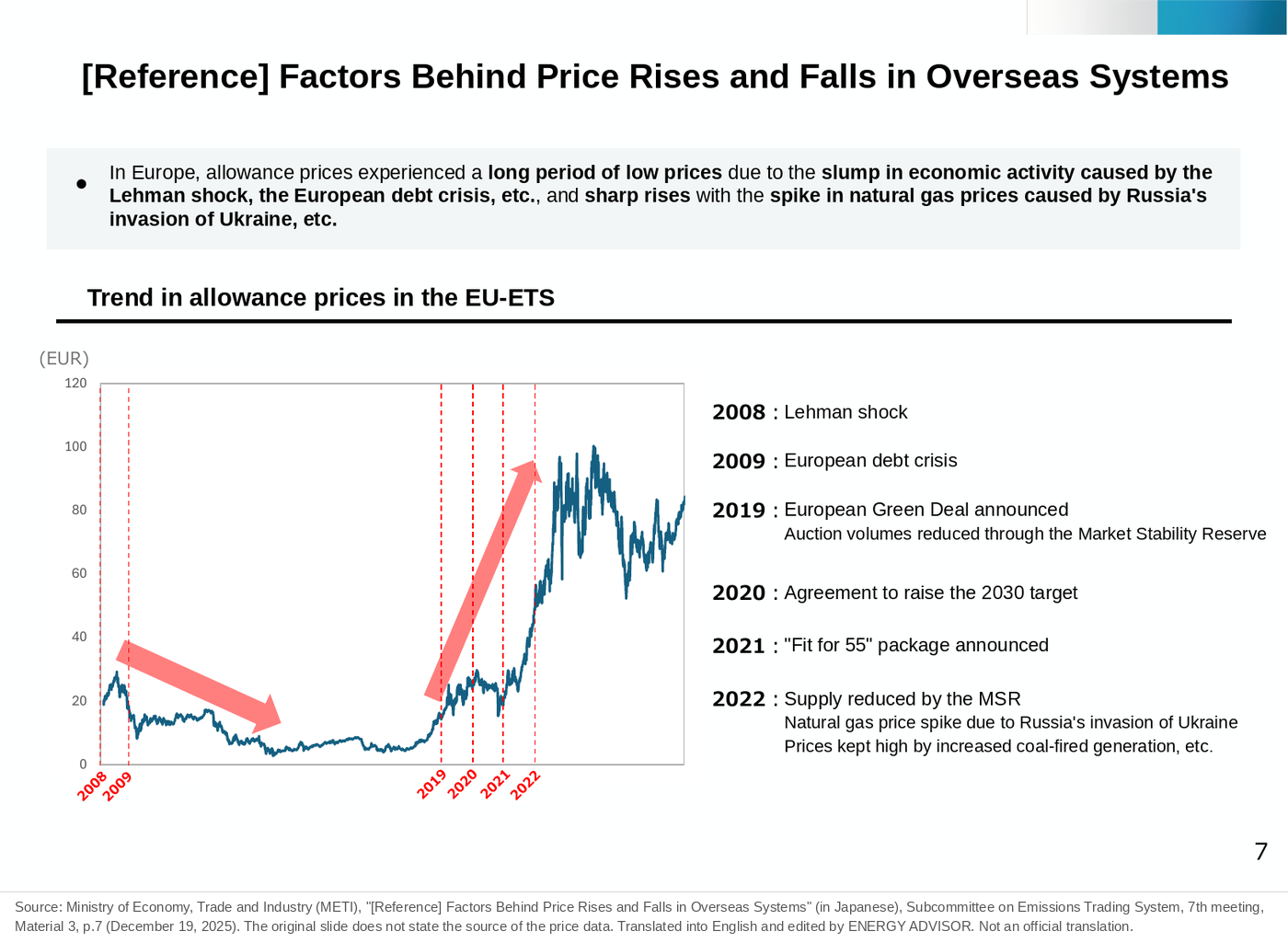
Phase 1 (2005–2007): Trial and the Problem of Over-Allocation
The first phase of the EU-ETS was an experimental stage for the system itself. Member states allocated allowances to companies free of charge, but the calculation methods were lax, and over-allocation occurred. As a result, the price of EUAs (EU allowances) fell sharply toward the end of the phase.
Because of this failure, the incentive to cut emissions did not work, and the foundations of the system were shaken. At the same time, however, important lessons for policy design were learned.
Phases 2 and 3 (2008–2020): Shift to Paid Allocation and Price Volatility
In Phase 2 (2008–2012), policymakers tightened allocation criteria and gradually raised the share of auctioning. In Phase 3 (2013–2020), paid auctions were greatly expanded. In addition, a “backloading” measure that temporarily postponed auction volumes was implemented to ease the effect of surplus allowances on the market.
It has been pointed out that prices swung widely in this period and that this discouraged investment.
In January 2019, the Market Stability Reserve (MSR) started operating (European Commission), and a mechanism began to work that absorbs allowances into the reserve when many are in circulation in the market.
Phase 4 (2021–2030): Stronger Climate Action
In Phase 4, EU climate action was strengthened through measures such as the Fit for 55 policy package (announced in 2021), and companies’ decarbonization investment accelerated. At the start of Phase 4, the rate at which the total amount of allowances is cut each year (the linear reduction factor) was raised from 1.74% to 2.2%, and international credits could no longer be used to meet obligations (European Commission, November 17, 2020). In 2022, EUA prices moved sharply, affected by factors such as the surge in natural gas prices following Russia’s invasion of Ukraine.
Comparison of the GX-ETS and the EU-ETS
Differences in Start Date and System Design
Japan’s GX-ETS entered full operation in FY2026, 21 years after the EU-ETS. Paradoxically, this delay became an advantage: Japanese policymakers were able to design the system in light of the EU-ETS’s failures.
The biggest difference is price stabilization in the early stage. The EU-ETS initially allocated 90–100% of allowances free of charge. The GX-ETS also adopts free allocation in principle in Phase 2 (FY2026–FY2032) and plans to move to paid allocation in stages in Phase 3 (FY2033 onward). On top of that, the GX-ETS is designed to introduce price stabilization measures from the early stage, in light of the lesson of the price crash caused by over-allocation in the EU-ETS.
| Item | EU-ETS | GX-ETS |
|---|---|---|
| Start | 2005 | Mandatory from FY2026 (FY2023–FY2025 was a trial with voluntary participation in the GX League, a framework for companies working on decarbonization) |
| Initial allocation | 90–100% free | Free in principle in Phase 2 (FY2026–FY2032) |
| Paid allocation | Paid auctions greatly expanded in Phase 3 (from 2013) | Paid auctions for the power sector from FY2033 |
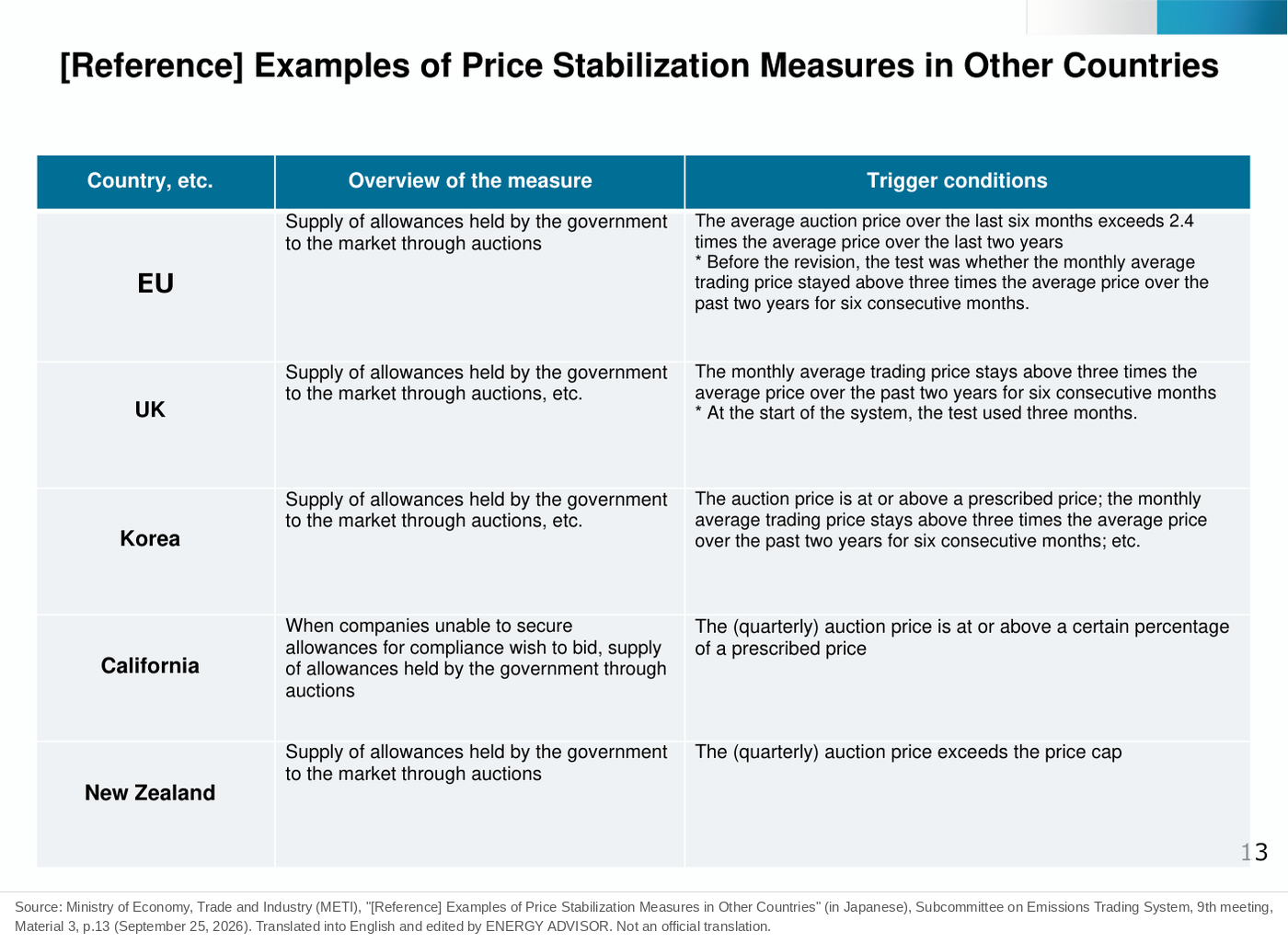
| Price stabilization | Market Stability Reserve (adjusts by volume, from 2019) | Upper and lower prices (adjusts by price, from the first year) |
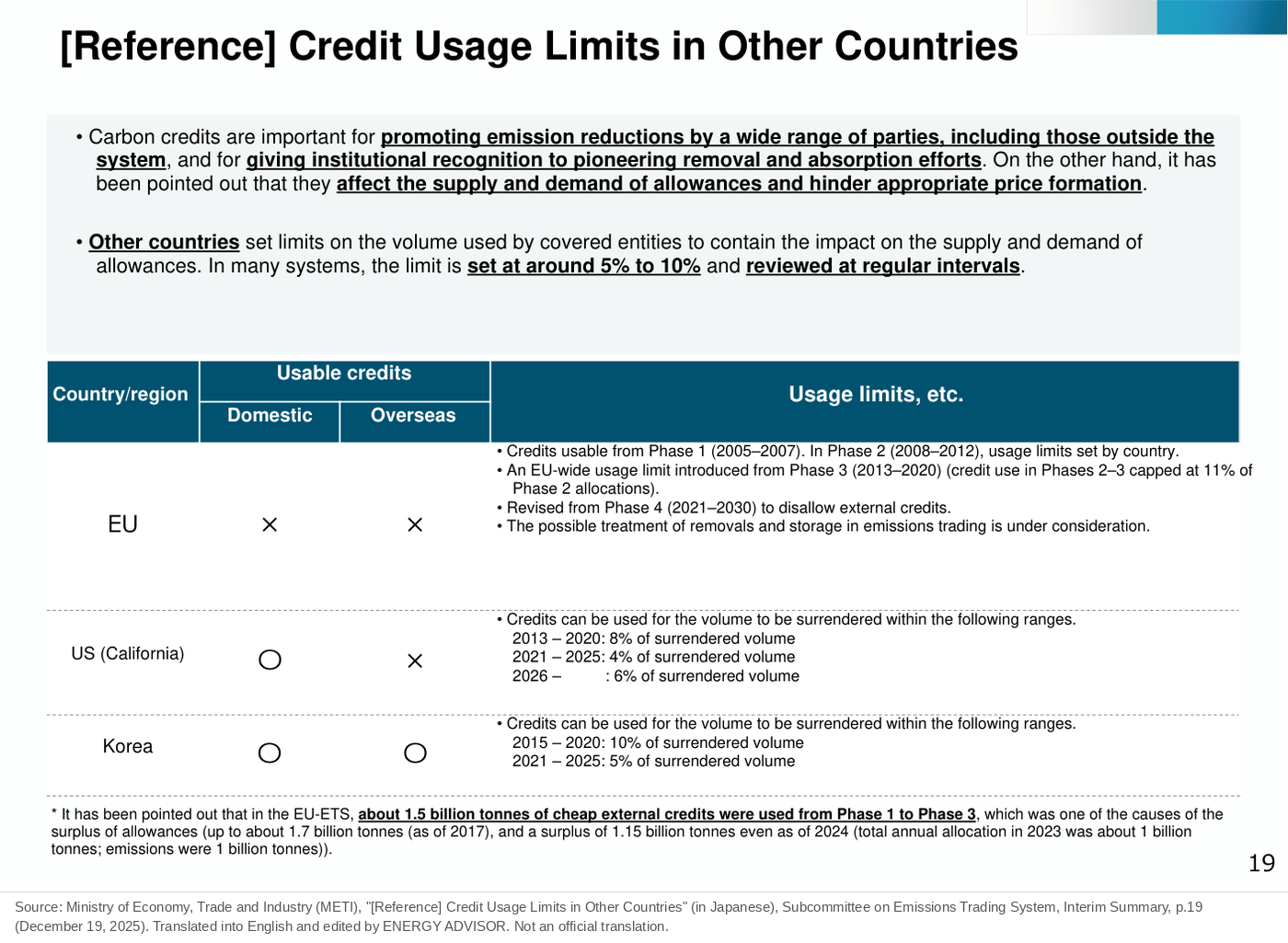
| Use of external credits | Not allowed in Phase 4 | Up to 10% of actual emissions (J-Credits and JCM credits) |
Price Band and Measures Against Volatility
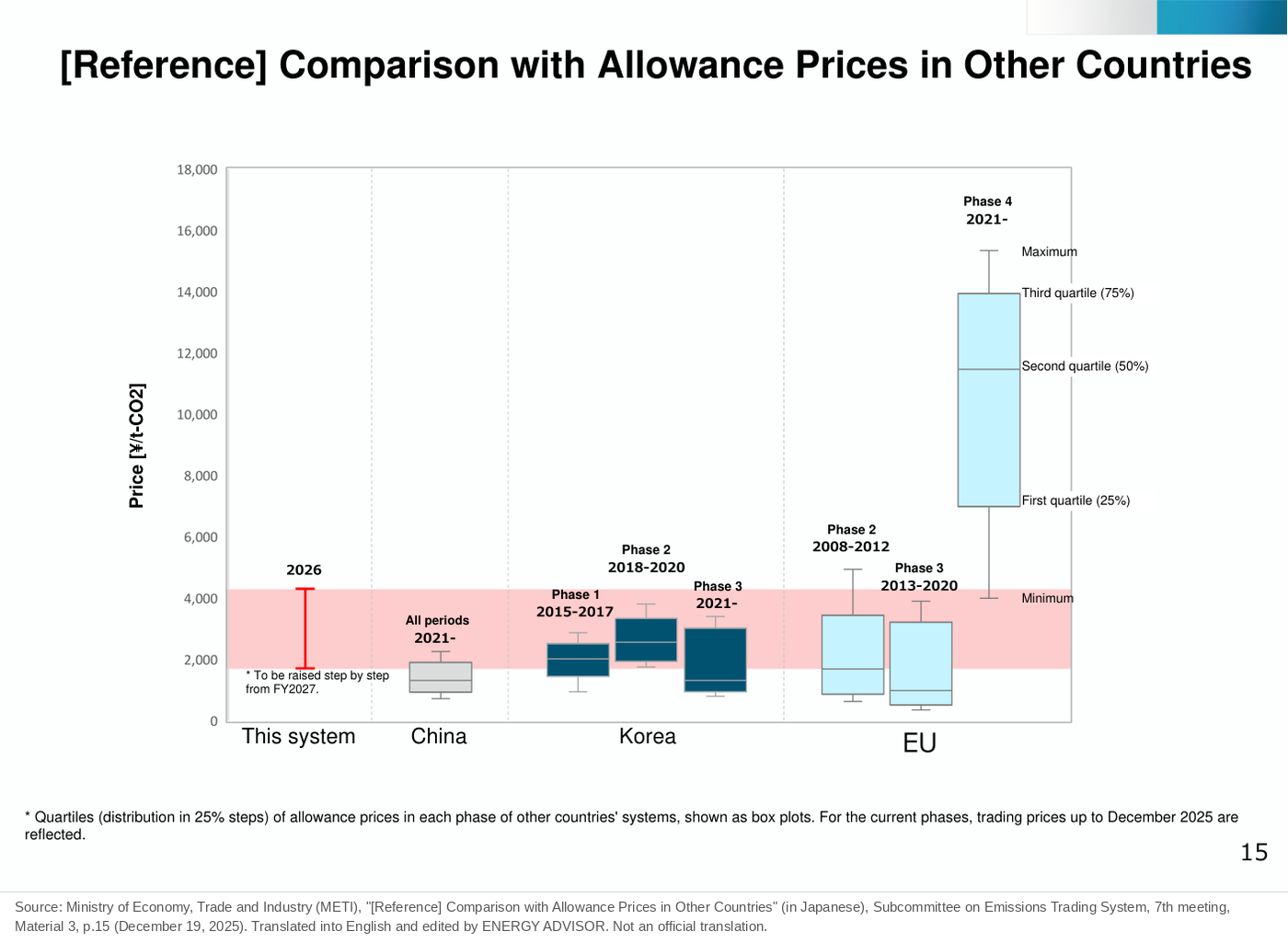
The initial price band of the GX-ETS is set, under its official names, at an upper reference price of ¥4,300/t-CO2 and an adjustment reference price of ¥1,700/t-CO2. This design takes into account maintaining the international competitiveness of Japanese companies and their gradual adaptation to the system.
Japan has also introduced price stabilization measures at the early stage, curbing excessive rises and falls in prices. This reflects an effort to avoid in advance the risk of price volatility experienced in the EU-ETS.
CBAM and Its Impact on Japan
As the EU-ETS evolved, the transitional period of the Carbon Border Adjustment Mechanism (CBAM) began in 2023. This is a system that imposes, also on goods imported from outside the EU, a cost equivalent to the carbon price set by the EU. It has applied in full since January 2026, and importers are obliged to buy and surrender CBAM certificates. CBAM certificates will be sold on a common central platform from February 2027, and certificates corresponding to imports in 2026 must be surrendered by September 30, 2027 (Environmental Protection Agency of Ireland, the national competent authority for CBAM).
CBAM affects global supply chains. Carbon costs will also be added to products that Japanese steel and chemical manufacturers export to the EU. This creates a structure in which Japanese companies are in effect affected by the EU’s emission reduction policy even if they are not covered by the GX-ETS.
Summary: Japan’s System Design Learning from the EU-ETS Experience
The EU-ETS offers Japan three main lessons. First, avoid over-allocation at the early stage. The price crash the EU-ETS faced led to distrust of the policy. Japan reflects this lesson with a design that includes price stabilization measures from the start and moves to paid allocation in stages from FY2033.
Second, secure market liquidity. The EUA market has enough size and participants for the price signal to work. Japan’s GX-ETS also needs to aim for a liquid market through the introduction of auctions and consideration of international linkage.
Third, the importance of international consistency. With the arrival of CBAM, each country’s carbon pricing system has begun to have global effects.
This article is based on published materials from the Ministry of Economy, Trade and Industry and its Agency for Natural Resources and Energy, the Electricity and Gas Market Surveillance Commission, the Organization for Cross-regional Coordination of Transmission Operators (OCCTO) and other sources. The English translations of figures are by ENERGY ADVISOR and are not official translations. When using this information for decisions, please check the original sources. When we find an error, we correct the article and note the date of the correction.
Sources
- METI, Subcommittee on Emissions Trading System, 7th meeting (December 19, 2025), Material 3 “Levels of the Upper and Lower Prices in the Emissions Trading System (Draft)” (in Japanese): p.7 “[Reference] Factors behind price surges and falls in overseas systems” (history of EU-ETS allowance prices; confirmed from the text in the figure); “[Reference] Comparison with allowance prices in other countries” (box plots for Korea, China, the EU and this system) (this page was read via a summary, and its page number is not confirmed). https://www.meti.go.jp/shingikai/sankoshin/sangyo_gijutsu/emissions_trading/pdf/007_03_00.pdf
- European Commission, “About the EU ETS” (launched in 2005; Phase 4 in 2021–2030; power and heat generation, industry and aviation, and maritime transport from 2024; about 40% of EU emissions; almost all free in Phase 1, about 90% free in Phase 2, auctioning as the default in Phase 3). https://climate.ec.europa.eu/eu-action/carbon-markets/about-eu-ets_en
- European Commission, “Start of phase 4 of the EU ETS” (November 17, 2020; linear reduction factor raised from 1.74% to 2.2%; international credits not usable in Phase 4). https://climate.ec.europa.eu/news-other-reads/news/start-phase-4-eu-ets-2021-adoption-cap-and-start-auctions-2020-11-17_en
- European Commission, “ETS Market Stability Reserve to reduce auction volume by almost 400 million allowances between September 2019 and August 2020” (May 15, 2019; MSR started operating in January 2019; threshold of 833 million). https://climate.ec.europa.eu/news-other-reads/news/ets-market-stability-reserve-reduce-auction-volume-almost-400-million-allowances-between-september-2019-05-15_en
- European Commission (Directorate-General for Taxation and Customs Union), “Carbon Border Adjustment Mechanism” (transitional period 2023–2025; definitive period from January 1, 2026). https://taxation-customs.ec.europa.eu/carbon-border-adjustment-mechanism_en
- Environmental Protection Agency (Ireland), “CBAM Certificates” (common central platform from February 2027; certificates for 2026 to be surrendered by September 30, 2027). https://www.epa.ie/our-services/licensing/climate-change/eu-carbon-border-adjustment-mechanism/cbam-certificates/
- METI, Subcommittee on Emissions Trading System, Summary report (December 19, 2025; the cover title of the PDF is “Interim Summary”) (in Japanese): p.6 (paid auctions for power generation companies from FY2033), pp.18–19 (credits up to 10% of actual emissions; credit usage limits in other countries) (pages were read via a summary and may be off by one). https://www.meti.go.jp/shingikai/sankoshin/sangyo_gijutsu/emissions_trading/pdf/20251219_1.pdf
- METI, Subcommittee on Emissions Trading System, 9th meeting (September 25, 2026), Material 3 “Measures Related to the Upper and Lower Prices” (in Japanese): p.13 (trigger conditions of price stabilization measures in other countries: EU, UK, Korea, California, New Zealand). https://www.meti.go.jp/shingikai/sankoshin/sangyo_gijutsu/emissions_trading/pdf/009_03_00.pdf
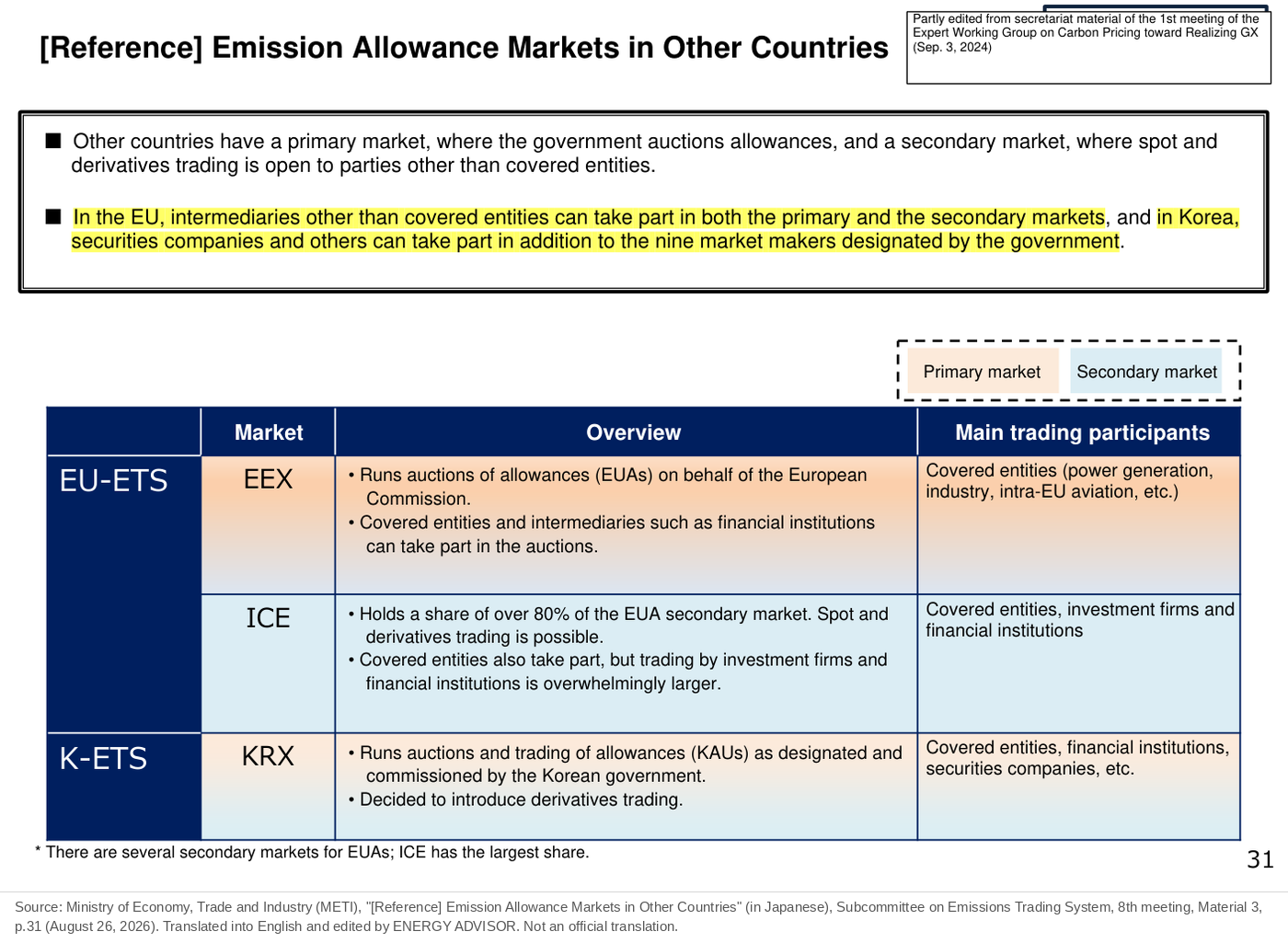
- METI, Subcommittee on Emissions Trading System, 8th meeting (August 26, 2026), Material 3 “Detailed Design of the Emission Allowance Market” (in Japanese): p.31 (allowance markets in other countries: EEX and ICE in the EU, KRX in Korea). https://www.meti.go.jp/shingikai/sankoshin/sangyo_gijutsu/emissions_trading/pdf/008_03_00.pdf