In April 2026, TEPCO Energy Partner (TEPCO EP below; the retail arm of the major utility in the Kanto area) changed how the fuel cost adjustment is calculated in its electricity rates for high-voltage and extra-high-voltage customers. Since this change, the fuel cost adjustment shown on bills has moved differently from before. The change shortens the base period for the calculation from a “three-month average” to a “one-month average.” This article sets out what changed and how it affects bills.
Key points
- 1From April 2026, the calculation period of TEPCO EP’s fuel cost adjustment for high-voltage and extra-high-voltage customers was shortened from a “three-month average” to a “one-month average.”
- 2With this change, the fuel cost adjustment rate is now calculated from the trade statistics prices of the most recent one month. Depending on the start of the metering period, the result for the previous month or the month before that is reflected in the current month. The lag was shortened to effectively one to two months (under the old system, it was about three months).
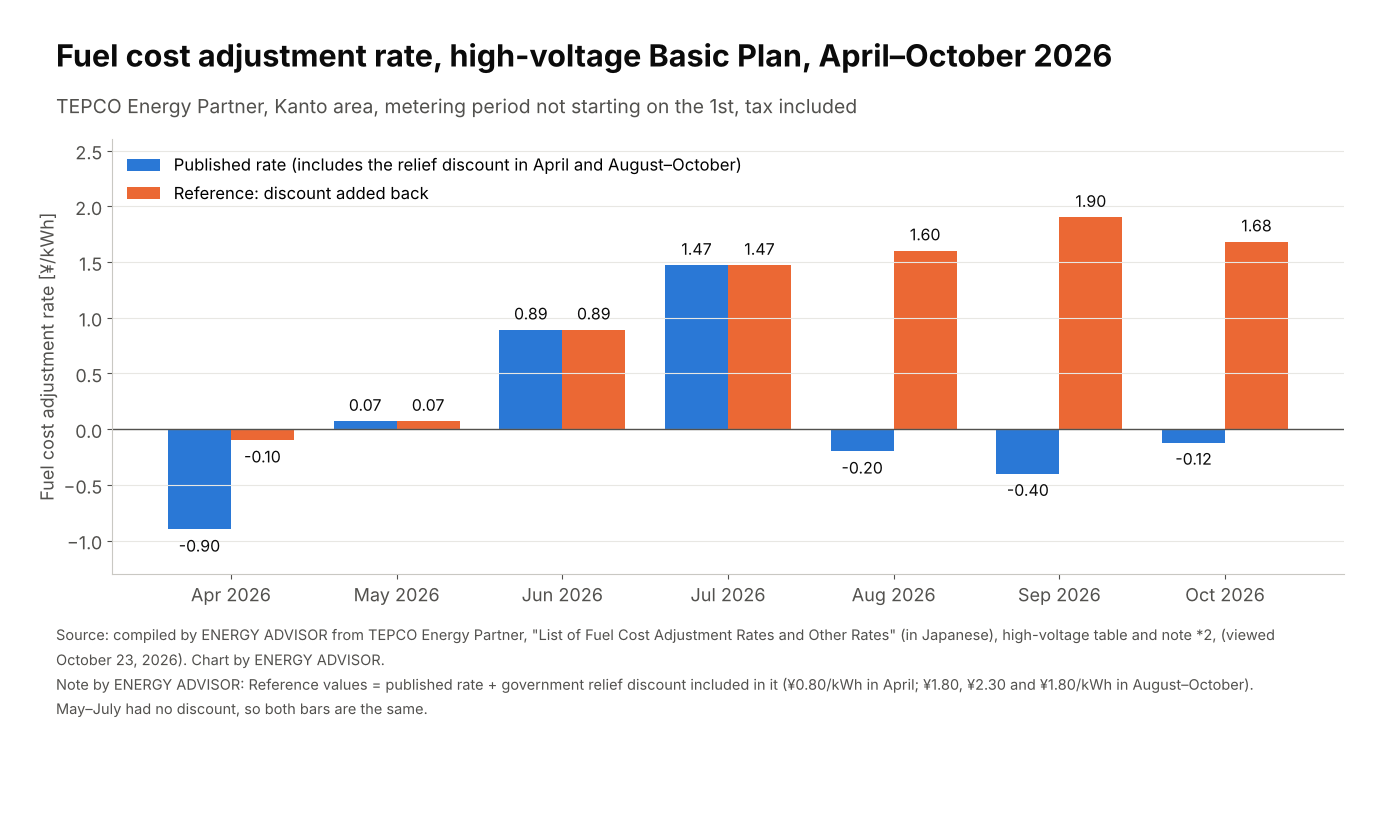
- 3TEPCO EP’s published fuel cost adjustment rates for high-voltage supply were −¥0.90/kWh in April 2026, ¥0.07 in May, ¥0.89 in June and ¥1.47 in July. The values for April and for August to October include the discount from government bill relief. Excluding the discount, the rate rose by about ¥1.6 in three months, from −¥0.10 in April to ¥1.47 in July.
- 4Standard tariffs have an item called the “market price adjustment rate,” separate from the fuel cost adjustment. For July 2026, this also rose from the previous month.
- 5High-voltage customers should check the trends in the fuel cost adjustment rate and the market price adjustment rate on their bills every month.
Part 2 looked at the three causes of the surge in prices in the JEPX day-ahead market (spot market) and how it spilled over into the fuel cost adjustment. This part looks at the mechanism by which the spot price surge reaches the bill.
What the Fuel Cost Adjustment Is
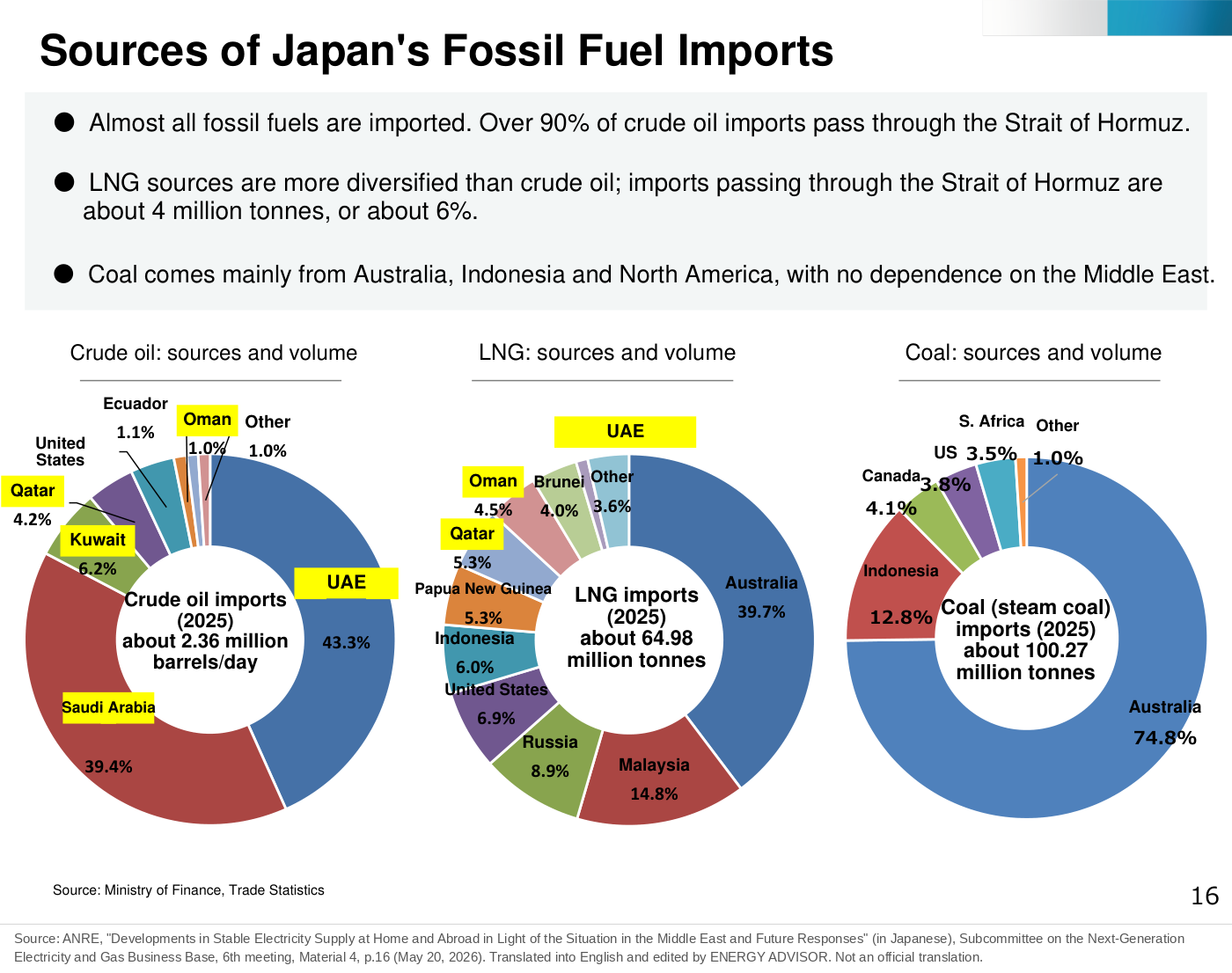
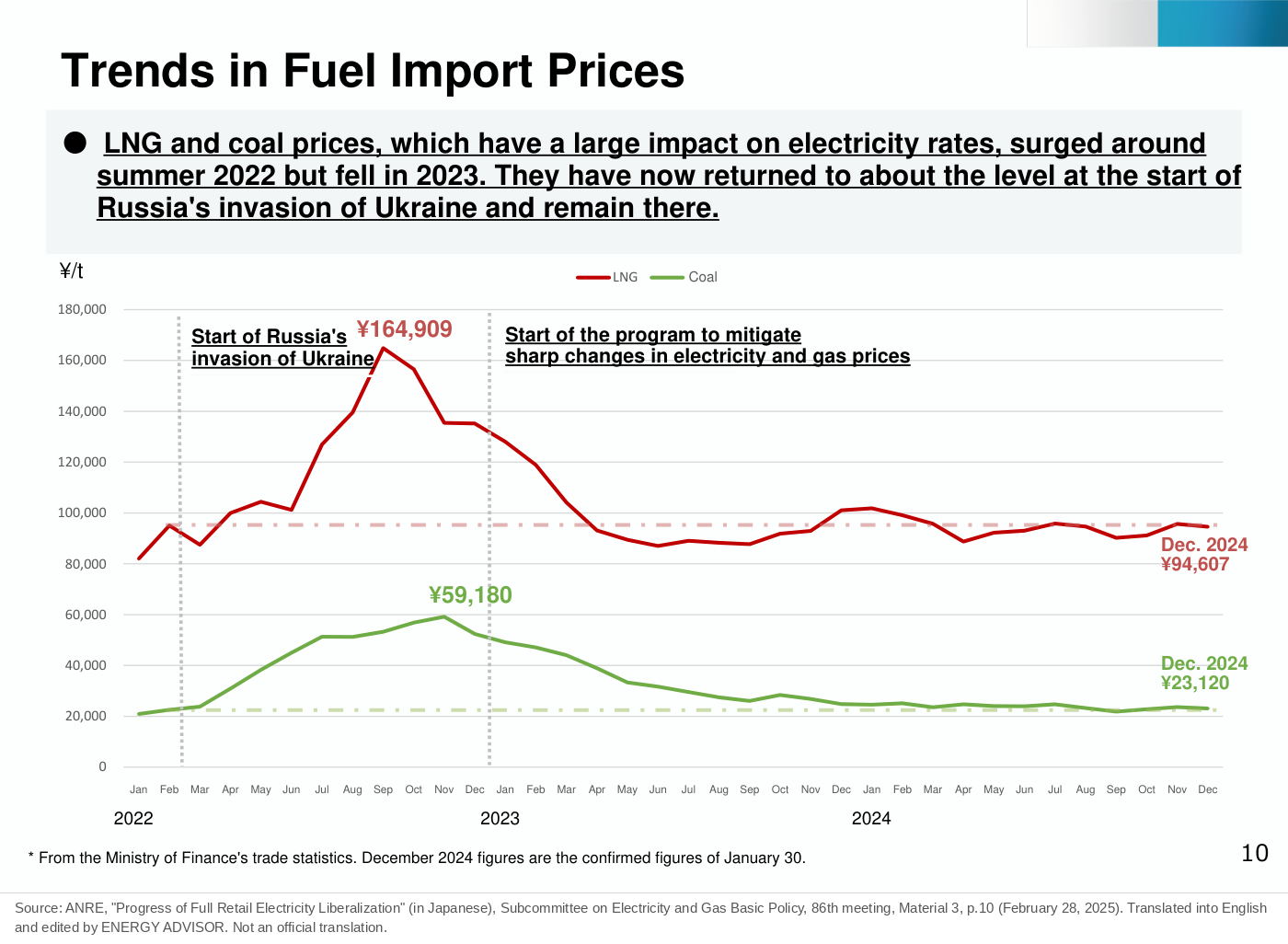
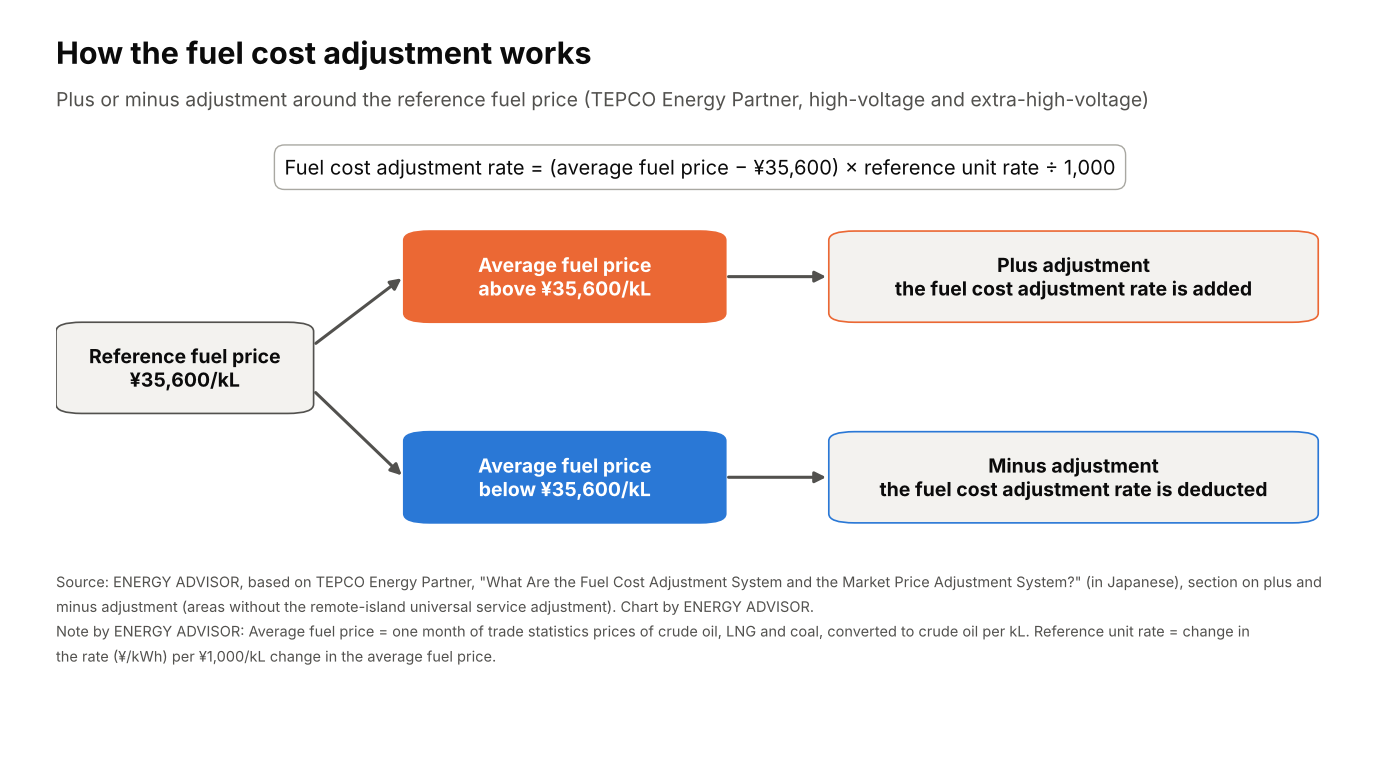
The fuel cost adjustment is a mechanism that reflects changes in the prices of fuels used for power generation, such as crude oil, LNG (liquefied natural gas) and coal, in electricity charges. When fuel prices go up, the fuel cost adjustment goes up; when fuel prices go down, it goes down. Because Japan imports most of its fuel for power generation, import price statistics (the Ministry of Finance’s trade statistics) are used for fuel prices.
For this reason, the fuel cost adjustment is one of the items on the monthly bill that changes. In high-voltage and extra-high-voltage contracts in particular, the effect of this rate on the total bill is not small.
What Changed with the “One-Month Average”
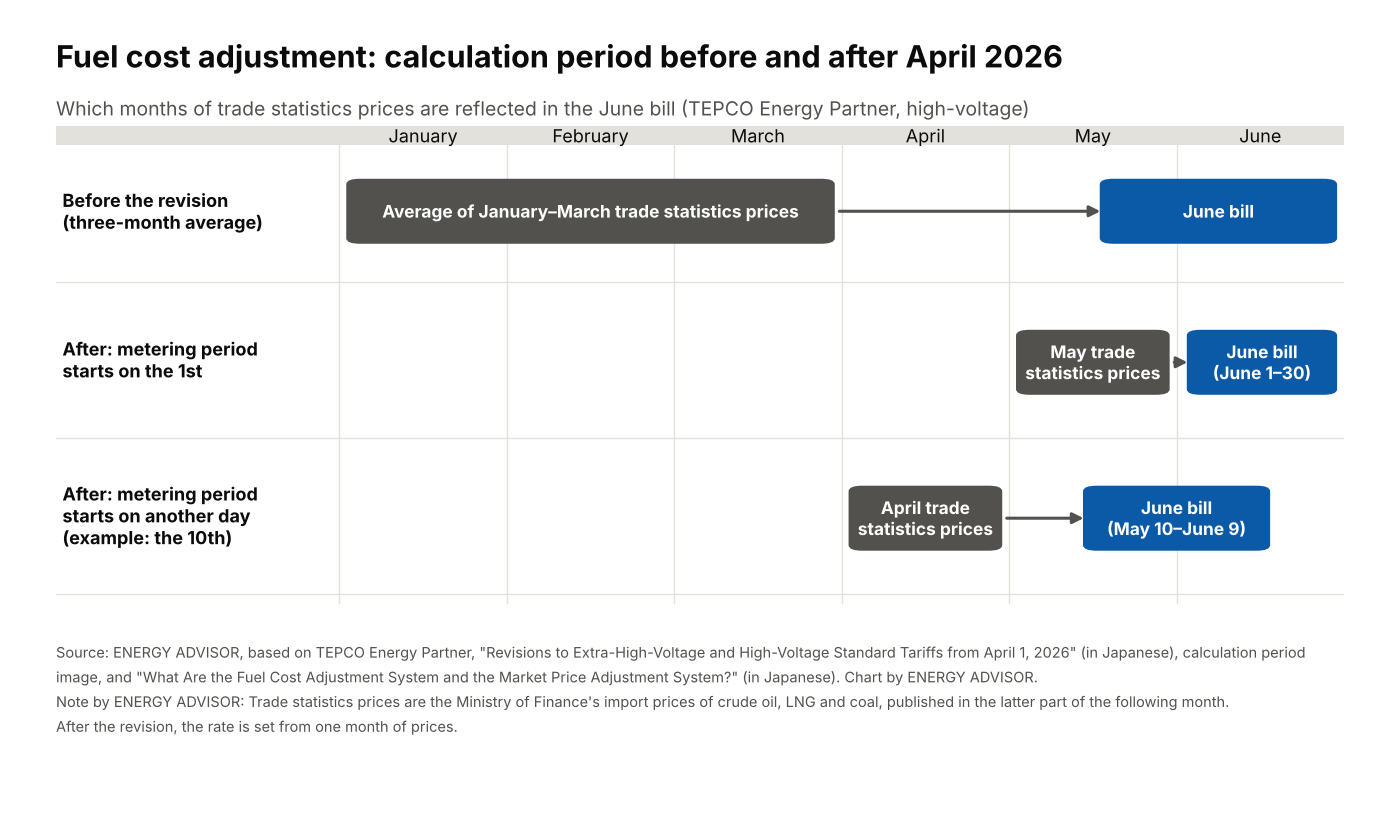
From April 2026, the base period for calculating TEPCO EP’s fuel cost adjustment for high-voltage and extra-high-voltage customers was shortened from a “three-month average” to a “one-month average.” The three-month average method uses the average of actual fuel prices over the most recent three months. The one-month average method uses only the actual results of the most recent one month. As a result, when fuel prices change, the time until the change is reflected in the calculation is shorter than before. TEPCO EP explains the reason for the revision as “to reflect fuel prices more appropriately, given that the Company’s power procurement situation will change significantly from April 2026” (page on the revision of standard tariffs from April 1, 2026).
Specifically, the fuel cost adjustment rate for each month is calculated from the trade statistics prices of the most recent one month (published by the Ministry of Finance in the latter part of the following month). The metering period is the one-month cycle over which electricity use is measured, and its start (the starting day) differs by customer depending on the timing of meter reading. For customers whose metering period starts on the 1st of each month, the trade statistics prices of the previous month are reflected in the current month’s rate. For customers whose metering period starts on a day other than the 1st, those of the month before the previous month are reflected. In other words, the effective time until the change is reflected is about one to two months. Under the three-month average method before the change, it took about three months (for example, the average results for August to October 2022 were reflected in January 2023).
Source: TEPCO Energy Partner, “What Are the Fuel Cost Adjustment System and the Market Price Adjustment System?” (in Japanese)
Source: TEPCO Energy Partner, “Revisions to Extra-High-Voltage and High-Voltage Standard Tariffs from April 1, 2026” (in Japanese)
A shorter averaging period also means that recent price movements show up more directly in the rate. Changes now reach the rate faster, in both the upward and the downward direction.
Examples of When Changes Are Reflected
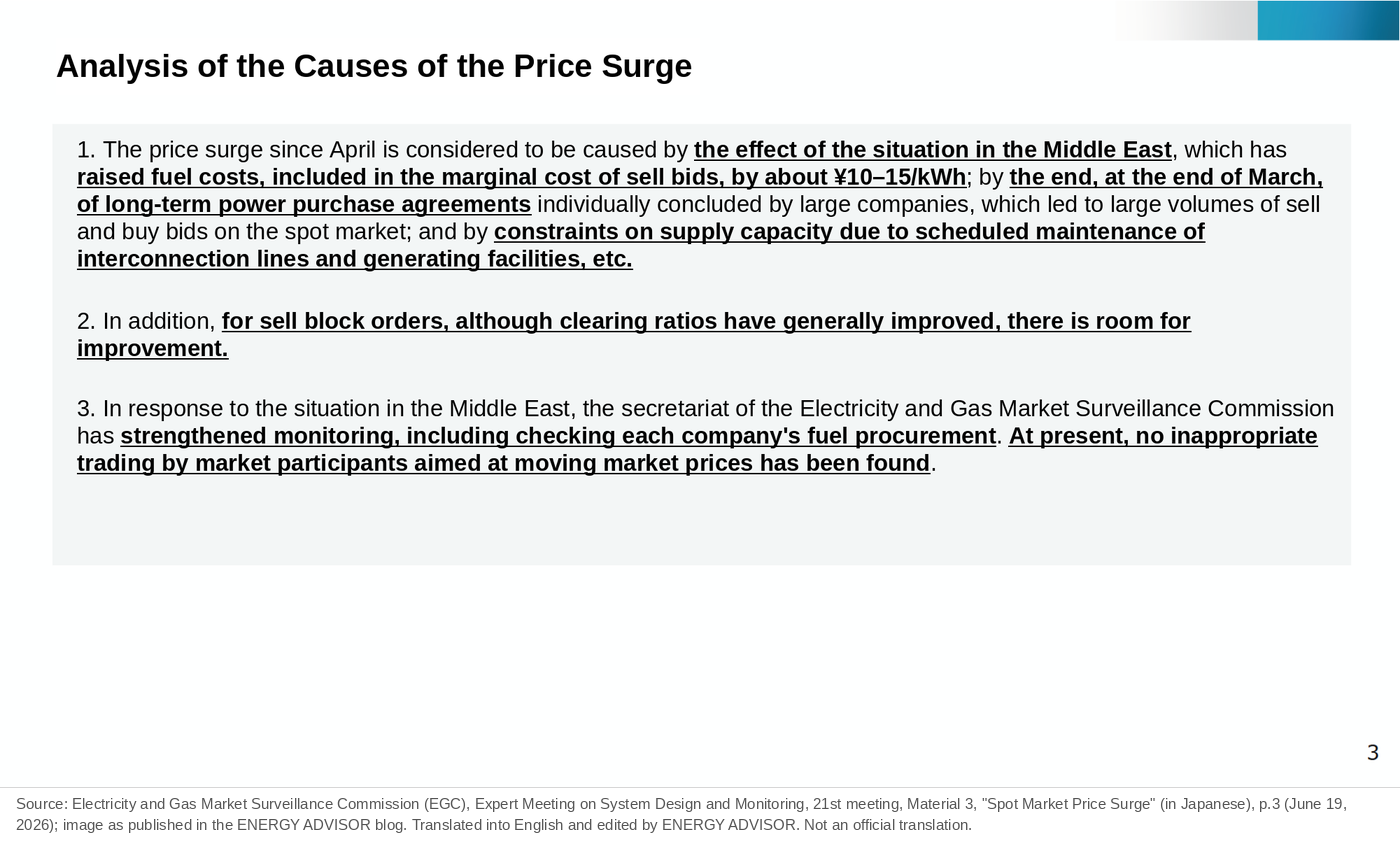
Specifically, for July 2026, the trade statistics prices of June or May 2026 are reflected, depending on the start of the metering period. Under the three-month average method before the change, it took about three months; for example, the average results for August to October 2022 were reflected in the fuel cost adjustment rate for January 2023. JEPX spot market prices have also risen since April 2026. As seen in Part 2, the rise in spot prices and the rise in the fuel cost adjustment share a common background: higher fuel prices.
Effect on Bills: Faster Reflection
Because the calculation period was shortened, when fuel prices rise, the rise is now reflected in the fuel cost adjustment within a shorter period of effectively one to two months. On the other hand, when fuel prices fall, the reflection is also faster, so the change does not necessarily work only to increase the burden. However, from April to July 2026, both fuel prices and market prices kept rising, so the rise in the fuel cost adjustment was easy to feel.
Actual Fuel Cost Adjustment Rates (April to October, Based on Official Figures)
TEPCO EP’s official fuel cost adjustment rates for high-voltage supply (Basic Plan, customers whose metering period does not start on the 1st of each month, tax included) have moved as follows.
| Month | Fuel cost adjustment rate (published) | Change from previous month | Government relief discount included in the published value | Reference value with the discount added back |
|---|---|---|---|---|
| April 2026 | −¥0.90/kWh | – | ¥0.80/kWh | −¥0.10/kWh |
| May 2026 | ¥0.07/kWh | +¥0.97 | None | (¥0.07/kWh) |
| June 2026 | ¥0.89/kWh | +¥0.82 | None | (¥0.89/kWh) |
| July 2026 | ¥1.47/kWh | +¥0.58 | None | (¥1.47/kWh) |
| August 2026 | −¥0.20/kWh | – | ¥1.80/kWh | ¥1.60/kWh |
| September 2026 | −¥0.40/kWh | – | ¥2.30/kWh | ¥1.90/kWh |
| October 2026 | −¥0.12/kWh | – | ¥1.80/kWh | ¥1.68/kWh |
(The reference values are the author’s calculation, adding the discount rate to the published value. For months without a discount, the published value is shown as is, in parentheses. As of October 22, 2026, rates for customers whose metering period does not start on the 1st have been published up to October. The same list also shows that the rates for February and March 2026 include a discount of ¥2.30/kWh.)
Source: TEPCO Energy Partner, “List of Fuel Cost Adjustment Rates and Other Rates” (in Japanese), checked October 22, 2026; TEPCO Energy Partner, “Notice of Fuel Cost Adjustment and Other Rates (April 2026)” (in Japanese)
Source: TEPCO Energy Partner, “List of Fuel Cost Adjustment Rates and Other Rates” (in Japanese)
A note on why the published value for April is negative. According to the notes in TEPCO EP’s rate list, the fuel cost adjustment rate for April 2026 includes a discount of ¥0.80/kWh from government electricity bill relief. This was the last month of relief for usage in January to March 2026 (the relief is explained in Part 6). Excluding the discount, the April rate was −¥0.10/kWh, almost zero. In other words, most of the negative published value comes from the discount. After that, the rate turned positive in May, June and July and kept rising.
The published values for August to October are negative again, but not because fuel prices fell. TEPCO EP’s rate list notes that the fuel cost adjustment rates for these three months include the discount from government electricity bill relief (for usage in July to September 2026). Adding the discount back gives ¥1.60 for August, ¥1.90 for September and ¥1.68 for October, the same as or slightly higher than July (¥1.47). Government relief and how it appears on bills are set out in Part 6.
Source: TEPCO Energy Partner, “What Are the Fuel Cost Adjustment System and the Market Price Adjustment System?” (in Japanese)
Some aggregation websites on the internet also publish series of reference values based on the old calculation method from before the April 2026 revision of standard tariffs. These are different from actual billed rates under the current plans, so this article does not show their figures. The actual rates can be checked every month on TEPCO EP’s official website.
Compared without the discount, the rate rose by about ¥1.6 from April to July, from −¥0.10 to ¥1.47. Because the calculation period was shortened to a “one-month average,” recent fuel price movements are more easily reflected in the rate.
The Market Price Adjustment Rate: Another Variable Item
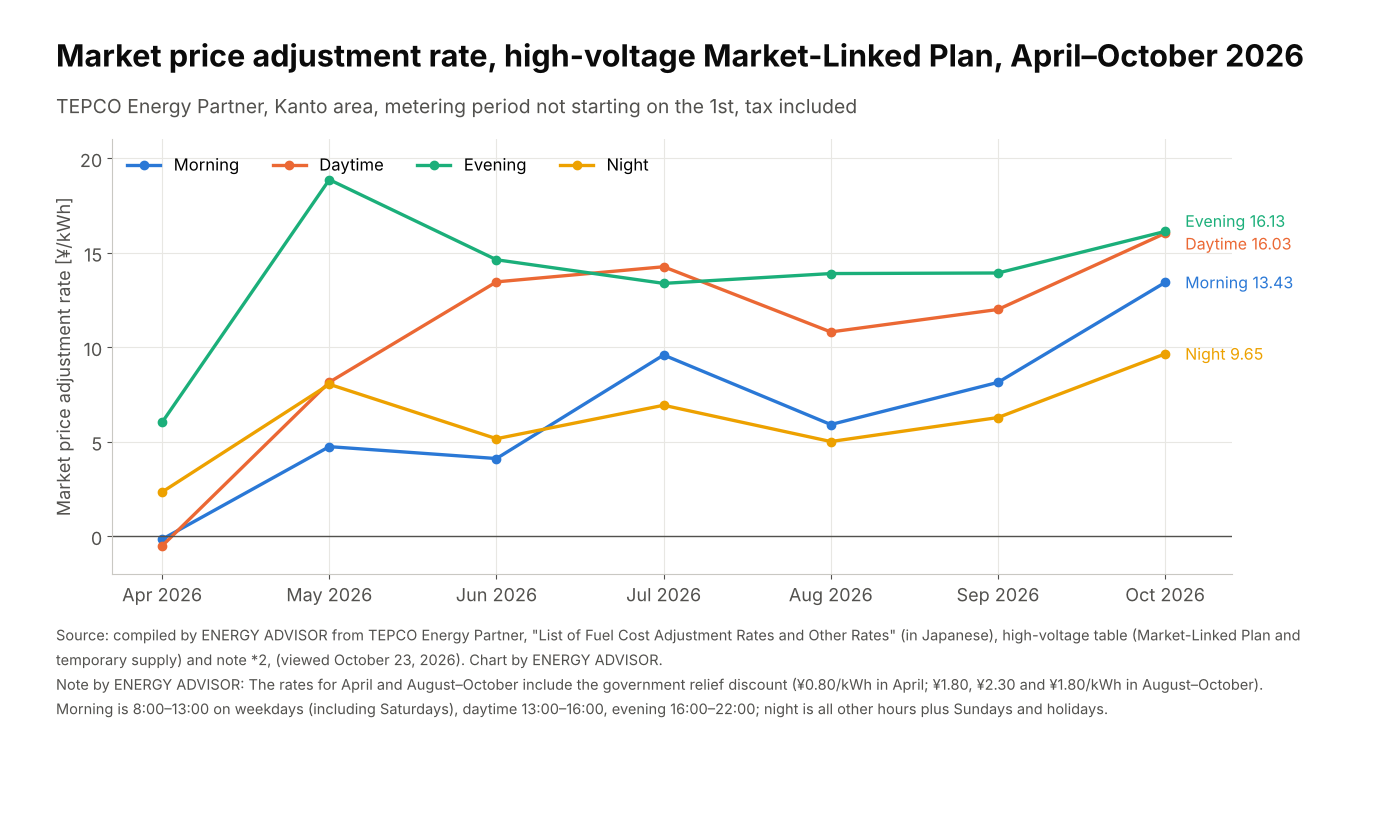
Standard tariffs have an item called the “market price adjustment rate,” separate from the fuel cost adjustment. The market price adjustment rate is a rate for reflecting changes in JEPX spot market prices in electricity charges. The three plans, the Basic Plan, the Zero Market Adjustment Plan and the Market-Linked Plan, differ in how much of this is reflected.
Source: TEPCO Energy Partner, “Revisions to Extra-High-Voltage and High-Voltage Standard Tariffs from April 1, 2026” (in Japanese)
Source: TEPCO Energy Partner, “List of Fuel Cost Adjustment Rates and Other Rates” (in Japanese)
As an example, the market price adjustment rates for July 2026 (high-voltage, customers whose metering period does not start on the 1st of each month, tax included) are shown in the table below. They rose from the previous month in every time period, and the Market-Linked Plan is at an even higher level than the Basic Plan.
| Time period | Basic Plan | Market-Linked Plan |
|---|---|---|
| Morning | ¥4.13/kWh | ¥9.59/kWh |
| Daytime | ¥6.15/kWh | ¥14.26/kWh |
| Evening | ¥5.77/kWh | ¥13.38/kWh |
| Night | ¥2.99/kWh | ¥6.93/kWh |
(July 2026, high-voltage, customers whose metering period does not start on the 1st of each month, tax included. Time periods: morning is 8:00–13:00 on weekdays (including Saturdays), daytime is 13:00–16:00, evening is 16:00–22:00, and night is all other hours plus all day on Sundays, national holidays and similar days.)
Source: TEPCO Energy Partner, “Notice of Fuel Cost Adjustment and Other Rates (July 2026)” (in Japanese)
After that, the daytime market price adjustment rate of the Basic Plan (same conditions) moved to ¥5.43 for August, ¥6.16 for September and ¥6.20 for October (TEPCO EP, “List of Fuel Cost Adjustment Rates and Other Rates,” checked October 22, 2026; the Basic Plan’s market price adjustment rate does not include the government relief discount).
In other words, the higher burden on high-voltage bills in 2026 arises from two items: the rise in the fuel cost adjustment and the rise in this market price adjustment rate. The rise in JEPX spot market prices behind the market price adjustment rate is as seen in Part 2.
If you check only the fuel cost adjustment and think “this month’s increase was small,” you may miss the rise in the market price adjustment rate. On a standard tariff bill, it is essential to check these two items together.
What High-Voltage Customers Should Check
Businesses with high-voltage or extra-high-voltage contracts should check every month the amount obtained by multiplying the fuel cost adjustment rate on the bill by that month’s electricity consumption. For this reason, it is important to know in advance which item on the bill is the fuel cost adjustment. Because the fuel cost adjustment rate reflects the trade statistics prices of the most recent one to two months, international trends in fuel prices such as crude oil and LNG will determine the level of future rates.
Summary
In April 2026, the calculation period of TEPCO EP’s fuel cost adjustment for high-voltage and extra-high-voltage customers was shortened from a “three-month average” to a “one-month average.” The key points of this article are:
- Because the calculation period was shortened, the fuel cost adjustment rate is now reflected with an effective lag of one to two months (under the old system, the lag was about three months).
- Excluding the discount, the fuel cost adjustment rate rose by about ¥1.6, from −¥0.10/kWh in April 2026 to ¥1.47/kWh in July. The published values for April and for August to October include the government relief discount; excluding the discount, August to October are at ¥1.60–1.90/kWh.
- Standard tariffs have a market price adjustment rate separate from the fuel cost adjustment, and for July 2026 this also rose from the previous month.
- The rise in the fuel cost adjustment and the surge in JEPX spot market prices (Part 2) share a common background: higher fuel prices.
As seen in Part 1, high-voltage electricity prices as a whole are hard to compare simply because of differences in how contract demand is calculated and in rate structures. You need to recalculate your own actual usage under each plan’s rate structure.
This article is based on published materials from the Ministry of Economy, Trade and Industry and its Agency for Natural Resources and Energy, the Electricity and Gas Market Surveillance Commission, the Organization for Cross-regional Coordination of Transmission Operators (OCCTO) and other sources. The English translations of figures are by ENERGY ADVISOR and are not official translations. When using this information for decisions, please check the original sources. When we find an error, we correct the article and note the date of the correction.
Sources
- TEPCO Energy Partner, “List of Fuel Cost Adjustment Rates and Other Rates” (in Japanese) (November 2024 to October 2026, including the high-voltage table; checked October 22, 2026). https://www.tepco.co.jp/ep/private/fuelcost2/newlist/index-j.html
- TEPCO Energy Partner, “Notice of Fuel Cost Adjustment and Other Rates” (in Japanese) (as of October 22, 2026, showing October 2026; the July table is from the time of the original article). https://www.tepco.co.jp/ep/corporate/adjust2/new/index-j.html
- TEPCO Energy Partner, “Notice of Fuel Cost Adjustment and Other Rates (April 2026)” (in Japanese). https://www.tepco.co.jp/ep/corporate/adjust2/backnumber/2604.html
- TEPCO Energy Partner, “What Are the Fuel Cost Adjustment System and the Market Price Adjustment System?” (in Japanese). https://www.tepco.co.jp/ep/corporate/adjust2/index-j.html
- TEPCO Energy Partner, “Revisions to Extra-High-Voltage and High-Voltage Standard Tariffs from April 1, 2026, Reflection of the November 1, 2026 Network Charge Revision in Electricity Rates, and Partial Revision of Supply Conditions” (in Japanese). https://www.tepco.co.jp/ep/corporate/plan_h/minaoshi_2026.html
- Agency for Natural Resources and Energy, “Developments in Stable Electricity Supply at Home and Abroad in Light of the Situation in the Middle East and Future Responses” (in Japanese), Advisory Committee for Natural Resources and Energy, Subcommittee on the Next-Generation Electricity and Gas Business Base, May 20, 2026, Material 4. https://www.meti.go.jp/shingikai/enecho/denryoku_gas/jisedai_kiban/pdf/006_04_00.pdf
- Agency for Natural Resources and Energy, “Progress of Full Retail Electricity Liberalization” (in Japanese), Subcommittee on Electricity and Gas Basic Policy, 86th meeting, Material 3, February 28, 2025. https://www.meti.go.jp/shingikai/enecho/denryoku_gas/denryoku_gas/pdf/086_03_00.pdf