In Phase 2 of the GX Emissions Trading System (GX-ETS) (FY2026–FY2032), covered companies are required to carry out measurement, reporting and verification (MRV) of their emissions. A system for accurately tracking and managing emissions is an essential foundation for handling emission allowances properly.
(Note for readers outside Japan) Japan’s fiscal year (FY) runs from April to March; FY2026 is April 2026–March 2027.
This article sets out, based on materials published by the Ministry of Economy, Trade and Industry (METI), the criteria for selecting covered companies under the GX-ETS and the rules for calculating emissions (MRV). It explains how covered companies are determined, the three steps of MRV, the calculation method and reporting obligations, and third-party verification and the non-compliance charge system.
Key points
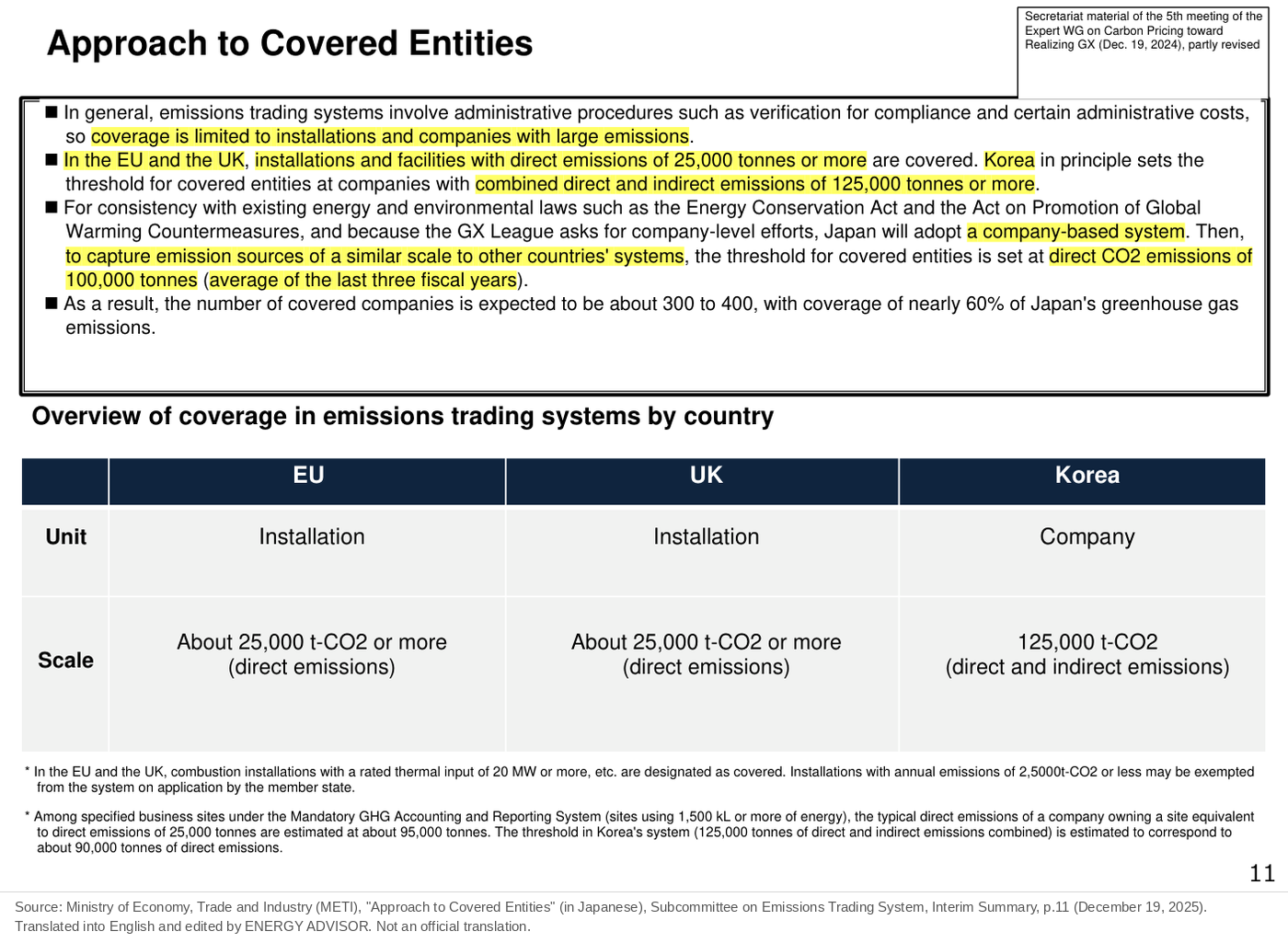
- 1Companies covered by the GX-ETS are those whose direct CO2 emissions (Scope 1) average 100,000 tonnes or more over the three fiscal years up to the previous fiscal year.
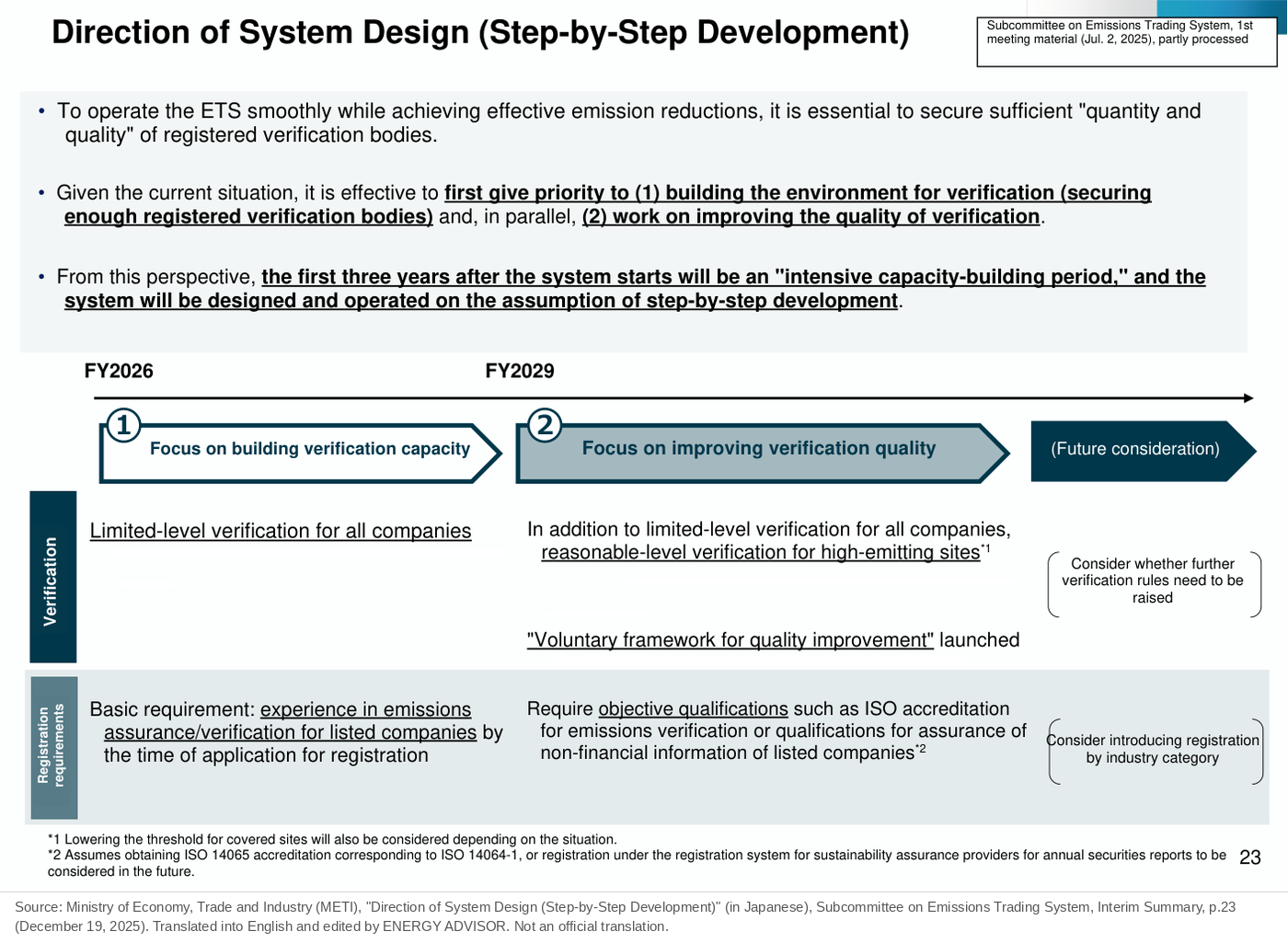
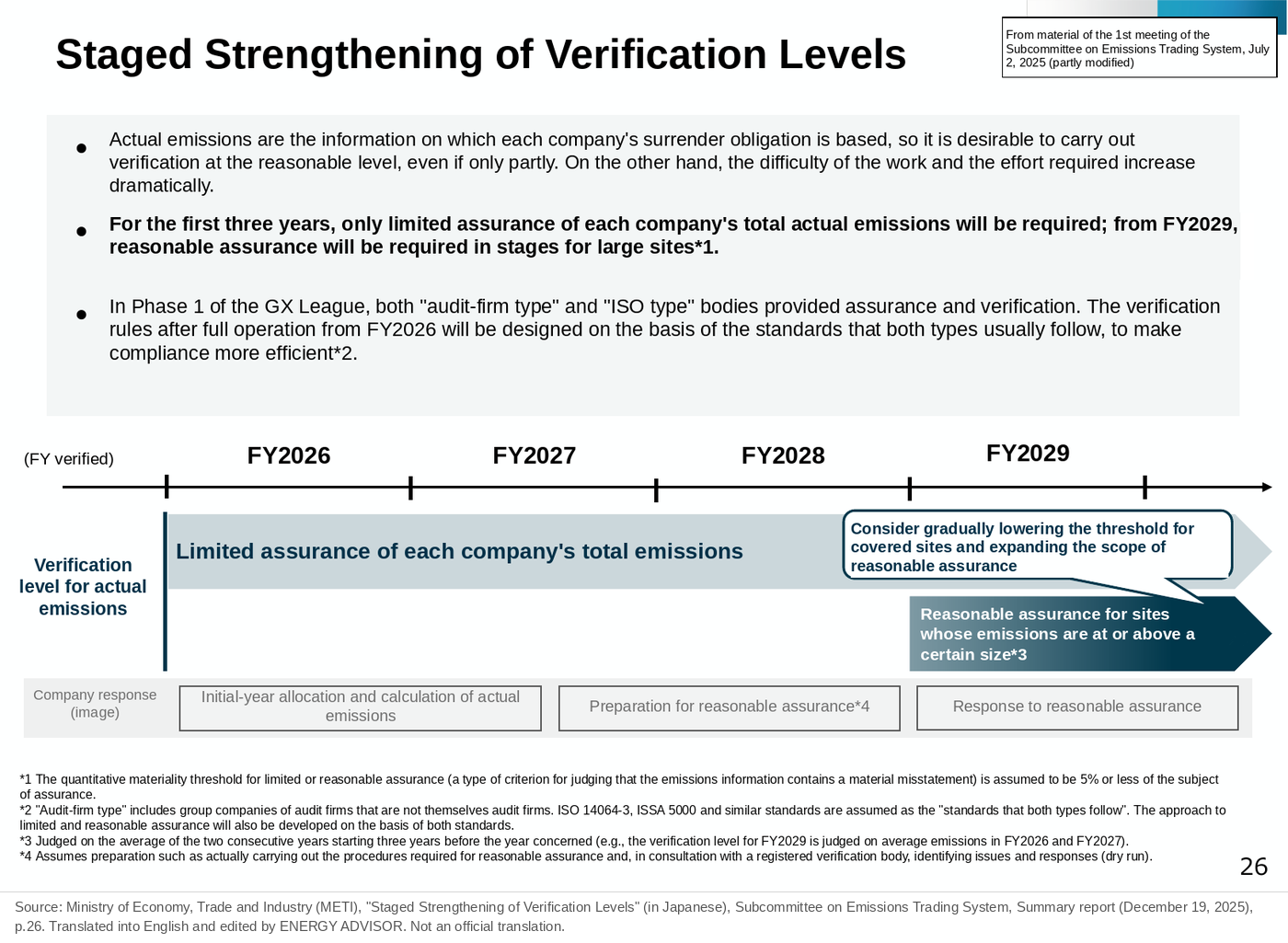
- 2The level of verification is staged: limited assurance in FY2026–FY2028, and reasonable assurance for large sites from FY2029 (the size of covered sites is to be considered).
- 3Emissions calculation is based on the Mandatory Greenhouse Gas Accounting and Reporting System under the Act on Promotion of Global Warming Countermeasures. ISO 14064-3, ISSA 5000 and similar standards are expected to be used as standards for verification.
- 4Checking of allocated amounts and verification of emissions by a registered verification body are mandatory.
Covered Companies: The Threshold of 100,000 Tonnes of CO2 a Year
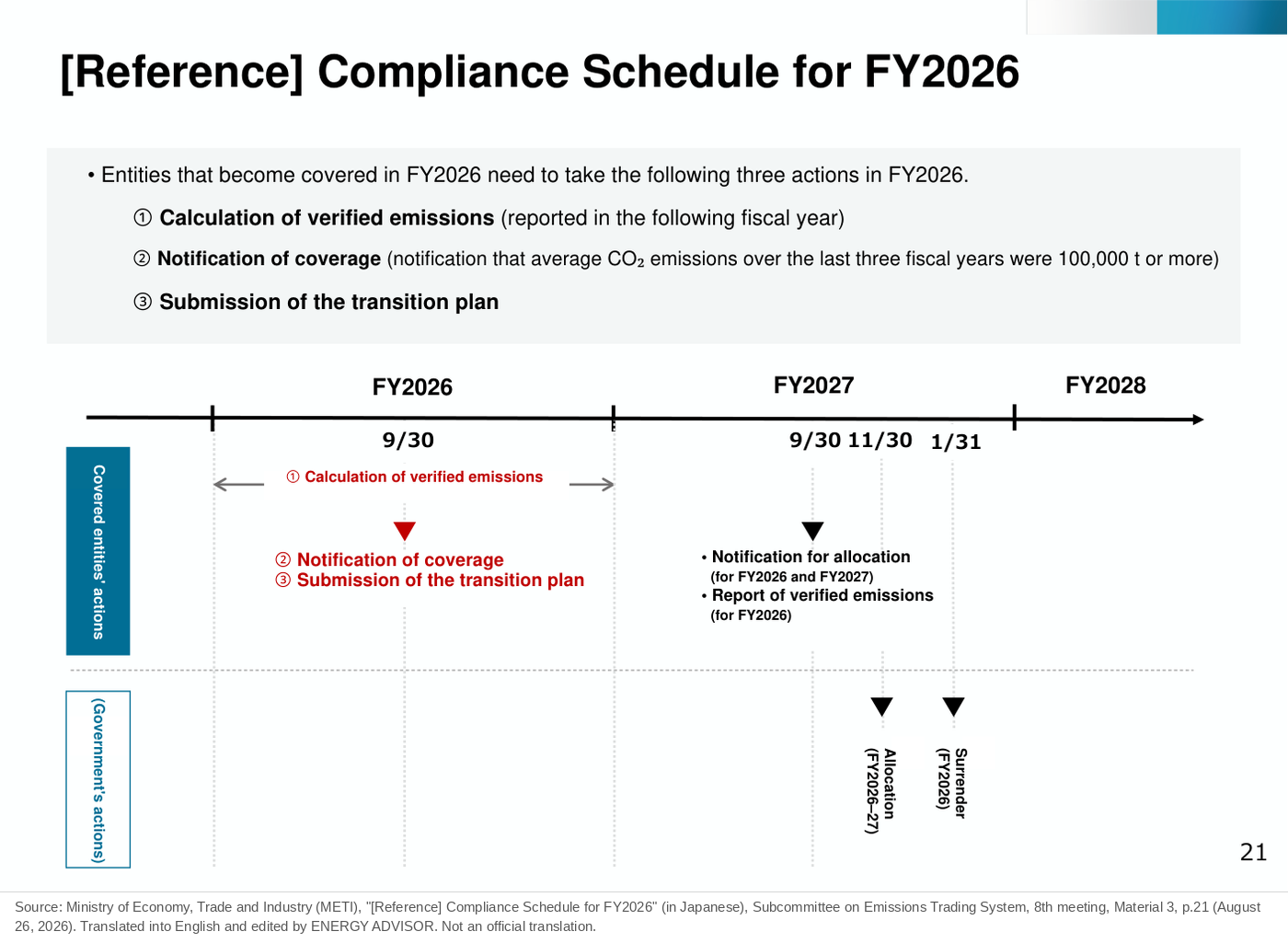
Companies obliged to participate in the GX-ETS are those whose direct CO2 emissions (Scope 1) average 100,000 tonnes or more over the three fiscal years up to the previous fiscal year. Coverage for FY2026 is determined by the three-fiscal-year average of FY2023–FY2025, and it is determined on a rolling basis every fiscal year.
The covered companies are mainly in energy-intensive industries. Benchmarks for manufacturing are being considered mainly for sectors such as oil refining, steel, chemicals (petrochemicals, soda, carbon black), pulp and paper, cement, lime production, aluminum, rubber products, flat glass, glass bottles and automobiles. Separately, the calculation formula for the power sector is being considered by the Working Group on Power-Sector Benchmarks (Summary report, p.6). The system is expected to cover about 300 to 400 companies and nearly 60% of Japan’s greenhouse gas emissions (Summary report, p.11). Companies accounting for more than 50% of Japan’s greenhouse gas emissions take part in the GX League of Phase 1 (Summary report, p.8).
(Note) Scope 1 is the CO2 a company emits directly by burning fuel in its own factories, boilers and so on. Scope 2 is the indirect CO2 from using purchased electricity and heat. Scope 3 is emissions across the whole supply chain. These categories come from the international accounting standard (the GHG Protocol).
Only Scope 1 (direct emissions) is covered. Scope 2 (indirect emissions from purchased electricity, etc.) and Scope 3 (supply chain emissions) are not covered at present.
The Three Steps of MRV (Measurement, Reporting and Verification)
MRV refers to three steps: Measurement, Reporting and Verification. These are the core of the GX-ETS framework for managing emissions.
In the measurement step, a company calculates its annual greenhouse gas emissions. In the reporting step, it submits the results to the government or an authorized body. In the verification step, an independent third party checks the accuracy of what was reported.
The level of verification is designed to be strengthened in stages. In the first three years, FY2026–FY2028, only “limited assurance” is required for all covered companies, as a preparation period in which they set up their calculation systems and IT systems. The Summary report designates the first three years after the start of the system as an “intensive capacity-building period” and states that the system will be designed and operated on the premise that it develops step by step (p.23). From FY2029 onward, “reasonable assurance” is scheduled to be required in stages for large sites. The size of the covered sites is to be considered in the future, and sites emitting 1 million tonnes or more a year have been shown as an example. ISO 14064-3, ISSA 5000 and similar standards are expected to be used as standards for verification work.
(Note) “Limited” and “reasonable” are levels of depth used in assurance engagements. Reasonable assurance is the deeper check, gathering more evidence to confirm the figures.
There are also SaaS tools that support the calculation and management of emissions (such as Zeroboard and booost technologies).
Calculation Method and Reporting Obligations: Emissions Calculation Based on the Act on Promotion of Global Warming Countermeasures
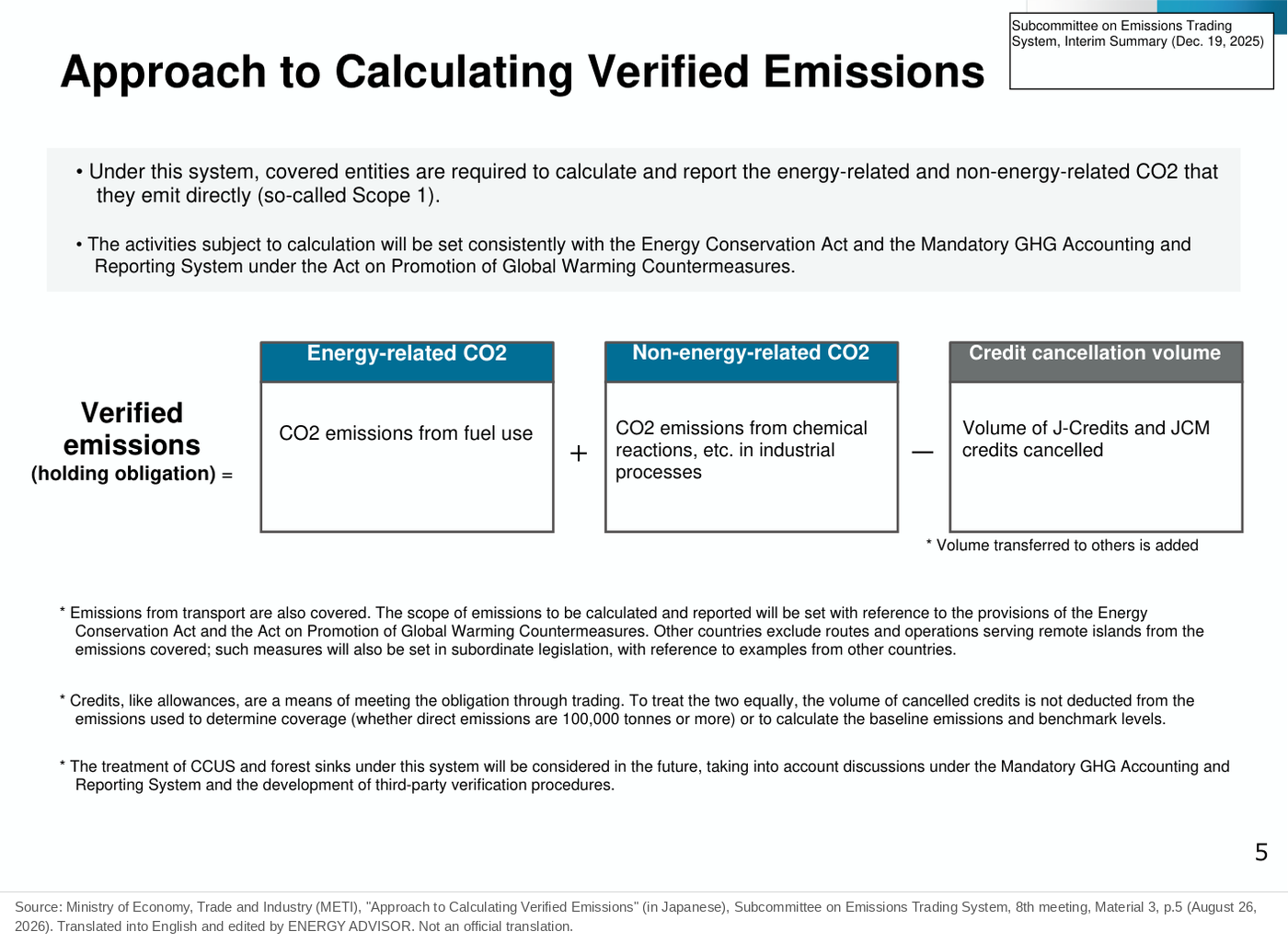
The calculation of greenhouse gas emissions under the GX-ETS is designed on the basis of the existing Mandatory Greenhouse Gas Accounting and Reporting System (SHK system) under the Act on Promotion of Global Warming Countermeasures. The SHK system is a Japanese system, in place before the GX-ETS, that requires emitters above a certain size to report their emissions.
A company calculates its annual emissions by multiplying its energy use and fuel consumption by emission factors. It is obliged to report the results to the government every fiscal year. By January 31 of the following fiscal year, it must hold allowances equal to its verified emissions.
As third-party verification gets fully underway, the accuracy of reporting becomes ever more important.
Third-Party Verification and Non-Compliance Charges: Compliance Obligations and Penalties
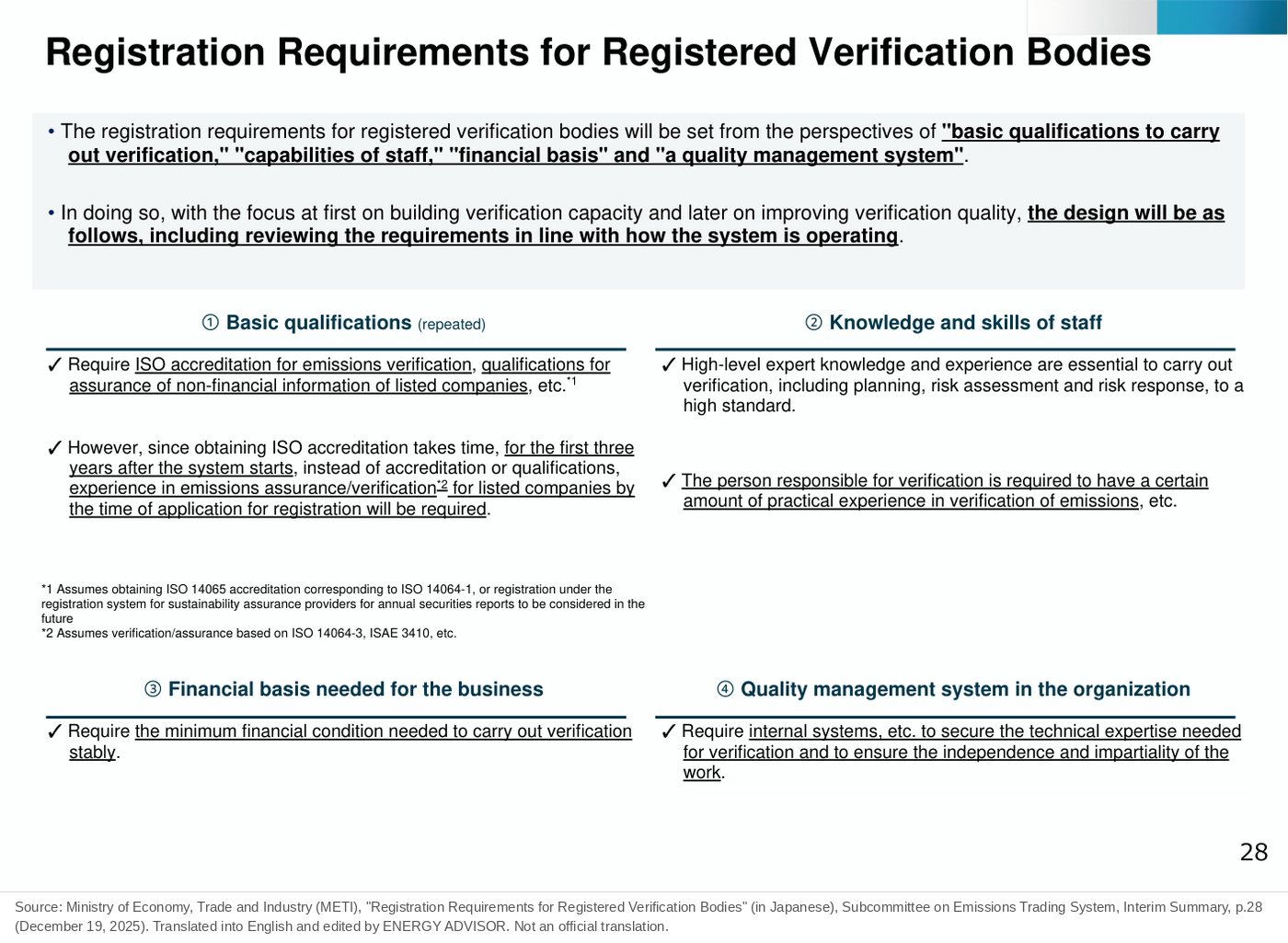
From FY2029, reasonable assurance by a registered verification body becomes mandatory in stages for large sites. A registered verification body checks whether a company’s measurement methods and reported figures are appropriate, and issues an assurance opinion. It must apply to METI for registration. There are four registration requirements: (1) basic eligibility, (2) knowledge and skills of the staff engaged in the work, (3) the financial basis needed for the work, and (4) a quality control system within the organization (Summary report, p.28). As of August 26, 2026, 21 applications had been received and 14 bodies had been registered (8th meeting of the Subcommittee, Material 3).
If the deadline passes while the obligation to hold allowances remains unfulfilled, a non-compliance charge of the unfulfilled amount × the upper price × 1.1 is imposed. Assuming the FY2026 upper price of ¥4,300, the charge is about ¥4,730 per unfulfilled tonne. In addition, failure to make notifications or report emissions, or making false notifications, can be punished under the GX Promotion Act with a fine of up to ¥500,000 (Article 143, items 1 and 5).
Because the non-compliance charge is a considerable economic incentive, it gives companies a motive to actively pursue investment in emission reduction and efficiency measures. At the same time, accurate tracking and reporting of emissions become even more important.
Summary: Building an MRV System
Companies covered by the GX-ETS (annual CO2 emissions of 100,000 tonnes or more) need to start preparing their calculation systems now, ahead of full implementation in FY2029. The three steps of MRV (measurement, reporting and verification) are a mechanism to ensure the transparency and reliability of emissions management.
Many companies already have experience with the calculation method based on the Act on Promotion of Global Warming Countermeasures, but the GX-ETS requires even stricter reporting accuracy.
This article is based on published materials from the Ministry of Economy, Trade and Industry and its Agency for Natural Resources and Energy, the Electricity and Gas Market Surveillance Commission, the Organization for Cross-regional Coordination of Transmission Operators (OCCTO) and other sources. The English translations of figures are by ENERGY ADVISOR and are not official translations. When using this information for decisions, please check the original sources. When we find an error, we correct the article and note the date of the correction.
Sources
- METI, Subcommittee on Emissions Trading System, Summary report (December 19, 2025; the cover title of the PDF is “Interim Summary”) (in Japanese): p.6 (sectors for which benchmark formulas are being considered, and the Working Group on Power-Sector Benchmarks); p.8 (three-fiscal-year average of 100,000 tonnes or more; companies accounting for more than 50% of Japan’s greenhouse gas emissions participate in the GX League; reporting to the government every fiscal year; holding by January 31 of the following fiscal year; 1.1 times the upper price for unfulfilled amounts); p.11 “Approach to covered entities” (about 300 to 400 covered companies; coverage of nearly 60%); p.23 “Direction of system design (step-by-step development)” (the first three years after the start of the system as an “intensive capacity-building period”); pp.26–27 (staged strengthening of verification levels; ISO 14064-3, ISSA 5000 and similar standards expected; p.26 confirmed from the text in the figure); p.27 (“if sites of 1 million tonnes or more were made subject to reasonable assurance”); p.28 “Registration requirements for registered verification bodies” (four requirements) (pages other than p.26 were read via a summary and may be off by one). https://www.meti.go.jp/shingikai/sankoshin/sangyo_gijutsu/emissions_trading/pdf/20251219_1.pdf
- METI, Subcommittee on Emissions Trading System, 8th meeting (August 26, 2026), Material 3 “Detailed Design of the Emission Allowance Market” (in Japanese): p.5 (calculation of verified emissions); pp.20–21 (21 applications received and 14 bodies registered as of August 26, 2026; compliance schedule for FY2026) (pages were read via a summary and may be off by one). https://www.meti.go.jp/shingikai/sankoshin/sangyo_gijutsu/emissions_trading/pdf/008_03_00.pdf
- METI, Subcommittee on Emissions Trading System, 9th meeting (September 25, 2026), Material 3 “Measures Related to the Upper and Lower Prices” (in Japanese): p.6 (FY2026 upper price of ¥4,300 published in a notification). https://www.meti.go.jp/shingikai/sankoshin/sangyo_gijutsu/emissions_trading/pdf/009_03_00.pdf
- GX League official website, “Emissions Trading System (GX-ETS)” (in Japanese). https://gx-league.go.jp/action/gxets/
- Act on the Promotion of a Smooth Transition to a Decarbonized Growth-Oriented Economic Structure (Act No. 32 of 2023; amended text in force from April 1, 2026; viewed on e-Gov Law Search on October 22, 2026), Article 143, item 1 (failure to make the notification under Article 33(1) or making a false notification) and item 5 (failure to report emissions under Article 35(1) or making a false report): fine of up to ¥500,000 (in Japanese). https://laws.e-gov.go.jp/law/505AC0000000032