Among SMEs asked by customers to calculate or reduce their CO2 emissions, many start by installing energy-saving equipment or reviewing their energy use. But there is another measure you can start without a large investment: reviewing your electricity contract and tariff plan. Building on the basic mechanism of high-voltage supply contracts, this article explains how reviewing your contract and tariff plan affects both emissions and costs.
Key points
- 1Reviewing your electricity contract and tariff plan is one of the few measures that can act on both costs and emissions.
- 2High-voltage supply contracts consist of the “contract demand,” the “demand charge” and the “energy charge.”
- 3Measures that hold down the “demand” on which the contract demand is based often cut costs and reduce consumption (and therefore CO2 emissions) at the same time.
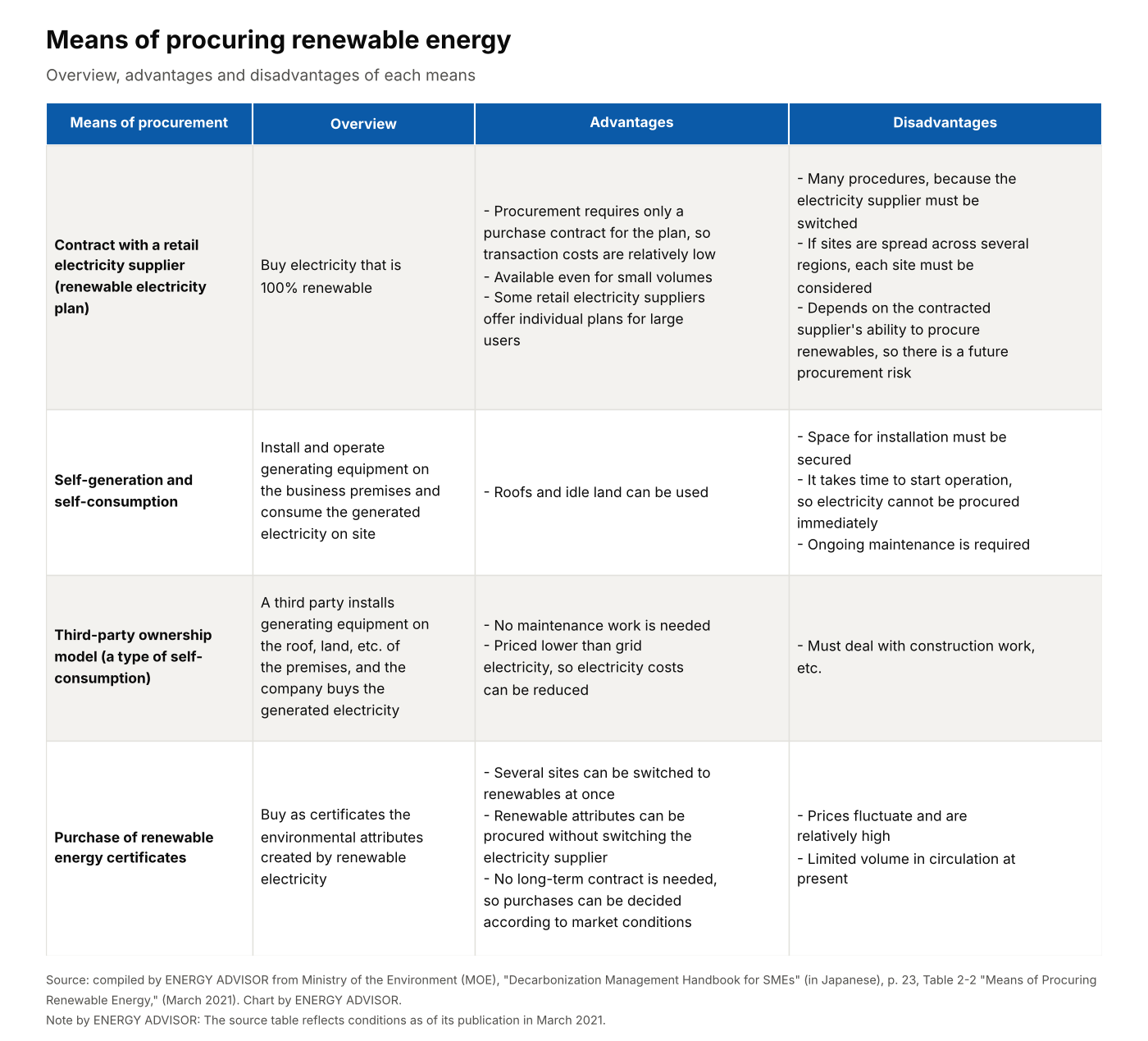
- 4Switching to a tariff plan based on renewable energy can reduce Scope 2 emissions, but it may carry an additional charge. The decision needs to take into account how strong customers’ requests are and how much cost you can accept.
- 5When switching contracts, it is essential to check the supplier’s situation and the contract terms in advance.
In this series, “SMEs and Decarbonization,” we have looked so far (up to Part 7) at how to calculate Scope 1 emissions (Part 6, in Japanese) and at the approach of organizing CO2 reduction efforts into three stages, “operational improvements,” “contract review” and “capital investment” (Part 7, in Japanese). This time, we take up “contract review,” the second of these three stages, and look concretely at how reviewing your electricity contract and tariff plan affects costs and emissions.
Why Contract Review Works on Both “Costs” and “CO2”
Of the three stages, operational improvements reduce consumption itself, and capital investment spends money on upgrading to high-efficiency equipment. Contract review, by contrast, is distinctive in that it may move both costs and emissions just through the choice of electricity company and tariff plan, without changing consumption.
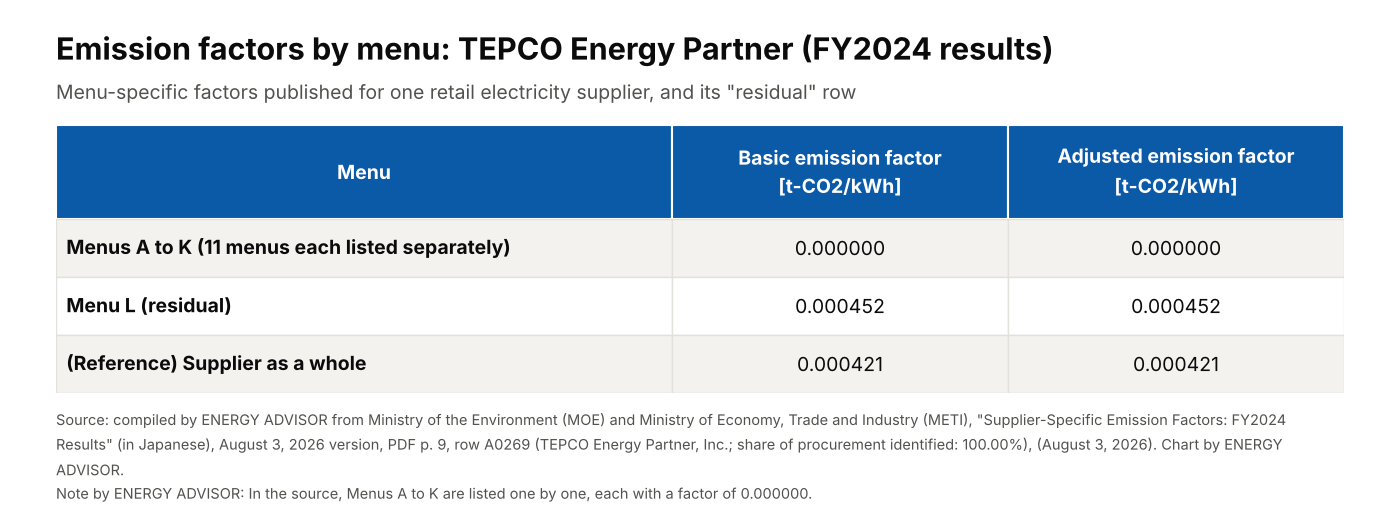
As confirmed in Part 5, the supplier-specific emission factors include, in addition to each supplier’s basic and adjusted emission factors, “menu-specific emission factors” that may be published separately for each tariff plan of the same supplier. In other words, even without changing the electricity company you have a contract with, the calculated CO2 emissions may change depending on which tariff plan you choose, even with the same consumption (kWh). On the cost side, the way the contract demand is set and the choice of tariff plan directly affect the monthly demand charge and energy charge. Because it works on both sides at once, contract review can be described as one of the few such measures.
Installing energy-saving equipment has a large effect, but investment decisions and installation take time. Reviewing your contract and tariff plan can start with checking your existing contract and meter reading notices, so it is a relatively easy measure to start.
A Review of the Basic Structure of High-Voltage Contracts: Contract Demand, Demand Charge and Energy Charge
As a premise for considering a review of your contract and tariff plan, here is a brief review of the basic structure of high-voltage supply contracts. Many high-voltage and extra-high-voltage electricity bills are calculated by adding a demand charge, set according to the size of the contract demand, and an energy charge, set according to the amount of electricity actually used. The contract demand is a value (kW), set in the contract with the electricity company, that serves as a guide to the upper limit of power the site can use. The demand charge is calculated as “contract demand (kW) × demand charge rate.” The energy charge is calculated as “electricity consumption (kWh) × energy charge rate,” and the fuel cost adjustment (an adjustment that reflects changes in fuel import prices in the bill) and the renewable energy surcharge (a surcharge through which electricity users bear the cost of purchasing renewable energy) are added or subtracted.
For example, under TEPCO Energy Partner’s high-voltage Basic Plan (Kanto area, effective April 1, 2026), the demand charge rate is ¥2,530.00 per kW and the energy charge rate is ¥17.43 per kWh (tax included; excluding the fuel cost adjustment and the market price adjustment).
For many customers with a contract demand of less than 500 kW, the contract demand is determined by what is called the “actual-demand method.” Under the actual-demand method, the highest of the monthly maximum demands over the past 12 months, including the current month, becomes that month’s contract demand.
Source: TEPCO Energy Partner, “How the Contract Demand Is Determined (Actual-Demand Method)” (in Japanese)
For customers with a contract demand of 500 kW or more, the contract demand is determined not by the actual-demand method but through negotiation with the electricity company. How the contract demand and demand charge are set and how to compare plans are explained in more detail in a previously published series on electricity rates.
Demand Management: Two Sides of Cost Reduction and Energy Saving (CO2 Reduction)
The demand (maximum demand) that drives the contract demand is the highest value, within the metering period, of the average power measured every 30 minutes. Under an actual-demand contract, once demand spikes, that value continues to be reflected in the contract demand for the following 12 months, so the burden of the demand charge lasts a long time. That is why many companies work on “demand control,” which keeps demand below a certain level.
Demand control methods include forecasting power use minute by minute, for example, and temporarily stopping some equipment or reducing its output when the contract demand is about to be exceeded.
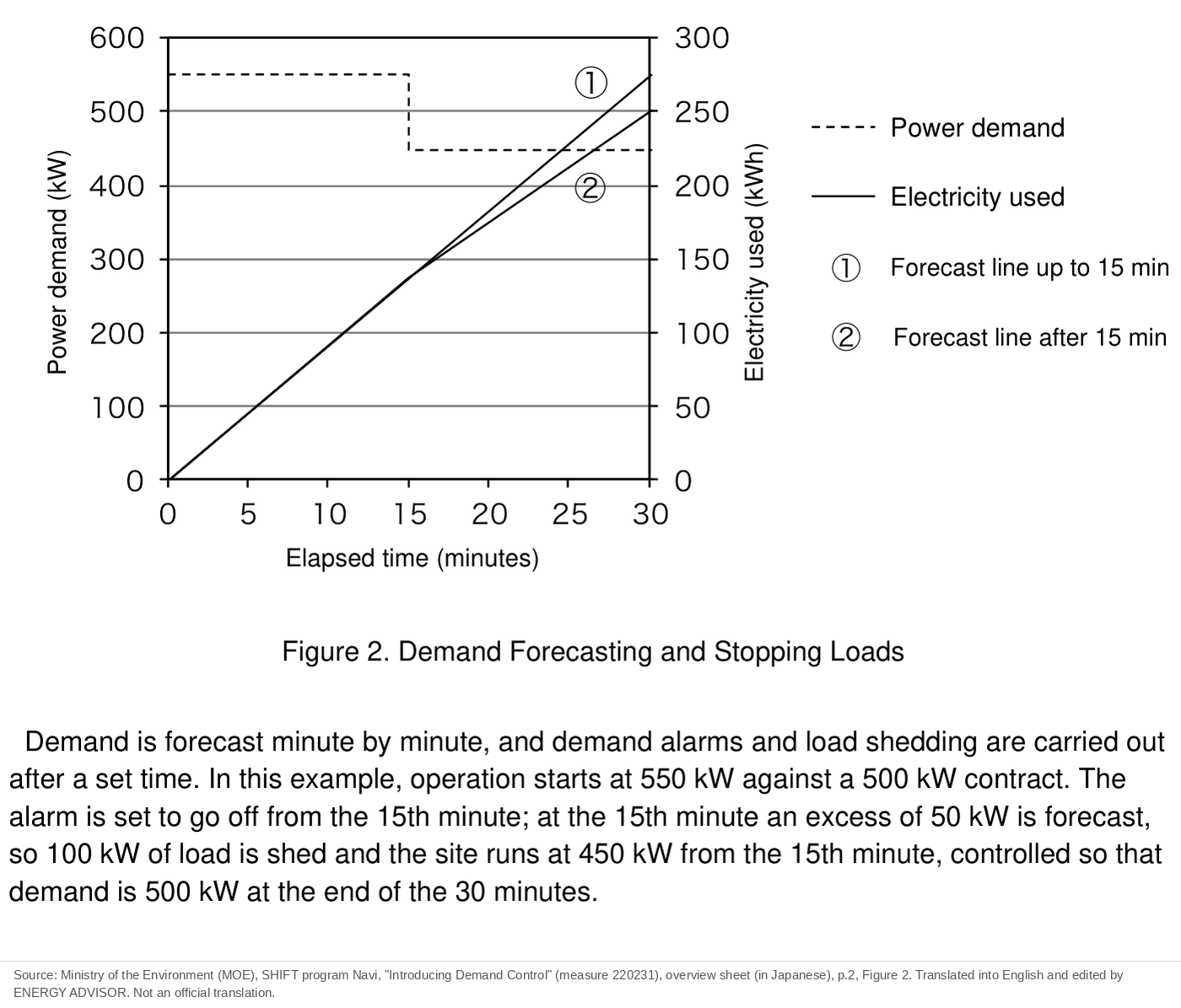
The important point here is that the effect on CO2 emissions differs depending on how demand is held down. Measures that reduce the power used in that time period itself, by stopping equipment or reducing output (so-called peak shaving), also reduce total monthly electricity consumption (kWh). They therefore lead directly not only to a lower demand charge but also to lower CO2 emissions from electricity use (Scope 2 = electricity consumption × emission factor). On the other hand, measures that only shift the timing of use to another time period (peak shifting) may not change total monthly electricity consumption much, so the demand charge may fall while Scope 2 emissions hardly change. When considering demand measures, therefore, it is good to keep in mind whether they involve reducing consumption itself.
Demand measures may sound like a matter of cost reduction, but if they involve reducing consumption, they are also energy-saving and CO2 reduction efforts. Recording them as part of the “operational improvements” covered in Part 7 also lets you use them in explanations to customers.
Switching to a Renewable Plan: Scope 2 Falls, but Costs May Rise
Another option is switching to tariff plans offered by electricity companies, such as “effectively renewable” or “CO2-free” plans. In these plans, the electricity company combines environmental attributes such as non-fossil certificates with ordinary electricity so that, for calculation purposes, the CO2 emission factor can be regarded as zero or close to zero. Even if electricity consumption stays the same, simply choosing such a plan may greatly reduce Scope 2 emissions.
However, these plans may carry an additional charge. For example, under Chubu Electric Power Miraiz’s “Green Denki,” for high-voltage electricity, ¥4.40 per kWh (tax included) is added to the normal charges for the added CO2-free value.
Source: Chubu Electric Power Miraiz, “Green Denki” (in Japanese)
There are also plans such as TEPCO Energy Partner’s “Aqua Premium,” which requires a contract demand of 500 kW or more and use for at least 10% of the whole facility’s electricity consumption or at least 1 million kWh per year, with prices set through individual negotiation.
Source: TEPCO Energy Partner, “Renewable Energy Plans for Businesses” (in Japanese)
In other words, switching to a renewable plan is a measure that involves a trade-off between costs and CO2: it can lower Scope 2 emissions, but costs may rise, or it may not be available depending on your company’s contract demand and consumption.
There is no single right answer to whether to switch to a renewable plan. The decision depends on two points: how specific your customers’ requests are (whether they only want emissions reported, or want reduction targets or renewable energy ratios met), and how much additional cost you can accept.
The decision criteria can be summarized as follows. If customers’ requests are still at the stage of measuring and reporting emissions, a realistic order is to first prioritize reducing consumption itself through operational improvements and demand management, and to consider switching to a renewable plan in light of the additional cost. On the other hand, if customers clearly ask you to meet a specific renewable energy ratio or reduction target and you can accept the additional cost, switching to a renewable plan is worth considering positively. In either case, there is no guarantee that it “will always be advantageous,” and it is essential to check the conditions one by one against your company’s actual usage.
Points to Note When Switching Contracts: Risk of New Entrant Retailers Exiting and Checking Contract Terms
When reviewing your contract and tariff plan, you also need to check the situation of the supplier you are switching to. According to a survey by Teikoku Databank, a private research company (published March 28, 2024, covering a population of 706 new entrant retailers (retailers that entered the market after liberalization, as opposed to the former regional incumbents) registered as of April 7, 2021), 119 of them had exited the business or gone bankrupt, a share of 16.9%.
Even if you can no longer receive electricity from the retail electricity supplier you had a contract with, high-voltage and extra-high-voltage customers are covered by a system called “last-resort supply,” under which the general transmission and distribution company (the company that operates the regional transmission and distribution grid; see the background section of Part 1, in Japanese) temporarily supplies electricity. The supply of electricity itself does not stop.
Source: TEPCO Power Grid, “About Last-Resort Supply Contracts” (in Japanese)
That said, last-resort supply is meant to be a temporary backstop, and its price level tends to reflect changes in market and fuel prices. When switching contracts, the practical point is not to worry only about exit risk, but to check the contract terms, such as the contract period, the conditions for termination during the term and the contact point in case of an emergency, before switching. This is not to say that switching to a particular supplier should be uniformly recommended or avoided; what matters is to decide after checking the conditions.
Summary
Unlike operational improvements and capital investment, reviewing your electricity contract and tariff plan is one of the few measures that can act on both costs and emissions without changing consumption. High-voltage supply contracts consist of the contract demand, the demand charge and the energy charge, and measures that hold down the demand on which the contract demand is based cut both costs and CO2 at the same time when they involve reducing consumption itself. Switching to a renewable plan can lower Scope 2 emissions, but it may bring additional costs, so the decision needs to take into account how strong customers’ requests are and how much cost you can accept. When considering a switch, it is also good to check suppliers’ exit trends and the contract terms in advance.
Related Articles
- Part 4: Calculating Scope 2 in Practice — CO2 Emissions from Electricity Consumption
- Part 5: The Emission Factor System — Basic, Adjusted, Menu-Specific and Residual Mix
- Part 7: The Order of Reductions — Operational Improvements, Contract Review and Capital Investment
- How the contract demand and demand are determined, in detail (from a previously published series on electricity rates)
- New entrant retailers’ exit trends and the risks of switching, in detail (from a previously published series on electricity rates)
Note: The information in this article is current as of the time of posting and may have changed by the time you read it.
This article is based on published materials from the Ministry of Economy, Trade and Industry and its Agency for Natural Resources and Energy, the Electricity and Gas Market Surveillance Commission, the Organization for Cross-regional Coordination of Transmission Operators (OCCTO) and other sources. The English translations of figures are by ENERGY ADVISOR and are not official translations. When using this information for decisions, please check the original sources. When we find an error, we correct the article and note the date of the correction.
Sources
- TEPCO Energy Partner, “FY2026 Electricity Rate Table (Extra-High-Voltage and High-Voltage)” (in Japanese). https://www.tepco.co.jp/ep/corporate/plan_h/pdf/2026minaoshisiryou.pdf
- TEPCO Energy Partner, “How the Contract Demand Is Determined (Actual-Demand Method)” (in Japanese). https://www.tepco.co.jp/ep/corporate/charge_c2/decision03.html
- MOE, Decarbonization Promotion Program (SHIFT program) Navi, “Introducing Demand Control” (in Japanese). https://shift.env.go.jp/files/navi/measure/220231.pdf
- Chubu Electric Power Miraiz, “Green Denki” (in Japanese). https://miraiz.chuden.co.jp/business/electric/menu/co2_free/
- TEPCO Energy Partner, “Renewable Energy Plans for Businesses” (in Japanese). https://www.tepco.co.jp/ep/eco/plan/corporate/index-j.html
- Teikoku Databank, “Survey on Business Exits by New Entrant Electricity Retailers” (March 2024) (in Japanese). https://www.tdb.co.jp/report/industry/5mwc1cunt7/
- TEPCO Power Grid, “About Last-Resort Supply Contracts” (in Japanese). https://www.tepco.co.jp/pg/consignment/lr/index.html