Among SMEs asked by customers to reduce CO2 emissions or raise their renewable energy ratio, many know that “procuring renewable electricity” is an option, but have not sorted out what methods actually exist and how they differ. Terms such as renewable plans, non-fossil certificates, corporate PPAs and self-consumption solar PV are often mentioned side by side, and it is hard to tell whether you should pick one of them or combine them. This article organizes the ways SMEs can procure electricity and environmental attributes from renewable sources into four types, and clearly explains each type’s position in the system and rough price levels.
Key points
- 1The ways SMEs can procure electricity and environmental attributes from renewable sources can be broadly organized into four types: (a) retail renewable plan contracts, (b) non-fossil certificates, (c) corporate power purchase agreements (PPAs) and (d) self-consumption solar PV.
- 2All four types work to reduce Scope 2 emissions, but they differ in the accounting logic, that is, on what basis the emission factor becomes zero or low in the calculation.
- 3For non-fossil certificates, customers can take part in the market directly and buy FIT non-fossil certificates. Non-FIT non-fossil certificates, in principle, are procured by retail electricity suppliers and built into their plans; customers can obtain them directly from power generation companies only when certain conditions are met.
- 4Corporate PPAs have two axes: “on-site / off-site,” depending on the location of the generating facility, and “physical / virtual,” depending on how the electricity is delivered.
- 5Voluntary frameworks such as RE100 and SBT set requirements separate from the national system, such as certificate tracking and confirmation of retirement, so you need to check the latest criteria of each framework you respond to.
In this series, “SMEs and Decarbonization,” we have looked so far (up to Part 8) at how reviewing your electricity contract and tariff plan affects both costs and emissions (Part 8, in Japanese), and at the emission factor system that underlies that decision (Part 5, in Japanese). This time, we organize the option of “procuring renewable electricity itself,” an extension of contract review, into four types, and look at each type’s system and price levels.
Four Types of Renewable Procurement: Overview
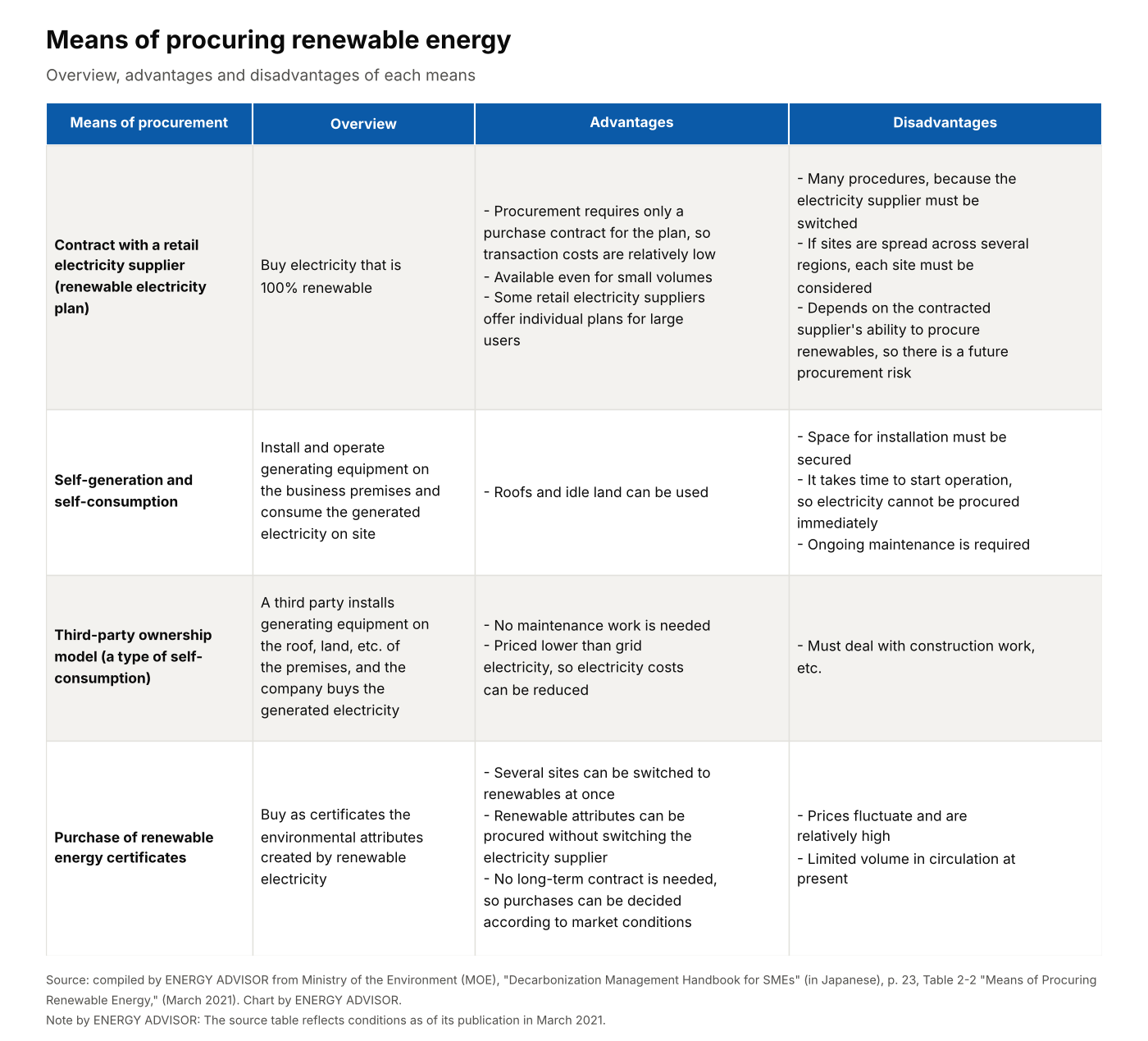
The ways SMEs can procure electricity and environmental attributes from renewable sources can be organized into the following four types. In terms of the three stages covered in Part 7, “operational improvements, contract review and capital investment,” (a) to (c) fall within “contract review,” which changes where electricity is procured from or the contract terms, while (d) self-consumption solar PV belongs to the “capital investment” stage, in which you spend money on a generating facility yourself.
| Type | How it works | Main treatment in Scope 2 accounting | Cost (as far as can be confirmed as of October 2026; certificate prices are the FY2025 (April 2025–March 2026) system price cap and floor and clearing trends) | Suited to |
|---|---|---|---|---|
| (a) Retail renewable plan contract | Switch your contract to a tariff plan in which the electricity company combines non-fossil certificates and the like with electricity | The “menu-specific emission factor” of the contracted plan applies (Part 5). The more certificates a plan combines, the lower its factor | Often involves a surcharge on the energy charge, with a range depending on the plan (Part 8) | Cases where you want to start first and keep the procedural burden low |
| (b) Procuring non-fossil certificates | Environmental attributes called non-fossil certificates are traded separately from the electricity itself. Customers can take part in the market directly and buy FIT certificates; non-FIT certificates, in principle, are procured by retail electricity suppliers and built into (a), and customers can obtain them directly only when conditions are met, such as obtaining them from a power generation company | In SHK system calculations, a method is set for deducting the volume of certificates the customer procured itself × the national average factor × a correction factor, up to the emissions of the purchased electricity (Calculation and Reporting Manual Ver. 6.1, pp. II-46–47). Treatment in voluntary frameworks such as CDP and RE100 depends on each framework’s criteria | In FY2025, FIT certificates tended to clear near the bottom of the price range (¥0.4/kWh). Non-FIT certificates tended to clear near the cap (¥1.3/kWh) (as of December 2025) | Cases where you want to specify a particular generating facility or renewable source, or meet requirements such as RE100’s |
| (c) Corporate PPA | A power generation company and a customer sign a long-term contract. There are combinations of on-site / off-site and physical / virtual | A physical PPA replaces purchased electricity by the amount supplied. A virtual PPA acquires only environmental attributes and is accounted for in a way similar to certificates | Long-term individually negotiated contract prices; comparison with market prices and standard plans is needed | Cases where you want to secure a substantial volume of renewable electricity or environmental attributes over the medium to long term |
| (d) Self-consumption solar PV | Install solar power equipment on your own roof or land and consume the electricity generated on site | Self-consumed electricity is not “purchased electricity,” so the electricity consumption subject to Scope 2 calculation itself falls | Initial investment and the payback period after operation need to be estimated case by case | Cases where you have room for capital investment, such as on a roof or land, and can make a medium- to long-term investment decision that also covers measures against power outages |
(a) Retail Renewable Plan Contracts: A Review of Part 8
As confirmed in Part 8, electricity companies offer tariff plans for high-voltage and extra-high-voltage business customers, such as “effectively renewable” and “CO2-free” plans. Even without changing your electricity company, switching to such a plan may greatly reduce Scope 2 emissions. In many of these plans, the electricity company procures non-fossil certificates and provides them to customers combined with ordinary electricity. Because the electricity company handles procuring the certificates and the procedures, customers hardly need to set up the mechanism themselves. However, there may be an additional charge, and conditions differ by plan.
(b) Non-Fossil Certificates: Whether Customers Can Procure Them Directly
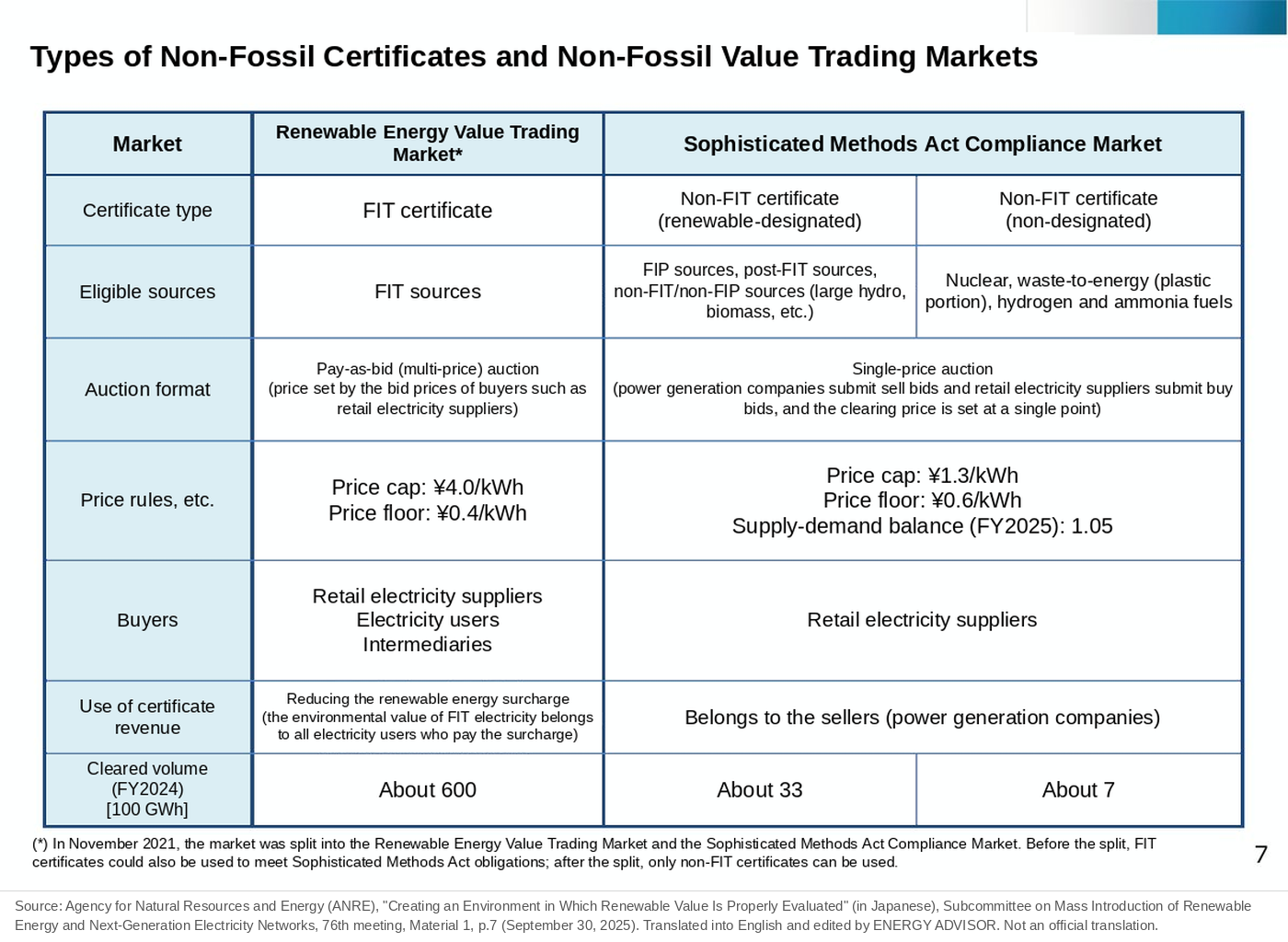
Non-fossil certificates are certificates that separate from the electricity itself the “zero-CO2” environmental attribute of electricity generated from non-fossil sources (sources that do not use fossil fuels, such as renewable energy and nuclear). There are “FIT non-fossil certificates,” derived from renewable electricity under the Feed-in Tariff (FIT) scheme, and “non-FIT non-fossil certificates,” derived from other non-FIT non-fossil sources.
On whether customers can procure these certificates directly, FIT non-fossil certificates and non-FIT non-fossil certificates are set up differently. The Renewable Energy Value Trading Market, where FIT non-fossil certificates are traded (a market held on the Japan Electric Power Exchange (JEPX), Japan’s only wholesale power exchange), lets not only retail electricity suppliers but also customers take part in bidding directly and buy certificates. On the other hand, the Sophisticated Methods Act Compliance Market, where non-FIT non-fossil certificates are traded, has retail electricity suppliers as the buyers in principle, and customers cannot, in principle, take part in the market directly. (The Sophisticated Methods Act, short for the Act on the Promotion of Use of Non-Fossil Energy Sources and Effective Use of Fossil Energy Materials by Energy Suppliers, is the law that sets retail electricity suppliers targets for the share of non-fossil sources in the electricity they sell.) However, when certain conditions are met, the system also allows customers to obtain non-FIT certificates directly from power generation companies. That said, taking part in the market and managing certificates involve a procedural burden on either route, so in practice, for many SMEs, procuring through a retail electricity supplier’s plan is the more realistic route.
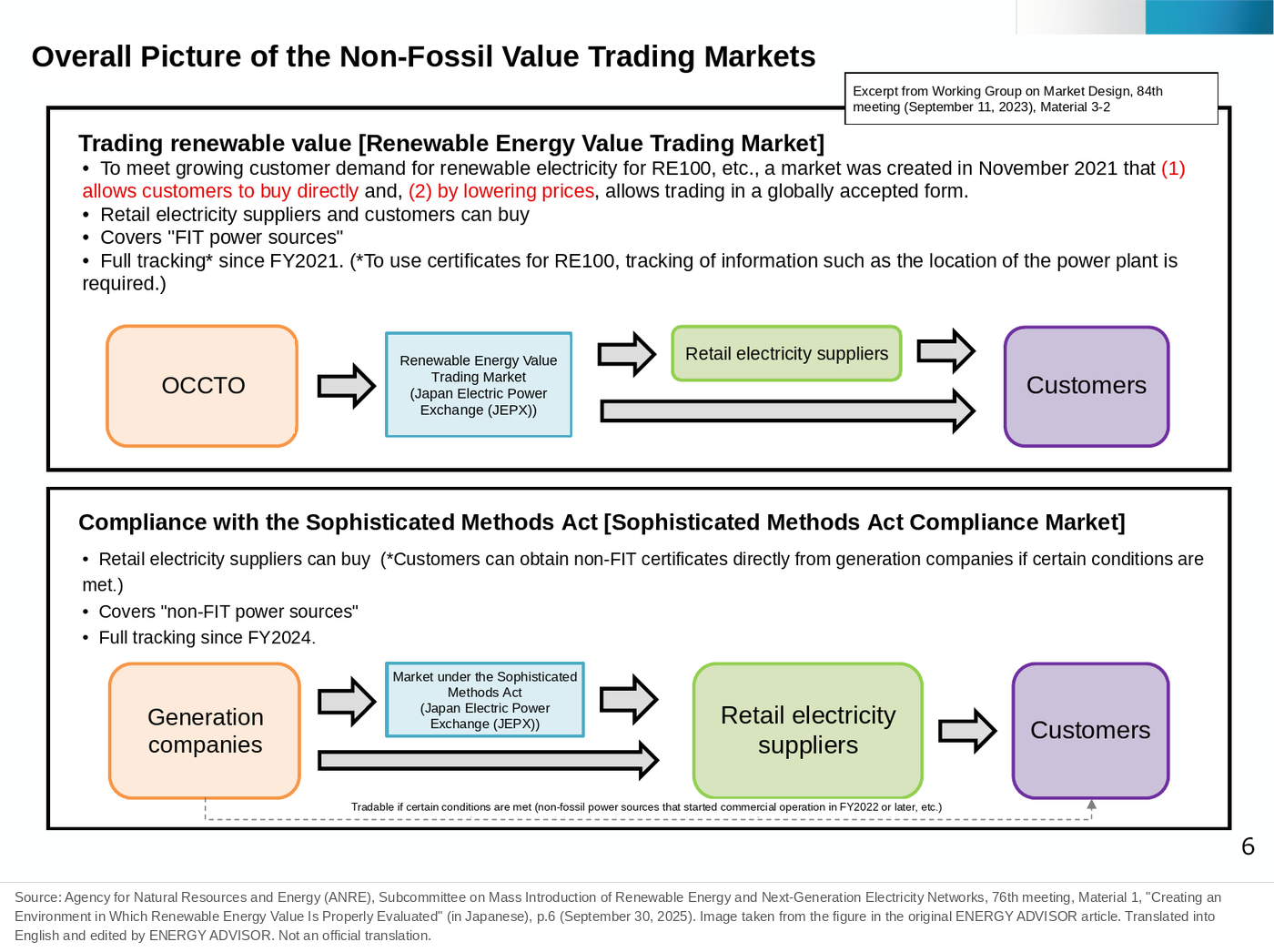
A point to note here is “tracking.” Tracking is a mechanism that attaches attribute information, such as the location of the generating facility a certificate comes from, to the certificate so that it can be identified. Full tracking has been carried out in the Renewable Energy Value Trading Market, which covers FIT sources, since FY2021, and in the Sophisticated Methods Act Compliance Market, which covers non-FIT sources, since FY2024. For certificates to be used in international frameworks such as RE100, this tracking is a requirement.
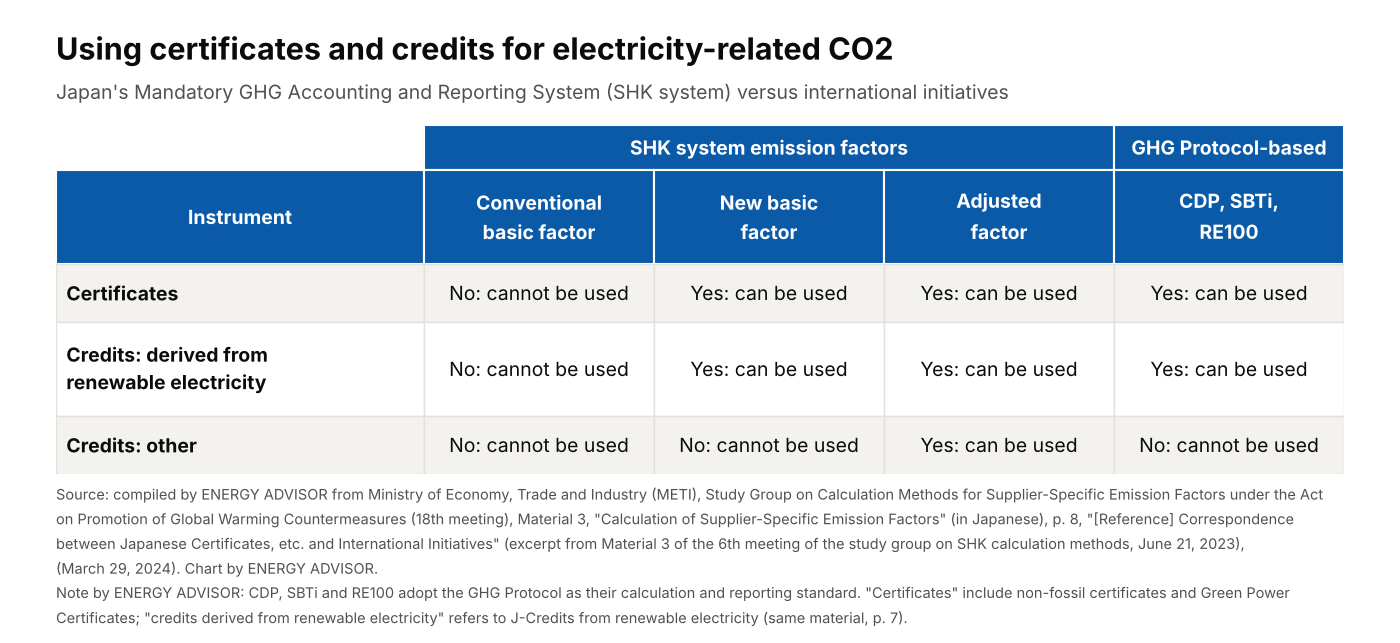
Note that procuring certificates separately does not change the emission factor of the electricity you have a contract for (unless it is an effectively renewable plan, the factor remains, for example, the “residual” factor covered in Part 5, in Japanese). On that basis, the calculation and reporting manual of the SHK system under the Act on Promotion of Global Warming Countermeasures sets a method for deducting the volume of non-fossil certificates the customer procured itself, multiplied by the national average factor and a correction factor (the “non-fossil power CO2 reduction equivalent”), up to the emissions from the use of purchased electricity. Certificates that an electricity supplier used to adjust its emission factor, and certificates transferred or sold to others, cannot be used. Treatment in voluntary frameworks such as CDP and RE100 depends on each framework’s criteria.
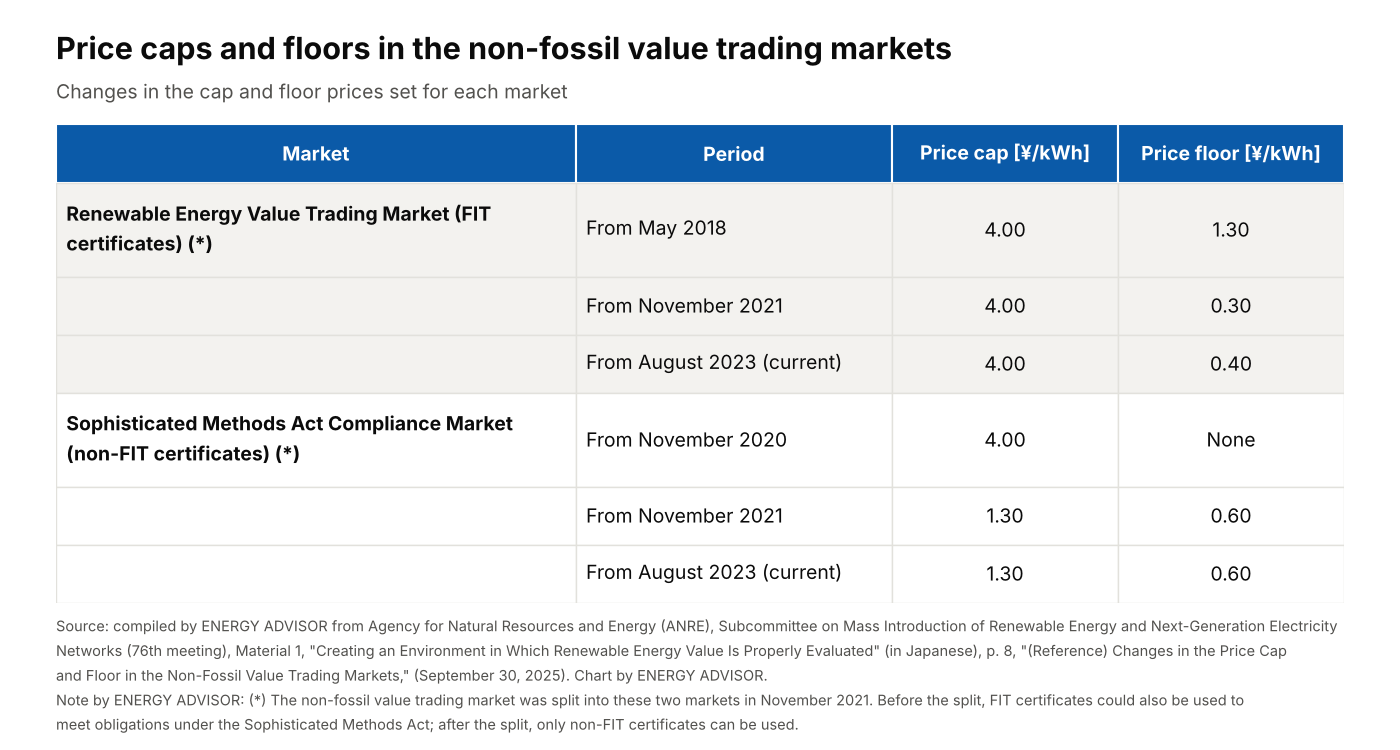
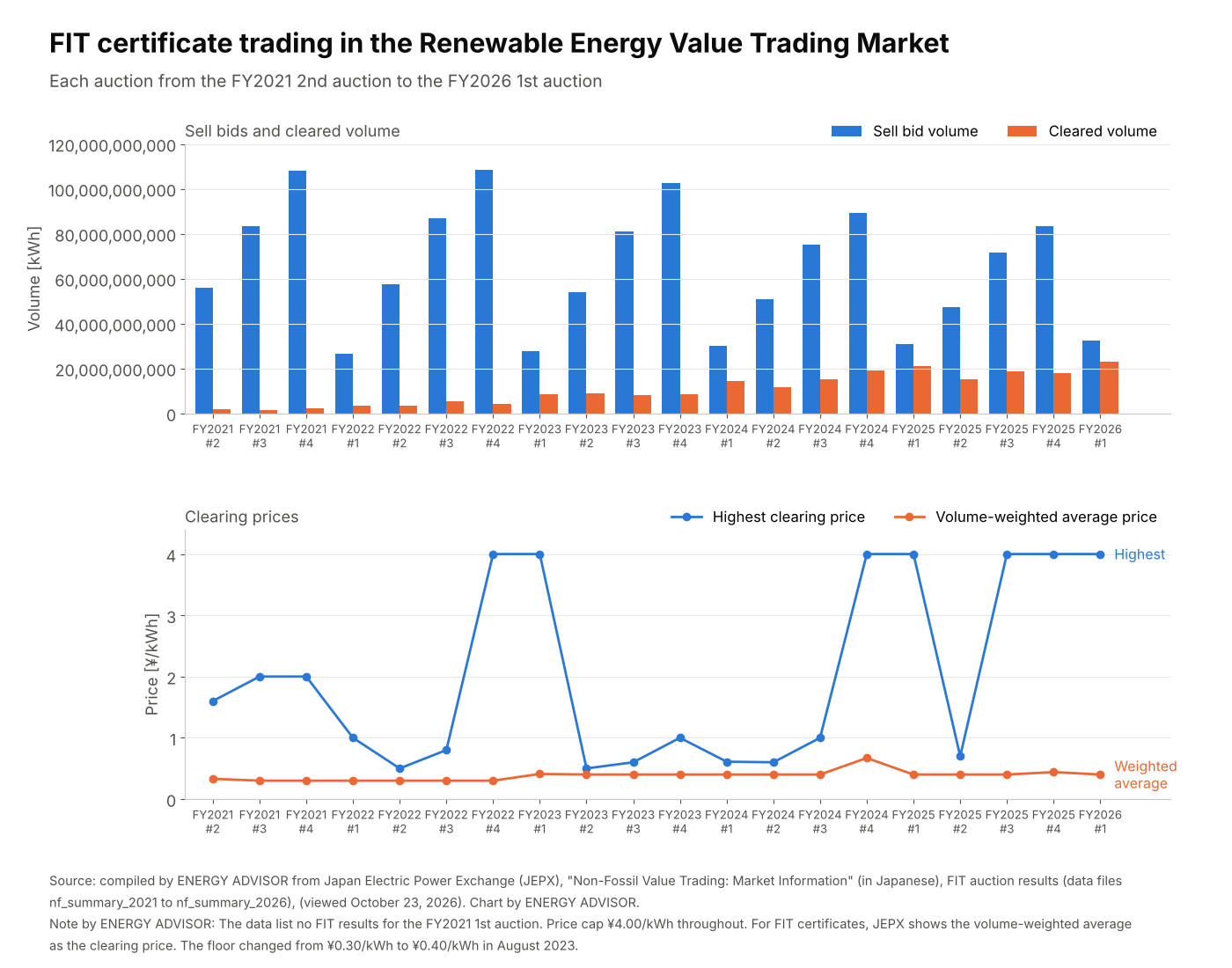
As for price levels, the system sets a price cap and floor for the non-fossil value trading markets. As of FY2025, the price ranges were a cap of ¥4.0/kWh and a floor of ¥0.4/kWh for FIT non-fossil certificates, and a cap of ¥1.3/kWh and a floor of ¥0.6/kWh for non-FIT non-fossil certificates. In recent auctions, FIT certificates have continued to clear near the floor price of ¥0.4/kWh and non-FIT certificates near the cap of ¥1.3/kWh. According to JEPX market information, the clearing prices in the first auction of FY2026 (August 27–31, 2026) were ¥0.40/kWh for FIT certificates (weighted average), ¥1.21/kWh for non-FIT certificates (renewable-designated) and ¥1.20/kWh for non-FIT certificates (non-designated).
Sources: ANRE, Working Group on Market Design (December 12, 2025), Material 3, “Non-Fossil Value Trading,” pp. 3–5 (in Japanese); same working group (March 4, 2026), Material 6, p. 6 (in Japanese); Japan Electric Power Exchange (JEPX), “Non-Fossil Value Trading: Market Information” (viewed October 22, 2026) (in Japanese)
Looking at the price of certificates alone, it seems a matter of a few yen per kWh or less, but the amount customers actually pay depends on how the electricity company builds these certificates into its plans and how much it adds on top. The market price of certificates and the additional charge of a plan are different things.
(c) Corporate PPAs: Basics of On-Site / Off-Site and Physical / Virtual
A corporate PPA is a mechanism in which a company (customer) and a power generation company directly sign a long-term contract for buying and selling renewable electricity. There are two main axes of classification. The first is the location of the generating facility: an “on-site PPA” installs the generating facility on the customer’s premises, and an “off-site PPA” procures electricity from a generating facility installed off the premises.
The second is how the electricity is delivered. Off-site PPAs are further divided into “physical PPAs” and “virtual PPAs.” A physical PPA is a contract form in which the generated electricity is actually supplied to the customer via the power grid, and the environmental attributes are transferred together with the electricity. A virtual PPA is a contract form in which the generated electricity itself is sold to the market or to other businesses and is not physically supplied to the customer, while only the environmental attributes are transferred to the customer.
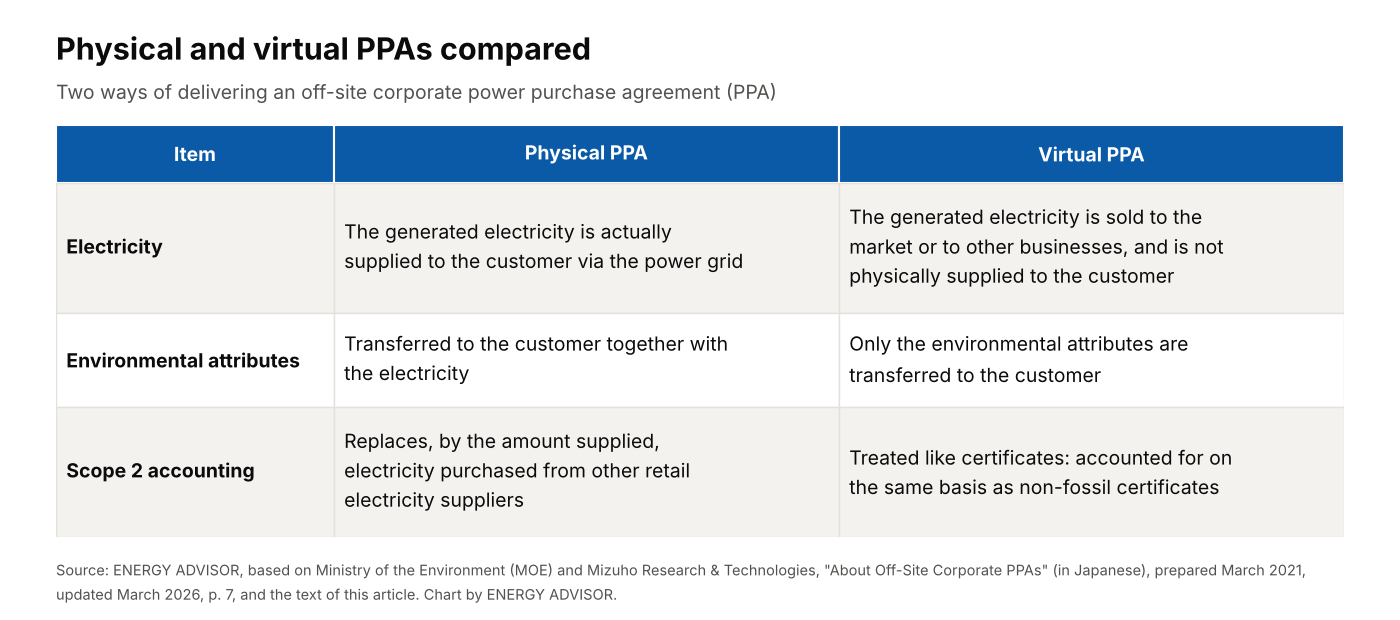
In Scope 2 accounting, electricity supplied under a physical PPA replaces, by that amount, electricity purchased from other retail electricity suppliers. A virtual PPA does not involve supplying electricity, so what the customer receives is environmental attributes similar to certificates, and accounting is organized on the same basis as the non-fossil certificates in (b). Corporate PPAs are often long-term contracts lasting more than 10 years, and price negotiation and comparison require a specialist perspective that weighs market prices and standard plans. This mechanism is explained in more detail in a previously published series on electricity rates.
(d) Self-Consumption Solar PV: The Choice Not to “Buy” Electricity
The fourth type is self-consumption solar PV, in which you install solar power equipment on your own roof or land and consume the electricity generated on site. Whereas the three types so far were procurement methods, “where to buy electricity and environmental attributes from,” self-consumption solar PV differs in character in that you generate electricity yourself instead of buying it from outside.
As shown on the Green Value Chain Platform of MOE and METI, Scope 2 covers only electricity, heat and steam that your company has purchased and used.
Source: MOE Green Value Chain Platform, “What Are Scope 1 and 2 Emissions?” (in Japanese)
Electricity generated by self-consumption solar PV and consumed on site is not purchased from outside, so it falls outside Scope 2 in this sense. In practice, the basic understanding is that it is reflected as a reduction in purchased electricity (kWh) itself by the amount self-consumed, and Scope 2 emissions calculated as “electricity consumption × emission factor” fall by that amount. However, some detailed operational points, such as the treatment when surplus electricity is sold, still need to be checked according to each business’s situation. Because the initial investment and payback period vary greatly with individual conditions, this article only sorts out its position as a procurement method.
Sorting Out the Treatment in Scope 2 Accounting
Organized from the viewpoint of Scope 2 accounting, the four types are as follows. (a) For a renewable plan, the “menu-specific emission factor” linked to the contracted plan is applied (Part 5, in Japanese). (b) Non-fossil certificates are treated the same as (a) if they are built into the electricity company’s plan. If the customer procures them on its own, in SHK system calculations, they are deducted from the emissions of purchased electricity using the method in the calculation and reporting manual. (c) A corporate PPA replaces purchased electricity if it is physical, and is treated like certificates if it is virtual. (d) For self-consumption solar PV, emissions fall because purchased electricity itself decreases.
Even though they are all called “procuring renewable electricity,” the accounting logic differs by type. When explaining to customers, being able to answer both which type you chose and why emissions fall by that amount makes it easier to deal with questions.
Differences in Treatment Under RE100 and SBT
The organization above assumes Japan’s public calculation and reporting systems, such as the SHK system under the Act on Promotion of Global Warming Countermeasures. However, voluntary international frameworks such as RE100 and SBT may impose their own requirements on the treatment of certificates. For example, in its Technical Criteria (5th edition) of March 24, 2025, RE100 decided that, in markets where certificates are commonly used, it requires procurement accompanied by the retirement (cancellation) of certificates. It also does not accept procurement of renewable electricity produced by co-firing with coal. Both apply to reporting from the 2027 CDP disclosure.
As confirmed in Part 3, SBT and RE100 are not schemes based on law, but voluntary frameworks set independently by their respective operators. Requirements such as certificate tracking and confirmation of retirement are set and revised by each initiative independently of Japan’s non-fossil value trading system itself. If customers specifically ask you to respond to SBT or RE100, it is recommended that you check the latest criteria of the relevant framework.
Criteria for Choosing
The criteria for deciding which of the four types to choose, or how to combine them, can be organized into three points:
- Strength of the request: Are customers’ requests still at the stage of measuring and reporting emissions, or are you being asked to meet a specific renewable energy ratio or reduction target? In the former case, it is realistic to start by considering (a) renewable plans; in the latter, you may need to consider combinations including (b) to (d).
- Cost tolerance: Costs arise differently by type: the additional charge of a plan, the price of certificates, the long-term contract price of a PPA, and the initial investment in self-consumption solar PV. As confirmed in Part 8, electricity from renewable sources often involves a trade-off with cost, so you need to determine the level your company can accept.
- Room for capital investment: Self-consumption solar PV and on-site PPAs depend on physical conditions, such as your roof and land, and on whether you can make a medium- to long-term investment decision. If there is no room for capital investment, options that do not involve your own capital investment, such as (a), (b) and off-site PPAs, are a realistic starting point.
Summary
The ways SMEs can procure electricity and environmental attributes from renewable sources can be organized into four types: (a) retail renewable plan contracts, (b) non-fossil certificates, (c) corporate PPAs and (d) self-consumption solar PV. All of them work to reduce Scope 2 emissions, but the accounting basis differs for each: applying a menu-specific emission factor, retiring certificates, replacing purchased electricity, or reducing purchased electricity itself. Customers can buy FIT non-fossil certificates directly in the market, but non-FIT certificates are, in principle, procured through retail electricity suppliers, and direct acquisition by customers is limited to certain conditions. Corporate PPAs are classified by location and by delivery method, and voluntary frameworks such as RE100 and SBT may impose their own requirements on the treatment of certificates, so you need to check the latest criteria of the relevant framework. When choosing, consider three axes: the strength of customers’ requests, cost tolerance and room for capital investment.
Related Articles
- Part 5: The Emission Factor System — Basic, Adjusted, Menu-Specific and Residual Mix
- Part 7: The Order of Reductions — Operational Improvements, Contract Review and Capital Investment
- Part 8: Electricity Contracts and CO2 — How Reviewing Your Contract and Tariff Plan Affects Emissions and Costs
Note: The information in this article is current as of the time of posting and may have changed by the time you read it.
This article is based on published materials from the Ministry of Economy, Trade and Industry and its Agency for Natural Resources and Energy, the Electricity and Gas Market Surveillance Commission, the Organization for Cross-regional Coordination of Transmission Operators (OCCTO) and other sources. The English translations of figures are by ENERGY ADVISOR and are not official translations. When using this information for decisions, please check the original sources. When we find an error, we correct the article and note the date of the correction.
Sources
- Japan Electric Power Exchange (JEPX), “Non-Fossil Value Trading: Market Information” (FY2026 first auction: FIT, August 31, 2026, clearing price ¥0.40/kWh; non-FIT renewable-designated, August 28, ¥1.21/kWh; non-FIT non-designated, August 27, ¥1.20/kWh; viewed October 22, 2026) (in Japanese). https://www.jepx.jp/nonfossil/market-data/
- ANRE, Working Group on Market Design (March 4, 2026), Material 6, “Non-Fossil Value Trading” (in Japanese). https://www.meti.go.jp/shingikai/enecho/denryoku_gas/jisedai_kiban/system_review/pdf/112_06_00.pdf
- ANRE, Working Group on Market Design (December 12, 2025), Material 3, “Non-Fossil Value Trading” (in Japanese). https://www.meti.go.jp/shingikai/enecho/denryoku_gas/jisedai_kiban/system_review/pdf/109_03_00.pdf
- ANRE, Advisory Committee for Natural Resources and Energy, Subcommittee on Mass Introduction of Renewable Energy and Next-Generation Electricity Networks (76th meeting, September 30, 2025), Material 1, “Creating an Environment in Which Renewable Energy Value Is Properly Evaluated” (in Japanese). https://www.meti.go.jp/shingikai/enecho/denryoku_gas/saisei_kano/pdf/076_01_00.pdf
- JEPX, “Non-Fossil Value Trading: Overview” (in Japanese). https://www.jepx.jp/nonfossil/outline/
- MOE and Mizuho Research & Technologies, “About Off-Site Corporate PPAs” (prepared March 2021, updated March 2026) (in Japanese). https://www.env.go.jp/content/000392101.pdf
- RE100, “RE100 Technical Criteria” (March 24, 2025 version; appendices updated April 15, 2025), Section Five 2, 2.1, 3 and 3.1, pp. 15–16. https://www.theclimategroup.org/hubfs/RE100/PDFs/RE100%20technical%20criteria%20+%20appendices%20(15%20April%202025).pdf?hsLang=en
- MOE Green Value Chain Platform, “What Are Scope 1 and 2 Emissions?” (in Japanese). https://www.env.go.jp/earth/ondanka/supply_chain/gvc/estimate_02.html